


Home » Guides » Lighting & Effects »
Laser Shows in the UK: Classes, Safety and What You Need to Run One
What the laser classes mean, whether you need a licence, what venues and councils will ask for, and how to set up beams that look spectacular without putting anyone’s eyesight on the line.
~12 min read · Updated July 2026 · By the Stage Supply team
In this guide: The short answer · Laser classes explained · The UK rules · Audience scanning · Setting up a show · Outdoor beams and aviation · What to look for when buying · Common mistakes · FAQ
The Short Answer
There is no such thing as a “laser licence” in the UK. What you have instead is a general legal duty: under the Health and Safety at Work etc. Act 1974 and the Management of Health and Safety at Work Regulations 1999, anyone putting on a laser display must assess the risks and control them, and where employees are exposed, the Control of Artificial Optical Radiation at Work Regulations 2010 apply too. On top of that, venues and local authorities routinely attach laser conditions to premises licences and event permissions, and they can and do ask for documentation before they let you switch anything on.
In practice that means: know what class of laser you have, keep beams out of reach of people unless a competent laser safety professional has signed off otherwise, document what you are doing, and never point anything at the sky without telling the Civil Aviation Authority first. This guide covers each of those in plain terms, and it will tell you, more than once, when to stop reading a web page and hire a qualified laser safety specialist.
What this guide is and is not
We are an equipment dealer, not a laser safety consultancy, and this article is general information, not a risk assessment for your event. Anything involving beams at or near audience level, outdoor projection, or exposure calculations needs a competent person: a Laser Protection Adviser (LPA) or an experienced operator acting as your Laser Safety Officer. A proper assessment costs little next to an eye injury claim.
Laser Classes Explained
Every laser product sold in the UK is classified under BS EN 60825-1, and the class is printed on a yellow warning label on the housing. Set by the manufacturer from the accessible output power and wavelength, the class tells you roughly how much damage the beam can do and how fast, and it is the first thing to check on any laser you buy or hire.
| Class | Typical power (visible beam) | What it means in practice | Where you meet it |
|---|---|---|---|
| Class 1 | Very low, or fully enclosed | Safe under normal use, including long deliberate viewing | CD drives, laser printers, enclosed industrial lasers |
| Class 2 | Up to 1 mW | The blink reflex protects you from accidental exposure; do not stare into it | Barcode scanners, basic laser pointers |
| Class 3R | Up to 5 mW | Low risk from brief accidental exposure, but eye injury is possible; direct viewing must be avoided | Better laser pointers, alignment tools |
| Class 3B | 5 mW to 500 mW | Direct eye exposure to the beam is dangerous, even briefly; diffuse reflections are generally safe | Smaller show lasers, lab lasers |
| Class 4 | Above 500 mW | Hazardous to eyes from direct beams and even from some reflections; can burn skin and ignite materials at close range | Most professional show lasers, cutting and welding lasers |
The number that matters for display work: nearly every show laser worth using is Class 3B or Class 4. A 1 W RGB unit, small by club standards, is already twice the Class 4 threshold. That is not a reason to avoid them; it is the reason the rest of this guide exists. Class 3B and 4 lasers are legitimate professional tools, used safely at thousands of UK events every year, because operators keep the beams away from people or bring in specialists when they cannot. (You may also see classes 1M and 2M: like 1 and 2, except hazardous when viewed through optics such as binoculars. They rarely matter for display work.)
Beware of fantasy labels
Cheap imported units are frequently mislabelled: “Class 2” stickers on multi-hundred-milliwatt hardware, or inflated “30 W” marketing figures on 2 W diodes. A reputable manufacturer states the true optical output and the correct class in the manual. If the paperwork does not add up, assume the laser is more dangerous than the label claims.
The UK Rules: No Licence, Plenty of Duties
The legal framework for laser displays in Great Britain is built from general health and safety law rather than a laser-specific permit scheme:
- Health and Safety at Work etc. Act 1974: the umbrella duty. If you run an event, employ crew, or operate equipment that can hurt people, you must do so safely as far as is reasonably practicable. This covers audiences as well as workers.
- Management of Health and Safety at Work Regulations 1999: the requirement for a suitable and sufficient risk assessment. For a laser show, this is the document everyone will ask to see.
- Control of Artificial Optical Radiation at Work Regulations 2010: requires employers to keep workers’ exposure to intense light sources, lasers included, within exposure limit values. Crew, performers and venue staff count as workers.
- Licensing Act 2003 and local authority conditions: the practical enforcement route. Many premises licences and event permissions require laser displays to be notified, documented, or run in line with recognised guidance, and councils’ safety advisory groups frequently ask for a laser safety plan before signing off.
For years the standard reference was HSE guidance note HSG95, “The radiation safety of lasers used for display purposes”. HSG95 has been withdrawn by the HSE, which handed custodianship of display laser guidance to the industry: its successor is PLASA’s “Guidance for the Safety of Display Lasers” (first edition April 2016), which carries the same core principles forward. If a venue or council still asks for “HSG95 compliance”, the PLASA guidance is the current document that answers the question.
What venues and councils actually ask for
Expect some or all of the following before you are allowed to run lasers at someone else’s premises or event:
- A written laser risk assessment specific to the venue and rig positions
- The class and output power of every projector, from the manuals or datasheets
- Beam plans showing where beams can and cannot go, including termination points
- The name of your Laser Safety Officer for the event: the person on site with authority to shut the lasers down
- For anything near audience level or outdoors: evidence that a Laser Protection Adviser or equivalent competent person has reviewed the design
- Public liability insurance that does not exclude laser effects (check the wording; some policies do)
A well-prepared laser pack gets waved through; turning up with an unlabelled projector and no paperwork gets your effects cut from the show at soundcheck, which is a far more common outcome than any legal action.
Audience Scanning: The High-Risk Practice
Audience scanning means deliberately sweeping laser effects through the space the audience occupies, so people are inside the beams rather than underneath them. It is the most visually immersive thing a laser can do, and by a wide margin the most dangerous: laser show eye injuries happen when beams reach eyes at audience level, whether by design or by accident.
The safety question comes down to the Maximum Permissible Exposure (MPE): the level of laser radiation the eye can receive without damage, defined in BS EN 60825-1. Whether a scanned effect stays under the MPE at the closest audience position depends on the projector’s power, the beam’s divergence, scan speed, effect geometry, distance, and what happens in the fraction of a second when a scanner slows at the edge of a pattern or fails outright. These calculations interact in unintuitive ways, the measurements need proper instruments, and getting them wrong injures people. We are not going to walk you through them, and you should be suspicious of any web page that does.
The rule we will not soften
Do not scan the audience with a Class 3B or Class 4 laser unless a qualified Laser Protection Adviser or equivalent laser safety specialist has assessed that specific show, with that specific projector, at that specific venue, and confirmed the effects are within the MPE at the closest point of audience access, including under fault conditions. “The software has a safety zone” and “the seller said it was fine” are not assessments. If you do not have that sign-off, keep every beam well above heads, full stop.
Safer ways to get the same wow
- Overhead beam ceilings: fans and waves passing safely above the audience read almost as dramatically as scanned effects once there is haze in the air, and they are the standard approach for club installs.
- Beam termination zones: aim beams to land on walls, drapes or dedicated masking rather than open air, so a scanner fault cannot drop a static beam into the crowd.
- More haze, less power: a modest laser in a well-hazed room out-performs a monster in clear air. See our smoke, haze and low fog guide; it is the cheapest upgrade any laser show can get.
- Hire the specialist for the big moment: if the brief genuinely needs crowd scanning, budget for an LPA-assessed design with measured outputs and documentation. That is a service, not a product, and it is how the big festival shows do it.
Setting Up a Show: The Practical Checklist
For a conventional overhead show, the long-standing separation figures from HSG95, carried into the PLASA guidance, are the starting point: keep any effect that exceeds the MPE at least 3 metres above the highest accessible floor level and at least 2.5 metres horizontally from any position the public can reach. Remember that “accessible” includes balconies, stairs, raised VIP areas, speaker stacks people climb on, and shoulders at a rowdy gig. Measure from the highest point a person can plausibly get their eyes, not from the dance floor.
- Rig high and rig solid: mount projectors so the lowest beam respects the 3 m separation, on proper clamps with safety bonds. A laser knocked askew by a bass bin is a beam heading somewhere you never planned. Our truss and rigging guide covers the hardware side.
- Walk the beam paths: at low power, trace where every effect goes at its widest. Check balconies, mezzanines, DJ risers, bar mirrors, glazing and polished metalwork. Specular reflections from a Class 4 beam are hazards in their own right.
- Terminate what you can: end beams on matt surfaces wherever the design allows. A beam that dies on black drape cannot surprise anyone.
- Set the safety zones in software: use the controller’s masking to hard-limit output below your safe horizon. Treat this as a backstop, not the primary control; the primary control is where you aimed the projector.
- Wire the emergency stop: professional projectors ship with a remote interlock connector and an E-stop or keyed remote. Wire it, put the E-stop where the operator actually stands, and test it before doors. An interlock left bridged with the supplied jumper plug is a safety feature you paid for and then disabled.
- Keep the key: remove the key when the unit is unattended so nobody else can power it up.
- Never run unattended: someone competent, your Laser Safety Officer for the night, watches the show with a hand near the stop whenever emission is possible. Auto mode running to an empty booth is how incidents happen.
- Log it: keep the risk assessment, beam plan and a note of who held the LSO role with the event paperwork.
Outdoor Beams and Aviation: Tell the CAA
The moment a beam leaves the venue, whether at an outdoor show or through open roof sections, you acquire a second audience: pilots. A show laser that is merely bright at ground level can dazzle a flight crew miles away. The Civil Aviation Authority publishes CAP 736, “Operation of Directed Light, Fireworks, Toy Balloons and Sky Lanterns within UK Airspace”, which sets out how outdoor laser displays should be planned and notified, and the CAA’s airspace regulation team expects to be told about displays that could affect aviation. Permanent installations that radiate into the sky are recorded in the UK Aeronautical Information Publication so pilots are warned about them.
Separately, the Laser Misuse (Vehicles) Act 2018 makes it a criminal offence to shine or direct a laser beam towards an aircraft (or any vehicle) where it dazzles or distracts, or is likely to dazzle or distract, the person in control. Penalties run to five years’ imprisonment and an unlimited fine, and the prosecution does not need to prove you intended harm.
Outdoor show, minimum homework
Read CAP 736, notify the CAA’s airspace regulation team well in advance of any display that sends beams skyward, check proximity to aerodromes and helicopter routes, and design so beams terminate below the horizontal unless the CAA process says otherwise. This sits alongside the ground-level safety work, and it is another point where a laser safety specialist earns their fee.
What to Look For When Buying a Show Laser
Safety is mostly about how a laser is used, but the hardware you choose decides how much safety you have to work with. These are the features that separate professional projectors from marketplace toys:
- Scan-fail safeguard: circuitry that kills the output if the scanners stop or slow below a safe speed, so a moving effect can never collapse into a stationary full-power beam. On professional units this is standard; on cheap imports it is routinely absent, which alone rules them out for public shows.
- ILDA input as well as auto and sound-to-light modes: the industry-standard ILDA connection lets you run the projector from proper laser control software and interfaces, with full control of content, output level and safety zones. Auto and sound modes fire built-in patterns wherever the unit is pointed, with no zone control; acceptable only when the mounting alone guarantees safe beam paths.
- Safety zones and beam attenuation in the control software: the ability to mask output below a horizon and to attenuate brightness inside defined zones. Look for controllers where these settings are stored and enforced rather than merely drawn on screen.
- Remote interlock, E-stop and keyed power: the connectors that make the checklist above possible. If a projector has no interlock circuit, it was not built for public display work.
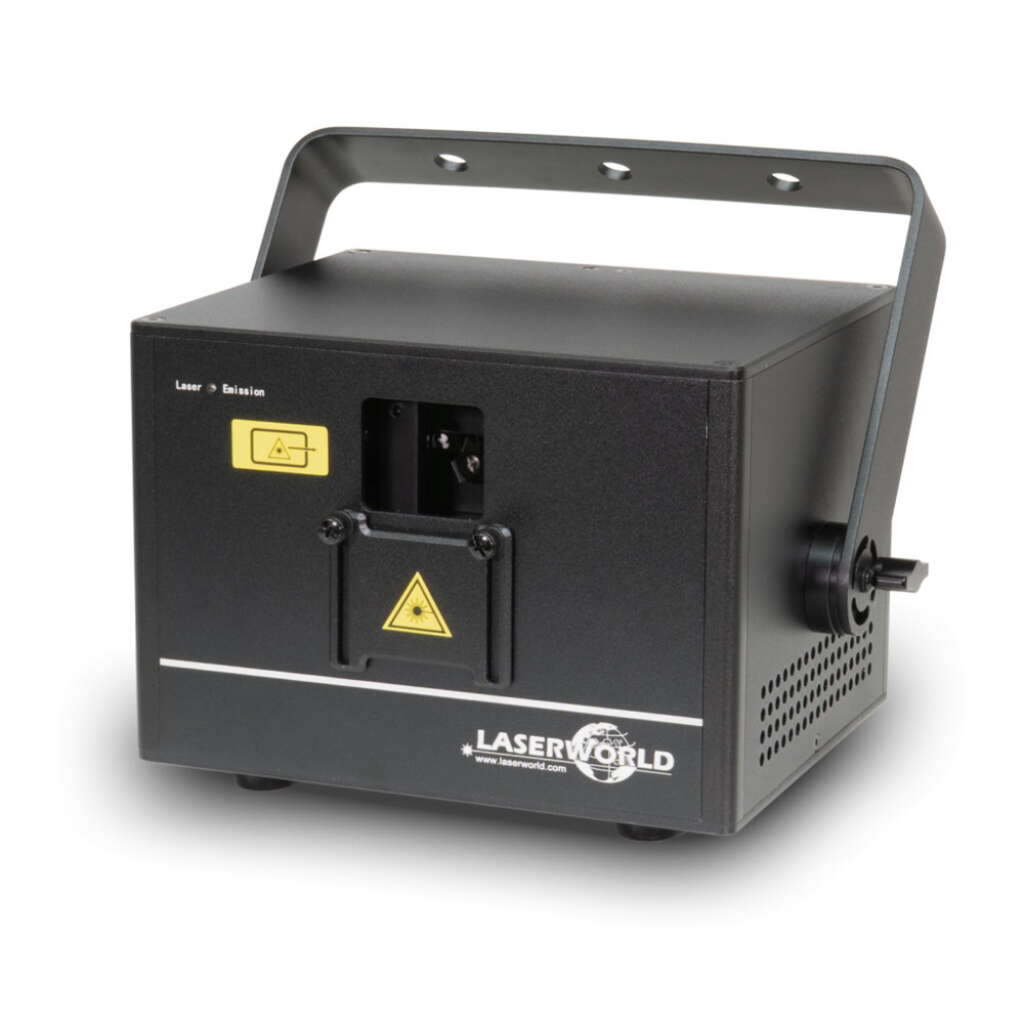
- Honest specifications, including divergence: beam divergence (spread, quoted in milliradians) governs how intense the beam stays at distance; low divergence looks better and carries risk further, and it belongs in any competent assessment. A manufacturer that publishes real power and divergence figures, as Laserworld does across its range, is giving your LPA the numbers they need. A listing that hides them is telling you something too.
- Sensible power for the room: with decent haze, a compact unit fills a small venue. Buy for the space you actually play; smaller beams are easier to keep safe. DMX-controllable units also slot in alongside the rest of the rig; see our DMX explained guide for how that fits together.
Common Mistakes
- Buying an unbranded Class 4 import with no scan-fail safeguard: the single most common way dangerous hardware ends up over a dance floor. No interlock, no key, no scan-fail and a suspicious spec sheet is not a bargain.
- Aiming lasers at mirror balls or into mirrored bars: a mirror ball turns one controlled beam into dozens of uncontrolled reflections at random heights, defeating every separation distance you planned.
- Trusting auto mode: built-in patterns do not know where your audience is. Aimed even slightly low, auto mode will happily scan the crowd all night.
- Measuring the 3 m from the floor, not the balcony: raised areas quietly break beam plans. Survey the whole space, including places people should not be but get to anyway.
- Ignoring venue and licence conditions: the promoter saying yes does not mean the premises licence agrees. Ask for the conditions in writing before the event, not during load-in.
- Running without haze and compensating with power: haze makes beams visible at lower power, which is both the better look and the safer show; our haze guide covers machine and fluid choice.
- Leaving the interlock jumper in and the key in the unit: the two supplied safety features most often found defeated. Wire the E-stop, pocket the key.
- Deciding audience scanning is fine because the venue is small: closer means worse, not better. Small rooms are where the sign-off matters most.
Popular picks from the shop
FAQ
Do I need a licence to run a laser show in the UK?
No. There is no laser display licence in the UK. Your obligations come from general health and safety law (the Health and Safety at Work etc. Act 1974 and the Management Regulations 1999), from the Control of Artificial Optical Radiation at Work Regulations 2010 where workers are exposed, and from whatever conditions the venue, premises licence or local authority attach. No licence does not mean no rules.
Is it legal to buy a Class 4 laser in the UK?
Yes. Class 3B and Class 4 projectors are sold legally for professional display use. The law bites on how you use them: a Class 4 unit run responsibly overhead with proper controls is routine; the same unit scanned into a crowd without a specialist assessment is a health and safety breach waiting for an injury.
What is HSG95 and does it still apply?
HSG95, “The radiation safety of lasers used for display purposes”, was the HSE’s laser show guidance. It has been withdrawn, and the current reference is PLASA’s “Guidance for the Safety of Display Lasers”. The legal duties never lived in HSG95 itself, so nothing got looser; venues that still cite HSG95 are really asking you to follow the PLASA guidance.
What is audience scanning and is it allowed?
Audience scanning is sweeping laser effects through the space the audience occupies, so beams reach people directly. It is not banned by name in the UK, but it is only defensible under health and safety law when a competent laser safety specialist has verified the exposure stays within the MPE at the closest audience position, including under fault conditions. Without that assessment, keep all Class 3B and 4 effects well above the audience.
How high do laser beams need to be above the audience?
The long-standing separation figures, from HSG95 and carried into the PLASA guidance, are at least 3 metres of vertical clearance above the highest accessible floor level and 2.5 metres horizontally from any publicly accessible position, for effects above the MPE. Measure from balconies, risers and anywhere else eyes can get to, not just the main floor.
What is a Laser Safety Officer, and do I need an LPA as well?
The Laser Safety Officer (LSO) is the named competent person supervising the display on the night, with authority to shut it down instantly. A Laser Protection Adviser (LPA) is a qualified specialist who assesses designs, performs exposure calculations and advises on compliance. For a straightforward overhead show, a trained operator acting as LSO is typically sufficient; for audience scanning, outdoor beams or anything a venue flags, bring in an LPA or equivalent specialist.
Do I need to tell anyone if my laser show is outdoors?
Yes. If beams go outdoors or upward, plan against the CAA’s CAP 736 guidance and notify the CAA’s airspace regulation team in advance, in addition to your local authority processes. Dazzling an aircraft crew can also engage the Laser Misuse (Vehicles) Act 2018, which carries up to five years’ imprisonment. Get specialist help with anything near an aerodrome or flight path.
Why does my laser look weak? Do I need more power?
Almost always you need haze, not watts. Beams are only visible where light scatters off particles in the air, so a hazed room makes a modest projector look enormous while letting you run lower, safer output. Fix the atmosphere first with a proper haze machine, then judge whether you genuinely need a bigger unit.
Shop this guide
Laserworld show lasers with the safety features that matter, plus the control interfaces, cabling and haze to run them properly. Talk to us about the right unit for your venue; for audience scanning and outdoor designs, we will always point you to a qualified laser safety specialist first.
Laser Systems Laser Interfaces & Software Laser Accessories & Cables Haze Machines


