

Home » Guides » Power, Cabling & Connectors »
Looking After Your Cables: Coiling, Testing, Storage and Repairs
Cables are the most common failure point on any rig and the cheapest one to prevent. Over-under coiling done properly, where cables actually break, how to catch the intermittent fault, when a re-terminate is worth it, and what UK law really asks of you.
~9 min read · Updated July 2026 · By the Stage Supply team
In this guide: Why cables fail first · Over-under coiling · When to use a drum · Where cables break · Labelling · Storage and ties · Testing · Repair or replace · Power cables and PAT · Data and network · Maintenance schedule · Common mistakes · FAQ
Why cables fail before anything else
Cables are the only part of a rig that gets coiled and uncoiled daily, walked on, driven over, hauled by the wrong end and cased while still wet. Everything else sits still. HSE puts it plainly: “Portable electrical equipment can be damaged as it is moved from place to place.”
The cost is show time, not cable. A dead cable found at line check costs five minutes; an intermittent one that drops out mid-song costs the audience’s confidence, plus twenty minutes blaming the microphone, the channel and the desk before anyone reaches for the lead.
Over-under coiling, done properly
Coil a cable the ordinary way and every loop rolls it through a half twist in the same direction. Thirty loops means thirty half twists, all one way, and the cable stores them: the jacket sets, conductors and screen wind around each other, and the run develops memory. That twist accumulates at the connectors.
Over-under cancels the twist instead of storing it:
- The over loop. Palm up, lay a normal loop in and let the cable roll: half a twist, one way.
- The under loop. Rotate that hand palm down and feed the cable in from underneath, so the loop forms the opposite way: an equal half twist back.
- Alternate to the end, so each pair nets to zero and the coil is twist-neutral at any length.
- Let the cable choose the loop size, and throw or pay the coil out rather than dragging the free end off the outside.
- Test it. A correct coil thrown across a stage pays out flat with no kinks.
The roadie wrap and the figure-of-eight are not the same thing
These get used interchangeably and should not be. Over-under, the roadie wrap, gives a round coil you can tie, hang and store: the everyday method. The figure-of-eight lays cable flat in a long eight around two anchor points, also cancelling twist because the cable reverses at each crossover, but it leaves a flat bundle rather than a coil. It suits cable that must not be coiled, or that you want flaked out ready to pull. Only one hangs on a peg.
Never coil round your elbow
Hand-to-elbow coiling is the most damaging habit in the industry, and common because it is fast. One twist direction on every loop with no reversal makes it the maximum-memory method, loop diameter is set by your forearm rather than the cable’s minimum bend radius, and the bundle cannot be thrown.
When a drum or reel is right instead
A drum wins when cable is long, heavy or stiff enough that a hand coil becomes a two-person lift or a bend-radius problem: single runs from roughly 50 m up, large-CSA power cable, combi cable, fibre and bulk stock. On a drum, cable is never bent tighter than the core.
The trade-off is heat, and it is a fire risk: a coiled cable cannot shed heat when the inner turns are insulated by the outer ones. HSE is unambiguous: “Only fully extended extension leads are capable of carrying the full current capacity of the cable without overheating. So fully unwind cable drums or coils to avoid the risk of fire.”
Where cables actually break, and the early signs
Cables fail in the last few centimetres, because the transition from flexible cable to rigid connector concentrates every bend into a short length.
- Right at the connector. The joint is where the conductor is stiffest, so bending work-hardens the copper until a strand fractures. On screened cable the pin 1 screen goes first.
- At the strain relief. The boot spreads bending over a longer length; once hardened, split or never refitted, the cable bends over a hard edge.
- At the cable grip. The gland holding the outer sheath is what stops a pull reaching the terminations. HSE requires the cable “clamped securely by outer sheath, no inner insulation visible”.
Every early sign is findable first: a connector that twists or slides in the boot, meaning the grip has gone; coloured inner insulation at the entry, which HSE lists as a user-check failure; a soft spot in the last 150 mm; kinks, bulges or flattening; burn marks, which HSE flags as overheating. Best of all, crackle when you flex the cable at the connector while it is live.
Labelling that survives a season
A scheme is only worth anything if it is still readable in twelve months, in the dark, after rain. Gaffer and a marker fails all three.
- Heat shrink over the cable, behind the boot. Write on it, slide it on, shrink it. It cannot fall off, survives abrasion, and adds a little strain relief.
- Colour as a length code. One colour per standard length, used consistently: length is what a crew reads from three metres away.
- Both ends, near the connector: a label mid-cable is useless when the cable is coiled.
- An asset number too: “XLR-047” lets you notice a cable has been repaired twice and should be retired. Keep the scheme written down with the stock.
Storage: dry, loose, not weight-loaded
Dry, above everything else. Water is the failure you cannot inspect: moisture in a cable end wicks along the copper under the jacket and corrodes it out of sight, and corroded copper goes high-resistance and intermittent rather than failing cleanly. Never case a rained-on cable.
Coiled loose, because tight coiling for months sets memory into the jacket. Not weight-loaded, because a cable at the bottom of a full trunk takes the crush of everything above it, flattening power cable and deforming data cable. Use shelves, divided trunks or pegs, and hang cables by the coil, never by a connector. Our flight cases guide covers trunks.
Cable ties, hook-and-loop and cable socks
- Hook-and-loop straps are the default for anything coiled regularly: reusable, impossible to overtighten, and workable one-handed in the dark.
- Nylon cable ties are for permanent bundling only. Pulled tight, a tie bites a groove into the jacket, permanently changing the internal spacing of twisted-pair cable. Fine for dressing a rack, wrong for a cable you handle nightly.
- Cable socks and braided sleeving are protection rather than restraint, guarding against abrasion.
Testing: continuity, and the fault that ruins shows
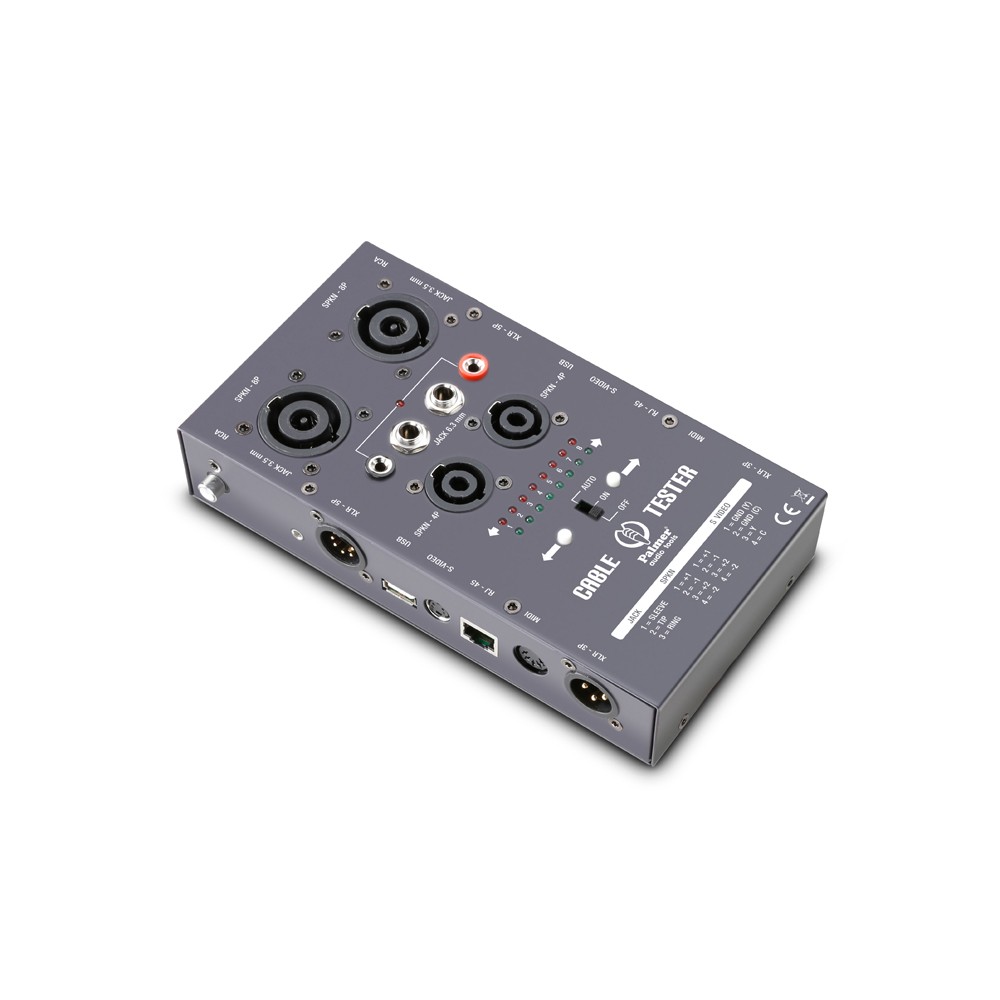
A cable tester is the cheapest test equipment in the building. It lights an indicator per pin at the far end, showing continuity, opens, shorts, and crossed wiring where pin 2 has landed on pin 3. The testers we stock range from XLR and jack units to models covering eleven connector types, and a 19-pin test plug checks a whole Socapex loom.
The intermittent is the one that matters
The open circuit is not your problem. A dead cable fails line check, you find it in ten seconds and swap it. The fault that ruins shows is the intermittent: a joint connected at rest that disconnects when the cable is flexed at a particular angle, when it is cold, or when the vocalist pulls the stand. Static checks pass it, line check passes it, then it fails in the second verse, undiagnosable because by then the cable is lying still.
So the test that matters is not the static one. Put the cable on the tester and flex it while you watch the indicators. Work the last 150 mm at each connector first, bending, twisting and gently pulling, then along the length. If any indicator flickers even once the cable is out of service and goes into a quarantine bag, not back into stock: one flicker on a bench is a hundred dropouts on a show. HSE frames the same discipline as user checks made “preferably before using it at a new location or when it is taken out of service for storage”.
Repair or replace
Re-terminating is worth doing when all four of these hold. On a good XLR lead or a long multicore, a connector costs a fraction of the cable.
- Good quality cable, sound along its length, with a known history.
- The fault is within a few centimetres of a connector, so you can cut back past it and keep a useful length.
- The connector is serviceable: XLR, speakON, jack, powerCON TRUE1, BS EN 60309 or an etherCON carrier.
- You can refit the strain relief and grip properly. Fail this one and you are building the next failure.
When the cable is scrap
- Crushed or flattened by a case wheel or truck ramp: the internal geometry is gone, invisibly.
- Kinked, with a permanent bend the sheath has set into.
- Water ingress: corrosion travels invisibly under the jacket.
- Unknown history, or a cheap moulded lead with nothing to service.
- A fault mid-run. Cut it into two shorter cables and terminate all four ends, or scrap it: an in-line joint is not a repair, and on mains it is a hazard.
- Repaired twice in the same place.
Soldering, at awareness level
Knowing what a good re-termination involves lets you judge one. The connector must suit the cable’s outside diameter, or the grip cannot clamp the sheath. The pin-out must be right: for 3-pin XLR that is pin 1 screen, pin 2 hot, pin 3 cold, standardised as AES14-1992 and internationally as IEC 60268-12, and swapping 2 and 3 gives a working but polarity-inverted cable. The screen goes to pin 1, trimmed so no strands bridge pins 2 or 3, and heat shrink goes over the joints and behind the boot.
The strain relief and grip must be refitted, the step people skip. HSE’s plug diagram is annotated “Cable grip should anchor the cable covering (sheath), not the internal wires.” Mains repairs “should only be made by someone who is competent to do so.”
A moulded consumer lead cannot be repaired. Replace it.
Moulded IEC, jack and USB leads have the connector moulded on as one sealed part: no shell to open, no terminal to reach, no grip to refit. HSE notes the same limit: “For equipment/cables fitted with moulded plugs only the fuse can be checked.”
Power cables, inspection and the UK PAT question
HSE’s user-check list is the best free checklist there is. With the lead disconnected, look for fraying, cuts or heavy scuffing; a damaged plug cover or bent pins; “tape applied to the lead to join leads together”; coloured wires showing where the lead joins the plug; and burn marks or staining. On stage power, add the gland and lid seal on BS EN 60309 CEEform connectors, cracked shells and any sign of arcing. Our event power guide and stage power checklist cover the supply.
The event standard for made-up leads is H07RN-F rubber-sheathed flexible cable to EN 50525-2-21: 450/750 V rated, rubber insulation, polychloroprene sheath, flexible class 5 conductor. That is why a good power lead shrugs off repeated coiling and cold, and outlives cheap PVC flex.
There is no statutory annual PAT test
The law is the Electricity at Work Regulations 1989, regulation 4(2): “As may be necessary to prevent danger, all systems shall be maintained so as to prevent, so far as is reasonably practicable, such danger.” That is a duty to maintain, not an instruction to test. HSE says so itself: the Regulations “do not specify what needs to be done, by whom or how frequently (ie they don’t make inspection or testing of electrical appliances a legal requirement, nor do they make it a legal requirement to undertake this annually).” “PAT” is maintenance practice, not a statutory annual event.
HSE asks instead for a risk-based scheme on three tiers: user checks before use, formal visual inspection by a trained person, and combined inspection and testing with an instrument, which “will detect the faults that cannot be seen at inspection, such as lack of continuous earth.” Frequency follows the risk: HSE’s guidance for entertainers says “Electrical testing every month would be reasonable until a suitable interval can be determined by risk assessment”, where intervals for office leads stretch to years. The industry reference is the IET Code of Practice for In-service Inspection and Testing of Electrical Equipment, 5th edition.
Never repair a damaged mains cable with tape
Not insulation tape, not self-amalgamating, not gaffer. Tape gives no mechanical strength and no reliable insulation at mains voltage, it fails once warm or wet, and it hides the damage from the next person. HSE treats a taped lead as a defect: its pass condition for a mains lead is “no bulges in cable, no kinks or twists or taped up joints”. Re-terminate it properly, or bin it.
Data and network cables
The connector answer for live network runs is etherCON, Neutrik’s ruggedised lockable RJ45: a cable carrier upgrades a conventional RJ45 into a metal-shelled locking connector across CAT5e, CAT6 and CAT6A, and panel connectors still take a bare RJ45 lead. Standardise on it for the latch and the shell: a bare RJ45 has a fragile plastic tab and no strain relief.
Why crushed data cable fails intermittently
A twisted-pair cable’s performance depends on physical geometry: the twist rate of each pair, the spacing between pairs, and the distance to the screen. Those dimensions set impedance and resistance to crosstalk, and crushing, kinking or over-tightening a tie deforms them permanently. Crucially, nothing breaks: all eight conductors stay continuous and DC continuity is perfect, so a continuity tester passes it. What changes is impedance, crosstalk and return loss, which only bite under real load. The link works, drops packets, renegotiates lower, then behaves perfectly on the bench.
So a continuity tester is not sufficient here: confirming eight conductors are in the right order says nothing about whether the link holds its speed under load, which needs a cable certifier. Carry spare pre-made network cables and swap rather than diagnose, never return a crushed data cable to stock, and avoid tight coils, hard ties and wheeled cases. The same goes for DMX.
A maintenance schedule you can keep
Frequencies should be set by your own risk assessment and fault log, as HSE requires. This is a starting shape for a hire stock, not a prescription.
| When | What to do | Who |
|---|---|---|
| Before each show | User check on every cable, disconnected: connectors, pins, latch, grip, boot, last 150 mm by feel, sheath for cuts, kinks, bulges and tape. Unwind drums fully. Line check, flexing each mic lead at the connector. | Anyone, with simple training |
| After each show | Coil over-under, tie loosely, dry anything wet before casing. Quarantine anything that misbehaved and remove damaged items from service. Log faults by asset number. | Anyone |
| Monthly | Bench-test the signal stock with the flex test. Clear the quarantine pile: re-terminate or scrap. Electrical tests on mains leads, including earth continuity, which visual inspection cannot detect. | Competent person for mains work |
| Annually | Review the fault log and adjust intervals on the evidence. Retire anything repaired twice in the same place, and confirm a spare exists for every critical cable. | Whoever owns the kit |
Common mistakes
- Coiling round the elbow, the maximum-memory method.
- Tight cable ties, which bite into the jacket and deform twisted-pair geometry.
- Pulling by the connector, or yanking a lead out by the cable, which loads the three points that fail first.
- Storing wet, which starts invisible corrosion.
- No labels, so you cannot pick the right cable in the dark or build a fault history.
- Taped mains repairs: a defect that hides a defect.
- Static-only testing, or returning a suspect cable to stock: it will find the most important channel on the busiest night.
- No spare of the critical cable. The one with no spare is always the one that fails.
Popular picks from the shop
Palmer MCT XLV 2 Multi Cable TesterView product → Elumen8 Hook and Loop Cable Strap 25 x 245mm, Pack of 10View product → Elumen8 6.4mm 2:1 Heatshrink Tubing, Black 100mView product → Titanex H07RN-F 2.5mm² 3 Core Rubber Cable, 100m DrumView product →
Frequently asked questions
What is the best way to coil a stage cable?
Over-under: alternate a normal loop with a reversed loop so each twist cancels the next. A correct coil thrown across a stage pays out flat with no kinks. Never coil hand-to-elbow.
Why do my cables keep failing?
Failures concentrate where flexible cable meets rigid connector: the solder joint, the strain relief and the grip. Usual causes are pulling by the cable, strain relief not refitted after a repair, and elbow coiling.
How should I store stage cables?
Dry, coiled loose, not under weight. Never case a wet cable, because corrosion wicks along the copper where you cannot inspect it. Hang them by the coil, not by a connector.
Can you repair an XLR cable?
Yes, routinely. If the cable is sound and the fault is near a connector, cut back past the damage and fit a new one: pin 1 screen, pin 2 hot, pin 3 cold, grip on the outer sheath.
How do I find an intermittent cable fault?
Put the cable on a tester and flex it while you watch the indicators, rather than testing at rest. Work the last 150 mm at each connector first. A single flicker condemns it.
Do stage cables legally need a PAT test every year?
No. The duty is regulation 4(2) of the Electricity at Work Regulations 1989: maintain systems so as to prevent danger so far as is reasonably practicable. HSE states that the Regulations do not make inspection or testing a legal requirement, nor make it one annually. Frequency should be risk-based.
Shop this guide
Testers, straps, heat shrink, connectors and cable by the drum, in stock and ready to ship.
Testing Equipment Cable Ties Heatshrink & Sleeving Cable Drums XLR Connectors Power Cables Network Cables



