


Home » Guides » Lighting & Effects »
Moving Head Lights: Spot vs Wash vs Beam vs Hybrid Buying Guide
By the end of this guide you will know which of the four moving head types fits your room, how to read a spec sheet without being fooled by the wattage figure, and how to power, control and rig them safely.
~11 min read · Updated July 2026 · By the Stage Supply team
In this guide: The four types · Comparison table · Reading the spec sheet · Sizing to your venue · Power and data · Rigging safely · Which should you buy? · FAQ
Moving heads are the workhorses of modern stage lighting: a lamp or LED engine in a yoke that pans and tilts under DMX control. But “moving head” covers four quite different optical designs, and buying the wrong type is the single most common mistake we see. A beam fixture in a low-ceilinged function room blinds the guests; an underpowered wash outdoors disappears at dusk. This guide breaks down what each type actually does with light, what the numbers on the spec sheet mean, and how to match fixtures to the rooms you actually work in.
The Four Types and What Each Does With Light
Every moving head starts with a light source, either an LED engine or a discharge (arc) lamp, and the optical train behind it defines the type. The differences are not marketing, they are physics: lens design decides whether you get a sharp projected image, a soft even field, or a solid column of light in the air.
Spot: the projector
A spot moving head focuses the source through a gate, so it can project hard-edged patterns. The signature features are gobos (metal or glass pattern discs, usually one rotating wheel and often a second static wheel), a motorised focus so you can sharpen or soften the projected image at any throw distance, and on better fixtures an iris to shrink the beam diameter without changing zoom. Spots are what you buy when you want texture: breakup patterns across a dance floor, rotating gobos through haze, logos on a wall. Most also carry a prism and a colour wheel or full colour mixing. Beam angles typically sit in the mid range, and on current LED spots a motorised zoom of very roughly 8 to 40 degrees is common, though fixed-zoom budget spots still exist.
Wash: the painter
A wash moving head produces a soft-edged, even field of colour with no gate and no gobos. Almost all modern washes are multi-chip LED (RGBW or RGBAL arrays, or a single homogenised COB source) with a wide motorised zoom, and the job is to cover people and scenery in smooth colour: stage washes, dance floor colour, uplighting a band, tone on a set. The two specs that matter most are zoom range (wider is more useful, a wash that only reaches 25 degrees will struggle to cover a stage from a short throw) and field flatness, meaning no hot spot in the middle. Washes with individually controllable LEDs add pixel effects as a bonus.
Beam: the searchlight
A beam fixture pushes all its output through narrow-angle optics, typically somewhere around 1 to 4 degrees, to create a tight, near-parallel column of light that stays visible in the air over long distances. Beams are mid-air effects fixtures: fast movement, prisms (often stacked or rotating) that split one beam into many, and very high intensity for the wattage because the light is so concentrated. Historically this category was built on small discharge lamps (the 7R class around 230 W being the classic example) and many still are, though LED beam engines are now common. What beams do not do well is light people: the field is too narrow and too intense at close range.
Hybrid: three fixtures in one, with compromises
Hybrids (usually badged BSW, for beam-spot-wash) combine a wide zoom with gobos, prisms and a frost filter, so one fixture can do a passable beam look, a decent spot look and a soft wash look. For a mobile rig where van space and channel count are limited, that flexibility is genuinely valuable. The compromise is that a hybrid rarely matches a dedicated fixture at any single job: its “wash” is a frosted spot rather than a true even field, and its “beam” is wider than a dedicated beam. Judge a hybrid by its zoom range, the quality of its frost, and whether it keeps output up at the wide end.
A note on profiles and LED engines
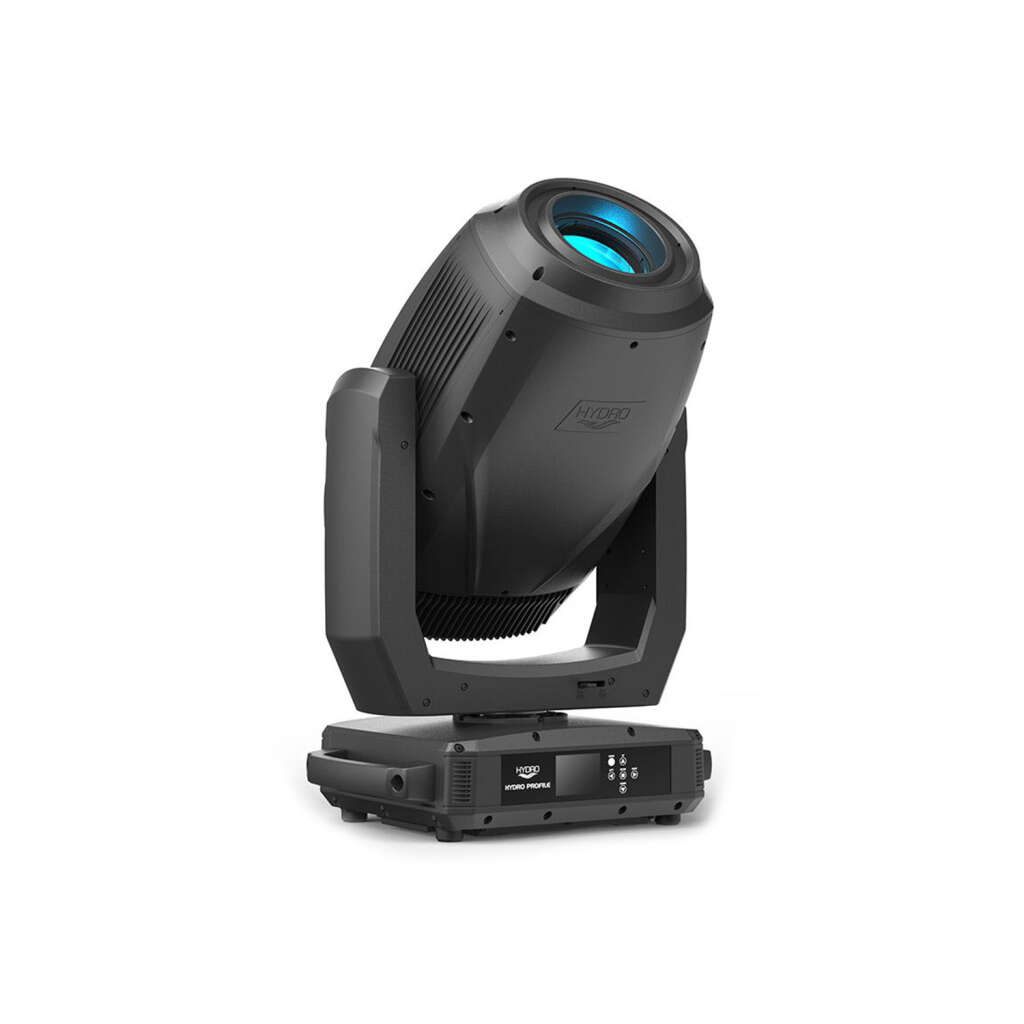
At the top of the spot family sits the profile moving head: a spot with framing shutters, four blades that let you crop the beam into precise shapes, plus typically CMY colour mixing and heavy-duty LED engines from roughly 300 W up to 1,000 W and beyond. Profiles are theatre and production tools with prices to match; most buyers reading this need them only when key-lighting presenters or doing broadcast work. Across all types, LED has effectively replaced discharge below the arena level: instant on and off, no lamp replacement cost, far lower heat, and dimming without a mechanical shutter. Discharge survives mainly in beams, where the small bright arc source still produces the tightest columns per pound spent.
Spot vs Wash vs Beam vs Hybrid at a Glance
| Spot | Wash | Beam | Hybrid (BSW) | |
|---|---|---|---|---|
| Optics | Hard edge, focusable; gobos, iris, prism | Soft edge, wide even field; no gobos | Very narrow near-parallel column; prisms | Wide zoom + gobos + prism + frost |
| Typical beam angle | Roughly 8-40° (zoom models) | Wide zooms, often into the 40-60° region | Roughly 1-4° | From beam-narrow to spot-wide, often ~2-40° |
| Typical use | Gobo texture, aerial effects with shape, feature lighting | Colouring people, stages, dance floors, sets | Mid-air looks in haze, big-room and outdoor effects | One-case-does-everything mobile and small production rigs |
| Throw | Short to medium | Short to medium | Long; wasted at short range | Short to long depending on zoom |
| Ceiling height suitability | Fine from ~2.5 m up | Fine at any height, the safest low-ceiling choice | Wants 4 m+ and haze; punishing in low rooms | Workable anywhere if you stay off the narrow end indoors |
| Needs haze to look good? | For aerial looks, yes | No | Yes, essential | For beam/spot looks, yes |
How to Read the Spec Sheet
Wattage is not brightness
The headline “150 W LED” on a moving head tells you how much power the LED engine consumes, not how much light comes out of the front. Two 150 W spots can differ enormously in output depending on LED efficiency, optical design and how much light the gobo gate and lenses throw away. The numbers that actually describe brightness are lumens (total output) and, more usefully for comparing fixtures, lux at a stated distance (illuminance on target, for example lux at 5 m at a stated beam angle). Be careful with lux figures too: a narrow beam concentrates the same light into a smaller circle, so a tight beam fixture can quote spectacular lux numbers from modest power. Only compare lux figures measured at the same distance and similar beam angles, and treat any spec sheet that quotes neither lumens nor lux with suspicion.
Zoom range
Quoted as a min-max beam angle, for example 8-40 degrees. For washes, prioritise the wide end; for spots, a usable narrow end lets one fixture double as an aerial effect. Cheap fixtures sometimes quote “zoom” that is really just a manual lens adjustment, so check the DMX chart for a zoom channel.
Colour: CMY vs fixed wheels vs RGBW
There are three common colour systems. Fixed colour wheels (a disc of dichroic filters) are cheapest: you get 7 to 9 saturated colours plus white, snap changes, and nothing in between. CMY mixing (cyan, magenta, yellow flags moving progressively into a white beam) gives smooth, continuous colour on discharge and white-LED fixtures and is the standard on production-grade spots and profiles. RGBW additive mixing (red, green, blue and white LEDs blended in the engine) is the norm on LED washes and gives millions of colours plus adjustable whites. For wedding and corporate work where you must hit specific colours cleanly, CMY or RGBW is worth paying for; a fixed wheel means the client gets the nearest of eight colours, not the one they asked for.
Movement: pan and tilt
The overwhelming majority of moving heads offer around 540 degrees of pan and somewhere in the 230 to 270 degree range of tilt, with both 8-bit and 16-bit DMX control. 16-bit matters: it splits each axis across two channels so slow movements are smooth instead of visibly stepped. Spec sheets also quote maximum pan/tilt speed; more relevant in practice is how quiet and smooth the motors are at slow speed, which is worth checking in person or in independent reviews for fixtures destined for churches, theatres and conference rooms.
Gobos, prisms, frost and pixels
- Gobo wheels: look for at least one rotating, indexable wheel. Interchangeable slots let you load custom logo gobos, a real earner for corporate work.
- Prisms: multiply one beam into 3, 8, 16 or more. Rotating prisms create the classic sweeping fan; some fixtures stack linear and circular prisms.
- Frost: a diffusion filter that softens the edge. On a hybrid, frost quality decides whether the wash mode is usable or just a blurry spot.
- Iris: mechanically shrinks the beam diameter independently of zoom, useful for tightening a gobo onto a small target.
- Pixel control: washes with individually addressable LEDs (or ring zones) can run chases and eye-candy effects, at the cost of a much bigger DMX footprint in extended mode.
- Colour temperature and CRI: if fixtures will light people on camera, check the white point (e.g. 6,500 K vs 3,200 K) and CRI, not just output.
Spec-sheet trap: the wattage headline
Budget listings routinely name fixtures after a wattage class they do not match, or quote total power consumption (LED engine plus motors and fans) as if it were source power. If a “300 W” fixture publishes no lumen or lux figure at all, assume the number is marketing. Compare fixtures on measured output at a stated distance, never on the number in the product name.
Spec-sheet trap: lux measured at the narrow end
Zoom fixtures almost always quote lux at the tightest beam angle, where the light is most concentrated. A wash you will actually run at 40 degrees may deliver a small fraction of the headline figure in real use. Check the beam angle printed next to the lux number before comparing.
Sizing Fixtures to Your Venue
Throw distance and ceiling height decide more than any other factor. A fixture that looks weak in a spec comparison may be exactly right for a 3 m ceiling, and the brightest beam in the catalogue is useless in the same room. Use the table below as a starting point, then adjust for ambient light: daylight-facing conference rooms and outdoor dusk shows need far more output than a blacked-out club.
| Venue | Typical throw | Sensible LED class | Type guidance |
|---|---|---|---|
| Function room / small wedding venue (2.5-3.5 m ceiling) | 2-5 m | Compact fixtures, roughly 60-150 W engines | Washes first; small spots for gobo texture. Avoid beams. |
| Club / live music bar (3.5-6 m ceiling) | 4-8 m | Roughly 150-300 W engines | Spots and washes as the core rig; beams or hybrids work here with haze. |
| Theatre / church / school hall | 6-15 m | Roughly 200-500 W engines | Quiet operation is critical: check fan noise and slow-move smoothness. Spots or profiles plus washes. |
| Larger production / big room | 10-25 m | Roughly 400-1,000 W engines or discharge beams | Dedicated types beat hybrids at this scale; 16-bit movement and CMY expected. |
| Outdoor / festival / marquee perimeter | Varies | High output, and IP65-rated | IP20 fixtures are for dry indoor use only; dew and drizzle kill them. IP65 moving heads cost more but survive open-air work. |
Common mistake: beams in a low room
A 2 degree beam at head height is not an effect, it is a hazard and an eyeful. Beams are designed to be seen in the air over distance, which needs ceiling height, throw and haze. For anything under about 4 m, buy washes and spots and get your aerial looks from a spot at its narrow zoom end.
Common mistake: mixing colour temperatures and colour engines
A rig of four RGBW washes from one range plus two fixed-wheel spots from another will never quite match: “red” and “white” mean different things to each engine. Buy matched pairs or quads of the same model where fixtures will share a look, and check white-point consistency if you mix ranges.
Power and Data Planning
Power: chaining with powerCON
Most current moving heads carry locking power in/out connectors, either Neutrik powerCON TRUE1 or a Seetronic equivalent, so fixtures can be daisy-chained from one feed. The connector on the fixture is rated at 16 A, but in the UK your limit is usually the supply: a standard 13 A socket gives you roughly 3 kW of total connected load. Add up the maximum power consumption of every fixture in the chain (the figure that includes motors and fans, not the LED wattage) and keep comfortable headroom; four 250 W-draw fixtures per 13 A feed is relaxed, ten is not. Fixture manuals state a maximum number of units per chain, which drops further on 110 V supplies; follow the manual, not the connector rating. On larger rigs, distribute from 16 A or 32 A outlets via proper power distribution rather than stacking 4-way extension leads.
Data: DMX footprints and modes
Every moving head occupies a block of consecutive DMX channels, its footprint, starting at the address you set. Simple fixtures use 12 to 16 channels; feature-heavy fixtures in extended (16-bit) mode use 24 to 40 or more, and pixel-mappable washes can go far beyond that. Most fixtures offer two or three modes so you can trade features for channel economy. Plan your addressing before the show: a universe holds 512 channels, so eight fixtures at 32 channels each is already a quarter of it, and mixing modes across identical fixtures is a classic source of patching chaos. Set identical fixtures to the same mode, space the addresses by the footprint (1, 33, 65 and so on for a 32-channel mode), and run the chain from a proper controller with the last fixture terminated. If addressing, universes and cabling are new territory, our DMX explained guide covers it end to end, and you can compare hardware in DMX controllers.
One cabling note that saves a support call: DMX is 110 ohm data cable on 3-pin or 5-pin XLR. Microphone cable will appear to work on short runs and then produce random fixture behaviour on long ones. Buy DMX cable, and terminate the line.
Rigging Safely: UK Practice
Moving heads are heavy for their size (a mid-size LED spot is commonly in the 10 to 20 kg range, and production fixtures well beyond that) and they vibrate themselves loose over time in a way static fixtures do not. The rigging basics: fixtures hang from clamps or couplers bolted to the fixture’s omega brackets, gripping 48-51 mm tube on a truss, wind-up stand or goalpost. Every clamp has a stated safe working load (SWL or WLL); check it against the fixture weight, and check the bar or truss span rating against the total load of everything on it, cables included. Heavier moving heads should hang from two clamps on two omegas, and clamps should be done up firmly and re-checked after transport.
Safety bonds and working at height
UK industry practice is that every flown fixture gets an independent secondary safety bond: a rated steel safety wire looped through the fixture’s designated safety point and around the bar or truss, so if the clamp or bracket fails the fixture drops millimetres, not metres. Use bonds rated for the fixture weight and sized so the free-fall distance is as short as possible, inspect them for kinks, crushed ferrules and damaged clips before every use, and retire anything that has arrested a fall. Never substitute cable ties, chain from a DIY shop or unrated wire. Rigging work is also work at height under the Work at Height Regulations 2005: it must be planned, done by competent people, and lifting equipment used at work falls under LOLER inspection requirements. Stock up on rated safety wires, and see our truss and rigging basics guide before flying anything over people.
Two moving-head specifics: mount fixtures so pan and tilt cannot strike truss, cables or scenery at full travel, and dress power and DMX with enough service loop that a full pan does not drag the cables tight.
Which Should You Buy?
Mobile DJ
- Start with 2-4 compact RGBW washes for floor colour, then add a pair of small spots or hybrids for gobos and aerial looks
- Prioritise weight, setup speed and powerCON chaining over raw output; most rooms are 3 m ceilings
- Skip dedicated beams unless you regularly work tall-ceiling venues with haze
Small venue / bar / club
- A matched core of washes over the stage or floor plus spots for texture; hybrids or beams only with 4 m+ height and a hazer
- Install duty is continuous: pick fixtures with good thermal design and available spares
- Plan DMX addressing and a house plot so guest engineers can walk in and work
Church / school / theatre
- Fan noise and smooth slow movement matter more than peak output; audition fixtures in a quiet room
- Washes with good whites (and decent CRI for camera work) first; a spot or profile for gobos and specials second
- Volunteer-friendly control: fixtures with sensible basic DMX modes save Sunday-morning stress
Production company
- Buy in multiples of 4 or 6 of one model per role; mixed odd fixtures are hard to plot and hard to cross-hire
- Dedicated types (CMY spots or profiles, zoom washes, beams) beat hybrids once the rig is big enough to specialise
- If any work is open-air, build an IP65 complement; dry-hire demand for rated fixtures is strong
Whichever profile fits you, the buying order is nearly always the same: washes first (they do the unglamorous work of actually lighting things), spots second for texture and features, beams last and only when the room justifies them. Browse the full moving head range with the type and venue filters above in mind.
Popular picks from the shop
Frequently Asked Questions
What is the difference between a spot and a beam moving head?
A spot projects a focusable, hard-edged image and carries gobos, so it can put patterns on surfaces as well as shapes in the air. A beam sacrifices all of that for a very narrow, intense column of light (typically only a few degrees wide) designed to be seen in haze over long distances. Spots are the more versatile purchase; beams are a specialist effect.
Are hybrid moving heads worth it?
For mobile operators and small rigs, usually yes: one case covers beam, spot and wash duties and halves your van space. For installs and larger productions, dedicated fixtures win because a hybrid’s wash is a frosted spot rather than a true even field, and its beam is wider than a dedicated beam. Judge hybrids on zoom range and frost quality.
How many moving heads do I need as a mobile DJ?
Two washes will colour a small dance floor; four (two on the floor, two crossing the room) is the point where the rig starts looking designed rather than decorated. Add a pair of spots or hybrids for gobo texture and aerial movement once the washes are in place. Beyond six fixtures, invest in better control before more heads.
Does a higher wattage moving head mean a brighter light?
No. Wattage measures power consumed, not light produced. Efficiency of the LED engine and losses in the optics vary widely, so compare fixtures on lumen output or lux at a stated distance and beam angle. A well-designed 150 W spot can outperform a poorly designed fixture sold as 250 W.
Can I use indoor moving heads outside under a gazebo or in a marquee?
Only if they are genuinely protected from rain, spray and condensation, and dry overnight storage is guaranteed. IP20 fixtures are designed for dry indoor use; overnight dew inside a marquee has ended plenty of them. For regular outdoor work, buy IP65-rated fixtures, which are sealed against dust and water jets.
How many moving heads can I run off one plug socket?
Add up each fixture’s maximum power consumption from the manual (the figure including motors and fans) and keep the total comfortably under the roughly 3 kW a UK 13 A socket supplies. For typical compact LED heads drawing 200-350 W each, that usually means around 4 to 8 fixtures per feed, but always follow the fixture manual’s stated maximum units per powerCON chain, which may be lower.
Do moving heads need a DMX controller?
Most will run standalone in sound-active or auto mode, which is fine for a plug-and-play party look. But you are paying for pan, tilt, colour and gobo control, and only a controller (hardware desk or software with a USB-DMX interface) unlocks it. Even a basic fixture-based controller transforms what the same lights can do; see our DMX explained guide for how addressing and universes work.
Do I really need safety wires on every fixture?
If the fixture is flown above people, yes, every time: a rated secondary safety bond through the fixture’s safety point and around the bar is standard UK practice, and venues and insurers increasingly refuse rigs without them. Clamps loosen with vibration and brackets fail; the bond is what turns that from an incident into a non-event.
Shop this guide
UK stock and fast delivery on moving heads, control and rigging hardware.
Moving Head Lights DMX Controllers Clamps & Couplers Safety Wires


