


Home » Guides » Drums & Percussion »
Drumstick Sizes Explained: 5A, 5B, 7A, 2B, Tips and Taper
5A, 5B, 7A, 2B. The codes are a leftover from a catalogue system that stopped being literal decades ago, so this guide gives the measured diameter of every stick we hold instead.
~8 min read · Updated September 2026 · By the Stage Supply team
In this guide: Short answer · What 5A means · Taper · Tips · Hickory and FireGrain · Rods · Bags and tape · Shop the range · FAQ
Drumstick model names look like a code and are in fact a leftover from a catalogue numbering system that stopped being literal decades ago. What matters now is four measurable things: diameter, length, taper and tip. This guide explains each one, gives the exact figures for every stick we stock, and says which to buy.
The short answer
5A is the most popular stick size in the world and the right starting point for almost everyone. Go to 5B if you want more weight behind the stroke, 7A if you want less, and 2B if you are hitting hard or practising for endurance. If you break sticks, buy FireGrain.
What 5A and 2B actually mean
The numbers and letters come from the original drum stick catalogues, where the number indicated a circumference class and the letter indicated the intended setting: A sticks were aimed at dance bands, B sticks at concert and brass bands. Lower numbers meant thicker sticks, which is why 2B is heavier than 5B.
None of that history helps you choose. Read the designation as a size step and nothing more, and then look at the actual diameter, because that is the number you feel. The range we stock, measured.
| Stick | Diameter | Length | Taper | Tip |
|---|---|---|---|---|
| Classic Forward 7A | 0.512 inch / 13mm | 15 3/8 inch / 390.5mm | Short, forward-weighted | Oval wood |
| Classic Forward 5A | 0.551 inch / 14mm | 16 inch / 406.4mm | Short, forward-weighted | Oval wood |
| Rebound 5A | 0.565 inch / 14.4mm | 16 inch / 406.4mm | Long, rear-weighted | Acorn wood |
| Classic Forward 5B | 0.590 inch / 15mm | 16 inch / 406.4mm | Short, forward-weighted | Oval wood |
| Rebound 5B FireGrain | 0.595 inch / 15.1mm | 16 inch / 406.4mm | Long, rear-weighted | Acorn wood |
| Classic Forward 2B | 0.630 inch / 16.1mm | 16 inch / 406.4mm | Short, forward-weighted | Oval wood |
Note something in that table that catches people out: a Rebound 5A is fatter than a Classic Forward 5A, at 0.565 against 0.551 inches, and a Rebound 5B is fatter than a Classic Forward 5B. The letter and number do not fix the diameter across model families. If you are switching between the two lines, you are changing size as well as feel.
Taper: the thing that actually changes how a stick plays
The taper is the section between the shaft and the tip. Its length moves the balance point, and the balance point decides whether a stick feels like a hammer or like a lever. ProMark run two taper philosophies and they are named after what they do.
- Classic Forward. A short taper, which keeps mass towards the front. The result is a forward-weighted feel with more power in the stroke. It hits harder for the same effort and it drives a wedge of a backbeat. This is the traditional feel and it is what most people picture when they think of a 5A.
- Rebound. A long taper, which shifts mass backwards. The result is a rear-weighted feel that increases agility, because the stick comes off the head faster and does more of the bouncing for you. Better for fast single strokes, ghost notes and anything where control matters more than volume.
If you play a lot of doubles, rolls and fast fills, try Rebound. If you play loud backbeats and want the stick to do the hitting, stay with Classic Forward.
Tips
- Oval wood (Classic Forward). A larger contact patch than a round tip, giving a full-bodied, warm tone that works across the whole kit. The all-purpose shape.
- Acorn wood (Rebound). ProMark’s reworked acorn gives a larger sweet spot, which translates into more consistent response and better articulation, particularly on a ride cymbal where a small change in stick angle otherwise changes the sound.
Every stick we hold is a wood tip. Nylon tips are brighter on cymbals and last longer, but they change the ride sound noticeably and they can come off. We can order nylon in if that is what you want.
Hickory, and what FireGrain adds
All of these are American hickory, which is the standard drumstick wood because it combines resilience, responsiveness and durability, and because it absorbs shock rather than transmitting all of it into your wrist. Maple is lighter and oak is harder, but hickory is the balance point, which is why almost everything on a professional stage is made of it.
FireGrain is a patented heat-tempering process applied to finished hickory sticks. Heat hardens the wood without adding anything to it, so the stick keeps its original weight and balance while getting substantially more durable. There is no coating, no resin and no composite, and the stick still feels and sounds like hickory. For a drummer who goes through several pairs a show, it is the cheapest upgrade available per hour of playing.
We stock it as Rebound 5A FireGrain and Rebound 5B FireGrain in 4-packs. There is also a bonus 4-pack that gives you three pairs of standard Rebound 5A plus one pair of Rebound 5A FireGrain, which is a cheap way to try the difference back to back on the same size stick.
One more thing: ProMark’s ProMatch process pairs sticks by weight and by pitch, not just by weight. Two sticks of the same mass with different densities sound different on a ride, and that is the inconsistency ProMatch is there to remove. It applies across the range.
Rods, for when a stick is too much
Rods are bundles of thin birch dowels that give you far less volume than a stick while keeping enough articulation to play properly. They are the answer to an acoustic set, a small room, a church, a restaurant or a rehearsal in a flat. Ours both now have a playable rubber end cap, so you can flip them round for a fuller tone on drums and cymbals.
| Rod | Dowels | Diameter | Length | Volume |
|---|---|---|---|---|
| Hot Rods | 19 medium premium select birch | 0.550 inch | 16 inch | Lighter than a stick, with plenty of articulation |
| Cool Rods | 19 small premium select birch | 0.425 inch | 16 inch | More delicate again. The quietest option here |
Both carry a wrap near the neck that tightens the sound and improves durability, which is the part of a rod that fails first.
Carrying and marking them
- Every Day Stick Bag. Weatherproof ballistic nylon, 18 inches long and 7.5 inches wide closed, opening out to 15 inches. It has a rigid 1 inch spine so it still closes when it is full, hanging tom mounts, a large front zipped pocket and a zipped inner pocket. The spine is the part that matters: soft-sided bags stop closing once they are loaded.
- White stick tape. Sold for marching sticks, where bright white increases the effect of the visuals, and it also adds grip. Kit players use it to mark their own sticks in a shared backline, which is a perennial problem at festivals and in rehearsal rooms.
The sticks we keep
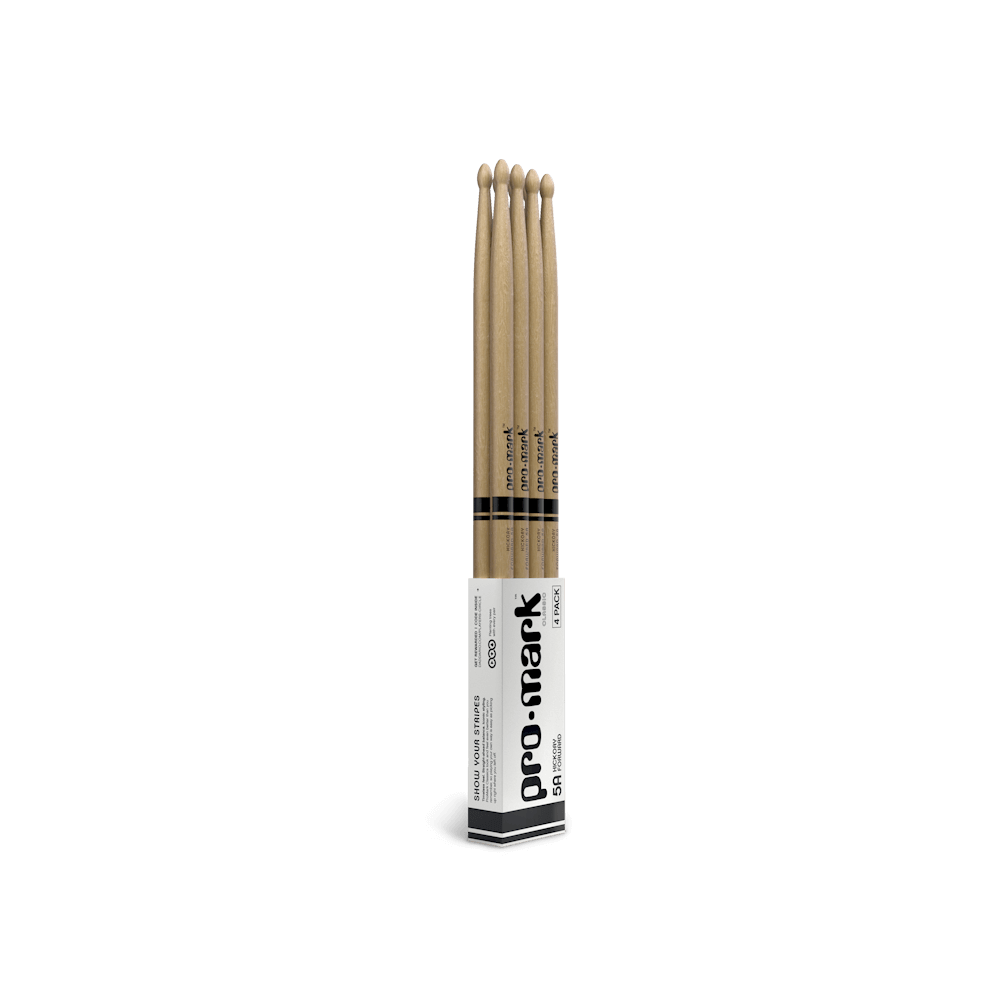
ProMark Classic Forward 5A, 4-packView product → ProMark Classic Forward 5B, 4-packView product → ProMark Rebound 5A FireGrain, 4-packView product → ProMark Hot RodsView product →
Shop the range
Every stick, rod, bag and roll of tape named above.
Stocked in our own warehouse for next-day UK delivery, with trade counter collection available. Anything in the D’Addario, Evans, ProMark or PureSound catalogue that we do not shelve, we can order in, so ask us if you cannot see it.
Frequently asked questions
What size stick should a beginner start on?
5A for most adults, and ProMark specifically note the thinner 7A as suited to children and beginners. Starting on something too heavy builds a tense grip that takes a long time to unlearn.
Is a 5B just a thicker 5A?
Within the same family, yes, and by a small margin: Classic Forward 5A is 0.551 inches and 5B is 0.590. Across families the comparison breaks down, because a Rebound 5A at 0.565 is already thicker than a Classic Forward 5A.
Does FireGrain change the sound?
It is designed not to. The heat-tempering keeps the stick’s original weight and balance and adds nothing to the surface, so it plays like hickory because it is hickory. What you get is more of them before the shoulder chews through on a hi-hat edge.
Why does everything come in a 4-pack?
Because that is how working drummers buy sticks. A hard hitter can go through two or three pairs in a show, so a single pair is not a realistic unit for anyone gigging. Four pairs covers a weekend.
Hot Rods or Cool Rods?
Hot Rods use medium dowels at 0.550 inches and keep more articulation, so they are the general-purpose quiet option. Cool Rods use smaller dowels at 0.425 inches and are more delicate again, for when even Hot Rods are too loud.


