


Home » Guides » DJ & Events »
The Mobile DJ Starter Setup: A Complete UK Equipment Guide
Everything a new mobile or wedding DJ needs to turn up, set up and get paid: source, sound, lighting, power, cases and the paperwork venues actually ask for.
12 min read · Updated July 2026 · By the Stage Supply team
In this guide: The rig as systems · Source · Sound · Lighting · Stands and booth · Power · Cases · Microphone · Business side · Buying path · Common mistakes · FAQ
Think in systems, not products
The mistake most new mobile DJs make is buying a shopping list of individual products. A working wedding rig is a set of systems, and every system needs to work on its own and fail gracefully. When you plan it that way, the buying decisions get much simpler: each pound goes to whichever system is currently the weakest link, not to whichever product looked best in a video.
| System | What it covers | Failure plan |
|---|---|---|
| Source | Controller or media player, laptop, music library | Second playback device, always |
| Sound | Active tops, sub when needed, signal cables | One top can carry a speech on its own |
| Lighting | Wash, effects, uplighters | Sound-to-light fallback if control fails |
| Structure | Speaker stands, lighting stand, booth or facade | Rated hardware, checked fittings |
| Power | Extensions, distribution, spare fuses | Two independent runs where possible |
| Voice | Announcement microphone | Wired backup for any wireless mic |
Source: controller, laptop and the redundancy rule
Your source system is a DJ controller or standalone media player plus the music library behind it. For weddings, standalone capability matters more than jog wheel feel: a player that runs from USB sticks without a laptop removes your single most common point of failure. If you run laptop software, the laptop becomes mission-critical, so treat it like one: dedicated machine, nothing else installed, notifications off, and the full library duplicated on USB.
The redundancy rule is simple and non-negotiable: you must be able to play the first dance from a second device. That can be a spare controller, a standalone player, or at minimum a phone or tablet with the key songs downloaded (not streamed, venues have terrible signal) and a cable into a spare mixer input. A wedding has moments that cannot be repeated. “The laptop crashed” is not an answer anyone accepts.
- Controller plus laptop: cheapest way in, best library management, but the laptop is a failure point. Carry a USB backup path.
- Standalone media player: plays from USB, no laptop on the booth, generally the more reliable wedding workflow.
- Either way: two copies of the client’s must-play list, on two devices, checked before you leave the house.
A pair of closed-back DJ headphones completes the source system. Closed-back matters because you cue against a loud room, and function rooms are loud in all the wrong frequencies. See our DJ headphones range.
Sound: active tops sized to real function rooms
For a first professional rig, a pair of active (powered) tops on stands is the right answer. Amplification is built in and matched to the drivers, there is no separate amp rack to buy, carry or wire, and limiting protects the speakers when a guest inevitably asks for more volume. The full reasoning is in our active vs passive PA speakers guide, but for a solo operator loading in alone, active wins on every axis that matters.
Size the tops to typical work, not the biggest gig you can imagine. Most UK wedding breakfasts and evening receptions happen in function rooms holding 60 to 150 guests, and a pair of quality 12 inch active tops covers that comfortably. Choosing speakers for a given room size is covered in depth in the small venue PA system guide; the short version is that clean headroom beats raw wattage claims, and a good 12 inch top run at 70 percent sounds better all night than a cheap 15 inch top run flat out.
Add a subwoofer when the work justifies it, not on day one. A single sub under one top (an asymmetric rig is fine for DJ work) transforms the dancefloor for larger rooms and party-heavy crowds, and it lets you high-pass the tops so they run cleaner. But a sub is also the heaviest single item in the van and the first thing a noise limiter objects to, so treat it as the upgrade that your bookings pay for.
Lighting: a sensible starter kit, not a shop display
Lighting is where new DJs overspend fastest and get the least back. A wedding dancefloor needs three things: colour wash over the floor, some movement or texture for the party set, and enough restraint that the photographer does not hate you during the first dance.
- Wash: 2 to 4 LED PARs or one batten. This is the backbone. A handful of RGBW PAR cans on a T-bar, or a single batten across the booth, gives you slow colour states for dinner and full-colour chases for the party. The trade-offs between battens, PARs and uplighters are covered in our LED battens, PARs and uplighters guide.
- Effects: 1 or 2 units. One derby or gobo effect, or a pair of small moving heads once budget allows. Effects lights are seasoning, not the meal. Every effect should have a sound-to-light or auto mode so the show keeps running if your control link fails.
- Uplighters: the wedding upsell. Battery uplighters around the room walls, set to the couple’s colours, are the single easiest paid add-on in mobile DJ work. No cables across the floor, ten minutes to deploy, and they photograph beautifully. A charging flight case pack pays for itself in hire fees.
Haze makes beams visible and is what separates a light show from some coloured tiles on the ceiling, but it belongs in the premium tier of your buying path, and only ever with the venue’s written blessing. See the fire alarm caveat in our smoke, haze and low fog guide before you even pack a machine.
Stands, booth and looking the part
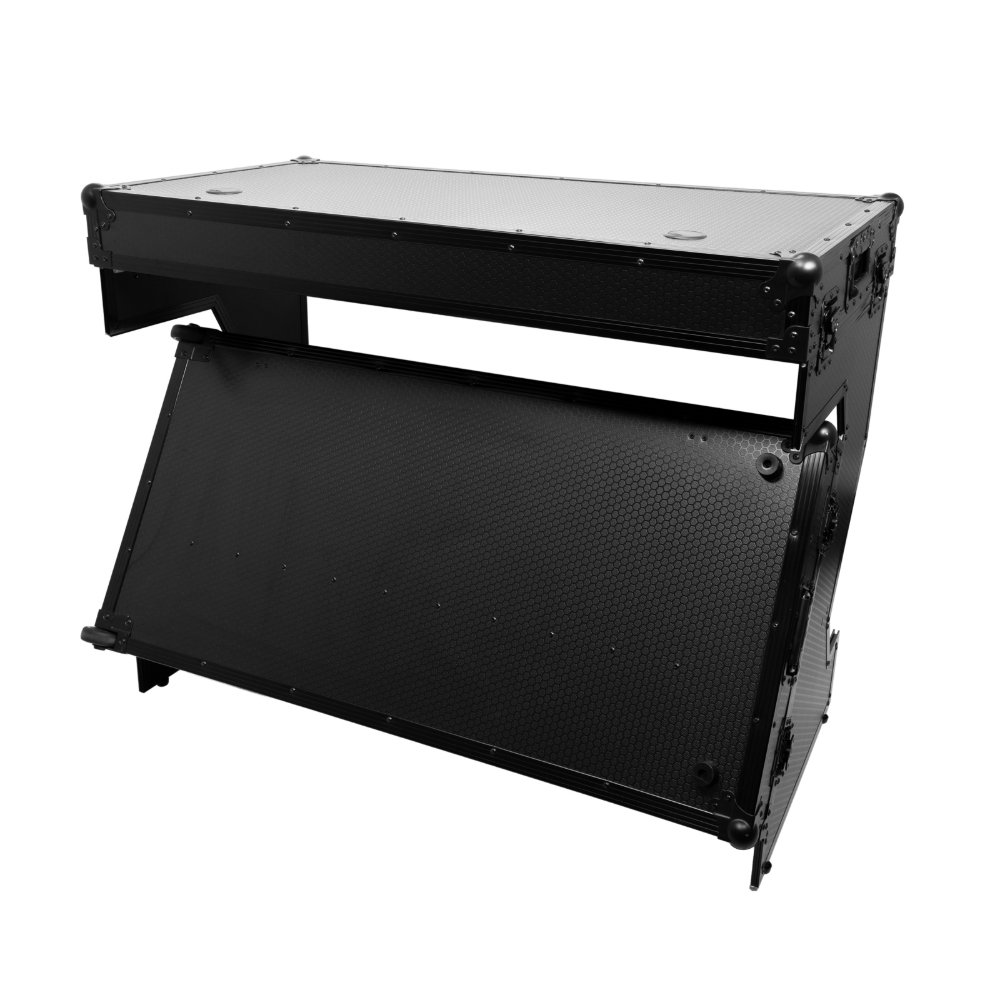
Structure is the least glamorous system and the one clients see first. You need: two speaker stands or poles rated well above the weight of your tops, a lighting stand or T-bar, and something to hide the mess, either a purpose-built DJ booth or a folding table with a stretch facade. Venues judge you in the first thirty seconds of load-in; a fitted facade with cables dressed behind it reads as professional in a way no amount of gear does. Browse stands and brackets for poles, T-bars and wall of hardware options.
Cable dressing is part of this system, not an afterthought. Velcro wraps on every cable, a consistent coiling habit, and gaffer tape (never duct tape, it leaves residue and venue managers remember) for anything crossing a walkway. A guest tripping on your speaker cable is both a safety incident and the end of that venue relationship.
Power and cabling: the 13A reality
Almost every mobile DJ gig in the UK runs from ordinary 13A wall sockets, and a standard 13A socket gives you roughly 3kW to play with. A typical starter rig, two active tops, a controller, a laptop and a handful of LED lights, sits comfortably inside that. The problems are never total load; they are distribution and habit.
- Use good quality extension leads, fully unwound. A coiled cable reel under load heats up, and most reels carry a much lower rating coiled than unwound.
- Never daisy-chain four-way blocks into four-way blocks. Run separate feeds from separate sockets where the room allows, ideally sound on one and lighting on another.
- Carry spare 13A fuses, a spare IEC lead, and a plug-in socket tester. Function room sockets have hard lives.
- Know where the venue’s sockets and breakers actually are before you build the booth around the wrong wall.
The full treatment, including load maths and what to ask a venue in advance, is in our stage power checklist; everything in it applies to DJ rigs too.
Cases and bags: protection is a system too
Gear that travels unprotected dies young, and it always dies on the night you need it. Minimum standard for a mobile rig: a padded case or bag for the controller, padded covers for the tops, a cable trunk or heavy tote so cables are not loose in the van, and hard cases for anything with a screen or faders. Rack sleeves and proper flight cases come later as the rig grows; our flight cases and racks guide covers when each level of protection is worth it.
A microphone for announcements
Every wedding involves speeches, and the DJ’s mic usually ends up doing them. A quality wired dynamic vocal mic on a boom stand is the reliable baseline: no batteries, no frequencies, nothing to fail. Wireless is what clients expect for speeches, though, because the best man will not stand at your booth, so a wireless handheld is a sensible early upgrade.
If you buy wireless in the UK, buy on legal frequencies. The 863 to 865MHz band (Channel 70) is licence-free and fine for one or two channels. Channel 38 systems offer more room but require an Ofcom Shared Licence, which is inexpensive and simple to hold. Avoid grey imports on frequencies that are not legal for UK use. Whatever you run wirelessly, keep the wired mic in the bag as backup: batteries die mid-speech, and the recovery move is handing over a cabled mic in five seconds, not apologising.
The business side: what venues actually ask for
Two documents get requested by UK venues over and over, and not having them costs bookings.
- PAT records. Many venues and most hotel chains ask for evidence of portable appliance testing on your electrical equipment before they let you plug in. Keep a dated record of testing for everything with a plug, and keep a copy (paper or PDF) in the van. This is an awareness point, not legal advice: testing intervals are risk-based, so speak to a competent tester about what suits touring equipment.
- Public liability insurance. Venues routinely ask for proof of PLI before confirming a booking, commonly at meaningful cover levels. Several UK DJ and entertainment associations offer it bundled with membership. Again, awareness level: pick cover with someone qualified to advise you.
Noise limiters are common, ask early
A large share of UK function venues run a noise limiter that cuts power to the sockets if you exceed a set level. Ask every venue at the booking stage, and plan the rig accordingly: tops only, sub at home, and manage guest expectations in advance. Our small venue PA guide covers working under a limiter without losing the dancefloor.
Finally, load-in discipline. Buy a decent folding trolley before you buy another light: it saves your back, halves your load-in time, and venues notice a DJ who arrives with a plan. Adopt the two-trip rule as a design constraint: if the whole rig cannot get from van to room in two trolley trips, the rig is too complicated for solo wedding work. Every purchase from now on has to justify its place on the trolley.
The staged buying path
You do not need everything at once. Buy in this order, and let bookings fund each stage.
- Minimum viable wedding rig: controller or standalone player, dedicated laptop or USB library with a backup playback device, two active 12 inch tops on rated stands, closed-back headphones, wired vocal mic and stand, four LED PARs on a T-bar, folding table with facade, quality extension leads, padded bags for everything, trolley. This rig does a 100-guest wedding properly.
- Comfortable: wireless handheld mic (Channel 70 or licensed Channel 38), a subwoofer for bigger rooms, one or two effect lights, a cable trunk, hard case for the controller, spare cables of every type you use, second set of speaker covers.
- Premium additions: battery uplighter pack with charging case (this one earns money rather than costing it), a pair of small moving heads, a hazer, but only after reading the fire alarm caveats, starcloth or booth lighting upgrades, rack case for outboard.
Common mistakes to avoid
- Buying looks before sound. Guests forgive plain lighting; nobody forgives distorted speeches or a thin dancefloor. Sound system first, always.
- No backup playback. One laptop, no USB path, no second device. This is the most preventable disaster in mobile DJ work, and it happens every weekend somewhere.
- Daisy-chained power. Extension into extension into a coiled reel is how sockets melt and limiters trip. Distribution is part of the rig, plan it.
- Skipping stands and cases, then breaking gear. A speaker on a wobbly table or a controller loose in a boot costs more in one accident than the stands and cases ever would.
- Ignoring the paperwork. Turning up without PAT records or PLI proof at a venue that requires them means playing to an empty room, from the car park.
Popular picks from the shop
Allen & Heath XONE:24 DJ Mixer View product → LEDJ Intense 9HEX10 PRO LED Slim Par View product → Equinox MaxiPar Quad MKII LED Par Can View product → Chauvet DJ Freedom Par Q9 Battery Uplighter View product →
Frequently asked questions
What equipment do I need to start DJing weddings?
At minimum: a controller or standalone media player with a backup playback path, two active tops on rated stands, a microphone for speeches, a small LED wash (2 to 4 PARs), a booth or facade, safe power distribution, cases for transport, plus PAT records and public liability insurance for the venues that ask.
Are active or passive speakers better for a mobile DJ?
Active, for almost every mobile operator. Built-in matched amplification, fewer boxes, faster setup and built-in protection. The full comparison is in our active vs passive guide.
Do I need a subwoofer for weddings?
Not on day one. A good pair of 12 inch tops covers typical function rooms of 60 to 150 guests. Add a sub when you regularly play larger rooms or party-heavy crowds, and leave it at home for venues with noise limiters.
How many lights does a mobile DJ need?
Fewer than you think. Two to four LED PARs or one batten for wash, plus one or two effect units, covers a wedding dancefloor. Uplighters are an add-on you charge for, not part of the core show.
Do I need a licence for a wireless microphone in the UK?
Channel 70 (863 to 865MHz) is licence-free for a channel or two. Channel 38 systems need an Ofcom Shared Licence, which is cheap and easy to obtain. Avoid imported systems on non-UK frequencies.
What do venues ask mobile DJs for?
Most commonly: proof of public liability insurance and PAT records for your electrical equipment. Increasingly they will also tell you about a noise limiter, so ask about all three at the booking stage, not on the day.
Can I use a smoke machine at a wedding venue?
Only with the venue’s explicit agreement. Many venues have optical smoke detection, and setting off the fire alarm mid-reception is a career moment you do not want. Read our smoke, haze and low fog guide first.
What should I buy first with a limited budget?
Sound, then reliability, then looks: decent active tops and a solid source system with a backup path come before any lighting beyond a basic wash. Follow the staged buying path above and let bookings fund each upgrade.
Shop this guide
Everything above is in stock at Stage Supply with UK delivery and trade-friendly advice on the phone.
DJ Equipment DJ Headphones Parcans Uplighters Smoke Machines Stands & Brackets


