


Home » Guides » Lighting & Effects »
Smoke, Haze and Low Fog: Which Effect Machine Do You Need?
By the end of this guide you will know exactly which of the three atmospheric effects your show needs, which fluid goes in which machine, and how to run it without setting off the venue’s fire alarm.
~10 min read · Updated July 2026 · By the Stage Supply team
In this guide: The three effects · Comparison table · Smoke machines · Hazers · Low fog · Fluids · Specs that matter · Fire alarms & safety · Control · Maintenance · Which should you buy? · FAQ
The Three Effects, and Why They Are Not Interchangeable
Ask ten first-time buyers what they want and eight will say “a smoke machine”. Ask what they want it to do and most describe a hazer. The three effect families look completely different in the room, use different hardware, and suit different jobs. Getting this decision right before you spend a penny is the whole point of this guide.
Smoke (fog): visible clouds
A smoke machine (the trade also says fogger; the terms are interchangeable for this type) produces dense, visible white clouds in short bursts. You see the smoke itself: a plume rolling off the stage, a burst on a beat drop, a filled room for a horror scene. It is dramatic, obvious and short-lived. The cloud disperses and thins over seconds to a few minutes depending on the fluid and the airflow in the room.
Haze: the invisible effect that makes light visible
A hazer produces a fine, even, semi-transparent suspension of particles that you barely notice until a light hits it. Haze does not read as “smoke” to the audience at all. Its entire job is to reveal light beams in mid-air: the fan of a moving head, the flat sheet of a laser, shafts through a window gobo. A properly hazed room looks clear on camera and to the eye, yet every beam is crisp. Fine haze particles stay airborne far longer than fog, so one machine on a low setting can keep a whole venue dressed for hours.
Low fog: the ground-hugging carpet
Low fog is the “dancing on clouds” effect: a thick white layer that hugs the floor and stays below knee height. It is really chilled smoke. Cool the fog below the ambient air temperature and it sinks instead of rising. First dances, ballet, pantomime graveyards and theatre reveals are the classic uses. As the fog warms it rises and thins, so the effect is inherently temporary and needs a machine designed for it, not a standard fogger pointed at the floor.
Smoke vs Haze vs Low Fog at a Glance
| Feature | Smoke / fog | Haze | Low fog |
|---|---|---|---|
| Visual effect | Dense visible clouds and bursts | Near-invisible atmosphere that reveals beams | Thick white carpet hugging the floor |
| Fluid | Water-based glycol/glycerine fog fluid | Dedicated haze fluid, water-based or oil-based | Fog fluid plus a chilling medium (ice, CO2 or dry ice) or ultrasonic water mist |
| Hang time | Seconds to a few minutes | Long: fine particles can stay airborne for hours with top-ups | Short: rises and vanishes as it warms |
| Detector risk | High: dense clouds readily trigger optical detectors | High over time: fine haze accumulates and aspirating (VESDA-type) systems are very sensitive to it | Lower at ceiling level but never zero; fog rises as it warms |
| Best for | DJ hits, theatre moments, Halloween, short bursts of drama | Beam looks with moving heads and lasers, whole-show atmosphere, camera work | First dances, ballet, pantomime, reveals |
| Typical buyer | Mobile DJs, schools, small venues | Anyone running moving heads or lasers, venues, churches, theatres | Wedding suppliers, theatres, dance schools |
Smoke Machines: How They Work and When They Are Right
Every conventional smoke machine is the same idea: a pump pushes water-based fluid (a mix of de-ionised water with glycols and/or glycerine) through a heated metal block, usually called the heat exchanger or heater block. The fluid flashes to vapour, expands, and is forced out of the nozzle where it condenses into visible fog on contact with cooler air. That is why every fogger needs a warm-up period before it will fire, and why it stops mid-set if the block drops below operating temperature: the thermostat cuts the pump until the block recovers.
Because the output is a burst rather than a continuous trickle, foggers are specified by peak output and duty cycle rather than by how evenly they can dress a room. A 400 to 900 W machine suits bedrooms, mobile DJ rigs and school halls. Around 1000 to 1500 W covers pubs, clubs and small stages. 2000 W and up is for large venues and outdoor use where wind eats the effect. Bigger heaters recover faster between bursts as well as producing more per burst.
The limitation: smoke is lumpy. It comes out as a cloud, drifts wherever the air conditioning sends it, and gives you patchy beams with a hot spot near the machine. If what you actually want is even, all-night beam definition for moving head lights, keep reading.
Hazers: What You Actually Want for Beam Effects
This is the section that saves most buyers from the wrong purchase. Moving heads, beam fixtures and lasers all rely on particles in the air to make their output visible. With no atmosphere, a beam moving head just paints a dot on the far wall; the audience never sees the beam itself. With haze, the whole cone of light is drawn in the air. If you have just bought moving heads (or are about to; see our moving head lights buying guide), a hazer is not an optional extra. It is the other half of the effect.
Hazers achieve their fine, even output in one of two ways:
- Pump and compressor (cracking) hazers atomise fluid with compressed air rather than heat. They produce very fine particles with long hang time. Traditionally the oil-based approach, though water-based crackers exist. Usually the quietest hiss but some compressor noise.
- Heated (thermal) hazers use a heater block like a fogger but run water-based haze fluid at a low continuous rate, often with a fan to break up and spread the output. Cheaper, and the dominant type at the affordable end of the market.
- “Faze” machines sit between the two: a fogger-style heater with a built-in fan, tuned for a haze-like output. A budget-friendly compromise for mobile use.
- Continuous duty is the defining spec: a proper hazer is designed to run all show at a low output level, not fire in bursts.
Technique matters as much as hardware. Run the hazer early (haze takes time to distribute evenly), keep output low with the fan doing the spreading, and let the room’s own air movement even it out. The goal is atmosphere the audience does not consciously see. If people can see haze drifting, you have used too much. Browse the range of haze machines by venue size rather than headline output; a small venue needs far less machine than you think.
Low Fog: Three Ways to Keep It on the Floor
All low fog machines work on the same physics: fog colder than the room air sinks. The differences are in how the chilling happens.
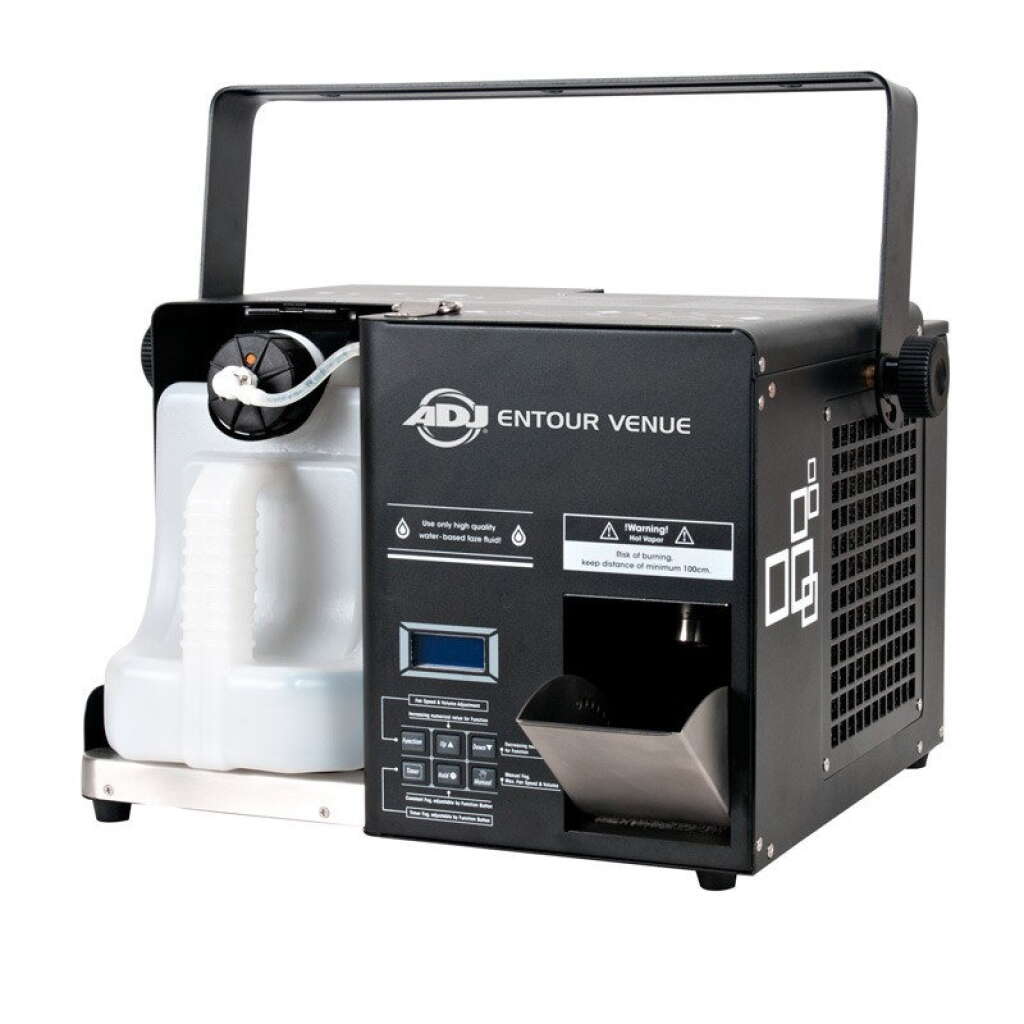
- Ice bin (chiller) machines: A standard fog generator fires through a chamber packed with regular ice cubes (or in some designs dry ice). Affordable and popular with wedding DJs. The trade-off is logistics: you need kilos of ice per performance and the effect weakens as the ice melts. Meltwater needs draining.
- Dry ice machines: The classic theatre effect: solid CO2 pellets dropped into heated water produce the thickest, whitest, lowest-lying fog of all, with no fluid consumables. But dry ice must be sourced fresh (it sublimates in storage), handled with insulated gloves to avoid cold burns, and the CO2 gas it releases displaces oxygen in low, unventilated spaces such as orchestra pits, basements and stairwells. That asphyxiation risk is real and must be in your risk assessment.
- CO2-chilled and refrigerated machines: Professional units chill standard fog with liquid CO2 from a cylinder, or with a built-in refrigeration compressor. Consistent output for as long as you feed them, at a professional price. The CO2 versions inherit the same ventilation cautions as dry ice. A separate family of ultrasonic units agitates plain water into a cold mist for small decorative effects; they are a table-top solution, not a stage one.
Common mistake
Pointing a normal smoke machine at the floor does not make low fog. Hot fog rises immediately, so you get an expensive way to fill the room from the bottom up. If you need the carpet effect, buy or hire a machine designed to chill the fog.
Fluids: Matching the Bottle to the Machine
Fluid is where cheap mistakes get made. The machine is a precision heater and pump calibrated for a particular fluid viscosity and chemistry; the wrong bottle clogs blocks, voids warranties and produces a worse effect.
Fog fluid: fast, medium and slow dissipating
Water-based fog fluids are graded by hang time. Fast-dissipating (high water content) fluid gives a punchy burst that clears quickly, ideal for CO2-jet-style hits and anywhere you need the air clear again fast. Slow or long-lasting fluid (higher glycol/glycerine content) produces denser fog that lingers, better for filling a space. Low fog machines generally want a dense, quick-clearing fluid so the carpet is thick but does not haunt the room once it rises; many manufacturers sell a dedicated low fog fluid.
Haze fluid: water-based vs oil-based
Haze fluids come in two chemistries and they are not interchangeable. Water-based haze fluid (glycol/glycerine in water) is the standard for heated hazers and most modern machines. Oil-based fluid (highly refined mineral oil) is used in specific cracking hazers designed for it; it hangs longest of all but leaves an oily film on fixtures, floors and truss over time, and some venues ban it for exactly that reason. Putting oil fluid through a water-based machine, or vice versa, is a fast way to wreck the pump and block. Use precisely the fluid type your manual specifies.
Common mistake
Topping up a half-full tank with a different brand of fluid. Formulations differ, and manufacturers advise against mixing fluids in the tank; residues from one fluid can react with or precipitate against another inside the heater block. If you are switching brand or type, run the tank down, then flush per the manual (typically with the manufacturer’s cleaning solution or distilled water where the manual allows) before filling with the new fluid. Never use tap water in any fog or haze machine; mineral scale kills heater blocks.
Buy fluid from a proper supplier with a safety data sheet available; you will need it for venue risk assessments. Our smoke and haze fluid range covers fog, haze and low fog grades from the major manufacturers.
The Specs That Actually Matter
Output rating
Fog output is usually quoted in cubic metres per minute (or cubic feet per minute) at full blast. Treat it as a comparative number between models rather than a lab-grade figure; there is no single enforced test standard and manufacturers measure optimistically. Wattage is the more honest proxy on foggers: more heater wattage means more vapour per burst and faster recovery. For hazers, look at fluid consumption per hour at a given output percentage and the quoted coverage; a machine sipping 40 to 100 ml per hour on low output will dress a small venue all night from a modest tank.
Tank size, warm-up and duty cycle
Small DJ foggers carry under a litre; installation and touring machines carry several litres. Match tank size to how long you run between chances to refill, and remember running a tank dry lets air into the pump and bakes residue into the block. Warm-up ranges from around a minute on small machines to several minutes on big blocks and pro hazers; plan it into your setup, because doors-open is a bad time to discover a ten-minute wait. Duty cycle is the sleeper spec on foggers: a budget machine may only manage short bursts before the thermostat pauses it to reheat, while continuous-duty machines and true hazers can run indefinitely at a set level. For a theatre show with a long smoke cue, duty cycle matters more than peak output.
Rough sizing by venue
- Mobile DJ / home / small hall: 400 to 900 W fogger, or a compact faze/haze machine if you run beam effects.
- Pub, club, school hall, church: 1000 to 1500 W fogger and/or an entry pro hazer with DMX.
- Theatre / mid venue: continuous-duty hazer sized for the auditorium volume, plus a fogger or low fog unit for specific cues.
- Large venue / outdoor: 2000 W plus foggers (wind destroys light effects fast outdoors) and high-output touring hazers.
Fire Alarms, Venues and the HSE: The Bit You Must Not Skip
Artificial fog and haze are engineered to look like smoke, and fire detection is engineered to find smoke. Optical (photoelectric) point detectors and aspirating systems such as VESDA respond to airborne particles; they cannot tell glycol vapour from combustion smoke. A single fog burst under a detector head, or an hour of haze slowly accumulating at ceiling level, can put a venue into full evacuation and, where the alarm is monitored, bring the fire and rescue service to the door. Heat detectors, by contrast, are not affected by fog or haze, which is why some venues have them fitted in performance spaces.
Venue procedure: before you press the button
1. Tell the venue in advance, in writing, that you intend to use smoke, haze or low fog. This is non-negotiable for every gig, wedding and school production.
2. Only the venue’s responsible person may isolate detection. Never silence, cover or disable a detector yourself. Venues with proper procedures can temporarily isolate specific detector zones on the fire panel, notify their alarm receiving centre, and put compensating measures (such as a fire watch by staff) in place for the duration, then restore the system afterwards. If the venue says the detection cannot be isolated, you do not use the effect. Full stop.
3. Know what heads are in the room. Optical and aspirating detectors will trigger; heat detectors will not. Sports halls, marquees and older buildings all vary. Ask, do not assume.
4. Follow HSE guidance. The Health and Safety Executive publishes entertainment-sector guidance on smoke and vapour effects. The consistent themes: risk-assess the effect, obtain and use the fluid manufacturer’s safety data, keep exposure to the minimum needed for the effect, ventilate between and after uses, and take extra care with CO2 and dry ice, which displace oxygen in low or enclosed areas. Glycol/glycerine fogs used as directed are widely used across the industry, but high concentrations can irritate eyes and the respiratory tract, so do not fog performers or audiences at point-blank range and consider asthmatic performers, children and long rehearsal exposures in your risk assessment.
Common mistake
Running a hazer “on low, so it will be fine” in a room with optical detectors that nobody isolated. Haze accumulates. The room can look barely dressed at head height while the concentration at the ceiling, where the detector lives, quietly climbs past its trigger threshold an hour into the event. The false alarm always happens mid-first-dance, never at soundcheck.
Timers, Remotes and DMX
Entry-level foggers ship with a wired remote: a button on a lead, sometimes with an interval/duration timer module so the machine fires automatically (for example a few seconds of output every couple of minutes). Wireless remotes are a cheap upgrade worth having when the machine lives behind the stage. Timers suit set-and-forget party use but have no idea what the room looks like, so keep an eye on density.
DMX control is the step up and standard on pro hazers and better foggers: typically one channel for pump/output level and, on fan-equipped hazers, a second for fan speed. That puts atmosphere on the same desk as your lights, so smoke hits land exactly on cue and haze density becomes a programmed state rather than guesswork. If your rig already runs from a console or software, a DMX-equipped machine plugs straight into the line alongside your fixtures; see our range of DMX controllers if you are building that control layer now. One caution: park the machine’s DMX channel at zero in your blackout and end-of-night states, because a snagged fader on a fog channel empties a tank into a sealed venue remarkably quickly.
Maintenance: The Ten-Minute Habit That Doubles Machine Life
Almost every dead fogger died the same way: fluid left in the block and lines between uses dries into a glycol residue that narrows and finally blocks the heater passage. The machine then spits, wheezes, and eventually produces nothing while the pump strains. Prevention is cheap and takes minutes.
- Flush per the manual before storage and roughly every 40 hours of use: run the manufacturer’s cleaner (or distilled water where the manual allows) through until the output runs clear, then purge.
- Never run the tank dry; air in the lines and baked residue in the block both shorten machine life.
- Empty the tank for transport and long storage; fluid degrades and leaks ruin flight cases.
- Store upright, capped, somewhere frost-free; freezing splits pumps and lines.
- Use only the specified fluid, from sealed bottles; keep the safety data sheet with your gig paperwork.
- Ice-bin low fog machines: drain meltwater after every use and dry the bin to stop corrosion and mould.
A partially blocked block sometimes responds to running dedicated cleaning fluid through a fully warmed machine in short bursts. A fully blocked one is a service job; on budget machines the economics rarely favour repair, which is another argument for the flush habit.
So Which Machine Should You Buy?
Choose a smoke machine if
- You want visible clouds and dramatic bursts on cue
- You are a mobile DJ or school on a tight budget
- The effect is momentary, not all-night atmosphere
- You need output outdoors, where haze blows away
Choose a hazer if
- You run moving heads, beams or lasers and want the beams visible
- You want subtle, even atmosphere the audience does not notice
- The machine will run for hours, not seconds
- You shoot video, where drifting fog clouds look terrible
Choose low fog if
- You want the dancing-on-clouds floor carpet
- You supply weddings, dance shows or theatre reveals
- You can handle the logistics: ice, dry ice or CO2 supply
- You have risk-assessed CO2 in pits and low areas
Plenty of working rigs carry two: a hazer running all show for the beams, and a fogger or low fog unit for the moments. If the budget only stretches to one and you own moving heads, buy the hazer first.
Popular picks from the shop
Frequently Asked Questions
What is the difference between a smoke machine and a hazer?
A smoke machine produces dense, visible clouds in bursts; the smoke itself is the effect. A hazer produces a fine, nearly invisible atmosphere that hangs in the air for hours and exists purely to make light beams visible. If your goal is beams from moving heads or lasers, you want a hazer, not a smoke machine.
Will a smoke machine set off fire alarms?
Very likely, yes. Optical smoke detectors and aspirating systems (such as VESDA) respond to airborne particles and cannot distinguish glycol fog or haze from real smoke. Heat detectors are unaffected. Always inform the venue in advance so their responsible person can isolate the relevant detector zones through the proper procedure with compensating measures in place. Never cover or disable a detector yourself, and if the venue cannot isolate detection, do not use the effect.
Is smoke machine fluid safe to breathe?
Water-based glycol/glycerine fluids from reputable manufacturers are widely used across the entertainment industry and are considered low hazard when used as directed. HSE entertainment guidance on smoke and vapour effects expects you to risk-assess the effect, use the fluid manufacturer’s safety data sheet, keep exposure to the minimum needed and ventilate the space. High concentrations can irritate eyes, throat and airways, so avoid fogging people at close range and think about asthmatic performers and long rehearsal exposures. CO2 and dry ice effects add an oxygen-displacement hazard in low or enclosed areas.
Can I use any fluid in my machine?
No. Use the fluid type the manufacturer specifies: fog fluid in foggers, water-based haze fluid in water-based hazers, oil-based fluid only in machines designed for it. Do not mix different brands or types in the tank; if you switch, run down and flush the machine first. Never use tap water, and never try home-brew fluid; both destroy heater blocks and the latter has no safety data behind it.
How do I get fog to stay on the floor?
Chill it. Fog sinks when it is colder than the room air, so you need a low fog machine: an ice-bin chiller, a dry ice machine, or a CO2/refrigerated pro unit. A standard fogger aimed at the floor will not work because the hot vapour rises straight away. The effect is temporary by nature; as the fog warms it lifts and disperses.
How much haze do I need for beam effects?
Less than you think. Start the hazer 20 to 30 minutes before doors on a low output with the fan spreading it, and top up little and often. The room should look clear to the eye while beams read crisply. If the audience can see haze drifting past them, back it off. Even, thin coverage beats occasional thick clouds every time, which is why hazers beat foggers for this job.
Why has my smoke machine stopped producing smoke?
The usual suspects, in order: it is mid-reheat (duty cycle pause; wait for the ready light), the tank is empty or the pickup tube is out of the fluid, or the heater block is partially clogged with dried fluid residue. Try dedicated cleaning fluid through a fully warmed machine in short bursts. If nothing passes at all, the block is blocked solid and it is a service job. Regular flushing before storage prevents nearly all of this.
Do I need DMX on a fog or haze machine?
For a mobile DJ with a wireless remote, no. For anyone running a lighting console or software, DMX is worth the small premium: fog cues fire exactly with the lighting state and haze density is repeatable night after night. Pro hazers are almost all DMX-controlled as standard, typically with separate channels for output and fan.
Shop this guide
UK stock of smoke, haze and low fog machines plus matched fluids, with fast delivery for venues, schools and production companies.
Smoke Machines Haze Machines Smoke & Haze Fluid Moving Head Lights


