


Home » Guides » Lighting & Effects »
Festoon and Outdoor Event Lighting: The UK Guide
How festoon systems actually work, what IP ratings mean in real weather, and how to power and rig outdoor lighting so it survives a British summer.
~12 min read · Updated July 2026 · By the Stage Supply team
In this guide: How festoon works · Choosing lamps · IP ratings decoded · Power planning · Rigging festoon · Uplighters outdoors · Design looks · Seasonal vs permanent · Common mistakes · FAQ
Festoon is the workhorse of outdoor event lighting: a run of lampholders moulded onto a tough cable, strung between poles, trees or buildings, with whatever lamps suit the look. It is also mains electricity outdoors, which means the difference between a professional install and a liability is mostly invisible: the cable grade, the IP ratings, the RCD, the strain relief. This guide covers the whole job, from choosing a harness to keeping it up all year, for wedding venues, event stylists, pubs with gardens and festival crews alike.
How Festoon Systems Work
A festoon harness is a continuous length of two-core cable with lampholders fitted at fixed intervals, terminated with a plug and socket so runs can be extended end to end. Professional harnesses come in two constructions. Flat “belt” festoon uses flat twin cable with lampholders welded onto the belt: the PCE festoon range we stock is UK-made on flat twin 2.5mm² Arctic-grade PVC (it stays flexible in the cold), finished with 16A plug and socket connectors ready to daisy-chain. Round rubber festoon, like the Elumen8 heavy-duty range, uses a rubber-sheathed cable that shrugs off repeated rigging and being dragged across a festival field. Both are a different animal from thin retail “party light” strings: the connectors, cable cross-section and lampholder sealing are what you are paying for.
BC or ES lampholders
UK festoon comes with either BC (B22 bayonet cap) or ES (E27 Edison screw) lampholders, and we stock both across the range. BC is the traditional UK fitting: push and twist, and the lamp cannot unscrew itself with vibration or wind movement. ES is the international standard and the fitting most decorative filament-style lamps are made for, so stylists chasing a specific lamp look often standardise on ES. Neither is better; pick one fitting and standardise across your stock so every lamp fits every harness.
Spacing and run length
Lampholder spacing sets the character of the run. Close spacing reads as a dense band of light; wide spacing reads as individual glowing points and covers distance far more economically. The harnesses we stock run from 0.3m spacing up to 3m, in lengths from 10m to 100m:
| Spacing | Lamps per 25m | The look | Typical use |
|---|---|---|---|
| 0.3m / 0.33m | 75+ | Dense, continuous band of light | Bar fronts, signage surrounds, stage and entrance dressing |
| 0.5m | 50 | Rich, full canopy feel | Canopy grids over courtyards, marquee interiors, dance floors |
| 1m | 25 | The classic festoon look | Swags between poles, garden perimeters, terraces, walkways |
| 3m | 8 | Sparse points of light | Long boundary runs, tree lines, festival site perimeters |
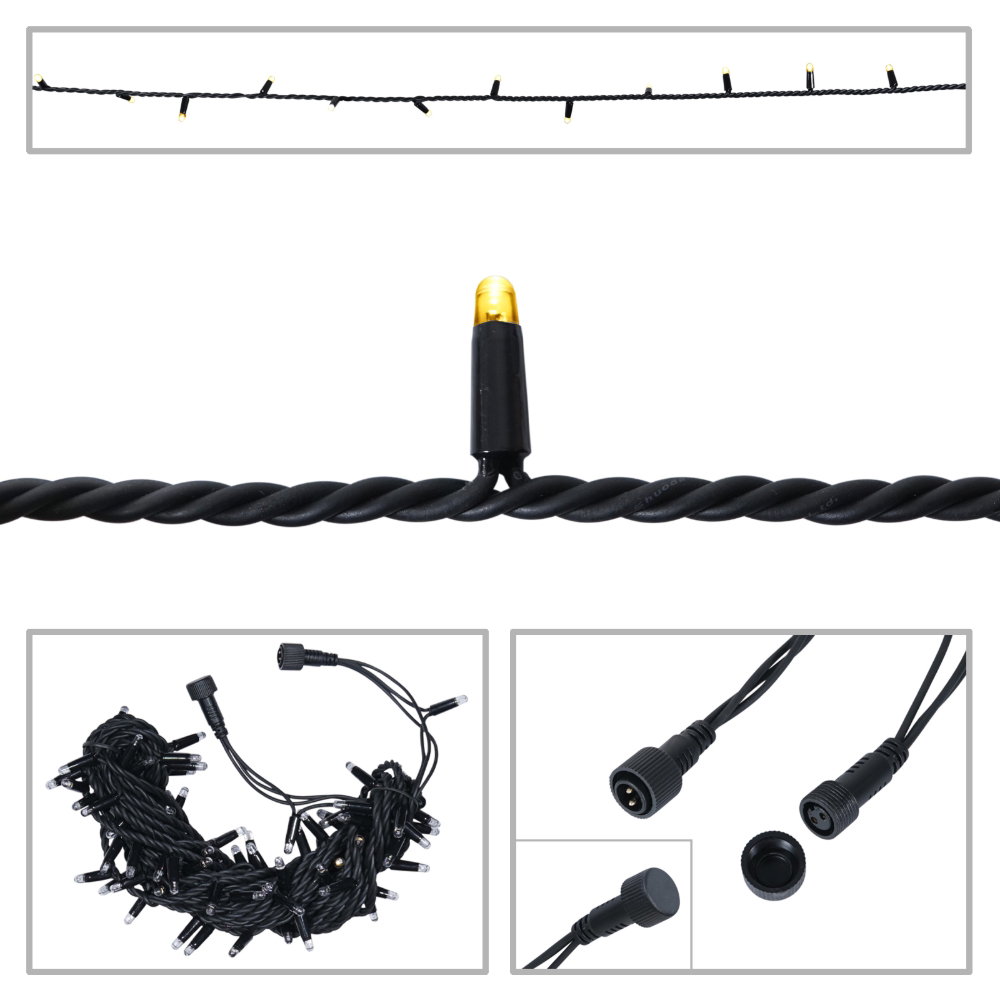
Because harnesses terminate in matching plug and socket connectors, runs extend in series from a single feed. How far you can chain depends on the connector rating, cable cross-section and total lamp load, so check the stated maximum load for the specific system rather than assuming; a 16A-connectored 2.5mm² harness loaded with 2W LED lamps will run a very long way, but the arithmetic changes completely if anyone ever fits incandescent lamps. Alongside continuous harnesses, single-drop festoon pendants (an IP44 E27 lampholder on a 0.25m to 3m rubber tail) hang individual statement lamps at different heights, and connectable LED string light sets with captive LEDs cover the plug-and-play end of the market.
Choosing Lamps
The harness is the infrastructure; the lamps are the look, and swapping them re-themes an entire venue in an afternoon. For outdoor event work, LED is now the only sensible choice: a fraction of the load per holder, no heat worth mentioning, and far better survival when a swag gets knocked. The main families:
- LED golf ball: small round lamps, the standard choice for close-spaced festoon where a big lamp would look crowded. Cheap to replace and available in warm white and colours.
- LED GLS: the traditional pear-shaped lamp silhouette. Reads well at 1m spacing and above, where each lamp is seen as an individual object.
- Filament-look LED: clear glass with visible LED filaments, usually in warm colour temperatures around 1800K to 2200K, in shapes from standard GLS to oversized globes such as the G125. This is the “Edison bulb” wedding and hospitality look, without the tungsten running cost or fragility.
Two specification traps. First, dimming: most cheap LED lamps are not dimmable, and putting them on a dimmer produces flicker, buzzing or early failure. If the level needs to drop as the evening goes on, buy lamps explicitly marked dimmable and pair them with a trailing-edge dimmer that states LED compatibility. Second, exposure: a bare lamp in an open festoon holder relies on its own construction and the holder’s sealing for weather protection, so check what the harness manufacturer specifies. Rubber lamp seals and cage-style lamp guards are cheap insurance, and guards earn their keep during rigging and de-rigging, when most lamp breakages actually happen.
IP Ratings Decoded
Every piece of outdoor electrical kit carries an IP (ingress protection) rating: two digits, the first for solids, the second for water. The second digit is the one that decides whether kit lives or dies outdoors, and the ratings you will actually meet on lighting and power kit are these:
| Rating | What it actually means | Outdoor verdict |
|---|---|---|
| IP20 | Protected against fingers; no water protection at all | Indoor only. Not for marquee edges “under cover” either |
| IP44 | Protected against solid objects over 1mm and water splashed from any direction | The practical minimum for outdoor use. Handles rain in normal orientation; does not handle standing water or jets |
| IP54 | Dust protected, splash protected | Fine for sheltered outdoor positions |
| IP65 | Dust tight, protected against water jets from any direction | Proper all-weather kit: driven rain, hose-down cleaning, fixtures sat on wet grass |
| IP67 | Dust tight, survives temporary immersion | Connectors and in-line joins that may end up in puddles |
Read the small print on where the rating applies. An IP44 festoon lampholder is IP44 with a lamp correctly fitted and any supplied seal in place; an empty holder is an open socket. A system is also only as protected as its weakest point, which is nearly always a connection: a moulded IP44 harness plugged into an indoor 13A extension reel lying on the lawn is an IP20 system. Anything left connected outdoors overnight should be rated for it, elevated off the ground, or both.
Power Planning
Start with arithmetic, not cable. Count the lampholders across every run and multiply by the lamp wattage: 100 holders of 2W filament-look LED is 200W, comfortably inside a single domestic circuit, where the same run in 25W incandescent golf balls would be 2.5kW. Then add everything else sharing the supply: the catering urn, the PA, the fridge behind the bar. Outdoor events fail on the kettle, not the lights.
RCD protection is not optional
Any socket or circuit feeding outdoor equipment must be protected by a 30mA RCD, and UK wiring regulations require it for outdoor use. If the supply comes from an older building where you cannot verify RCD protection at the board, use a plug-in RCD adaptor at the socket as a minimum. Test the RCD with its test button before the event, not during it. For anything beyond plugging into an existing protected socket, temporary event power is electrician territory.
Practical rules for getting power to the lights:
- Use IP-rated connectors for every outdoor join. 16A ceeform-style connectors, as fitted to professional festoon harnesses, are designed for exactly this job. Where a 13A connection is unavoidable outdoors, put it inside a purpose-made IP-rated weatherproof enclosure, never a plastic bag.
- Plan the cable route before rigging anything. Feeds should run at height with the festoon or along boundaries, not across walkways. Where a cable must cross ground people use, protect it with cable ramp matting; where vehicles cross, use rated ramps or reroute overhead.
- Keep drops off the ground. Connectors resting on grass sit in dew by 2am. Lift joins onto a fence post or up a pole with a drip loop, or use IP67-rated in-line protection.
- Respect the system’s maximum load. Series runs are limited by the connector rating and cable size of the first harness in the chain, which carries the current for everything downstream. Check the manufacturer’s stated maximum and total your actual lamp wattage against it.
On generator-fed festival and field sites the same discipline applies at larger scale: know your total load, keep lighting on its own RCD-protected ways, and size the set with headroom. Small portable generators need their earthing arrangement confirmed before RCDs will actually protect anyone, one of several reasons field power belongs with a competent supplier or electrician. Our stage power checklist covers load planning, distro and cable sizing in more depth.
Rigging Festoon
The single most important rule: the festoon cable is not the support. Electrical cable is not rated to carry structural load, and a run that survives a calm rig night comes down in the first squall. Professional installs hang festoon from a catenary wire: a galvanised or stainless steel wire rope tensioned between fixing points, with the festoon clipped or tied to it at intervals so the wire takes all the load and the cable just hangs.
- Fix to structure, not fittings: eye bolts into masonry or solid timber, purpose-made pole systems, or slings around tree limbs with chafe protection. Never gutters, downpipes, fascia boards or fence panels; none of them are structural, and a wind-loaded 25m run pulls far harder than people expect.
- Tension the wire, then dress the cable: set the catenary with a turnbuckle, leaving deliberate sag (a dead-straight wire multiplies the load on the end fixings), then attach the festoon with clips or ties that grip the jacket without crushing it.
- Strain-relieve every termination: where the festoon leaves the wire to drop to a socket, the mechanical load must land on a proper cable grip or the catenary itself, never on the connector or lampholder terminations.
- Form drip loops: at every connector and building entry, route the cable in a downward U before it rises to the connection, so rainwater drips off the bottom of the loop rather than tracking along the cable into the join.
- Mind the headroom: keep the lowest point of any swag, allowing for sag, lamp length and wind movement, comfortably above head height over pedestrian areas. Keep runs away from vehicle routes, or high enough that the tallest vehicle using the route cannot touch them; delivery lorries find low cables with depressing reliability.
Zip ties are not strain relief
Cable ties are for dressing cable to a catenary that carries the load. A zip tie taking the weight of a run bites through the sheath, becomes brittle in UV within months, and fails without warning. Anywhere load is carried, use rated wire rope, proper grips and tensioners.
Uplighters and Wash Fixtures Outdoors
Festoon gives you the canopy; uplighters and wash fixtures give you the drama. A handful of uplighters at the base of trees, along a stone wall or washing a marquee lining transforms a space festoon alone cannot, adding depth and colour behind the warm glow overhead.
For gardens and courtyards, battery uplighters with wireless DMX are the format that works: no cable runs across lawns, no trip hazards, and repositioning takes seconds when the ceremony area becomes the dance floor. The non-negotiable for outdoor use is the IP rating; standard IP20 event uplighters are indoor fixtures, full stop, while IP65-rated units sit happily on wet grass through drizzle and hose-down cleaning afterwards. Check the quoted battery runtime against your event length, remembering headline figures are usually measured on a single colour at reduced output, not full-brightness saturated colour all evening. Warm amber on trees and foliage flatters a wedding; saturated single colours suit branded and festival work. For how uplighters, battens and PARs compare, and how many fixtures a space needs, see our wash lighting guide.
Design Looks That Work
Straight runs
Festoon tensioned close to the catenary in clean, level lines. Reads modern and architectural; suits building frontages, bar runs, market stalls and anywhere the geometry of the space is the feature. Straight runs are also the most economical, covering the most distance per metre of harness.
Swagged runs
The classic look: generous dips between support points, usually at 1m lamp spacing. Swags read romantic and informal, which is why they dominate wedding work. Keep the swag depth consistent, and remember every swag lowers the minimum height, so plan the dip against your headroom, not just the fixing height.
Canopy grids
Parallel runs or a criss-cross grid over a courtyard, terrace or dance floor, typically at 0.5m spacing for density. A canopy puts a ceiling of light on the space, defining an outdoor room. It is also the most demanding rig: every run needs its own catenary, fixing points carry cumulative load, and feed planning matters because several runs usually share one supply.
Warm white or colour
Warm white festoon around 2200K to 2700K is the default for hospitality and weddings; it flatters skin, food and photographs. Colour belongs in two places: coloured or multicolour lamp sets for seasonal and festival looks, and colour from uplighters underneath a warm white canopy, which gives a themeable space without re-lamping hundreds of holders. Dimmable connectable LED string sets in single colours add accents around the warm white core with minimal effort.
Seasonal or Permanent?
Pubs and venues quickly discover that festoon rigged for one event earns its keep every week, and the question becomes whether to leave it up. Left up year-round, the enemies are UV and weather cycling: sunlight embrittles cheap cable sheaths and cable ties, water works into marginal joins, and winter wind tests every fixing that was “probably fine” in July. If the install is staying up, treat it as an installation: heavy-duty rubber harness, stainless or galvanised catenary hardware, UV-stable ties or purpose-made clips, IP-rated connections off the ground, and ideally a dedicated RCD-protected circuit rather than a trailing extension from the cellar. Then walk the run twice a year, checking fixings, ties, seals and any lamp with water inside it.
If the kit comes down between seasons, de-rig with care: coil harnesses in wide loops, remove or guard lamps before lowering runs, dry connectors before boxing, and store off concrete floors. Most “the festoon stopped working” calls in April are really “the festoon was stored damp in November”.
Common Mistakes
- Indoor festoon outside. Retail party-light strings and IP20 kit have no business in weather. One wet bank holiday writes off the kit and trips the venue’s power.
- Ignoring the system’s maximum load. Chaining harness after harness from one feed without totalling the lamp wattage against the connector and cable rating. Especially dangerous when someone later swaps LED lamps for incandescent.
- No RCD. Running outdoor lighting from an unprotected socket in an outbuilding. The RCD is the thing standing between a damaged cable and a casualty.
- No drip loops. Cable entering connectors from above turns every join into a funnel. Thirty seconds of dressing prevents it.
- Hanging from gutters and fascias. Not structural. Use eye bolts into structure, poles or a proper catenary.
- Zip ties as strain relief. Fine for dressing cable to a load-bearing wire, catastrophic as the load path.
- Tension on connectors. Letting the plug-socket join between harnesses hang mid-span carrying cable weight. Support the join to the catenary and give it a drip loop.
- Swags at head height. Design the low point of the swag, allowing for sag and wind, not the fixing height. Marquee entrances and photo spots attract raised arms.
Popular picks from the shop
FAQ
What spacing should I choose for festoon lighting?
1m spacing is the classic all-round look and the safe default for swags between poles and around gardens. Go tighter (0.5m or 0.3m) for dense canopy grids and bar dressing, and wider (3m) for long boundary runs where you want points of light over distance.
Is IP44 enough for outdoor festoon?
For a strung festoon run in normal orientation, IP44 handles British rain, which is why professional outdoor festoon lampholders are typically rated IP44 with lamps correctly fitted. Kit that sits on the ground, gets hosed down or stays out permanently is better at IP65. Whatever the rating on the holders, the connections are usually the weak point, so keep joins off the ground and use drip loops.
B22 or E27: which lamp fitting should I standardise on?
Both are stocked across UK festoon ranges. B22 bayonet resists vibration and wind loosening; E27 screw gives you the widest choice of decorative filament-look lamps. The real answer is consistency: pick one, standardise every harness and lamp box on it, and never carry adaptors up a ladder.
How many festoon harnesses can I run from one plug?
There is no universal number. The limit is the rated maximum load of the system (set by the first harness’s connectors and cable, which carry everything downstream) against the total wattage of your actual lamps. Check the manufacturer’s stated maximum and do the arithmetic; low-wattage LED lamps allow far longer chains than incandescent ever did.
Do I need an electrician for outdoor event lighting?
Plugging a made-up, load-checked festoon system into an existing RCD-protected outdoor socket is within a competent venue team’s reach. New circuits, generator supplies, distro for larger events, and anything you cannot confirm is RCD protected belong with a qualified electrician. Temporary event power in the UK is guided by BS 7671 and BS 7909, and larger events will be asked for evidence of a competent install.
Can festoon lighting be dimmed?
Yes, if every lamp on the run is a dimmable LED type and the dimmer is rated for LED loads (trailing-edge designs behave best). Non-dimmable LED lamps on a dimmer flicker and fail early. Connectable LED string sets are often sold as dimmable as a system; check the set’s own specification for the compatible dimmer type.
Can I leave festoon up all year?
Heavy-duty rubber festoon on a properly tensioned catenary with UV-stable fixings can stay up permanently, and for pubs and venues it usually should. Budget PVC party strings, standard cable ties and ground-level connections will not survive a winter. Inspect a permanent run every spring and autumn: fixings, ties, seals, and any lamp showing internal moisture.
What lights work with festoon for a wedding garden?
Warm white festoon overhead, battery IP65 uplighters in warm amber at the base of trees and walls, and a few festoon pendants at varied heights over key spots (the bar, the cake table, the entrance). Battery units with wireless DMX avoid every cable-across-the-lawn problem; our wash lighting guide covers choosing and counting them.
Shop this guide
UK stock and fast delivery on festoon, string lighting and outdoor event power.


