


Home » Guides » Power, Cabling & Connectors »
Event Power Distribution Explained: 13A, 16A, 32A, 63A and Powerlock
From the humble 13A plug to three phase Powerlock feeds, this guide walks through how temporary power gets from the supply to your rig, what the connector colours and pin counts mean, and where the legal lines sit for bands, venues, schools and event crews in the UK.
12 min read · Updated July 2026 · Stage Supply technical team
In this guide: 13A and BS 1363 · Ceeform connectors · Distro boxes · Three phase · Powerlock · BS 7909 · Generators · Cable size and voltage drop · Common mistakes · FAQ
Start at the wall: 13A and BS 1363
Every UK event starts, at some scale, with the familiar square pin plug. The BS 1363 plug and socket system is rated at 13A, which at 230V gives you roughly 3kW through a single plug. Uniquely, every BS 1363 plug carries its own fuse (up to 13A), which protects the flexible cable downstream of the plug rather than the appliance itself.
For a solo act, a duo, a school hall PA or a small band with a compact powered system, 13A is often completely fine. A typical modern powered PA with two tops, a sub and a small mixer rarely draws more than a few amps continuously; the big numbers printed on amplifier panels are peak figures, not steady draw. The practical questions are: how many sockets do you have, which circuit are they on, and what else is sharing that circuit?
Wall sockets in UK buildings usually sit on a ring final circuit protected at 32A, or a radial protected at 20A or 32A. That protection covers the whole circuit, so two double sockets on the same ring do not give you 4 x 13A of independent capacity. Kettles, urns and heaters in the same room are the classic way to trip a venue circuit mid set.
Where 13A stops being fine: larger lighting rigs (especially anything with lamps or high power LED wash fixtures in quantity), bigger PA systems, catering loads, or any situation where you are tempted to stack multi way strips into other multi way strips. That is the point to move up to proper distribution on BS EN 60309 connectors.
Ceeform connectors: BS EN 60309 at 16A, 32A, 63A and 125A
The round industrial connectors you see on stages, festival fields and building sites are made to BS EN 60309 (the British implementation of IEC 60309). The trade calls them ceeform or commando connectors. They are unfused, weather resistant, and keyed by colour and pin layout so you physically cannot plug a 230V lead into a 400V outlet.
The colour tells you the voltage band:
- Blue: 200 to 250V, which in the UK means 230V single phase. This is the standard colour for stage and event power at 16A and 32A.
- Red: 380 to 480V, which in the UK means 400V three phase. Common at 32A, 63A and 125A.
- Yellow: 100 to 130V, the 110V centre tapped supply used on construction sites. You will rarely see it on stages, but do not confuse it with blue.
The pin count tells you the rest. A blue single phase connector is 2P+E (line, neutral, earth). A red three phase connector is usually 3P+N+E (three lines, neutral, earth, five pins) for event work, though a four pin 3P+E version exists for motor loads without a neutral. The earth contact sits at a defined clock position for each voltage, which is part of what stops mismatched connections.
| Connector | Colour | Pins | Approx capacity | Typical event use |
|---|---|---|---|---|
| 13A BS 1363 | White or black | 3 flat | 3kW | Backline, small PA, local drops |
| 16A single phase | Blue | 2P+E | 3.6kW | Individual lighting bars, PA feeds, chain hoist control |
| 32A single phase | Blue | 2P+E | 7.3kW | Small stage feed, distro input, larger PA |
| 32A three phase | Red | 3P+N+E | 22kW | Mid size rig feed into a distro |
| 63A single phase | Blue | 2P+E | 14.5kW | Larger single phase feeds, catering |
| 63A three phase | Red | 3P+N+E | 43kW | Full production feed for lighting or audio |
| 125A three phase | Red | 3P+N+E | 86kW | Large stage or festival distribution |
Capacities above are the connector rating multiplied out at nominal voltage; what you can actually draw is set by the supply, the cable and the protective devices, not the plug on the end. If you are new to the connector landscape more broadly, our audio connectors guide covers the signal side of the same multicore world.
Distro boxes: turning one big feed into many usable outlets
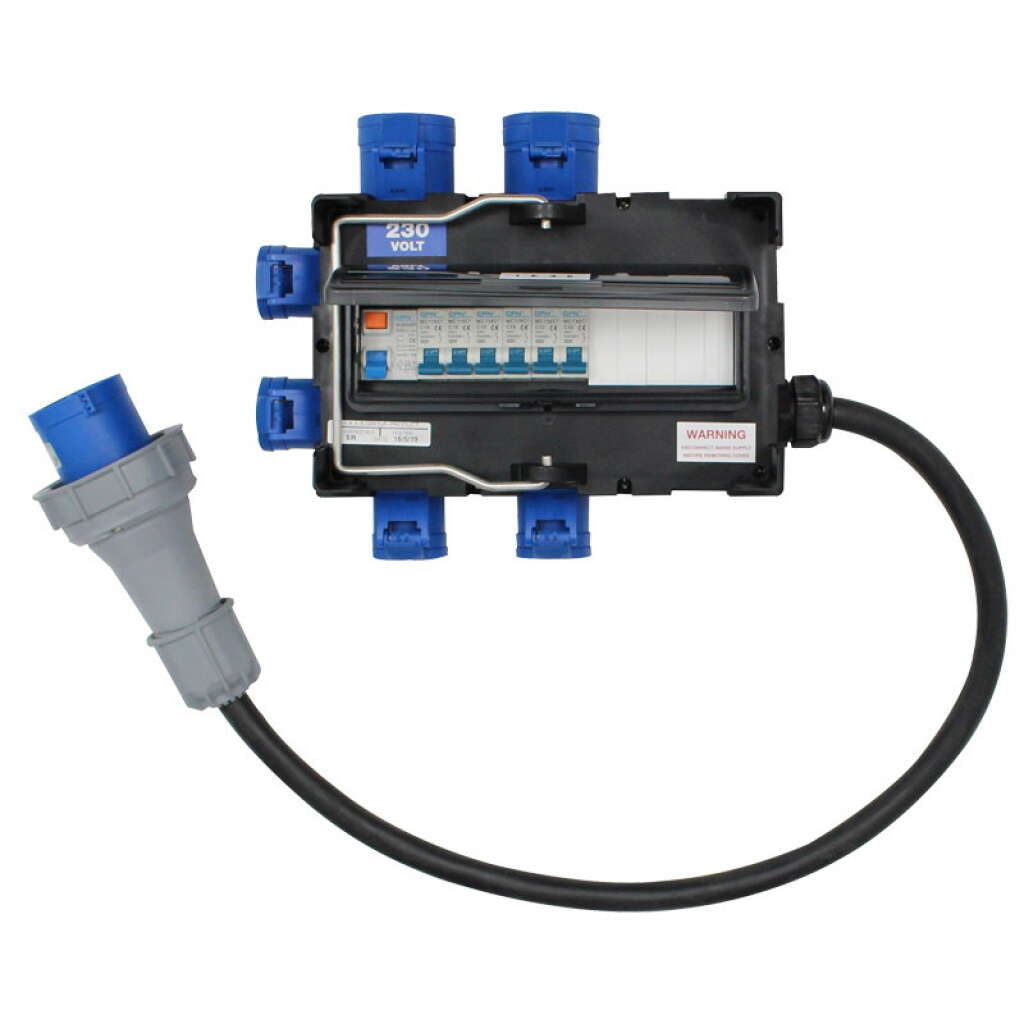
A distribution box (distro) takes a single larger supply, say 32A or 63A, and splits it into several smaller protected outlets. A good event distro does three jobs:
- Overcurrent protection: each outlet sits behind its own MCB (miniature circuit breaker) sized for that outlet, so a fault on one lighting bar trips one breaker rather than dropping the whole stage.
- Earth leakage protection: RCDs (residual current devices) disconnect the supply when current leaks to earth, typically through a person. BS 7671 requires 30mA additional RCD protection for socket outlets rated up to 32A in most situations, and for equipment used outdoors this is non negotiable. Many event distros use RCBOs, which combine the breaker and the RCD in one device per outlet, so one damp cable does not kill every circuit on the box.
- Connector conversion: a typical unit takes 63A single phase in and gives you a mix of 32A and 16A outlets, or takes 32A three phase in and breaks it out to six 16A single phase ways.
When you are choosing between distros in our power distribution range, look at the input connector (it must match what the venue or generator actually offers), whether the outlets are individually protected by RCBOs or share one RCD, and the IP rating if any of it will live outdoors.
Three phase basics, without the design course
A three phase supply delivers power on three separate live conductors, each a 230V supply relative to neutral, with 400V measured between any two phases. That is why a red 3P+N+E connector is marked 400V while everything you plug into the far end of the distro still sees a normal 230V single phase supply.
Three phase matters at events for a simple reason: capacity. A 63A three phase feed carries three times the power of a 63A single phase feed down one cable. Distros split the three phases out into groups of single phase outlets, usually labelled or colour grouped as L1, L2 and L3.
You will hear crews talk about phase balancing: spreading the load so each of the three phases carries a roughly similar current, rather than piling everything onto L1 and leaving L2 and L3 idle. A badly unbalanced system wastes capacity and can trip the supply breaker on one phase while the others sit nearly empty. Awareness is the goal here: know which outlets are on which phase, and know that the person designing the system should be thinking about balance. Actually designing and verifying a three phase temporary system is work for a competent person under BS 7671 and BS 7909, not a diagram from the internet.
Safety note
400V between phases is present inside every three phase distro, cable and connector. Never open, modify or “quickly fix” three phase equipment on site unless you are competent to do so and the system is proven dead. If a red connector or a distro looks damaged, take it out of service.
Powerlock and the single pole world
Above 125A, multi pin connectors give way to single pole systems, and Powerlock is the dominant format in UK events. Instead of one connector carrying everything, each conductor (earth, neutral, L1, L2, L3) gets its own heavy single pole connector on its own cable, colour coded (green/yellow, blue, brown, black, grey) and keyed so the earth and neutral cannot be swapped with a phase. Common ratings are 400A and above per line, which is festival main stage and touring production territory.
Two things are worth knowing at awareness level. First, sequence matters: earth is connected first and disconnected last, with neutral before phases, so the protective conductors are always in place while phases are live. Second, this is emphatically a competent person only zone. Powerlock feeds are terminated into supplies by electricians or experienced production power crew, tested, and documented. If your event has grown to the point where someone says the word Powerlock, it has also grown to the point where you hire power crew.
BS 7909: the standard that covers event power
BS 7909 is the British Standard code of practice for temporary electrical systems for entertainment and related purposes: concerts, theatre, festivals, film and TV, exhibitions and similar events. Where BS 7671 (the IET Wiring Regulations) covers electrical installations in general, BS 7909 deals with the specific reality of systems that are built, used and torn down again, often outdoors, often by touring crews.
The concepts worth knowing even if you never read the document:
- Someone must be responsible. BS 7909 expects a named competent person to take responsibility for the temporary electrical system. For larger or more complex systems this is the Senior Person Responsible (SPR), who plans the system, oversees its construction, and signs off completion documentation before it is energised for use.
- Small systems are treated proportionately. The standard recognises simple, small scale setups (the kind a band creates by plugging approved equipment into a venue supply) and applies lighter arrangements to them. Proportionate does not mean exempt: equipment still needs to be in good condition, suitable for the environment and RCD protected where required.
- Documentation and testing are part of the job. Bigger systems get earth fault loop and RCD testing plus a completion certificate before show power goes live, and the Health and Safety Executive points to BS 7909 as the relevant guidance for event power under the Electricity at Work Regulations 1989.
For a working band or a school, the practical takeaway is modest: keep your own equipment tested and in good order, use RCD protection, and when an event involves generators, three phase distribution or anything beyond plugging into house sockets, make sure someone competent has explicitly taken responsibility for the power. Our upcoming stage power checklist for bands turns this into a pre gig routine.
Generators vs house power
House power (the venue’s fixed installation) comes with an earthing system, tested circuits and known protection already in place; your job is mostly not to overload it and to add RCD protection where it is missing. Generators are different: a generator is a complete electrical island, and its earthing arrangement has to be deliberately established before it is safe, which may involve earth electrodes and always involves someone who knows what they are doing. Fuel, positioning, noise, and changeover between sets are additional headaches.
The awareness level rule: house power first where it exists and has capacity. If the event needs a generator, treat the generator and everything downstream of it as a BS 7909 system with a competent person responsible for it, not as a big petrol powered extension lead.
Cable size, length and voltage drop
Two things limit how much current a cable can carry and how far. The first is heat: current warms the conductor, and the cross sectional area (CSA) of the copper sets how much it can carry continuously without damage. The second is voltage drop: every metre of cable has resistance, so the voltage at the far end is lower than at the source, and the longer and thinner the cable, the worse it gets. BS 7671 recommends keeping the drop within about 5% for power (3% for lighting), because equipment at the end of a long thin run can misbehave or work hard and hot on low voltage.
The flexible rubber cable used for event power is H07RN-F, a tough 450/750V rated cable that handles abrasion, water and cold, which is why it fills our power cables range. As a rough orientation for single phase runs:
| CSA (per core) | Typical continuous rating (flexible, in air, unwound) | Typical use | Approx run before 5% drop at full load |
|---|---|---|---|
| 1.5mm² | 16A | 16A extensions, fixture links | ~25m at 16A |
| 2.5mm² | 25A | Heavier 16A runs, short 20A circuits | ~40m at 16A |
| 4mm² | 32A | 32A feeder cables | ~30m at 32A |
| 6mm² | 40A | Long 32A runs | ~50m at 32A |
| 10mm² | 60A | 63A feeders (short) | ~40m at 63A |
| 16mm² | 80A | 63A feeders (longer) | ~65m at 63A |
Treat the table as orientation, not design: real ratings depend on the cable construction, how it is run, ambient temperature and grouping, and a system of any size should be designed to BS 7671 by a competent person. The pattern to internalise is simple though: longer runs need fatter copper, and running a cable at its limit over a long distance is where problems start.
Cable drums: unwind them
A coiled cable cannot shed heat, so cable drums carry two ratings: one fully unwound and a much lower one wound, often around half. A drum run near its full rating while still coiled heats up layer upon layer and can melt its own insulation. If you are drawing serious current through a drum, unroll all of it, every time.
Common mistakes we see at small events
- Daisy chained 13A strips. Strip into strip into strip concentrates the whole load through one plug and one fuse, invites loose connections, and makes the total draw invisible. If you need that many outlets, you need a distro, not more strips.
- Coiled drums under load. Covered above; the most common overheating fault at small events, and the cheapest to avoid.
- Domestic adaptors and strips outdoors. BS 1363 accessories are not weatherproof. Outdoor connections should be IP rated ceeform or purpose made weatherproof 13A equipment, kept off wet ground.
- No RCD. Older venue circuits and direct generator outlets may have no 30mA protection at all. A plug in RCD or an RCD protected distro is cheap insurance; outdoors it is essential and expected under BS 7671 and BS 7909.
- Trusting the connector, not the supply. A 32A socket on a wall does not promise 32A of spare capacity; find out what else is on the circuit and what the breaker actually is.
- Running signal and power decisions separately. Power placement affects audio hum and rigging routes alike; plan them together, and see our truss and rigging basics guide for how power runs interact with flown rigs. For multicore lighting power on larger rigs, our upcoming Socapex guide covers the 19 pin world.
Popular picks from the shop
Elumen8 ISCHL Distro 63A In, 2 x 32A + 4 x 16A Out View product → Elumen8 ISCHL Distro 32A 3PH, 6 x 16A RCBO View product → Titanex H07RN-F 1.5mm 3 Core Rubber Cable 100m View product → Elumen8 H07RN-F 2.5mm 3 Core Rubber Cable 100m View product →
Frequently asked questions
What is the difference between 16A and 32A?
Both are blue 230V single phase ceeform connectors; the 32A version is physically larger and carries twice the current, roughly 7.3kW against 3.6kW. They are not interchangeable, but 32A to 16A adaptors (with appropriate downstream protection) and distros bridge between them. 16A is the workhorse for individual lighting and audio feeds; 32A is a small stage feed.
Can I plug a 16A lead into a 13A socket?
Not directly, but 13A to 16A adaptors are a standard piece of kit. The 13A plug’s fuse limits the whole chain to 13A, so you get the rugged connector format without the extra capacity. Going the other way (16A supply to 13A socket) needs an adaptor with its own fuse or breaker, since ceeform circuits are not fused at the plug.
Why is one ceeform blue and another red?
Colour is the voltage code in BS EN 60309: blue is 230V single phase, red is 400V three phase, yellow is 110V site supply. Pin positions differ too, so a blue plug will not enter a red socket.
Do I need an RCD for a gig in a village hall?
Modern installations should already have RCD protection on socket circuits, but many older halls do not. A plug in 30mA RCD adaptor or an RCD protected power strip costs little and protects your performers. Anything outdoors must be RCD protected.
What is a 63A distro?
A distribution box fed by a 63A supply (single or three phase) that splits the feed into protected smaller outlets, typically a mix of 32A and 16A ways, each behind its own breaker or RCBO. It is the standard way to turn one venue or generator feed into usable stage power.
Is Powerlock dangerous?
Used correctly by competent crew, single pole systems are a mature, safe standard for high current feeds. The risk sits in incorrect connection sequence, damaged connectors and unqualified people improvising, which is why Powerlock work is restricted to competent persons and covered by BS 7909 procedures and documentation.
Do I need a Senior Person Responsible for my band’s pub gig?
No. Plugging tested, well maintained equipment into a venue’s existing sockets is the kind of small, simple setup BS 7909 treats proportionately. The SPR role belongs to larger temporary systems: generator supplies, three phase distribution, festival builds. You are still responsible for your own equipment being safe.
How long can my power cable run be?
It depends on the current and the cable CSA. As a rough single phase guide at full load, 1.5mm² at 16A is good for around 25m before voltage drop bites, 2.5mm² stretches that to around 40m, and 32A runs want 4mm² or 6mm². Lightly loaded cables can run much further. When in doubt, go up a size.
Shop this guide
Everything above, from 16A extensions to three phase distros and H07RN-F by the drum, is in stock and ships from the UK.


