

Home » Guides » Power, Cabling & Connectors »
16A and 32A PDUs: Rack Power Strips vs Stage Distro, and Which You Need
What a rack PDU actually does, how a 16A or 32A inlet is shared between its sockets, which outlet type to pick, and why a portable distro box with RCBOs is a different tool from a rack power strip. Product selection only: no wiring.
~10 min read · Updated October 2026 · By the Stage Supply team
In this guide: The short answer · PDU or distro · 16A and 32A inlets · Outlet types · Overload vs RCD protection · Layout, metering, vertical PDUs · Stage distro boxes · Side by side · Which do you need · Popular picks · FAQ
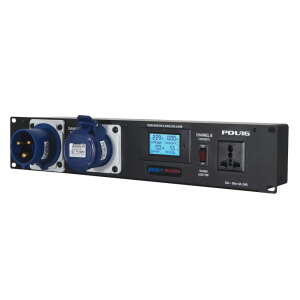
“PDU” gets used for two quite different things in this trade: a 19-inch rack strip that feeds the equipment in one rack, and a portable box that takes a 32A or 63A feed and splits it into protected 16A and 32A outlets for a stage. They look similar on a spec sheet and do different jobs.
This guide is about choosing between them. Connector basics, three-phase and BS 7909 are covered in our event power distribution guide, so they are not repeated here.
The short answer
- Powering the kit inside one rack (amps, a mixer rack, a DJ or playback rack): you want a rack PDU. Choose it by inlet (13A plug, 16A or 32A CEEform), by outlet type to match your equipment leads, and by whether you want metering.
- Feeding several racks, dimmers, fixtures or backline positions around a stage or site: you want a distro box with RCD protection on the outlets, sized to the supply you will be given.
- A 32A rack PDU is not a 32A socket strip. The Penn Elcom 32A models covered here split a 32A feed into two 16A circuits, typically eight sockets sharing 16A plus a 16A loop-through or a second bank.
- Rack PDU breakers protect against overload, not electric shock. Penn Elcom says so plainly in its own documentation. Shock protection (a 30mA RCD or RCBO) has to be provided upstream, usually by a distro or the venue supply, as specified by whoever designs the system.
Before you buy: design, installation and testing of electrical systems, including temporary event power, is work for a competent person. This guide helps you choose products to discuss with them. It is not wiring advice.
What a PDU is, and what a distro is
A power distribution unit takes one supply and presents it as several outlets. Everything else is detail, but the detail matters.
Rack PDUs
A rack PDU bolts into a 19-inch rack (1U or 2U horizontally, or full height on the rear rails) and feeds the equipment in that rack. It lives indoors, in a dry case. Penn Elcom’s user guides for both its PDU16 series and the PDU16-10DJ state that the units are intended for indoor use only and should not be installed where excessive moisture or heat is present. Its protection is a thermal overload breaker.
Distro boxes
A stage distro is a free-standing, splash-resistant box that sits on the floor at the end of a feeder cable. The PCE-built IMST, ISCHL and MERZ boxes covered in this guide (sold under the PCE and Elumen8 names) are described as IP44 rated, with polyamide or thermoplastic housings, and their outputs are protected by 30mA RCBOs or an RCBO plus MCBs. They take 32A or 63A single-phase or three-phase inputs.
In practice the two work together: the distro protects and divides the supply on the stage, and each rack PDU divides one of its 16A or 32A outputs among the equipment in a rack.
16A and 32A inlets: how the current is shared
The inlet tells you what supply the PDU expects. The breaker layout tells you how much you can actually draw from its sockets. They are not the same number.
| Inlet | Example we stock | How the current is divided (manufacturer data) |
|---|---|---|
| 13A UK plug (on a C20 lead) | Penn Elcom PDU16-10DJ-UK | 10 switched IEC C13 outlets behind a 16A trip, but Penn Elcom marks the supplied UK lead as limited to 13A maximum load and specifies a blue 16A C-Form lead for 16A use. |
| 16A CEEform (blue) | Penn Elcom PDU16-UK | 16A C-Form inlet; 8 UK sockets with a maximum combined load of 16A on their own 16A trip, plus a 16A C-Form loop-through on a separate 16A trip. Both share the one 16A feed. |
| 32A CEEform | Penn Elcom PDU16-UN32 | 32A C-Form inlet; 8 universal sockets with a maximum combined load of 16A on a 16A breaker, plus a breaker-protected 16A C-Form outlet to feed another rack. |
| 32A CEEform, two banks | Penn Elcom PDU32-CTR1 | 32A C-Form input split into two channels, each 16A across four powerCON TRUE1 outputs on its own 16A thermal breaker, with an LCD power monitor. |
Two practical consequences follow.
- A 16A PDU on a 13A plug is a 13A PDU. The plug and the wall socket set the limit, not the breaker on the front panel.
- A 32A PDU does not put 32A through its socket bank. On the PDU16-UN32 and its UK-socket sibling, the PDU16-UK32, the eight sockets share 16A and the other 16A is available at the C-Form outlet. If you need all eight outlets on one 16A circuit and a second rack on the other, that layout suits. If you need more than 16A on the sockets themselves, you need two PDUs or two circuits.
Blue 16A and 32A CEEform connectors and the cables that feed them are explained in the event power guide. If your venue is on 15A round pin, see 15A round pin and socket inserts; if you feed racks from a drum, check the cable drum ratings first, because a coiled drum carries less current than the same cable laid out.
Outlet types: UK 13A, IEC, Schuko, universal or powerCON
Pick the outlet that matches the mains leads on the equipment going into the rack, so nothing needs adaptors.
| Outlet | Rating (manufacturer data) | Good for | Watch out for |
|---|---|---|---|
| UK 13A (BS 1363) | Plugs fused to suit the equipment | Mixed UK kit with moulded plugs; quick swaps | Bulky plugs use rack depth; the eight-socket models still share 16A |
| IEC C13 | 10A per outlet (Penn Elcom PDU16-10DJ declaration; Schurter connector data) | Amps, processors, computers with IEC inlets; neat, short leads | Leads can pull out unless retained |
| IEC C19 | 16A (Schurter connector data) | Larger amplifiers and servers with C20 inlets | Not interchangeable with C13 |
| Schuko (CEE 7) | Per PDU rating; see PDU16-EU | European touring kit and EU-plugged equipment | Not for UK 13A plugs |
| Universal | Accepts UK, US, European and Australian plugs (Penn Elcom) | International touring racks | Penn Elcom notes the earth pin of a Euro Schuko plug has no connection in its universal socket |
| powerCON (blue / grey) | 20A, 250V for the original NAC3FCA / NAC3FCB; 16A, 250V (EN 60320-1) for the current powerCON XX parts (Neutrik) | Locking leads on touring racks | Neutrik’s older NAC3FCA / NAC3FCB cable connectors have no breaking capacity and must not be connected or disconnected live or under load; its newer powerCON XX cable connectors allow hot plugging only when mated with the matching XX chassis sockets (NAC3MPXXA / NAC3MPXXB). Check which leads and sockets you have |
| powerCON TRUE1 TOP | 16A 250V (EN 60320-1), with breaking capacity; IP65 when mated, with Neutrik’s sealing accessory on the chassis socket (Neutrik) | Locking leads that can be connected or disconnected under load | A separate family from blue / grey powerCON, so check your leads are TRUE1 |
For lighting fixtures and powered speakers with powerCON or TRUE1 inlets, a powerCON PDU such as the Penn Elcom PDU16-PC (eight powerCON outlets sharing 16A, 16A C-Form loop-through) or the TRUE1 PDU32-CTR1 removes a layer of adaptors. More on the connectors themselves in our pro audio connectors guide.
Overload protection is not RCD protection
This is the point most buyers miss. Penn Elcom’s datasheet for the PDU16-10DJ describes its trip switches as thermal circuit breakers that “are not an RCD and do not function in the same way”, and explains that an RCD protects people from electric shock while a circuit breaker protects the wiring and the equipment attached. It also notes the breakers are designed to ride through normal peaks in current and trip if an overload is continuous.
Distro boxes are where the personal protection normally sits. The examples we stock show the patterns you will see:
- An RCBO on every outlet. The Elumen8 ISCHL 32A three-phase box gives six 16A single-phase sockets, each with its own 16A 30mA RCBO, plus a 32A three-phase pass-through. The Elumen8 IMST 6 x 13A does the same for UK sockets with a 10A 30mA RCBO per socket. One fault trips one outlet, not the whole stage.
- One RCBO for the box, MCBs per outlet. The Elumen8 IMST 32A single-phase box (one 32A and four 16A outlets) has a Type A 32A 30mA RCBO covering all outputs and a 16A MCB on each 16A socket. Simpler and lighter, but an earth fault anywhere drops the lot.
- Pairs of outlets sharing an RCBO. The PCE ISCHL 63A three-phase box protects each of its three 32A sockets with a 30mA RCBO and its six 16A sockets in pairs, each pair on one RCBO.
Which arrangement, and whether a time-delayed or adjustable device is needed upstream for discrimination, is a decision for whoever designs the system. The useful buying question is simply: where is the 30mA protection for every final circuit, and how much goes off when one trips?
Rack layout, metering, switching and vertical PDUs
1U or 2U, front or rear
1U strips usually face their sockets forwards or backwards: Penn Elcom makes the same eight-way Schuko strip with front-facing sockets or with rear-facing sockets and an on/off switch (PDU-EU-8 and PDU-EU-8SWR). Rear sockets keep leads out of sight; front sockets suit kit that is swapped often. The 2U PDU16 range puts the inlet, breakers and display on the front, and Penn Elcom’s PDU16 user guide shows one of the eight outlets on the front panel and seven on the back, which is handy for a laptop or test lamp.
Metering
The 2U PDU16 and PDU32 units covered here carry an LCD power monitor (the 1U PDU16-10DJ does not). Penn Elcom lists voltage, current, active power and energy, plus a settable over-power alarm that flashes the backlight. On the 16A models the meter reads the eight-socket channel only, not the loop-through, so it tells you how close that bank is to its 16A trip. In a busy amp rack that is the difference between knowing and guessing.
Switched outlets
The PDU16-10DJ-UK gives each of its ten C13 outlets its own illuminated rocker switch. Penn Elcom also advises having connected equipment switched off before switching the PDU on, because inrush current can trip the protection, so a switched PDU makes a sensible power-up order easy.
Vertical PDUs
Tall install racks and enclosures often take a vertical strip on the rear rails, which uses no rack units. Penn Elcom describes its PDU20-UK as 20 UK sockets in two banks of ten, each bank on its own 8A trip, with a 16A C-Form connector and a unit length of about 1.3m. Check your enclosure has room down the back before ordering.
Where the PDU sits relative to heat and cable runs is covered in building a rack.
Stage distro boxes: single-phase, three-phase and Socapex
Distro boxes are chosen by their input, which is decided by the supply you will be given, and then by the mix of outlets you need.
- 32A single-phase in. The usual answer for a small stage fed from a 32A socket: the IMST 32A box above gives a 32A and four 16A outlets.
- 32A three-phase in. Spreads load across three phases from a small generator or a 32A five-pin socket. The ISCHL 32A three-phase box gives six 16A single-phase outlets and a pass-through to the next box.
- 63A three-phase in. The Elumen8 MERZ 63A in/thru box takes a 63A five-pin feed, protects it with a four-pole MCB, and gives one 32A three-phase, three 32A single-phase and six 16A outlets, all RCBO-protected, plus a 63A pass-through for daisy-chaining further boxes.
- Socapex. For lighting bars, a MERZ 63A three-phase to Socapex box feeds three 19-pin Socapex outputs, each with six 16A 30mA RCBOs, one per circuit. How Socapex multicores and breakouts work is in Socapex explained.
Three-phase boxes need a competent person to plan phase balance and supply capacity. That is a design job, not a product choice.
Rack PDU vs distro box, side by side
| Rack PDU | Stage distro box | |
|---|---|---|
| Where it lives | Inside a 19-inch rack or case, indoors | On the floor or a stage, at the end of a feeder |
| Typical input | 13A plug, 16A or 32A CEEform | 32A or 63A, single- or three-phase |
| Outlets | UK, IEC, Schuko, universal, powerCON | 16A and 32A CEEform, 13A, Socapex, three-phase |
| Protection on the examples in this guide | Thermal overload breakers | 30mA RCBOs, or an RCBO plus MCBs |
| Weather | Indoor use only (Penn Elcom) | IP44 splash-proof housings (PCE / Elumen8) |
| Metering | LCD power monitor on the 2U PDU16 / PDU32 models above | Not listed on the boxes above |
| Feeds | The equipment in one rack | Racks, dimmers, fixtures, backline, other distros |
Which do you need?
A DJ, playback or small mixer rack
A 1U or 2U PDU on a 13A plug or 16A CEEform, with outlets matching your leads. If the rack goes out to venues with unknown power, make sure it is fed from an RCD-protected supply, such as a protected socket or an RCBO-protected distro outlet, and do not assume one is there. The stage power checklist for bands covers the small-gig side.
An amplifier rack
List the amplifiers’ rated mains draw from their manuals and give it to whoever is planning the power. That figure decides whether one 16A bank is enough or whether a 32A PDU with two 16A banks suits better. Ask your electrician whether the feeding circuit has the RCD protection the system design needs.
A touring or international rack
Universal or powerCON outlets avoid adaptor bags, and a 16A or 32A CEEform inlet works in most of Europe. Remember the universal-socket earth note above for Schuko-plugged equipment.
A stage, marquee or outdoor event
A distro box sized to the supply you will be given, then rack PDUs downstream where racks need them. Everything that goes out on hire or site should be on a test regime: see PAT testing for event equipment.
A lighting rig on bars
A three-phase distro with Socapex or 16A outputs, followed by breakouts or fixtures. Rack PDUs are the wrong tool here.
Popular picks from the shop
Elumen8 ISCHL 32A Three-Phase Distro, 6 x 16A RCBOView product → Elumen8 IMST 32A Distro, 1 x 32A + 4 x 16AView product → Penn Elcom PDU16-UK 2U 16A Rack PDU, 8 x UK, MeteredView product → Penn Elcom PDU16-UN32 2U 32A Rack PDU, Universal SocketsView product → Penn Elcom PDU16-PC 2U 16A Rack PDU, 8 x powerCONView product → Penn Elcom PDU32-CTR1 2U 32A Two-Channel PDU, powerCON TRUE1View product → PCE ISCHL 63A Three-Phase Distro, 3 x 32A + 6 x 16AView product → Penn Elcom PDU16-10DJ-UK 1U 10-Way Switched PDUView product →
Frequently asked questions
What is the difference between a 16A and a 32A PDU?
The inlet. A 16A PDU takes a blue 16A CEEform feed; a 32A PDU takes a 32A one. On the Penn Elcom 32A models covered here, that 32A is split into two 16A circuits, so the eight-socket bank still has a combined limit of 16A.
Can I plug a 16A rack PDU into a 13A socket?
Only with a lead designed for it, and then the whole PDU is limited to 13A. Penn Elcom marks the UK lead supplied with its PDU16-10DJ as limited to 13A maximum load.
Does a rack PDU have RCD protection?
None of the Penn Elcom rack PDUs covered here lists RCD protection. Their breakers protect against overload, and Penn Elcom states in its PDU16-10DJ datasheet that its trip switches are not an RCD. Shock protection has to be provided upstream, usually by a distro with 30mA RCBOs or the venue supply, as decided by a competent person.
What is a powerCON PDU?
A rack PDU whose outlets are Neutrik powerCON or powerCON TRUE1 locking connectors, for fixtures and powered speakers with matching inlets. Older blue / grey powerCON leads must not be connected or disconnected under load; TRUE1 has breaking capacity.
What is a distro?
A portable distribution box that takes one larger supply, such as 32A or 63A single- or three-phase, and splits it into protected 16A, 32A, 13A or Socapex outlets for a stage or site.
Do I need a vertical PDU?
Only if your rack or enclosure has rear vertical space and you need a lot of outlets without using rack units. For touring cases a 1U or 2U horizontal PDU is the usual choice.
Shop this guide
Rack PDUs, distro boxes and the connectors to feed them. Tell us what is going in the rack and the supply you have, and we will help pick the product.
Power Distribution 16A Commando Plugs & Sockets 32A Commando Plugs & Sockets powerCON Connectors Socapex Connectors 19 Inch Racks & Accessories



