

Home » Guides » Wireless Mics & In-Ear Monitoring »
Radio Mic and IEM Batteries: Alkaline, Lithium, NiMH or Rechargeable Packs?
What Shure, Sennheiser and Audio-Technica actually say about powering the transmitters and in-ear bodypacks we sell: which AA chemistries they allow, which rechargeable pack and charger goes with which system, the runtimes they publish, and why the battery meter can mislead you if the chemistry is wrong.
~11 min read · Updated October 2026 · By the Stage Supply team
In this guide: The short answer · System by system · Shure · Sennheiser · Audio-Technica · Alkaline, lithium or NiMH AAs · Bulk AA batteries · Charging, storage and disposal · Popular picks · FAQ
The short answer
If your system has its own rechargeable pack, use it. Wherever Shure and Sennheiser publish both figures, the pack outlasts alkaline AAs, and Shure’s packs report remaining time in hours and minutes. If you are running on AAs, use what the manufacturer lists for that transmitter, tell the transmitter which chemistry is fitted where it has a battery-type menu, and never mix old and new cells.
- Shure SLX-D, QLX-D and ULX-D: alkaline, NiMH or lithium AAs are all allowed, but set the AA battery type in the transmitter menu so the runtime display is accurate. Shure rechargeable packs (SB903 or SB900 series) need no setting.
- Sennheiser EW-D and EW-DX: 1.5 V alkaline AAs or the BA 70 pack. Sennheiser advises against NiMH AAs because two 1.2 V cells give too little voltage and the transmitter will soon show low battery and shut down.
- Audio-Technica 2000 Series and 3000 Digital: alkaline or NiMH AAs, and both series can recharge NiMH cells in the transmitter on an A-T charging station.
- Shure GLX-D+: rechargeable SB904 only.
Choosing the system itself is covered in our wireless microphone buying guide and in-ear monitor systems guide. This guide is only about what goes in the battery compartment.
System by system: battery, charger and published runtime
Runtimes are the manufacturer’s own figures, under the manufacturer’s own test conditions. Real shows vary with RF power, volume (for IEMs), temperature, and the age and brand of the battery. Where a system has no rechargeable pack, the charger column says so.
| System | Power | Charger | Manufacturer’s runtime |
|---|---|---|---|
| Shure SLX-D (SLXD1, SLXD2) | 2 x AA or SB903 | SBC10-903 (single, USB) or SBC203 (two bays, takes batteries or transmitters) | Up to 8 h on 2 AA; over 8 h on a fully charged SB903 |
| Shure QLX-D (QLXD1, QLXD2) | 2 x AA or SB900C | SBC10-100, SBC200, SBC800, SBC220 | Over 11 h on SB900C; 8 h on alkaline (user guide, 470 to 865 MHz). Shure's product page says up to 10 h rechargeable, 9 h AA |
| Shure ULX-D (ULXD1, ULXD2) | 2 x AA or SB900C | As QLX-D | Over 11 h on SB900C; 9 h on alkaline (spec sheet, at 10 mW). Shure’s battery chart gives over 11 h 30 min and over 8 h (1/10 mW, 470 to 810 MHz) |
| Shure PSM 300 P3RA | 2 x AA or SB900C | As QLX-D | 5 h 30 min on AA; 8 h 10 min on SB900C |
| Shure PSM 900 P9RA+ | 2 x AA or SB900-series | As QLX-D | 6 h on alkaline, 8 h on SB900B (volume level 4) |
| Shure BLX (BLX1, BLX2) | 2 x AA | No Shure pack | Up to 14 h on alkaline |
| Shure GLX-D+ (e.g. GLXD16+) | SB904 only | Receiver charging bay, USB-C on the transmitter, or SBC10-904 | Up to 12 h |
| Sennheiser EW-D (EW-D SK, SKM-S) | 2 x 1.5 V alkaline AA or BA 70 | L 70 USB (two slots) | Up to 8 h on AA; up to 12 h on BA 70 |
| Sennheiser EW-DX (EW-DX SK, SKM) | 2 x AA or BA 70 | L 70 USB, or CHG 70N-C (charges the transmitter in the bay) | Up to 12 h on BA 70 |
| Sennheiser ew G4 (SKM 100 G4, SK 100 G4) | 2 x AA or BA 2015 | L 2015 (LA 2 adapter for handhelds) | Typically 8 h |
| Sennheiser EK IEM G4 | 2 x AA or BA 2015 | L 2015 | Approx. 4 to 6 h, depending on volume |
| Sennheiser XS Wireless (SK-XSW, SKM-XSW) | 2 x AA | No Sennheiser pack | Approx. 10 h |
| Sennheiser XSW IEM EK | 2 x AA primary cells or rechargeable batteries | No Sennheiser pack | Approx. 6 h, depending on volume |
| Audio-Technica 2000 Series (ATW-T210c, ATW-T220c) | 2 x AA alkaline or NiMH | ATW-CHG2a (charges NiMH in the transmitter) | 7 h high power, 9 h low power (alkaline) |
| Audio-Technica 3000 Digital (ATW-DT3101, DT3102) | 2 x AA alkaline or NiMH | ATW-CHG3 or ATW-CHG3N | Approx. 6 h alkaline; 7 h (1900 mAh NiMH) or 9 h (2500 mAh NiMH), all on High |
| Audio-Technica System 10 (ATW-T1001, T1002) | 2 x AA (alkaline recommended) | No A-T pack | Over 7 h on alkaline |
Shure: what the user guides say
SLX-D: SB903 or AAs
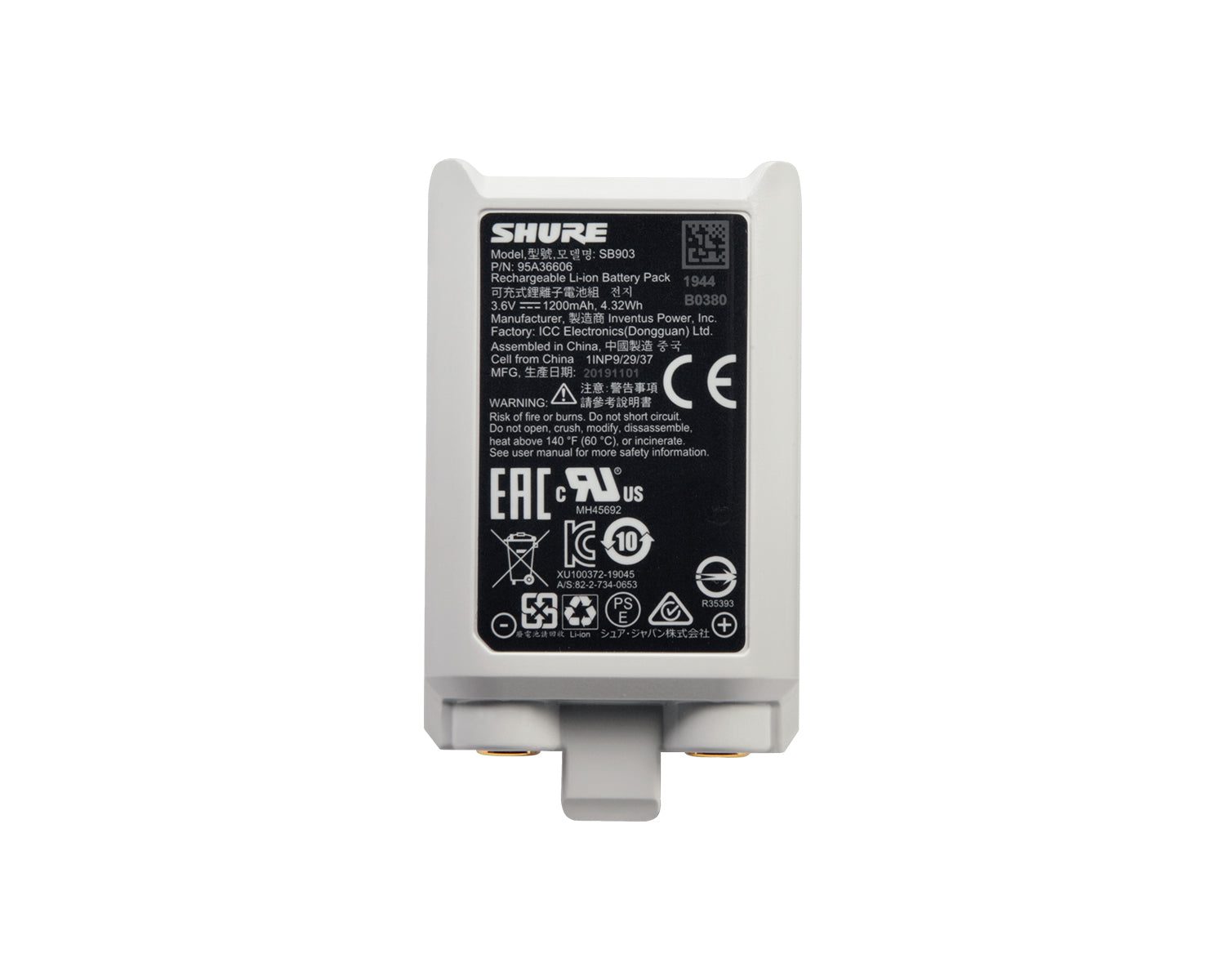
SLX-D transmitters take a Shure SB903 lithium-ion pack or two AAs, and Shure is specific: to avoid damaging the transmitter, use only the SB903 or 1.5 V AA batteries. The battery menu offers Alkaline (the default), NiMH and Lithium, the last listed as non-rechargeable, 1.5 V max. Shure says to set it to match the fitted AAs to ensure accurate display of runtime. With an SB903 fitted, the menu disappears because the pack reports its own state.
Charge the SB903 in the SBC10-903, which runs from a mains adapter or a USB port, or the SBC203, which takes two batteries or two transmitters with batteries inside. Shure says a new SB903 must be fully charged before first use, and that first charge must be done with the battery directly in the charger; after that it can be charged in the transmitter in the SBC203. Shure’s tables give more than 8 hours from a full charge, which takes 5 hours 30 minutes in the SBC10-903 and 2 hours 30 minutes in the SBC203. Note that SLX-D takes the SB903, not the SB900-series packs used by QLX-D and ULX-D. If you are weighing SLX-D against the newer model, see SLX-D vs SLX-D+.
QLX-D, ULX-D, PSM 300 P3RA and PSM 900: the SB900 family
These share one battery family. Shure describes the SB900C as compatible with Axient Digital, ULX-D and QLX-D, plus PSM 300, PSM 900 and PSM 1000, and lists the SBC10-100, SBC200, SBC210, SBC220, SBC800 and SBRC as its chargers. Shure says SB900-series packs charge to 50% in one hour and fully within three hours.
- Single: the SBC10-100 takes one battery and runs from its mains adapter or a USB port.
- Two bays, docking: the SBC200 takes two transmitters, bodypacks or loose batteries. Shure lists P9RA, P10R, ULXD1, ULXD2, QLXD1, QLXD2, P3RA, AD1 and AD2, and up to four SBC200s can share one power supply.
- Eight bays: the SBC800 holds eight loose SB900-series batteries and is designed to fit a rack drawer.
- Networked: the SBC220 lets you see battery information remotely. Shure warns not to insert transmitters that are running on AA batteries, and recommends keeping SBC220/240 firmware up to date for SB900C performance.
On AAs, QLX-D offers AL (alkaline), nH (NiMH) and Li (lithium primary) in the battery menu, and ULX-D has the same setting under UTILITY > BATTERY > SET.AA.TYPE. Use the supplied AA adapter in the battery bay when running on AAs. With a Shure pack fitted, ULX-D shows remaining time in hours and minutes, which Shure says is accurate to within 15 minutes, plus battery health, charge cycles and temperature.
For in-ears, Shure’s published runtimes depend on volume and earphones. The P3RA gives 5 hours 30 minutes on AAs and 8 hours 10 minutes on an SB900C in Shure’s test, and the P9RA+ table gives 6 hours on alkaline against 8 hours on an SB900B at volume level 4, falling to 3 hours 15 minutes and 6 hours at level 8. Turning the mix up costs battery. How the two PSM systems compare is in PSM 300 vs PSM 900.
BLX and GLX-D+
BLX (BLX1 and BLX2) has no Shure pack and runs on two AAs, which Shure rates at up to 14 hours on alkaline. Note the warning LED: Shure says the solid red low-battery light, meaning roughly an hour left, applies to alkaline batteries only. With rechargeable AAs, solid red means the batteries are already flat.
GLX-D+ is the opposite: it takes only the SB904 lithium-ion pack. Charge it in a GLX-D+ receiver’s charging bay, through the USB-C port on the transmitter, or in the SBC10-904 single charger. Shure quotes up to 12 hours. Its charging table gives up to 1 hour 30 minutes of use from a 15-minute charge and up to 11 hours 30 minutes from 3 hours. Where each Shure range fits overall is in Shure wireless ranges compared.
Sennheiser: what the manuals say
EW-D and EW-DX: BA 70 or alkaline AAs
Sennheiser specifies two 1.5 V AA batteries (alkali-manganese, i.e. alkaline) or the BA 70 lithium-ion pack for EW-D transmitters, and rates the EW-D SK bodypack at up to 8 hours on AAs and up to 12 hours on the BA 70. The same pack fits EW-DX. Sennheiser’s own support article on EW-D, EW-DX and EW-DP batteries says it is not advisable to run these transmitters on NiMH AAs: each cell is 1.2 V, so two give 2.4 V, and the transmitter may work for a while but will soon show low battery and shut down. It also says the battery monitoring is matched to the two supported types, alkaline AA and BA 70.
For charging, the L 70 USB takes two BA 70 packs and comes with its NT 5-20 UCW power supply. Sennheiser gives a maximum charging time of 3.5 hours with that supply. The EW-D charging set bundles an L 70 USB with two BA 70s. EW-DX transmitters also have charging contacts, so they can be charged in the CHG 70N-C, a two-bay network charger that runs on PoE or Sennheiser’s NT 12-35 CS supply (also sold as a kit with power supply). For rack charging there is the LM 6070 module, which charges BA 70 packs in Sennheiser’s L 6000 rack charger. Sennheiser also now makes a BA 70 (2.2), a higher-capacity grey version for EW-D, EW-DP, EW-DX and Spectera. Sennheiser says it needs updated charger firmware on the L 6000, CHG 70N and CHG 70N-C. The differences between the two ranges are in EW-D vs EW-DX.
ew G4 and EK IEM G4: BA 2015
G4 transmitters such as the SKM 100 G4 and the EK IEM G4 in-ear receiver take two AAs or the BA 2015 pack, which Sennheiser specifies as a 2.4 V rechargeable. The L 2015 charges a BA 2015 on its own or inside a bodypack transmitter or receiver; handhelds need the LA 2 charging adapter. The CHG 1 kit puts the charger and packs in one box, and the BA 2015 also comes as a pack of four. Sennheiser rates G4 transmitters at typically 8 hours and the EK IEM G4 at about 4 to 6 hours depending on volume. If you are moving from G4 to digital, the BA 2015 does not carry over; see the G4 to EW-D upgrade guide.
XS Wireless
XS Wireless transmitters such as the SK-XSW have no Sennheiser pack and run on two AAs, rated at about 10 hours. The XSW IEM EK in-ear receiver is specified for two AA primary cells or rechargeable batteries, at about 6 hours.
Audio-Technica
Audio-Technica is the one maker here built around NiMH AAs rather than a proprietary pack. The 2000 Series ATW-T210c bodypack and ATW-T220c handheld take alkaline or NiMH AAs, and both have charging contacts. Fitted with NiMH cells, they drop into the ATW-CHG2a two-bay station, which charges the cells in the transmitter. A-T gives 10 hours to charge 1,900 mAh NiMH cells and lists Panasonic eneloop and eneloop pro, Energizer, VARTA and GP ReCyko+ as suitable. Its manual says not to put alkaline batteries in, because they cannot be recharged, and the charger’s lamp flashes red if non-rechargeable (or damaged rechargeable) batteries are fitted. The 2000 Series manual says to use only disposable LR06 (AA) alkaline or NiMH batteries, and not to mix new and old batteries or different types. A-T rates the transmitters at 7 hours on high power and 9 hours on low with alkalines.
The 3000 Digital Series ATW-DT3101 is unusual in that A-T rates NiMH ahead of alkaline: about 6 hours on alkaline against about 7 hours on 1,900 mAh NiMH and 9 hours on 2,500 mAh NiMH, all on High power. Its charging docks are the ATW-CHG3 and ATW-CHG3N. System 10 (ATW-T1001 and T1002) runs on two AAs; the manual recommends alkaline and rates it at more than 7 hours.
Alkaline, lithium or NiMH AAs: what the meter needs to know
An AA cell’s chemistry changes its voltage: an alkaline AA is 1.5 V, while a NiMH AA is 1.2 V, as Sennheiser and Audio-Technica both state. A transmitter reading voltage to estimate what is left can therefore be fooled by the wrong chemistry. The manufacturers deal with that in three ways:
- Tell the transmitter: Shure SLX-D, QLX-D and ULX-D have a battery-type menu; set it to match the fitted AAs.
- Read the warning differently: Shure BLX has no menu, and its one-hour low-battery warning applies to alkalines only.
- Do not use it: Sennheiser advises against NiMH AAs in EW-D and EW-DX.
Lithium AAs (the disposable kind) are permitted by Shure on the digital systems above, with SLX-D specifying a 1.5 V maximum, but they are not on Audio-Technica’s 2000 Series list, which says alkaline or NiMH only. Sennheiser’s EW-D documentation names alkaline. If a manufacturer does not list a chemistry for your transmitter, do not assume it is fine.
The rule that matters most: never mix old and new batteries, or different types, in one transmitter. Audio-Technica and Duracell both say so, and Duracell warns it can cause leakage or rupture as well as poorer performance. Duracell also advises against mixing brands in one device.
Bulk AA batteries
For systems that run on AAs, we sell Duracell Procell Constant AA in boxes of ten, with AAA and 9V PP3 sizes in the same range. Duracell makes two Procell alkalines: Constant, recommended for low- and mid-drain general-purpose devices (its examples include smoke detectors and remote controls) and which Duracell says can be used in all devices, and Intense, engineered for high-drain devices that need a lot of power or peaks of power. Duracell does not classify radio mics either way. Whichever brand you use, the manufacturers’ runtimes assume fresh, good-quality alkalines. Shure’s PSM runtimes were measured with Energizer alkalines, and Shure notes that runtime varies with battery brand and age.
Audio-Technica’s System 10 manual sums up the general advice: use only fresh alkaline or fully charged rechargeable batteries. If you are building a show box, our spares kit guide covers what else to carry.
Charging, storage and disposal
Shure’s battery and charger guides are the most detailed on this. The main points:
- Use the maker’s charger for the maker’s pack. Shure’s battery safety text says to use only a Shure charger for Shure rechargeable batteries, and not to charge or use other battery packs in them.
- Mind heat. Shure says not to open, crush, modify, heat above 60°C or incinerate battery packs, and its chargers show a fault if a battery is outside its charging temperature range. Shure gives the SB900C a charging range of 0°C to 45°C.
- Ventilate and do not move them while loaded. Shure’s charger guides say not to charge in enclosed spaces without proper ventilation and not to transport chargers with batteries inserted.
- Protect the terminals. Shure says to store packs in the charger or a proper container, not loose in a box or pocket with metal objects.
- Store part-charged. For long-term storage Shure recommends about 40% charge at room temperature, checking every six months. For storage longer than eight days it gives 10 to 25°C.
- Recycle, do not bin. Shure’s UK and EU battery notice says batteries must be collected separately from household waste; ask your local authority or retailer about collection. Duracell says all batteries, alkaline included, should be recycled according to local guidance.
Popular picks from the shop
Shure SB903 Rechargeable Battery for SLX-DView product → Shure SBC203 Dual Charging Dock for SB903View product → Shure SB900C Rechargeable Battery for QLX-D, ULX-D and PSMView product → Shure SBC10-100 USB Single Charger for SB900-SeriesView product → Sennheiser BA 70 Rechargeable Battery for EW-D and EW-DXView product → Sennheiser L 70 USB Charger for 2 x BA 70View product → Duracell Procell Constant AA, Box of 10View product → Shure SB904 Rechargeable Battery for GLX-D+View product →
Frequently asked questions
Can I use rechargeable AA batteries in radio mics?
It depends on the make. Shure SLX-D, QLX-D and ULX-D accept NiMH AAs if you set the battery type to NiMH in the menu. Audio-Technica’s 2000 Series and 3000 Digital are designed for NiMH and can charge it in the transmitter. Sennheiser advises against NiMH AAs in EW-D and EW-DX, because two 1.2 V cells do not give enough voltage; use the BA 70 instead.
Are lithium AA batteries OK in Shure wireless mics?
On SLX-D, QLX-D and ULX-D, yes: lithium is a battery-type option in the menu, and SLX-D specifies non-rechargeable lithium at 1.5 V max. Set the menu to Lithium so the runtime display is right.
How long do radio mic batteries last?
Manufacturers’ figures range from about 6 hours (Audio-Technica 3000 Digital on alkaline, High power) to up to 14 hours (Shure BLX on alkaline). Rechargeable packs typically run 8 to 12 hours: Shure quotes over 11 hours for an SB900C in ULX-D and QLX-D, and Sennheiser up to 12 hours for a BA 70 in EW-D. In-ear receivers run shorter and depend on volume.
Why does my battery meter drop suddenly with rechargeable batteries?
Usually because the transmitter is judging the cells as the chemistry it expects. Set the battery type where there is a menu (Shure SLX-D, QLX-D, ULX-D). On Shure BLX, solid red with rechargeables means flat, not an hour left. Sennheiser EW-D and EW-DX monitoring is matched to alkaline AAs and the BA 70 only.
Can I charge Shure batteries in a generic charger?
No. Shure says to use only a Shure charger for Shure rechargeable batteries. The SB903 uses the SBC10-903, SBC203 or SBC80-903; SB900-series packs use the SBC10-100, SBC200, SBC800, SBC220 and related Shure chargers.
Does the BA 70 fit both EW-D and EW-DX?
Yes. Sennheiser lists the BA 70 for EW-D and EW-DX transmitters, charged in the L 70 USB. EW-DX transmitters can also be charged with the pack fitted, in a CHG 70N-C.
Shop this guide
Rechargeable packs, chargers, AA batteries and the transmitters they power. Tell us which system you run and we will check which pack and charger it takes.
Wireless Mic Accessories Batteries Bodypack Transmitters Handheld Transmitters IEM Bodypack Receivers



