


Home » Guides » Power, Cabling & Connectors »
Socapex Explained: Multicore Power for Stage Lighting
Six circuits of power down one cable: what Socapex actually is, the standard 19-pin wiring, what the connectors are really rated for, and how to build and deploy a Soca-based rig without the classic mistakes.
~12 min read · Updated July 2026 · By the Stage Supply team
In this guide: What is Socapex · The 19-pin pinout · Ratings and load maths · Where it is used · The Soca ecosystem · Power only · Deploying on site · Alternatives · Buying guidance · Common mistakes · FAQ
What is Socapex?
Socapex is technically a brand name: Amphenol Socapex, the French connector manufacturer whose SL61 series circular multipin connector became the entertainment industry’s standard way of moving lighting power around a venue. In day-to-day use the name has gone generic. Crews say SocapexSoca or 19-pin interchangeably, and they almost always mean the same thing: a 19-pin connector on a multicore cable carrying six independent circuits of mains power down a single run.
That is the whole idea in one sentence. Instead of dragging six separate power cables from a dimmer rack or power distro to a lighting bar, you run one 19-core multicore terminated in Socapex connectors, then split it back out to individual outlets at each end. One cable to run, one cable to coil, one connector to mate, and six circuits delivered. On a rig with ten bars, that is the difference between sixty cable runs and ten.
The connector itself is a robust metal-shelled circular design with a threaded locking ring, rated for mains voltage (the SL61 series is specified up to 600 V) and available in cable-mount and panel-mount versions, male and female. Genuine Amphenol connectors sit alongside a healthy market of compatible 19-pin connectors from other manufacturers, all built to mate with the same shell and insert pattern.
The 19-pin pinout: six circuits, one spare pin
The standard lighting wiring gives each of the six circuits its own live, its own neutral and its own earth. Nothing is shared: no common neutral, no common earth between circuits. That matters, because it means the six circuits can legitimately come from different phases or even different supplies without interaction. Lives sit on the odd pins 1 to 11, neutrals on the even pins 2 to 12, and the six earths on pins 13 to 18.
| Circuit | Live | Neutral | Earth |
|---|---|---|---|
| Circuit 1 | Pin 1 | Pin 2 | Pin 13 |
| Circuit 2 | Pin 3 | Pin 4 | Pin 14 |
| Circuit 3 | Pin 5 | Pin 6 | Pin 15 |
| Circuit 4 | Pin 7 | Pin 8 | Pin 16 |
| Circuit 5 | Pin 9 | Pin 10 | Pin 17 |
| Circuit 6 | Pin 11 | Pin 12 | Pin 18 |
| Spare | Pin 19: normally unused (occasionally connected to the cable screen) | ||
Pin 19 is the odd one out. In standard UK lighting practice it is simply left unconnected; a few builders land the cable screen on it where the multicore has one. It is not a seventh circuit and it should never be used as one.
Not every 19-pin loom is lighting wired
The same 19-pin connector is also used for chain hoist looms, where the cores carry motor power and control wired to a completely different scheme (mixed 110 V control and 400 V three-phase motor supply). A motor loom mated into a lighting rig, or vice versa, is a genuinely dangerous mismatch. Keep motor Soca physically separated and clearly labelled in your cable stock.
Ratings and load maths
Connector contact ratings depend on the contact and cable size fitted. Distributor listings for the Amphenol SL61 series show cable-mount 19-pin variants rated up to 25 A per contact with the larger crimp contacts (suited to 2.5 mm² cores), while smaller-contact variants for 1.5 mm² cable carry a lower rating. You will also see 20 A and 23 A quoted across various manufacturers’ catalogues for compatible connectors. The connector is rarely the limiting factor in practice.
What limits a Soca circuit in the real world is the multicore conductor size and the protective device feeding it. In the UK the working convention is simple: treat each circuit as a 16 A circuit, protected by a 16 A breaker at the distro or dimmer, matching the 16 A BS EN 60309 outlets on the breakout at the far end. Multicores made with 2.5 mm² cores support that comfortably; 1.5 mm² multicores are lighter and fine for LED rigs, but they belong on circuits protected at a lower current or loaded well within their limits, not on six fully loaded 16 A ways.
Do the maths before you load it
Six circuits at 16 A is a theoretical 96 A of load down one multicore, which at 230 V is around 22 kW. Almost no single-phase supply you will meet feeds that. If your Soca run is fed from a 32 A single-phase supply through a fan-in, the six circuits share 32 A between them in total, however the individual breakers are rated. That is fine for a bar of LED fixtures drawing an amp or two each; it is not fine for six 2 kW loads. Plan circuit loading from the supply downwards, not from the number of outlets on the breakout. Our event power distribution guide walks through supply types, phase balancing and diversity in detail.
Where Socapex is used
Soca earns its keep anywhere multiple circuits need to travel together.
- Dimmer racks and distros to lighting bars. The classic application: each bar in a theatre or on a festival stage gets one multicore feeding six outlets along the bar. Pre-rigged truss sections often have a Socapex inlet and factory-wired outlets already in place.
- Moving head runs. A line of moving heads across an upstage truss takes one Soca run and a fan-out to TRUE1 or 16 A, rather than a bundle of individual extensions back to the distro.
- Festival and touring rigs. Tours standardised on Socapex decades ago because it makes rigs repeatable: the same multicores, the same breakouts, the same patch every night, and hire stock from any supplier mates with everything else. Load-in speed is the whole business case.
- Dimmer city and patch bays. Panel-mount Socapex on racks and patch panels lets a whole installation’s circuits be repatched at one point without touching individual cables.
The Soca ecosystem: multicores, breakouts, panels and bars
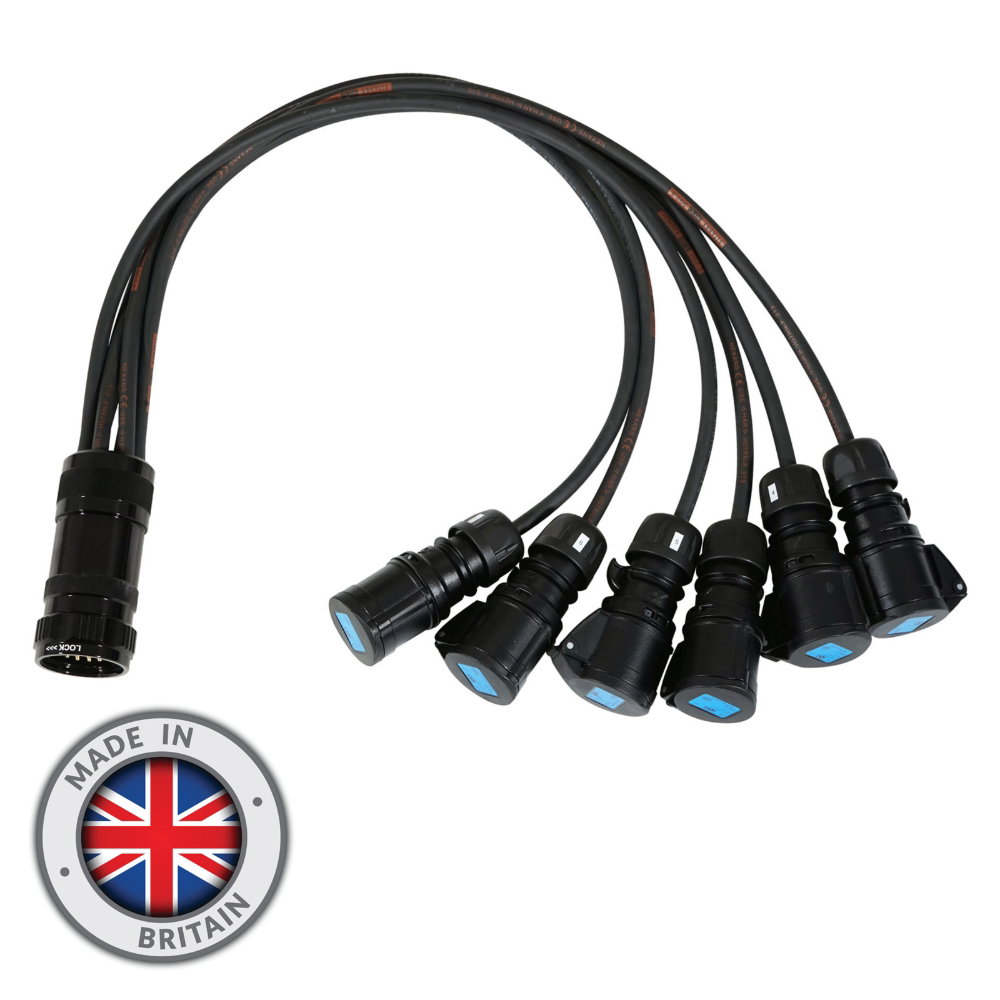
A working Socapex system is built from a small family of parts, and the naming trips people up more than the wiring does. The direction words are from the point of view of the multicore: a fan-out (or breakout) splits the 19-pin into six individual tails at the fixture end; a fan-in (or breakin) gathers six supply tails into one 19-pin at the distro end.
- Multicore lengths. Off-the-shelf 19-core multicores run from short 3 m and 5 m jumpers up to 20 m, 30 m, 40 m and 50 m drums, male to female so they extend end to end. Stocked lengths in 1.5 mm² and 2.5 mm² live in our Socapex range and power cables section.
- Fan-outs. Socapex male to six tails: 16 A BS EN 60309 sockets for general UK use, powerCON TRUE1 for modern moving heads and LED fixtures, or 15 A round-pin for theatres still standardised on it. Staggered versions space the tails along the loom so outlets land at fixture positions along a bar.
- Fan-ins. Six 16 A plugs (or a single supply connector on some designs) into a Socapex female, feeding the multicore from a distro’s outlets.
- Breakout boxes. A 19-pin inlet on a compact box with six panel-mounted 16 A sockets: tidier than a loom where the break happens at floor level or on a dip.
- Patch panels and distro outlets. Panel-mount 19-pin connectors appear on dimmer racks, power distros and installation patch fields, so the multicore plugs straight into the rack with no fan-in at all.
- Six-way bars. Pre-rigged truss bars and lighting bars with a Socapex inlet and six outlets wired along their length, which is how most touring rigs consume Soca.
- Accessories. Coloured coupling rings for circuit identification, weatherproofing caps for outdoor rigs, spider glands for building your own looms, and 19-pin test plugs for verifying wiring and continuity before a loom goes into stock.
Is Socapex ever used for data or low voltage?
In normal practice, no. Lighting-wired Socapex is a power-only format: mains circuits, nothing else. DMX, Ethernet and audio travel on their own cabling with their own connectors, and running control data through a multicore alongside mains circuits is bad practice even where it is physically possible. If you are sorting out the signal side of a rig, see our DMX guide for control and our audio connectors guide for the sound end of the multicore world.
The exceptions you may meet are specialist, not general practice: the motor-control looms mentioned above use the 19-pin shell for hoist power and control, and a smaller 7-pin Socapex connector exists and turns up in motor and control applications. Both are wired to their own standards. Treat them as different products that happen to share a family name.
Deploying Soca on site
- Label circuits 1 to 6 at both ends: numbered tails on fan-outs and numbered outlets at the distro are the difference between a thirty-second repatch and twenty minutes of flash-and-shout up a ladder. Buy fan-outs with numbered tails, or number them yourself, and keep circuit 1 meaning circuit 1 across your whole stock.
- Patch cold where you can: the discipline that keeps Soca systems safe is making and breaking connections with circuits dead. Hot-patching a 19-pin under load draws an arc across pins carrying real current, pitting contacts and eventually making the whole connector unreliable. Kill the breakers, patch, then bring the circuits back up.
- Never break a connector under load: the same rule, stated the way it gets broken. Pulling a Socapex apart while fixtures are drawing current is how connectors get arc damage and how people get startled at the top of a ladder. If a bar needs to move, drop its circuits first.
- Respect the weight: 19 cores of 2.5 mm² rubber-jacketed cable is heavy, and long lengths are a two-person lift or a job for a cable trolley. Coil in generous loops onto a drum or into a flightcase rather than tight hanks over a shoulder, and never let the connector take the load when hauling a run up to a truss: tie the cable off, not the plug.
- Protect the connectors: threaded locking rings should be done up hand-tight on every mate, and open connectors on outdoor rigs should wear weatherproofing caps. A bent pin on a 19-pin connector takes a whole six-circuit run out of service.
- Test looms before they ship: a 19-pin test plug and a continuity check catches crossed circuits, open earths and miswired tails in the warehouse rather than on the load-in.
Alternatives, briefly compared
| Approach | Where it wins | Where it loses |
|---|---|---|
| Individual 16 A runs | Simple, cheap per cable, every venue owns them, easy fault-finding | Six times the cables to run, coil and store; slow load-ins on anything beyond a few circuits |
| powerCON TRUE1 daisy chains | Minimal cabling for rows of low-draw LED fixtures; one circuit feeds several units | Everything on the chain shares one circuit and fails together; total draw must be added up carefully |
| Socapex multicore | Six independent circuits per run; the touring and hire standard; repeatable patch | Heavy cable; needs breakouts and discipline; overkill for a two-light mobile rig |
| Powerlock | Supply level, not circuit level: single-pole connectors moving hundreds of amps from generator or mains intake to the distro | Not a fixture-feed format at all; it lives upstream of everything on this page |
These are layers, not rivals. A festival stage typically runs Powerlock from the generator to the distro, Socapex from the distro to the bars, and short TRUE1 or 16 A jumpers from the breakouts to the fixtures.
Buying guidance
Cable grade
For anything that gets flown, trucked or rained on, buy multicore built on H07RN-F rubber-jacketed cable (Titanex is the name you will see most). It stays flexible in the cold, shrugs off abrasion and is the grade the hire industry standardised on. The choice that actually matters is core size: 2.5 mm² for full 16 A circuit duty and general hire stock, 1.5 mm² where weight matters and loads are modest, which in practice means LED rigs.
Connectors
Genuine Amphenol Socapex commands a premium; quality compatible 19-pin connectors from established brands mate with it perfectly and are what most hire stock is built on. Whatever the brand, look for solid metal shells, positive locking rings and properly crimped or soldered contacts, and match the connector’s cable-entry gland to your cable diameter: line connectors are sold in versions for 1.5 mm² looms, 2.5 mm² looms and larger-entry glands for big multicores. Numbered inserts are worth the small extra for anyone else who will ever work on your looms.
Lengths and custom builds
Standard lengths cover most rigs, and mixing a few short jumpers with your long runs saves coiling 30 m to travel 4 m. For fixed installations, awkward venues or pre-rigged bars, custom-length looms and fan-outs built to your outlet spacing are a standard job: talk to us about custom builds, or pick up connectors and spider glands and build your own.
Common mistakes
- Assuming six circuits means six full loads. The multicore delivers six circuits; it does not conjure supply. Six 16 A circuits fed from one 32 A feed share 32 A. Add up the actual fixture draw per circuit and check it against the supply, not the outlet count.
- Mixing lighting and motor looms. Same connector, different wiring, dangerous combination. Label motor Soca loudly and store it separately.
- Unlabelled breakouts. An unnumbered fan-out turns every patch change into trial and error. Number everything, both ends, permanently.
- Breaking connectors under load. Arc-damaged pins are cumulative and invisible until the connector fails on a show. Circuits dead before you patch.
- 1.5 mm² multicore on full-load circuits. Light cable is tempting on weight alone; it is not the right loom for six heavily loaded 16 A ways.
- Trusting an unknown loom. Hired-in or second-hand multicores get tested with a 19-pin test plug before they go anywhere near a rig. Crossed circuits and floating earths are exactly the faults a visual check cannot see.
Popular picks from the shop
Elumen8 Socapex 19-Pin Line Female Socket, NumberedView product → Elumen8 10m Socapex 19-Pin Titanex 2.5mm CableView product → Elumen8 Socapex 19-Pin to 6 x 16A Fan-Out Cable 2.5mmView product → Elumen8 Socapex Breakout Box, 19-Pin to 6 x 16AView product →
Frequently asked questions
What does Socapex actually carry?
Six independent mains power circuits, each with its own live, neutral and earth, down one 19-core multicore. In lighting use it carries power only, never DMX or audio.
What is the Socapex pinout?
Lives on odd pins 1, 3, 5, 7, 9 and 11; neutrals on even pins 2, 4, 6, 8, 10 and 12; earths on pins 13 to 18, one per circuit; pin 19 unused (occasionally the cable screen). See the full table above.
How many amps is a Socapex circuit?
Connector variants are rated as high as 25 A per contact, but UK practice treats each circuit as 16 A, protected by a 16 A breaker and matched to 16 A outlets on the breakout. On 1.5 mm² multicore, load each circuit more conservatively.
Can I run DMX down a spare Soca circuit?
No. The multicore is mains power cable, not data cable, and mixing control signals with mains circuits in one loom is bad practice. Run DMX on proper 120 ohm DMX cable alongside.
What is the difference between a fan-out and a fan-in?
A fan-out (breakout) splits the 19-pin male into six individual sockets at the fixture end of the run. A fan-in (breakin) gathers six plugs into a 19-pin female to feed the multicore from a distro’s outlets.
Are all 19-pin connectors compatible with each other?
Mechanically, quality Socapex-compatible connectors from reputable brands mate with genuine Amphenol and with each other. Electrically, only if they are wired to the same standard: lighting-wired and motor-wired looms use the same shell with different wiring and must never be mixed.
Can Socapex be used outdoors?
Yes, it is the standard on festival stages, but treat mated pairs and open connectors sensibly: locking rings done up, weatherproofing caps on unused connectors, and connections kept off wet ground where possible.
Should I buy 1.5mm or 2.5mm Socapex multicore?
Buy 2.5 mm² if the loom will ever feed full 16 A circuit loads or go into general hire stock. Choose 1.5 mm² where the rig is all LED, the loads are light and the weight saving on long runs genuinely matters.
Shop this guide
Connectors, multicores, fan-outs and everything upstream, in stock and ready to ship.


