


Home » Guides » Guitar & Bass Strings »
Guitar String Gauges Explained: What the Numbers Actually Mean
Nine to forty-two. Ten to forty-six. The numbers on a string packet are diameters in thousandths of an inch, and they change how a guitar plays more than anything else you can buy for it.
~8 min read · Updated September 2026 · By the Stage Supply team
In this guide: Short answer · What the numbers mean · Electric gauges · Changing gauge · Acoustic gauges · Tuning down · Pack sizes · Shop the range · FAQ
String gauge is the one specification on a packet that changes how a guitar plays, and it is written in a shorthand nobody ever explains. This guide decodes it, sets out what actually changes when you move up or down a gauge, and says which set to reach for by instrument and tuning. Every gauge quoted here is one we stock.
The short answer
For a standard-tuned electric, 10-46 is the default and the one most guitars leave the factory with. Move to 9-42 if you bend a lot or your hands are tired by the third set, and to 11-49 for more volume and a firmer feel. For a steel-string acoustic, 12-53 is the equivalent default. For bass, 45-100. Everything below is why.
What the numbers mean
A gauge is the diameter of the string in thousandths of an inch. A set described as 10-46 has a 0.010 inch top E and a 0.046 inch bottom E, with the four strings in between filling the gap. Manufacturers name sets by those two outer figures because they tell you the two things you feel most: how hard the top strings are to bend, and how tight the bottom strings sit under the pick.
The plain strings (the thin, unwound ones) are just steel wire. The wound strings have a core wire with a wrap wire spun around it. Every D’Addario electric, acoustic and bass set we stock is built on a hexagonal high-carbon steel core, which is what stops the wrap slipping on the core and is why the sets hold intonation from one change to the next.
Electric gauges, in order
These are the five XL Nickel gauges we keep, lightest first. The descriptions are D’Addario’s own characterisation of each set, and they match what people report in practice.
| Set | Gauges | Name | What it gives you |
|---|---|---|---|
| EXL120 | 9-42 | Super Light | Easy to bend, very flexible. Vintage-voiced single coils, players with a light touch, anyone doing a lot of string bending |
| EXL125 | 9-46 | Super Light Top, Regular Bottom | More low-end weight while the top three stay flexible for bends. A very common compromise set |
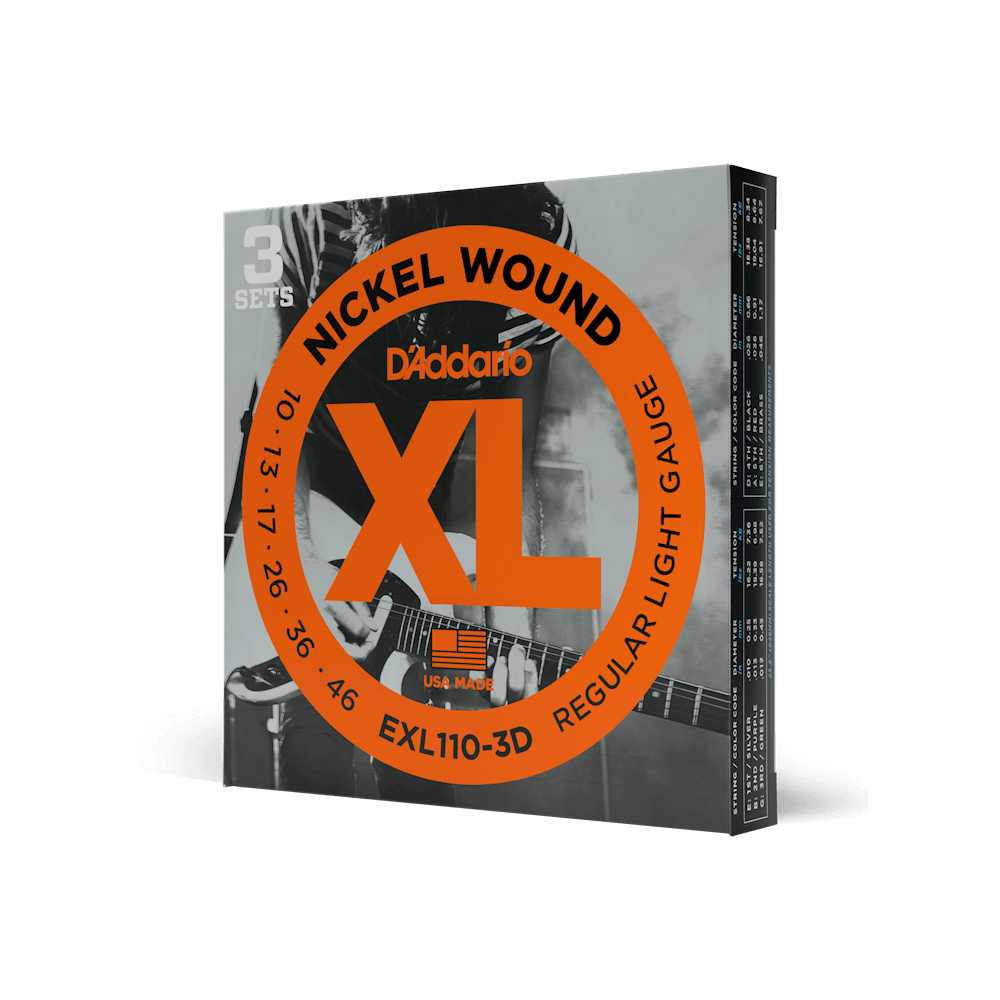
| EXL110 | 10-46 | Regular Light | The most popular gauge there is, and the balance point between tone and playability |
| EXL140 | 10-52 | Light Top, Heavy Bottom | A deeper low end than Regular Light with the same top three. The set for drop tunings on a standard scale |
| EXL115 | 11-49 | Medium | More volume, more tension, more resistance under the fingers. Jazz, blues, slide and anyone tuning to E flat |
Two of those, EXL125 and EXL140, are hybrid sets. They pair the top three strings from one gauge with the bottom three from a heavier one. That solves a real problem: a 10-46 set tuned down to D sounds and feels slack on the low string, while a straight 11-49 set makes the bends hard work. A hybrid gives you the loose top and the tight bottom at the same time.
What changes when you change gauge
Gauge is not a free choice. A heavier set pulls harder on the neck and the bridge, and a guitar that was set up for one gauge will not be quite right on another. If you move by one step, most guitars cope. If you move by two or more, or you change tuning at the same time, budget for a setup.
- Neck relief. More tension pulls more forward bow into the neck, so the action rises. Less tension lets the neck straighten and the strings can start to buzz. The truss rod is what corrects this.
- Intonation. A thicker string needs its saddle further back to play in tune up the neck. Go up a gauge without touching the saddles and chords at the twelfth fret will sound sharp.
- Nut slots. Going heavier is the direction that causes trouble. A 0.046 slot will not accept a 0.052 string without binding, and binding at the nut is the usual reason a guitar will not stay in tune. A drop of LubriKit in the slot helps; a slot that is genuinely too narrow needs filing by someone who does that work.
- Tremolo balance. On a floating bridge, changing gauge changes the spring balance, so the bridge sits at a different angle and the whole guitar goes out of tune with itself until the claw is reset.
- Amount of pick attack it takes. Heavier strings move less for the same energy. That is why they sound louder and tighter, and also why they are more tiring over a three-hour function set.
A string height gauge and a multi-tool cover the measuring and the hex keys for most of that work. The full routine is in changing strings and making them last.
Acoustic gauges
Acoustic sets run heavier than electric sets, because on an acoustic the string has to drive a wooden top rather than a magnetic pickup. Volume and gauge are linked much more directly than they are on an electric.
| Set | Gauges | Name | What it gives you |
|---|---|---|---|
| EJ15 | 10-47 | Extra Light | Easy to play and easy to bend. Small-bodied guitars, beginners, anyone with hand trouble |
| EJ26 | 11-52 | Custom Light | Slightly more volume and projection than Extra Light while staying easy to play |
| EJ16 | 12-53 | Light | D’Addario’s most popular acoustic gauge and the balance point between playability and tone |
| EJ17 | 13-56 | Medium | Maximum volume and projection, with more tension and more resistance. Dreadnoughts, flatpicking, heavy strumming |
A warning worth repeating: do not put mediums on a small-bodied or older acoustic without checking what the maker specifies. Acoustic tops are built to a tension, and 13-56 pulls considerably harder than 11-52. Vintage instruments and parlour bodies are usually built for light or extra light.
All four sets are phosphor bronze, which is the wrap alloy D’Addario introduced for acoustic strings in 1974 and which has since become the industry default. It is warmer and more balanced than the 80/20 bronze that preceded it.
Tuning down, and scale length
Two guitars in the same tuning with the same strings can feel completely different, because tension depends on scale length as well as gauge. A 25.5 inch scale (most Fender-style instruments) holds the same string at higher tension than a 24.75 inch scale (most Gibson-style ones). That is why 10s feel stiffer on a Strat than on a Les Paul, and it is why players moving between the two often run a different gauge on each.
- E flat or half a step down. Go up one gauge from what you use in standard. If you play 9-42 in E, use 10-46 in E flat.
- Drop D only. A hybrid set is the efficient answer, because only the bottom string drops. EXL125 9-46 or EXL140 10-52 depending on how heavy you want the rest.
- Full step down to D. EXL140 10-52 on a 25.5 inch scale, EXL115 11-49 if you want the top strings firmer too.
- Anything below D. You are into gauges we do not hold as stock. Call us and we will order them in on the D’Addario account.
Buying in threes, tens and twenty-fives
The same set is sold in several pack sizes and the cost per set falls as the pack grows. The suffix on the code tells you which is which: -3D is three sets, -10P is ten, -B25 is a box of twenty-five, and TP on a bass set is a twin pack of two.
Three-packs suit a player. Ten-packs suit a band, a teaching studio or a guitar tech who restrings two or three instruments a week. The twenty-five set boxes, which we hold in 10-46 and 9-42, are for backline companies, hire stock and festival workboxes, where the question is never which gauge but how many.
The gauges we keep on the shelf
D'Addario EXL110 XL Nickel 10-46, 3 setsView product → D'Addario EXL120 XL Nickel 9-42, 3 setsView product → D'Addario EXL140 XL Nickel 10-52, 3 setsView product → D'Addario EJ16 Phosphor Bronze 12-53, 3 setsView product →
Shop the range
Every gauge named above is on the shelf, in three-set, ten-set and bulk packs.
Stocked in our own warehouse for next-day UK delivery, with trade counter collection available. Anything in the D’Addario, Evans, ProMark or PureSound catalogue that we do not shelve, we can order in, so ask us if you cannot see it.
Frequently asked questions
Do heavier strings really sound better?
They sound louder and tighter, which is not the same thing. A heavier string moves less air for the same displacement but stores more energy, so it drives a pickup or an acoustic top harder and holds its pitch better under a heavy pick. Whether that is better depends on what you are playing. Plenty of the tone people chase was recorded on 9s.
Can I put a heavier gauge on without a setup?
One step up, usually yes, and then check the intonation at the twelfth fret. Two steps or more, no. The neck relief and the saddle positions will both be wrong, and on a floating tremolo the bridge will not sit flat.
What is the difference between a hybrid set and a custom set?
A hybrid set such as EXL125 or EXL140 is a factory set with a deliberately mismatched top and bottom, so the tension is still balanced across the neck. Mixing loose singles from two packets gets you something similar but usually with a tension step in the middle of the set, which is why the wound third often ends up feeling wrong.
How often should I change strings?
By feel and sound rather than by calendar. Strings go dull, then they go sharp at the frets where the windings have flattened, and then they break. A gigging player typically changes every few shows, a studio player before every session, a bedroom player every few months. Making a set last covers what shortens their life.
Do you stock coated strings?
Not as shelf stock. Our range is the uncoated XL, NYXL and Phosphor Bronze lines, which is what most players and almost all techs buy. D’Addario’s coated XT and XS lines can be ordered in on our trade account, so ask if that is what you want.


