


Home » Guides » Instrument Accessories »
Guitar Picks Explained: Gauge, Material and Buying in Bulk
A pick costs pennies and changes your tone more than most pedals do. It is also the thing most likely to be lost, which is why the sensible unit of purchase is a hundred.
~6 min read · Updated September 2026 · By the Stage Supply team
In this guide: Short answer · Gauge · Material · Pack sizes · Picking one · Shop the range · FAQ
Gauge decides how much the pick flexes, and flex decides how much of your stroke reaches the string. Material decides grip and how fast the point wears away. This guide covers both, with the exact thicknesses D’Addario use, and says what is in each pack we hold.
The short answer
Thin picks flex and give a softer, more percussive attack, which suits strumming. Thick picks do not flex, so all the energy goes into the string, which suits single notes and lead playing. Medium celluloid at 0.70mm is the safe middle. If you are stocking a venue, a rehearsal room or a hire department, buy the 100-packs.
Gauge
Pick gauge is a thickness in millimetres, and it behaves in a straightforward way. A pick that bends absorbs some of the energy of the stroke and releases it more slowly, which softens the attack and evens out the difference between strings. A pick that does not bend transfers everything immediately, which is louder, more defined and less forgiving.
| Gauge | Thickness | Feel | Suits |
|---|---|---|---|
| Light | 0.50mm | Flexes noticeably, soft attack | Strumming, acoustic rhythm, jangly electric |
| Medium | 0.70mm | Slight flex, the compromise point | Strumming and articulate picking both |
| Heavy | 1.00mm | Effectively rigid, hard defined attack | Lead playing, riffing, anything needing definition |
Those are the three gauges we hold in celluloid, in Light, Medium and Heavy. All are the standard shape, which is the 351-style teardrop that most players use.
Material
Material changes grip, attack noise and wear rate, and to a lesser degree tone. We stock three.
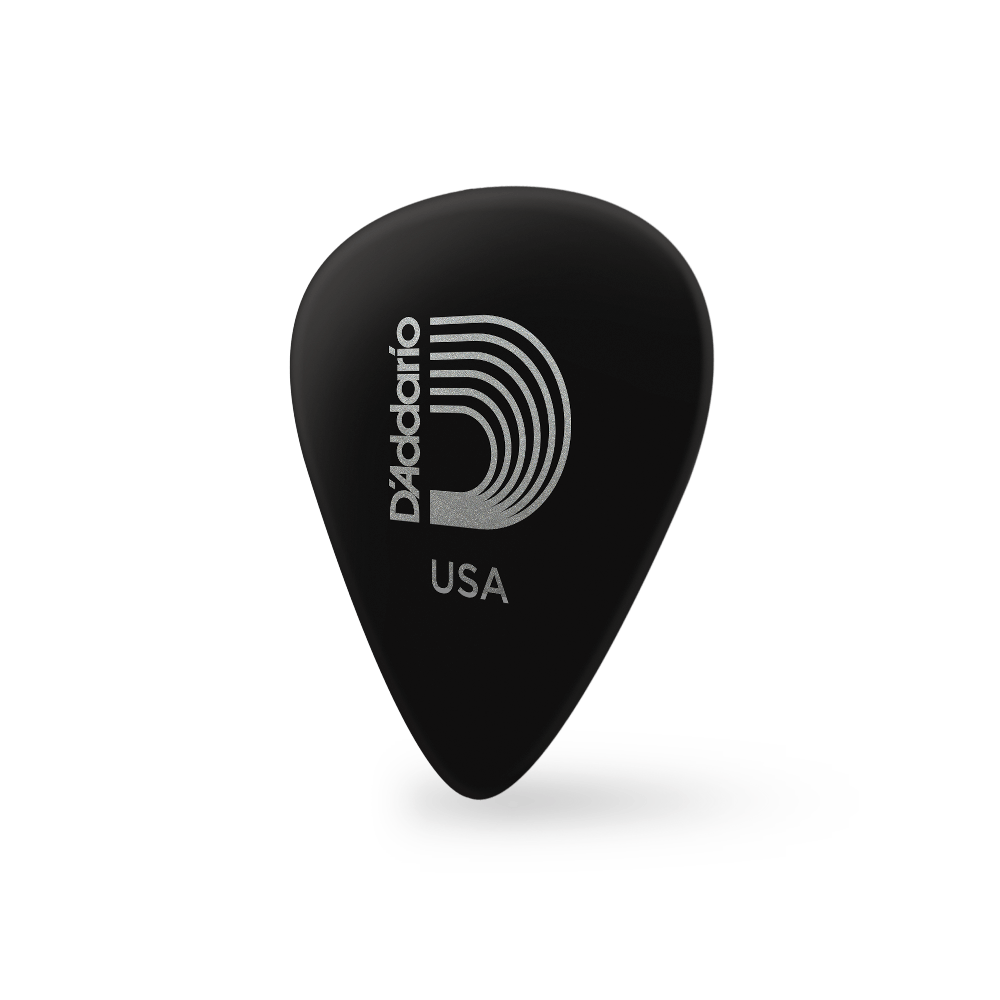
- Celluloid. The traditional material, and still the reference. It has a natural feel under the fingers and a warm, fat tone, with a slightly softer attack than the synthetics. It wears faster than the others, which is part of why it is sold in quantity. In black and white.
- Duralin. Also known as acetal or Delrin. It is an industrial polymer used to replace metal bushings and bearings, chosen here for stiffness, dimensional stability, fatigue resistance and low friction. In practice it is grippier and far more abrasion resistant than celluloid, so it holds its point for much longer. We stock Light/Medium in yellow at 0.70mm and Medium/Heavy in blue at 1.00mm, with the colour coding the gauge.
- Nylflex. Nylon with a two-sided moulded grip pattern. Flexible feel and response, a warm tone, and a deliberately softer attack that D’Addario describe as giving a smooth, compressed strum. If you like the sound of a thin pick but keep dropping them, this is the one, because the grip pattern is the point. In Light, Medium and Heavy.
Why 25 and 100 packs
Picks are consumable in a way no other guitar accessory is. They wear out, they get dropped inside the guitar, and they leave with the audience. The pack sizes exist to match how they are actually used.
- 25-pack. A player’s supply, or a single gauge for one guitarist in a band. We hold celluloid black in all three gauges at this size.
- 100-pack. A venue, a rehearsal room, a teaching studio, a hire department or a touring guitar tech’s pick tin. Celluloid comes in black medium, black heavy and white medium, and both Duralin gauges and all three Nylflex gauges are 100-packs only.
A tip for anyone running a venue or a backline department: keep one gauge in quantity rather than a spread of gauges in small numbers. A guitarist who has forgotten their picks does not need exactly their preferred gauge, they need a pick, and a box of 100 mediums solves that for a year.
Picking one
| If you play | Start with |
|---|---|
| Acoustic rhythm and strumming | Celluloid Light, 0.50mm or Nylflex Light |
| A bit of everything | Celluloid Medium, 0.70mm |
| Electric lead and riffs | Celluloid Heavy, 1.00mm or Duralin 1.00mm |
| Sweaty stages, or you drop picks | Nylflex or Duralin |
| Stocking a venue or rehearsal room | Celluloid Medium, 100-pack |
The packs we stock
Celluloid Medium 0.70mm, black, 25 packView product → Celluloid Medium 0.70mm, black, 100 packView product → Duralin Medium/Heavy 1.00mm, 100 packView product → Nylflex Medium, 100 packView product →
Shop the range
All three materials, in 25 and 100 packs.
Stocked in our own warehouse for next-day UK delivery, with trade counter collection available. Anything in the D’Addario, Evans, ProMark or PureSound catalogue that we do not shelve, we can order in, so ask us if you cannot see it.
Frequently asked questions
Does pick material really affect tone?
Less than gauge does, but yes, and mostly in the attack. A harder, slicker material gives a sharper click as it leaves the string; a softer one rounds it off. Through a clean amp and close microphone it is obvious. Through a distorted amp in a loud band it is much less so.
What gauge is a “medium” pick?
In the D’Addario celluloid range, 0.70mm, with Light at 0.50mm and Heavy at 1.00mm. Be aware the words are not standardised across brands, so always look for the millimetre figure.
What is Duralin?
D’Addario’s name for acetal, also sold elsewhere as Delrin. It is an engineering plastic with high stiffness, low friction and strong abrasion resistance, which means it grips well and keeps its point far longer than celluloid.
Why do my picks keep slipping?
Usually smooth celluloid plus warm hands. Nylflex has a moulded two-sided grip pattern designed for exactly that, and Duralin has a naturally higher friction surface than celluloid.


