

Home » Guides » Wireless Mics & In-Ear Monitoring »
Sennheiser SpeechLine Digital Wireless vs EW-DX: Which for Presenters, Lecture Halls and Churches?
Two Sennheiser digital wireless families that both turn up in meeting rooms, lecture theatres and churches, built for different jobs. How SpeechLine Digital Wireless (1.9 GHz) and EW-DX (UHF) differ on band, licensing, latency, channel count, transmitters and control, and which one fits your room.
~10 min read · Updated October 2026 · By the Stage Supply team
In this guide: The short answer · Side by side · SpeechLine explained · EW-DX and EW-D · UK licensing · Sharing 1.9 GHz · Which for which room · Popular picks · FAQ
Sennheiser makes two digital wireless systems that end up specified for the same rooms. SpeechLine Digital Wireless (SL DW) is, in Sennheiser’s words, “a presentation solution dedicated to speech”. EW-DX is the professional end of the Evolution Wireless Digital family, used for everything from conference rooms to theatre.
Both are encrypted, both are networkable and both run on rechargeables. The differences are the radio band, the latency, how far each scales and who is expected to operate it. This guide sets them side by side. For EW-D against EW-DX on its own, see our EW-D vs EW-DX guide; for moving off analogue, the G4 upgrade guide.
The short answer
- Choose SpeechLine Digital Wireless for speech in rooms that run themselves: meeting rooms, lecture halls, classrooms and the pulpit or lectern. It works in the 1.9 GHz DECT band, which Sennheiser states is licence-free, picks its own frequencies, sets its own input gain and is managed over the network from Sennheiser Control Cockpit or a Crestron or AMX style control system.
- Choose EW-DX when the same system also has to carry singing, instruments or theatre, when you need a lot of channels in one place, or when latency matters. It is UHF, with 1.9 ms system latency against SpeechLine’s 19 ms.
- Consider EW-D if you only need a few UHF channels for a band, school hall or church and do not need networked control.
A church that is mostly spoken word at the lectern suits SpeechLine. A church with a worship band, singers on handhelds and in-ear monitors is EW-DX territory, and many end up with both: SpeechLine for the speaker, UHF for the music.
Side by side
| SpeechLine Digital Wireless | EW-DX | |
|---|---|---|
| Band (UK version) | 1,880 to 1,900 MHz (DECT band), variant -3 | UHF; the S1-10 version tunes 606.2 to 693.8 MHz, including Channel 38 |
| UK licence | None required, per Sennheiser | Ofcom licence needed (Channel 38 shared licence, or site-specific elsewhere in the band) |
| Channels | Up to 20 links per reception range in the -3 variant, fewer if other DECT kit is nearby; more across a campus with Multi-Room Mode | Up to 146 in standard mode, 293 in Link Density Mode, across up to 88 MHz of switching bandwidth |
| System latency | 19 ms | 1.9 ms |
| Encryption | AES-256 | AES-256 |
| Frequency setup | Automatic frequency and interference management | Scan and deploy, with equidistant channel spacing |
| Audio | 24-bit/48 kHz, more than 120 dB(A) dynamic range, automatic sensitivity adjustment on the transmitter | 134 dB dynamic range |
| Transmitters | Handheld, bodypack, tablestand (133-S and 153-S), boundary (114-S) | Handheld (SKM, SKM-S), bodypack (SK with 3.5 mm jack or SK 3-pin), tablestand (TS 3-pin and 5-pin) |
| Receivers | SL Rack Receiver DW (one channel, half 19", XLR and RCA out); SL MCR 2 and MCR 4 DW (2 or 4 channels, PoE, Dante, wall or ceiling mount) | EM 2 (two channels, half rack), EM 2 Dante, EM 4 Dante (four channels, full 19") |
| Battery (typical) | Handheld and bodypack: 15 h on the Li-ion pack; tablestand 10 to 11 h; boundary 12 h | Bodypack and handheld: 12 h on BA 70, up to 8 h on AA |
| Control | Sennheiser Control Cockpit; Media Control Protocol for AMX and Crestron | Sennheiser Control Cockpit, Wireless Systems Manager, Smart Assist app |
Two rows decide most projects: the band, because it decides licensing and what you share the air with, and the latency, because it decides whether the system can carry music.
SpeechLine Digital Wireless explained
SpeechLine is built so that nobody has to touch it once it is installed. Sennheiser describes three automatic functions: frequency management finds a free frequency with no planning, interference management moves away from interference such as DECT phones without the audience noticing, and sensitivity management means no gain to set on the transmitter. The rack receiver adds a low cut, a 7-band graphic EQ and sound profiles for female voice, male voice and instrument or media.
Transmitters and microphones
- SL Handheld DW. Comes with the MME 865 super-cardioid condenser capsule, available as the SL Handheld DW transmitter with MME 865. Sennheiser lists the evolution capsules, including the MMD 835 and the MME 865, as compatible with SpeechLine Digital Wireless handhelds as well as ew G3, G4, D1 and AVX. Runs on a BA 10 pack or two AA cells.
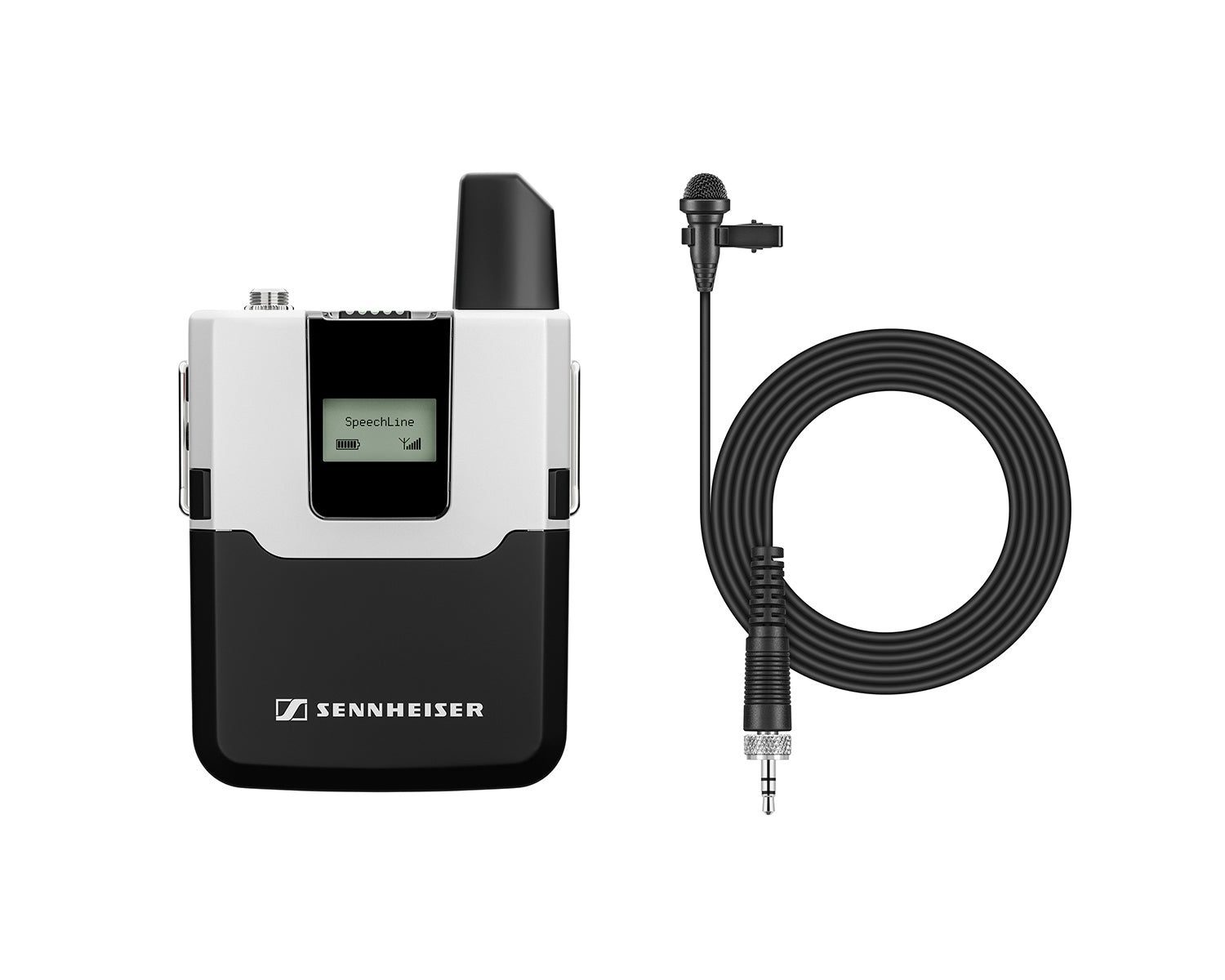
- SL Bodypack DW. A lockable 3.5 mm input for mic or line level. Sennheiser sells it as kits with a microphone: the SL Bodypack ME 2 Kit (ME 2 omni clip-on), the MKE 2 Kit (MKE 2 ew Gold sub-miniature lavalier), the MKE 40 Kit (cardioid clip-on) and the HM 1 Kit with the SL Headmic 1 headworn. Sennheiser’s FAQ says the bodypack works with any Sennheiser headset or lavalier.
- SL Tablestand 133-S DW and 153-S DW. Cable-free bases for a gooseneck on a lectern or conference table. Sennheiser describes the 133-S as compatible with all Sennheiser XLR-3 gooseneck microphones; the SL TS 133 Set pairs it with a MEG 14-40 B gooseneck and an SL Rack Receiver DW.
- SL Boundary 114-S DW. A cardioid boundary microphone for a meeting table, charged wirelessly on the CHG 2W or over USB. Available on its own as the SL Boundary 114-S DW transmitter.
Note that the SL Bodypack kits are transmitter and microphone only. They need a receiver: either an SL Rack Receiver DW or a multi-channel receiver. The complete sets with the rack receiver included are the SL Lavalier Set DW and the SL Headmic Set DW.
Receivers
The SL Rack Receiver DW is a half-19" unit for one transmitter, with an OLED display, a balanced XLR output, two RCA outputs and an Ethernet port. It goes into a rack with the GA 4 mounting kit, and the antennas can be mounted front or back, or remotely on extension cables.
The SL Multi-Channel Receiver DW comes in 2 and 4 channel versions (SL MCR 4 DW). It mounts on a wall, ceiling or mic stand rather than in a rack, is powered over Ethernet (PoE, IEEE 802.3af Class 3), and has two Dante ports plus one analogue output on a 3-pin terminal block. That makes it the natural fit for a lecture theatre or meeting room already running Dante into a DSP.
Charging and control
Handheld and bodypack charge in the network-enabled CHG 2N or CHG 4N, about 2 hours to full per Sennheiser. The tablestand and boundary charge on the inductive CHG 2W. SpeechLine devices can be monitored and controlled remotely in Sennheiser Control Cockpit, so whoever looks after the building can check on every room from one place, and the receivers also speak Sennheiser’s Media Control Protocol for AMX and Crestron.
EW-DX, and where EW-D fits
EW-DX is UHF digital wireless with up to 88 MHz of switching bandwidth. In the UK, the S1-10 version covers 606.2 to 693.8 MHz. Sennheiser quotes up to 146 channels in standard mode and 293 in Link Density Mode across that range, 1.9 ms latency, 134 dB dynamic range, AES-256 encryption and up to 100 m working range from the 10 mW transmitters. In practice your channel count is set by how much spectrum you are licensed for, not by those maximums (see licensing below).
- Receivers: the two-channel half-rack EW-DX EM 2, the EM 2 Dante, and the four-channel full-rack EM 4 Dante.
- Bodypacks: the EW-DX SK with a lockable 3.5 mm jack, or the EW-DX SK 3-pin version.
- Handhelds: EW-DX SKM and the switched SKM-S, taking interchangeable capsules.
- Tablestand: the EW-DX TS 3-pin takes XLR-3 goosenecks; Sennheiser lists the MEG 14-40 B, MZH 3015, MZH 3040 and MZH 3042, and the ME 34, ME 35 and ME 36 heads. A 5-pin version takes XLR-5 goosenecks. Up to 11 hours on a BA 40 pack, charged over USB-C or wirelessly on the CHG 2W.
- Power: BA 70 rechargeable or two AA cells, charged in the transmitter on the network-enabled CHG 70N-C, which cascades up to five units from one power supply and network connection.
The easiest way in is a set such as the EW-DX SK and SKM-S Base Set (one bodypack, one handheld, an EM 2 and two BA 70 packs) or the EW-DX MKE 2 / 835-S combo set.
EW-D in one paragraph
EW-D is the simpler UHF sibling: 56 MHz of switching bandwidth for up to 90 channels, the same 1.9 ms latency and 134 dB dynamic range, up to 12 hours on BA 70, and setup from the Smart Assist app (Sennheiser says for installations up to 16 channels) rather than Control Cockpit, which Sennheiser lists for EW-DX. For a church band or a school hall with a handful of mics, sets such as the EW-D ME2 / 835-S combo cover it. The full comparison is in our EW-D vs EW-DX guide.
UK licensing: the practical difference
SpeechLine. Sennheiser’s FAQ answers “Do I need a license?” with “No, the 1G9 DECT range is license free”, and its -3 variant (1,880 to 1,900 MHz) is the one listed for Europe and the UK. For context, Ofcom’s UK Interface Requirement 2011, which covers cordless telephony, gives the licensing requirement for DECT cordless telephony equipment in 1880–1900 MHz as “Licence Exempt for private self provided communication”. Ofcom’s own licence-exempt list for wireless microphones does not mention 1.9 GHz, so the “no licence needed” statement for SpeechLine comes from Sennheiser. On that basis there is nothing to apply for and nothing to renew.
EW-DX and EW-D. UHF radio mics in the UK need an Ofcom licence unless they sit in a licence-exempt band. Ofcom makes Channel 38 (606.5 to 613.5 MHz) available on a shared, non-protected basis under a UK Wireless Microphone Licence lasting one or two years. Coordinated frequencies outside Channel 38 need an Ofcom Standard Licence, booked location by location and date by date. The details are in our Channel 38 licensing guide and licensing beyond Channel 38.
Why this matters for a building
Going by Sennheiser’s licence-free statement, a school, university or church buying SpeechLine has no licence to track and no licence to renew. An EW-DX system needs someone to keep its Ofcom licence current. Neither should be a deal-breaker, but in a building where the AV person changes every few years, it is worth thinking about.
Sharing the 1.9 GHz band
SpeechLine’s licence-free status (per Sennheiser) comes from sharing the DECT band, and that has a cost. Sennheiser’s planning notes say the number of SpeechLine links available depends on how many other DECT systems (cordless phones, DECT intercom and the like) are in use within about 100 m. Before you buy:
- Ask whether the building has DECT phones or DECT access points, and find where they are.
- Keep SpeechLine remote antennas at least 3 m from any DECT access point, as Sennheiser recommends.
- For larger rooms, use the remote AWM 2 or AWM 4 antennas (for example the AWM 2 MKII), and the SL PASC 4 splitter/combiner to run several receivers on one antenna.
- Across a campus, Multi-Room Mode lets you set transmitter power to suit each room, so more links can run across the site than the 20-per-range figure for a single room.
Which for which room
Presenters, meeting rooms and conference venues
SpeechLine. A bodypack kit for the presenter, a handheld for questions, a boundary or tablestand on the table, and an MCR on the ceiling feeding Dante into the room DSP. Auto gain helps when the next presenter has never touched a radio mic. The wider room design is in our conference room AV guide, and wired options are in conference and gooseneck microphones. If the venue also runs evening events with bands, EW-DX with an EW-DX TS on the lectern covers both.
Lecture halls and lecture capture
SpeechLine fits here well: the encryption keeps lecture content private, Control Cockpit lets one person monitor every room’s system, and the MCR’s Dante output goes straight into the capture and reinforcement system. The 19 ms latency is irrelevant for a recording and, in Sennheiser’s words, “an applicable value for speech” in the room.
Churches
For the lectern, pulpit and a radio mic on the minister, SpeechLine is the low-maintenance choice: no licence and no gain settings for volunteers to get wrong. Worship music is a different job. Singers, instruments and anyone on in-ear monitors are better served by UHF, with EW-DX for larger setups or EW-D for a handful of channels. Our church AV upgrade guide covers the rest of the system.
Theatre, music and anything with a band
EW-DX. You need the lower latency, the channel count, the 3-pin bodypack option for theatre lavaliers and the frequency coordination tools. SpeechLine is not designed for this. For fitting and placing mics on performers, see microphone technique on a live stage, and for the bigger buying picture, the wireless microphone buying guide.
Popular picks from the shop
Sennheiser SL Bodypack DW ME 2 Kit (1.9 GHz)View product → Sennheiser SpeechLine SL Lavalier Set DW with Rack ReceiverView product → Sennheiser SpeechLine SL TS 133 Gooseneck Tablestand Set DWView product → Sennheiser SpeechLine SL MCR 4 DW 4-Channel Dante ReceiverView product → Sennheiser EW-DX SK and SKM-S Base Set (S1-10)View product → Sennheiser EW-DX EM 2 Two-Channel Receiver (S1-10)View product → Sennheiser EW-DX TS 3-Pin Tablestand Transmitter (S1-10)View product → Sennheiser EW-D ME2 and 835-S Combo Set (S1-7)View product →
Frequently asked questions
Do I need a licence for Sennheiser SpeechLine Digital Wireless in the UK?
Sennheiser says no: its FAQ states “the 1G9 DECT range is license free”, and the -3 variant (1,880 to 1,900 MHz) is the one listed for the UK. Ofcom’s UK Interface Requirement 2011 gives DECT cordless telephony equipment in 1880–1900 MHz as “Licence Exempt for private self provided communication”; Ofcom’s licence-exempt list for wireless microphones does not cover 1.9 GHz, so the confirmation for SpeechLine itself is Sennheiser’s.
How many SpeechLine microphones can I use in one room?
Up to 20 links per reception range with the European and UK variant, according to Sennheiser, fewer if other DECT equipment is in use nearby. Across several rooms, Multi-Room Mode lets you run more links by reducing transmitter power to suit each room.
Can SpeechLine and EW-DX work together?
They work in different bands (1.9 GHz and UHF), so both can be installed in the same building, but transmitters and receivers do not mix between families. Handheld capsules do cross over: Sennheiser lists the MMD 835 and MME 865 as compatible with SpeechLine Digital Wireless and the ew G3, G4, D1 and AVX handhelds, and both are on the capsule list in Sennheiser’s EW-DX SKM-S specification.
Is SpeechLine good for singing?
It is designed and tuned for speech, with 19 ms latency that Sennheiser describes as suitable for speech. For singers, instruments and anyone on in-ear monitors, a UHF system such as EW-DX (1.9 ms) or EW-D is the better choice.
Does SpeechLine work with Dante?
Yes, through the SL Multi-Channel Receiver DW, which has two Dante ports and is powered over Ethernet. The single-channel SL Rack Receiver DW has XLR and RCA analogue outputs plus Ethernet for control. On the EW-DX side, the EM 2 Dante and EM 4 Dante have Dante outputs.
How long do the batteries last?
Sennheiser quotes typically 15 hours for the SL Handheld DW and SL Bodypack DW on their Li-ion packs, 10 to 11 hours for the tablestands and 12 hours for the boundary mic. EW-DX handhelds and bodypacks run typically 12 hours on a BA 70 or up to 8 hours on AA cells.
Shop this guide
SpeechLine Digital Wireless and EW-DX systems, transmitters, receivers and microphones. Tell us about the room and what it is used for, and we will help put the system together.
Wireless Microphone Systems Bodypack Transmitters Boundary & Gooseneck Transmitters Wireless Mic Receivers Lavalier & Headset Microphones Wireless Mic Accessories



