

Home » Guides » Mixers & PA Systems »
Choosing and Placing Subwoofers
When a PA needs a sub and when it does not, how to size one, where to set the crossover, and why placement and array geometry matter more than the cabinet you buy.
~10 min read · Updated July 2026 · By the Stage Supply team
In this guide: Do you need one · Sizing · The crossover · Placement · Arrays and the power alley · Delay and polarity · Room and neighbours · Weight and transport · Common mistakes · Popular picks · FAQ
Do you actually need a subwoofer?
A subwoofer covers one narrow slice of the band, so the question is whether your material has anything worth reproducing there. d&b audiotechnik put the typical operating range of a subwoofer cabinet at 35 Hz to 120 Hz, wavelengths of roughly 10 m to 3 m. Everything above is your tops’ job.
When a sub earns its place
- Recorded music and DJ sets. Dance, hip hop and modern pop carry real energy below 60 Hz; through 12 inch tops much of the record is absent.
- Bands with a kit and a bass rig at gig level. Kick weight and the bottom octave of a five-string bass sit in the sub band.
When a sub is the wrong purchase
- Speech, conference and presentation. On the articulation index the octaves centred on 1 kHz, 2 kHz and 4 kHz account for roughly 22, 33 and 23 per cent of intelligibility, and a low male speaking fundamental sits around 85 Hz to 180 Hz. A sub here adds thumps and rumble, not clarity.
- Acoustic duos, light worship bands and background music. Good 12 inch tops or compact cabinets cover these; a sub mostly amplifies rumble and footfall.
- Venues with a tight noise condition. On a C-weighted or octave-band limiter the sub trips it first, so read our noise limiter guide before buying.
Why a sub beats bigger tops on a thin PA
A two-way 12 or 15 inch cabinet runs out of cone excursion at the bottom of its range long before it runs out of midrange level, so the low end fails first and the distortion smears everything above. Adding a sub and high-passing the tops fixes both halves at once: the lows move to a driver built for them, and the tops recover the excursion they were wasting on 50 Hz. Our small venue PA guide covers the whole-system version.
Sizing: what the numbers tell you
Driver diameter is the first figure on every spec sheet and the least reliable: an 18 inch driver in a badly tuned box is beaten by a well-engineered 15, and reflex, bandpass and horn-loaded designs on one driver behave differently. Treat diameter and cabinet type as indicators of intent, then read the figures.
| Cabinet | Drivers | Response ±3 dB | -10 dB point | Max SPL (half space) | Weight |
|---|---|---|---|---|---|
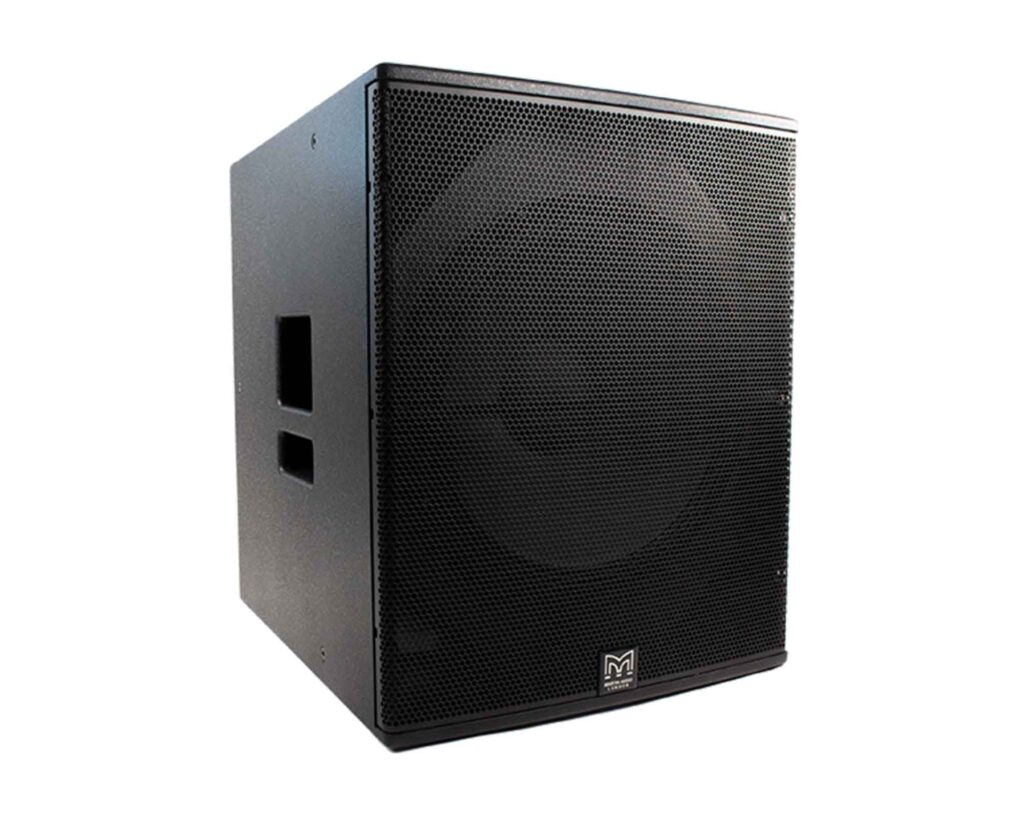
| Blackline X118 (passive) | 1 x 18 in | 42 Hz to 150 Hz | 36 Hz | 130 dB cont, 136 dB peak | 42 kg |
| Blackline XP118 (powered) | 1 x 18 in | 42 Hz to 150 Hz | 38 Hz | 131 dB cont, 137 dB peak | 44 kg |
| BlacklineQ Q218 (passive) | 2 x 18 in | 38 Hz to 100 Hz | 31 Hz | 136 dB cont, 142 dB peak | 82.5 kg |
Doubling the drivers buys about 6 dB and a few hertz of extension for double the weight, and costs top-end reach: the double 18 is specified to 100 Hz against the single’s 150 Hz, so it needs a lower crossover point. For mobile work two single 18s usually beat one double, because two cabinets can be split, coupled or deployed cardioid.
How many subs do I need?
The working rule of thumb is one sub per top: two 12 inch tops, two subs. It is convention rather than physics, but it balances the sub band against what a pair of tops delivers above the crossover. Adjust on programme material and room volume, not headcount: a 300 capacity room with a band or DJ is a two-sub job minimum. Buy for headroom, since a sub on its limiter sounds compressed, not loud.
Placement then adds output for free. Two subs far apart add up to 3 dB, only what doubling the power gives; close enough to couple gives up to 6 dB. QSC put the condition as acoustic centres within a quarter to a half wavelength of the top frequency reproduced, about 1.75 m for a sub running to 98 Hz. Side by side meets that; either side of a wide stage does not.
The crossover: what it does and where it lives
The crossover splits the signal into a low band for the sub and a high band for the tops; the crossover point is where the handover happens. Too low and the tops are still making bass they cannot make cleanly. Too high and the sub takes over the bass guitar’s body and the low end of male vocals.
There is no universal number. Martin Audio specify the passive X118 as “80 to 120 Hz active” while the powered XP118 is fixed at 100 Hz, and d&b’s controller presets offer 100 or 130 Hz, 110 or 140 Hz, and 70 or 100 Hz by cabinet. So 80 Hz to 120 Hz is where most portable systems sit, but a preset for your exact pairing beats any generic figure: it encodes point, slope, gain, delay and EQ measured properly.
High-pass the tops. This is not optional.
Leave the tops full range and both cabinets reproduce the crossover region at once, arriving at slightly different times and phasing against each other. The usual result is less low end than the subs alone. Use the sub’s high-pass output, the tops’ “with sub” preset, or a filter.
Where the DSP lives
The choice follows whether the system is powered or passive, a decision our active versus passive guide covers in full.
- Powered sub with a built-in crossover. Mixer output into the sub, sub’s link output up to the top on its pole, already high-passed. Martin Audio’s XP118 works this way, with EQ presets for their XP12 and XP15 tops.
- Outboard processor or DSP amplifier. A Martin Audio DX0.4 gives crossover slopes from 6 dB to 48 dB per octave in three filter types, ten bands of parametric EQ, 600 ms of input delay and a two-stage limiter over two inputs and four outputs. Cardioid and end-fire work need that, as does any passive rig. Do not run both: a powered sub high-passing the tops while a processor also crosses over puts two crossovers in series. See matching amplifiers and speakers for the amp side.
Placement is where most of the gain is
Floor coupling and boundaries
Subwoofers belong on the floor. Confining the radiation into a smaller solid angle raises output, and classical theory gives roughly 3 dB per additional boundary, so corner loading into a floor and two walls is theoretically worth about 9 dB over free field. Manufacturers quote maximum SPL “half space” because floor placement is the assumed condition.
One caveat from people who have measured it: Pat Brown’s work on boundary effects notes that real venues rarely deliver textbook figures, because available boundaries are often not large or rigid enough and room modes dominate subwoofer response anyway. Corner loading is the strongest boundary condition and the likeliest to backfire, exciting room modes and pushing energy into the structure. Ground stacking is right for the great majority of work; flown subs are legitimate on larger productions, but suspending loudspeakers overhead is rigging work needing a competent rigger, and this guide gives no rigging advice.
Keep the subs out of the microphones
A single subwoofer cabinet is effectively omnidirectional. d&b are specific: rear rejection for a typical 18 inch subwoofer is about 3 dB at 70 Hz, and a three-high stack manages only about 5 dB. Useful directivity needs a source as large as the wavelength it radiates, roughly 5 m at 70 Hz.
So a sub on stage radiates almost as much energy backwards into the vocal mics and drum overheads as forwards into the audience, muddying the mix and eating gain before feedback. Get the cabinets downstage of the microphones. It is also the strongest argument for cardioid deployment, which d&b note raises gain before feedback. See how to stop feedback.
Arrays: left-right split versus centre-clustered mono
The power alley
Put one sub each side of a wide stage and you have built a two-element interference machine. Both cabinets radiate the same content from positions metres apart, so their outputs reach each listener with a different time offset, and identical signals offset in time comb filter: alternating bands of reinforcement and cancellation across the room.
Because the wavelengths are metres long, those lobes and nulls are wide and unmistakable. Fulcrum Acoustic’s modelling of stacks either side of an 8 m wide stage shows nulls 20 dB down from the lobes at 100 Hz; 4 m off the centre line the nearer stack arrives about 2.5 ms before the other, putting the first deep cancellation around 100 Hz. With two cabinets 14 m apart the power alley of correct bass is roughly 4 m wide. Walk that rig across the room at soundcheck and the kick pumps in and out as you go.
Why mono, and why in one place
Two decisions fix it. First, feed the subs a mono sum: there is no useful stereo information below roughly 100 Hz for an audience spread across a room, and stereo bass only guarantees the positions interfere. Second, put them in one place. Fulcrum’s conclusion is blunt: the only real way to avoid the power alley is a single sub location. Centre-clustered subs behave as one larger source, couple for extra output, and cover the room smoothly rather than in stripes. Where sightlines forbid that, keep the clusters as central as possible and still feed them mono.
End-fire arrays
An end-fire array is a row of subs front to back along the axis of coverage, all facing the same way, with progressive delay so their outputs arrive in step in front and in disorder behind. The most forward cabinet carries the most delay, less as you work backwards. At around 343 m/s one metre of spacing is about 2.9 ms, so a four-element array on 1 m centres uses multiples of that. It also eats several metres of floor depth, which many stages cannot spare.
Cardioid arrays
A cardioid arrangement adds a second source behind the main one, processed to cancel energy radiating rearwards while adding slightly to the forward output. To cancel at the back and not the front, the path from rear source to front must be around a quarter of the wavelength being controlled, with phase and level set by separate processing and amplification.
In d&b’s Cardioid Subwoofer Array the minimum configuration is a stack of three cabinets with the middle one reversed on its own amplifier channel with the CSA filter engaged, giving 180 degree dispersion and at least 15 to 20 dB rejection to the rear. In Electro-Voice’s approach a rear-facing cancellation cabinet is polarity-inverted and DSP-matched to the forward cabinets’ rear response, and they quote up to 25 to 35 dB. Both stress the same conditions, and amateur attempts fail on them:
- Cardioid behaviour holds over only a little more than an octave, since source spacing is fixed while wavelength changes: just enough for a sub’s bandwidth.
- Forward sensitivity is lower than a conventional stack of the same cabinets: you trade output for pattern control.
- Cabinets must be aligned precisely, and every amplifier channel must share the same gain and signal, with only the rear one processed.
- The array needs clear space behind it: d&b specify at least 60 cm to walls, and any reflective surface behind a steerable array changes its polar response.
Know the principle, measure the numbers
Understanding why these arrays work helps when planning a system; deriving the settings from first principles at a load-in does not. Use the manufacturer’s array presets where they exist, and otherwise treat it as measurement work with someone who has done it before.
Delay and polarity alignment
Polarity. If sub and top are out of polarity through the crossover region they cancel exactly where they should be handing over, leaving a hole in the response. With music playing, flip the polarity switch and keep whichever setting gives more energy around the crossover at the mix position. The correct setting is the louder one.
Delay. With subs on the floor and tops on poles behind them, the acoustic centres sit at different distances from the audience, so their outputs do not arrive together. Delaying whichever cabinet is closer brings them into step, and at roughly 343 m/s every metre of path difference is about 2.9 ms, so a tape measure gives a starting estimate. Both settings can be got usefully close by ear, but a measurement shows the real phase relationship through the crossover, and the difference is audible as impact in the kick: on a system you own, measure once and save a preset.
Room and neighbours: bass leaves the building
Wavelengths in the sub band run from around 3 m to 10 m, so low frequency energy diffracts around obstacles that stop mids and highs, and couples into the structure, travelling as vibration and re-radiating elsewhere. Hence the neighbour two floors up who hears the kick drum and nothing else.
- A limiter-controlled venue is a bass problem first. A-weighting discounts low frequencies heavily and C-weighting barely does, so on a C-weighted or octave-band condition the sub band dominates. Our noise limiter guide has the figures band by band.
- Decouple the cabinets. A sub hard on a suspended timber floor drives it as a diaphragm; isolation pads cut structure-borne transmission cheaply.
- Cardioid deployment is a noise-control tool too. Fifteen to twenty decibels less energy backwards is that much less through the rear wall.
Weight and transport reality
Subwoofers are the heaviest items in most PA inventories, and weight decides what a mobile rig can carry. A single 18 inch cabinet at around 42 kg is a firm one-person lift; a double 18 at 82.5 kg is a two-person item and needs castors to be practical. Check that factory castor boards exist, since retrofitting rarely satisfies, that there is a 35 mm pole socket to carry the top and save two stands, and that two fit side by side in your van.
Common mistakes
- Stereo subs either side of a wide stage. Builds a comb filter with lobes and nulls metres wide, so most of the room hears a different low end from the mix position.
- No high-pass on the tops. Both cabinets fight over the same octave and phase against each other, often giving less low end than the subs alone.
- Crossover set too high. At 150 Hz or beyond the sub takes over the bass guitar’s body and the bottom of male vocals, muddying the vocal range.
- Subs behind or beside the mix position. You are mixing on an unrepresentative low end, making decisions that are wrong for everyone in front of you.
- One sub for a 300 capacity room. It runs out of headroom before the mix does, heard as a low end that collapses rather than a quiet sub.
- Cardioid without processing or measurement. A reversed cabinet with no delay, gain matching or filtering is not a cardioid array; it is one sub facing the wrong way, and with only about 3 dB of natural rear rejection it puts everything it makes into every open mic.
Popular picks from the shop
Martin Audio X118 BlacklineX 18 inch SubwooferView product → Martin Audio Blackline XP118 18 inch Powered SubwooferView product → Martin Audio Blackline Q218 Dual 18 inch SubwooferView product → Martin Audio DX0.4 Loudspeaker Management SystemView product →
Frequently asked questions
Do I need a subwoofer for my PA?
For full-band music, DJ sets or a band with a kit and bass at gig level, yes. For speech, an acoustic duo or background music, no: there is little useful content in the 35 Hz to 120 Hz band, so a sub adds cost and rumble for nothing.
Where should I place subwoofers for live sound?
On the floor, downstage of the microphones, and clustered in one place rather than split left and right. Centre-clustered subs fed a mono signal give the smoothest coverage and couple for extra output. Keep them out of corners where there is a noise condition.
How many subs do I need?
One sub per top is the working rule of thumb, so a pair of tops means a pair of subs. Adjust for programme material and room volume rather than headcount: a 300 capacity room with a band or DJ wants two minimum; the same room doing speech, none.
What crossover frequency should I use between subs and tops?
Most portable systems sit between 80 Hz and 120 Hz, and 100 Hz is a reasonable default. Martin Audio specify 80 to 120 Hz for the passive X118 and a fixed 100 Hz for the powered XP118. Prefer the manufacturer’s preset over any generic figure.
Why should subwoofers be mono and not stereo?
Nobody localises frequencies that low, so there is nothing to gain and much to lose: two widely spaced positions radiating different signals interfere unpredictably across the audience. A mono feed removes that variable; clustering removes the comb filtering spacing causes.
What is a cardioid subwoofer array?
A rear-facing, separately processed source behind the main subs, so output cancels behind the array and adds slightly in front. d&b quote 15 to 20 dB of rear rejection from a three-cabinet stack with the middle box reversed; Electro-Voice up to 25 to 35 dB from a polarity-inverted cancellation cabinet.
Shop this guide
Subwoofers, tops, processors and amplifiers, in stock. For advice on a specific room, get in touch.
Subwoofers Install Subwoofers Point Source Speakers System Processors Amplifiers



