

Home » Guides » Venue Guides »
Music Licensing for UK Venues and Businesses: TheMusicLicence, Premises Licences and the Kit
Playing music in a shop, pub, gym, office or hall usually involves two separate permissions: a copyright licence from PPL PRS and, in some cases, an entertainment licence from the local council. This guide sets out what the official sources say about each, how background music, live bands and DJs are treated, and the equipment that runs a background music system.
~9 min read · Updated October 2026 · By the Stage Supply team
In this guide: The short answer · Two different licences · TheMusicLicence · Entertainment licensing · Background, live and DJ · Streaming, radio and TV · The kit · Checklist · Popular picks · FAQ
This is not legal advice
We sell sound equipment; we are not licensing advisers. Everything below summarises what gov.uk and PPL PRS publish, with links. Your circumstances decide what you need, so check with PPL PRS for the music licence and with your local council’s licensing team for anything under the Licensing Act.
The short answer
According to gov.uk, you usually need a licence called TheMusicLicence if you play recorded music in public or at your business, including background music on a CD, radio or music channel, or if you stage live music in public. It comes from PPL PRS Ltd. Gov.uk states that playing live or recorded music in public without one infringes copyright, and you could be sued for damages.
That is a copyright licence. It is not the same thing as a premises licence or other authorisation under the Licensing Act 2003, which is issued by the local council and covers “regulated entertainment” such as live and recorded music in certain circumstances. Many venues need to think about both. Neither depends on what speakers you buy, but the way you choose and set up a system should match how you will use music.
Two different licences, two different bodies
| TheMusicLicence | Entertainment licensing (Licensing Act 2003) | |
|---|---|---|
| What it is about | Copyright: permission to play or perform music owned by rights holders | Whether the activity of providing entertainment needs local authorisation |
| Who issues it | PPL PRS Ltd | Your local council, as licensing authority |
| Typical form | TheMusicLicence (with temporary permits or amendments for events) | Premises licence, club premises certificate or temporary event notice (TEN) |
| Where it applies | Businesses and organisations playing music in public | England and Wales (gov.uk points to separate applications for Scotland and Northern Ireland) |
| Where to check | pplprs.co.uk, or 0800 0720 808 (the number gov.uk lists) | Your council’s licensing team |
PPL PRS describes the two as separate: the council’s entertainment licence lets you provide entertainment, possibly with conditions on hours or attendance, while TheMusicLicence covers the copyright music. One does not give you the other.
TheMusicLicence: what PPL PRS says
PPL PRS Ltd was set up so customers get one licence and one point of contact. Before 2018 businesses needed separate licences from PPL, which represents record companies and performers for recorded music, and PRS for Music, which represents songwriters, composers and music publishers for compositions and lyrics. Gov.uk now says you need a single licence from PPL PRS instead of separate ones.
Points from the TheMusicLicence pages and gov.uk:
- Who needs it. Gov.uk’s list runs from shops, offices and hairdressers to cinemas and theatres, hotels, restaurants, pubs and nightclubs, gyms, sports grounds, clubs, churches and halls, and public transport.
- Theatre productions. Gov.uk says you usually need a licence to play live or recorded music in a theatre, or to use sound recordings in a theatrical production, including on-stage and off-stage effects.
- Staff-only music counts. PPL PRS says that even if music is only for employees you will usually need TheMusicLicence.
- The radio is not covered by the station’s licence. PPL PRS explains that stations pay for the right to broadcast, but that does not cover playing the radio in public, such as on business premises.
- Working alone. PPL PRS runs a discretionary policy for solo homeworkers and single-worker premises with no customer or visitor access. Ask them whether it applies to you.
- Royalty-free music. Gov.uk says you do not need a licence to play royalty-free music. PPL PRS asks businesses relying on a royalty-free supplier to send confirmation from that supplier so it can update its records.
- Events. New customers can arrange temporary permits for events; existing licensees contact PPL PRS to amend their licence.
- Cost. The fee varies with the type of premises and how music is used. We do not quote figures here because they change; PPL PRS will give a quote.
If music you want to use is not managed by PPL PRS, gov.uk notes you may need a licence from another licensing body.
Entertainment licensing: the Live Music Act changes
The Licensing Act 2003 covers England and Wales. The Live Music Act 2012 and later deregulation changed when an entertainment licence is needed for music. The government’s entertainment licensing guidance summarises it like this: a licence is not required for live music or playing recorded music if all three of these apply:
- it takes place between 8am and 11pm;
- it takes place at premises licensed to sell alcohol on the premises; and
- the audience is no more than 500 people.
The same page adds that unamplified live music needs no licence anywhere between those hours, and amplified live music at a workplace needs none between those hours for an audience of no more than 500. It also lists exemptions, in defined circumstances, for places of worship, village and church halls, schools, hospitals, local authority premises, and music that is incidental to other activities.
It flags these situations as ones where a licence may be required:
- any entertainment between 11pm and 8am;
- amplified live or recorded music to an audience of more than 500;
- recorded music to an audience on premises not licensed to sell or supply alcohol.
The statutory guidance under section 182 (revised September 2026) adds detail that matters to venues: on alcohol-licensed premises, the exemption for recorded music and amplified live music only applies while the premises are open for the sale or supply of alcohol for consumption on the premises (paras 16.28 and 16.35); a licensing authority can, after a review, reinstate or add music conditions (para 16.57); and a beer garden included in the licence is covered by the same exemption for live amplified music within the hours and audience limit (para 16.44). Conditions such as noise controls can also apply. If your licence carries a noise condition, our noise limiters guide covers how those systems work.
Background music, live music and DJs
PPL PRS lists background music, live performances, DJs, jukeboxes, karaoke and music in quizzes among the uses TheMusicLicence covers in pubs and bars. Under the Licensing Act, the question is whether the activity counts as live or recorded music, and when and to whom it happens.
| Use | Copyright (TheMusicLicence) | Licensing Act (per the s182 guidance) |
|---|---|---|
| Background music (CD, streaming, radio, TV) | Usually needed; the radio station’s licence does not cover public playing | Recorded music. Exempt on alcohol on-licensed premises 8am-11pm, audience up to 500, while open for alcohol sales. Music that is genuinely incidental can fall outside regulated entertainment. |
| Live band or singer | Covered by TheMusicLicence; amend it or use a temporary permit for events | Live music. Unamplified: exempt 8am-11pm anywhere. Amplified: exempt 8am-11pm, audience up to 500, on alcohol on-licensed premises while open for alcohol sales, or at a workplace that is not licensed other than for late night refreshment. |
| DJ | Listed by PPL PRS as a use TheMusicLicence covers | Para 16.32: “The performance of a DJ who is merely playing tracks would not be classified as live music”, but it might be if the set “largely consisted of mixing recorded music in a live performance to create new sounds”. The guidance says organisers should check with their licensing authority where this matters. |
The same guidance treats a backing track or drum machine used by a band or singer as part of the live performance, and karaoke as generally live music.
Streaming services, radio and TV
PPL PRS is direct about personal streaming accounts: when you sign up to a service such as Spotify, you agree to use it for personal use only, not in a commercial setting. To stream music in a business it says you need a commercial streaming service, from one of the companies licensed by PPL and PRS for Music to supply businesses, and you still need TheMusicLicence to play that music to staff and customers.
TV counts too. PPL PRS points out that sports programming often contains music that will be played out in your pub or bar.
For equipment, that means a commercial streaming subscription is arranged with the provider, not built into a speaker or amplifier. Some install kit integrates with business services: Optimal Audio says the WebApp on its Zone controllers integrates Bluesound Professional and Soundtrack Your Brand.
The kit: what a background music system needs
The licence does not depend on your equipment, but good equipment keeps music at a sensible level, in the right rooms, at the right times. A typical system has four parts, each covered in its own guide.
1. A dedicated music source
A fixed player that starts on its own each morning is more dependable than someone’s phone. Options we stock include:
- Ecler PLAYER ONE: plays from USB and microSD, internet radio, AirPlay and DLNA, with calendar-based scheduling and a built-in web app. Half-rack or desktop.
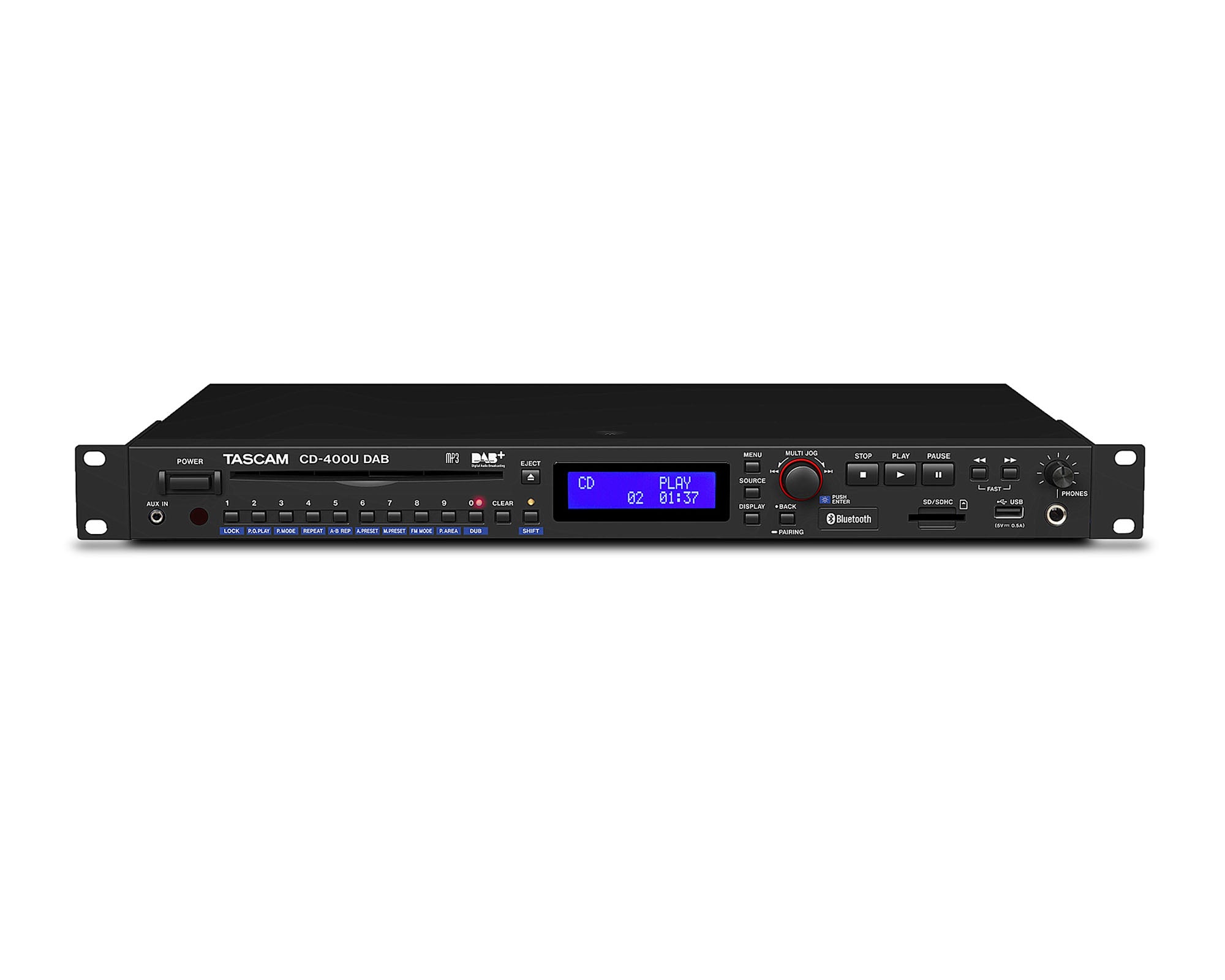
- Tascam CD-400UDAB: CD, SD and USB, Bluetooth and a DAB+/FM tuner, with RS-232C control. The tuner has its own independent output, which Tascam says allows simultaneous playback with other media, for example radio in one area and another source elsewhere.
- Apart PC1000RMKII: CD, USB and SD in 1U, with an Auto Play mode that starts playback whenever it is powered on, and rear USB and SD slots so media cannot easily be removed.
- Tascam SS-R250N: a networked solid-state recorder/player whose event lists can auto-play background music and announcements, and fetch files from an FTP server. Tascam suggests this for chain stores distributing the same files to several sites.
Playing your own files from a card does not by itself remove the need for TheMusicLicence. That depends on what the music is and who controls the rights, which is a question for PPL PRS.
2. Zone control
A zone mixer sends different sources and levels to different areas, such as a bar, restaurant and terrace, and usually has a paging mic input and a fire alarm music-mute interface. The Cloud Z4 Mk4 is a four-zone mono mixer with up to six line sources, wall remotes for level and source, and a fire alarm “music mute” interface. The Optimal Audio Zone 4P combines four zones of DSP with four 100W amplifier channels in 2U, browser control through its WebApp, scheduled routines, and an alarm override that mutes on a fire alarm trigger. A ZonePad 1 is a single-zone wall controller giving staff source selection and volume for one zone, with a local mic and mono line input. Our zone mixers compared guide goes through the Cloud, Optimal, Apart and Ecler ranges model by model.
3. Amplification and wiring
Most multi-speaker venues use 100V line. Many speakers run from one amplifier channel, and each speaker’s level is set by its tap. How that works, and when low impedance is the better choice, is in our commercial and background audio guide. Design, installation and testing of the electrical side is for a competent person.
4. Speakers
Several smaller speakers spread evenly sound better than two loud ones, and they keep level down near the bar and tables. Examples: the Optimal Audio Up 6 is a two-way 6in ceiling speaker with a steel back can and 70/100V taps or 16 ohm operation; the Apart MASK6CT is a surface speaker with 100V taps and an IP64 rating; the Optimal Audio Cuboid 5TX is a compact 100V cabinet that reaches IP54 with its optional terminal cover. For spacing and quantities see install speakers: how many you need; for beer gardens and terraces see outdoor speakers. If the venue also has bands and sport on screens, pub and bar AV puts the pieces together.
Checklist before music goes on
- Contact PPL PRS (or check its website) about TheMusicLicence for every way you use music: background, radio, TV, live, DJs, events.
- Check your premises licence or club certificate, any conditions on it, and the hours you are open for alcohol sales. Ask the council if anything falls outside the exemptions.
- Use a commercial streaming service, not a personal account, if you stream.
- Choose a source that restarts by itself, and zone controls staff can use without touching the rack.
- Make sure music mutes on the fire alarm where the system design calls for it, and agree the design with your installer.
- Set and lock maximum levels per zone where the kit allows it, especially if your licence has noise conditions.
Popular picks from the shop
Optimal Audio Zone 4P 4-Zone Controller with AmplifierView product → Cloud Z4 Mk4 Four-Zone MixerView product → Ecler PLAYER ONE Streaming Audio PlayerView product → Tascam CD-400UDAB Media Player with DAB+/FMView product → Apart PC1000RMKII CD/USB/SD Media PlayerView product → Biamp Apart MASK6CT 100V Surface Speaker, PairView product → Optimal Audio Cuboid 5TX 100V SpeakerView product → Optimal Audio Up 6 Ceiling Speaker, 100VView product →
Frequently asked questions
Do I need a licence to play music in my shop or office?
Usually, yes. Gov.uk lists shops, offices and factories among the places where you usually need TheMusicLicence, and PPL PRS says this includes music played only for staff. Check with PPL PRS for your situation.
Is TheMusicLicence the same as a premises licence?
No. TheMusicLicence is a copyright licence from PPL PRS. A premises licence, club certificate or temporary event notice comes from the local council under the Licensing Act 2003. They are separate.
Can I use my personal Spotify account in my business?
PPL PRS says personal streaming accounts are for personal use only under their terms. For a business it says you need a commercial streaming service licensed to supply businesses, and you still need TheMusicLicence.
Do I need a licence to play the radio at work?
PPL PRS says yes, usually: the station’s licence covers broadcasting, not playing the radio in public such as on business premises.
Does a pub need a licence for a live band or DJ?
TheMusicLicence covers live performances and DJs, and PPL PRS can amend it for events. Under the Licensing Act, gov.uk guidance says music on alcohol-licensed premises between 8am and 11pm, to no more than 500 people, needs no entertainment licence, subject to the conditions in the guidance. Check later finishes and bigger audiences with your council.
Shop this guide
Media players, zone mixers, amplifiers and install speakers for background music. Tell us about your rooms and how you use music and we will help with a system.
Media Players Zone Mixers Install Amplifiers Ceiling Speakers Install Speakers Sound Limiters



