


Home » Guides » Mixers & PA Systems »
PA Systems for Small Venues, Churches and Function Bands: UK Buying Guide
How to size and specify a complete PA for rooms up to about 300 people, pick the right topology for the job, and avoid the money pits, from someone who has mixed in most of these rooms.
~12 min read · Updated July 2026 · By the Stage Supply team
In this guide: Use cases · System topologies · What size PA do I need? · Coverage basics · The complete system · Install vs portable · Budget philosophy · UK practicalities · FAQ
Start With the Job, Not the Speaker
Every bad small-venue PA purchase starts the same way: someone picks a speaker they liked the look of, then tries to bend the room and the programme around it. Work the other way. Define the job first, because the five common small-venue jobs pull in genuinely different directions:
- Pub / function band. Full-range music at real level, vocals over a drum kit, fast load-in, different room every week. Needs headroom, subs and portability.
- Church / worship. Speech intelligibility first, music second, in a reverberant room, operated by volunteers. Controlled dispersion matters more than raw SPL.
- Conference / spoken word. Vocal range only, even coverage across seating, near-zero tolerance for feedback with lapel and podium mics.
- Mobile DJ. Recorded music, which means dense, sustained low end. Subs are not optional; one-person load-ins are the norm.
- Village hall / community install. Mixed use, untrained operators, gear that lives on walls. Simplicity and idiot-proofing beat performance on paper.
Everything below (topology, size, mixer, monitoring) flows from which of these you are. Most buyers are honestly two of them, and that is fine: buy for the harder job.
System Topologies: Honest Trade-Offs
Powered point-source tops (plus subs)
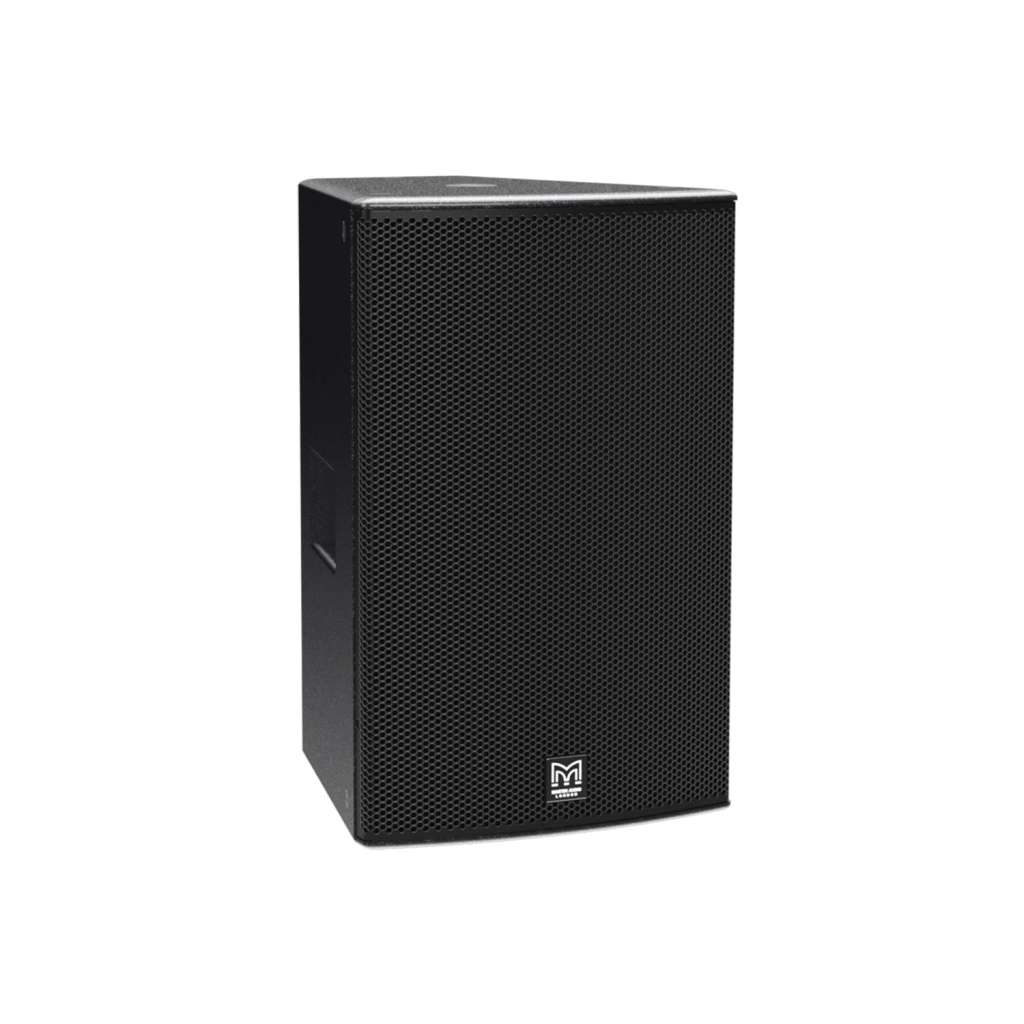
The default small-venue answer for good reason. A pair of powered 10″, 12″ or 15″ point source speakers on stands gives the best output-per-pound of any topology, takes EQ and abuse well, and doubles as monitor wedges in many designs. The trade-off is coverage: a typical 90 x 60 degree horn sprays energy at walls and ceilings in reverberant rooms, and a pair on poles leaves a hole in the middle of wide rooms. Amp, DSP and crossover are built in, so the passive matching homework disappears.
Column arrays
Column PA systems stack multiple small drivers vertically over a compact sub base. The physics gift is dispersion: very wide horizontally (often 120 degrees or more) and deliberately narrow vertically, so energy goes at ears and not at a reflective ceiling. That is what a church or a spoken-word room wants, and it is why columns have taken over the wedding and acoustic-act market. The trade-offs: less raw SPL and low-end punch than a 12-inch-plus-sub rig at similar money, and near-zero flexibility: you cannot re-aim the vertical pattern or use one as a wedge.
Compact line arrays
Real line arrays, even compact ones, only earn their keep when you have depth to throw down and height to fly from. Below roughly 200 capacity in a shallow room, a flown mini-array is usually money spent on the wrong problem. Where they win in our size bracket is the deep, narrow room (a long church nave, a 300-cap club with a balcony) where the controlled vertical pattern keeps rear rows loud without frying the front row. Expect rigging, cost and setup complexity a class above everything else here.
Passive speakers plus separate amps
The classic install topology, and still the right one for permanent systems: amps live in a locked rack, speakers on walls stay light and unpowered, one mains feed to the rack rather than a socket behind every cabinet. For portable use it has largely lost to powered boxes, because you carry amp racks and must get impedance, power matching and crossover settings right yourself. If you go this route, read our guide to matching amplifiers and speakers before buying anything: mismatched passive systems are the most common self-inflicted wound in this market.
| Point source + subs | Column array | Compact line array | |
|---|---|---|---|
| Coverage pattern | Typically 90 x 60 degrees per box; wide and tall, excites the room | Very wide horizontal, narrow vertical; kind to reverberant rooms | Narrow, steerable vertical; even front-to-back in deep rooms |
| Setup time | Fast; two stands, two subs, done in minutes | Fastest; one-piece or two-piece per side, no stands | Slowest; flying hardware or ground stacks, angles to set |
| Max useful SPL for the money | Highest; best raw output per pound | Moderate; enough for speech and light-to-medium bands | High, but you pay a premium for it at this scale |
| Low end | Strong with subs; scalable | Built-in sub base; fine for most music, limited for DJ level | Needs separate subs; scalable |
| Best for | Function bands, DJs, general-purpose hire | Churches, speech, acoustic acts, weddings | Deep or balconied rooms, permanent installs near 300 cap |
Choose point source if
- You play full-band or DJ programme at real level
- You want maximum output per pound and easy repairs
- The room changes every week
Choose a column if
- Speech intelligibility in a lively room is the priority
- One person sets up and the look matters
- Programme is vocals, acoustic acts or background music
Choose a line array if
- The room is deep, narrow or balconied
- You can fly it, and someone competent signs off the rigging
- It is a permanent install near the top of this size bracket
What Size PA Do I Need?
Forget watts as a shopping number, manufacturers count them differently and a well-designed 1,000 W box will bury a badly designed 2,000 W one. Think in terms of level at the listener and distance. Speech reinforcement wants roughly 70 to 80 dBA at the furthest seat. A function band is typically playing at 95 to 102 dBA out front; a club-style DJ night pushes past that. Sound falls off at about 6 dB per doubling of distance from a point source, so the real question is: how loud, how far away, with how much headroom left over. As a rule of thumb keep 10 dB of headroom above your average level; a system running flat out sounds strained long before it clips.
| Room / audience | Speech / background | Full band / DJ |
|---|---|---|
| Up to ~80 people, small hall or pub back room | Single column, or a pair of powered 8″/10″ tops | Pair of powered 12″ tops; add one 15″ or 18″ sub for DJ or kick-heavy bands |
| 80-150 people, function room, mid-size church | Pair of columns, or powered 10″/12″ tops aimed properly | Pair of powered 12″ tops plus a pair of 15″/18″ subs |
| 150-300 people, large hall, club, big church | Columns or point source plus delay fills if the room is deep | Powered 12″/15″ tops, two to four 18″ subs, or a compact array if you can fly it |
When do you actually need subs?
Be honest about programme. Speech has almost no useful content below 100 Hz, a sub on a conference rig adds nothing but rumble from handling noise and plosives. Acoustic duos and worship bands with light percussion usually get by on decent 12″ tops or a column’s built-in bass section. The moment there is a full drum kit, bass guitar at gig level, or recorded dance music, add subwoofers: asking a 12″ top to reproduce kick drum at 100 dBA is how tops die young and mixes turn to mud. Highpass the tops where they cross to the subs and everything above cleans up audibly.
Common mistake: subs with no crossover knowledge
Buying subs and running the tops full range alongside them. The tops and subs then both reproduce 80-120 Hz, phase against each other, and the result is less low end than the subs alone. Use the sub’s built-in crossover output or the mixer’s highpass so the tops only handle everything above the crossover point (typically 80-120 Hz), and check polarity by ear: flip the polarity switch and keep whichever setting gives more bass at the mix position.
Coverage Basics: Aim Before You EQ
Dispersion figures on a spec sheet (say 90 degrees horizontal by 60 degrees vertical) describe the wedge of the room the speaker actually covers at high frequencies. Two boxes at 90 degrees each, toed in slightly from the front corners of the stage, will cover most small rooms; wider rooms may want 100-110 degree boxes or a deliberate crossfire aim. Everything outside that wedge hears a dull, distant version of the mix and everything reflected off walls inside it smears intelligibility.
Height matters as much as angle. Get the HF horn to roughly 1.8 to 2.2 m, just above standing head height, so the front row does not block the back row’s treble. This is the single cheapest upgrade in small-venue sound: a pair of decent speaker stands or wall brackets transforms boxes that were sat on a table or the floor.
Common mistake: speakers on the floor
Full-range tops stood on the floor or a table fire their HF into the first two rows’ waistlines. The front row gets blasted, the back row hears mush, and the operator turns it up to compensate, which triggers the noise limiter. Subs belong on the floor; tops belong at head height or above, tilted slightly down at the audience.
Delay fills, briefly
In a long room (roughly beyond 15-20 m deep), rather than hammering the front rows to reach the back, add a small pair of fill speakers halfway down, fed from a delayed output. Sound travels at about 343 m/s, so delay the fills by roughly 3 ms per metre they sit in front of the mains, plus a few milliseconds more so the mains still arrive first and the image stays on stage. Any modern digital mixer or DSP speaker has output delay built in; it is a ten-minute job that transforms deep rooms.
The Rest of the Chain: A Complete System, Not Just Speakers
Mixer: analogue or digital?
For anything beyond a couple of mics, buy digital. A compact digital mixer gives you per-channel EQ and dynamics, scene recall (save the Sunday-service or the wedding-set setup once, recall it forever), built-in effects, and enough aux sends for proper monitoring, all things that cost racks of outboard in the analogue world. Analogue still earns a place where the operator is a nervous volunteer who needs one knob per job, or as a grab-and-go for two-mic gigs. If you are weighing up the popular Allen & Heath options, our Qu vs SQ vs Avantis comparison covers that decision in depth.
Monitors or IEMs?
Wedges are cheap, simple and forgiving, but every wedge on a small stage adds level and feedback risk in the room. In-ear monitoring takes stage volume down dramatically, a huge win in noise-limited venues and reverberant churches, at the cost of per-musician buy-in and a learning curve. Many small acts run hybrid: IEMs for the singers, one wedge for the drummer. Our in-ear monitor systems guide covers licensing, mixes and budgets.
The unglamorous essentials
DI boxes for anything with a jack output going a long way to the mixer (acoustic guitars, keyboards, laptops, backing tracks), a DI balances the signal, kills most hum, and its ground-lift switch fixes the classic laptop buzz. Stands for mics and speakers. Cabling: balanced XLR for signal runs, proper speaker cable (never instrument cable) for passive boxes, and PowerCON or IEC mains leads for powered boxes. Budget a genuine 10-15% of system cost for cables, stands and cases; it is the difference between a system and a pile of boxes.
Complete-system checklist: function band (up to ~200 cap)
- Pair of powered 12″ tops on stands
- Pair of 15″ or 18″ powered subs with crossover engaged
- 16-24 channel digital mixer with 4+ aux sends
- Vocal mics, drum mic set, DIs for keys/tracks/acoustic
- 2-3 wedges or IEM systems, or a hybrid of both
- Multicore or digital stagebox, XLR looms, mains distro from one 13A feed
Complete-system checklist: church / worship
- Pair of columns, or wall-mounted point source with controlled dispersion
- Compact sub only if the band needs it; speech does not
- Digital mixer with saved scenes and locked-down volunteer layer
- Lectern/headset mics for speech, vocal mics and DIs for the band
- IEMs preferred over wedges to keep the room quiet
- Delay fills for a deep nave, tidy installed cabling, hearing-loop feed from a mixer output
Complete-system checklist: conference / spoken word
- Column pair or 8″/10″ tops; no subs
- Small digital mixer with per-channel EQ for feedback control
- Wireless lapel/handheld/podium mics as the format demands
- DI or USB/Bluetooth input for laptop playback and videos
- Speakers forward of the lectern line to keep gain-before-feedback
- Spare batteries, spare mic, spare XLR. Speech events have zero tolerance for downtime
Install vs Portable
If the system lives in one room, install it. Wall or ceiling brackets get speakers to the right height permanently, aimed once by someone who knows what they are doing, with no stands to trip over and no weekly setup drift. Passive boxes with amps in a locked rack come back into their own here, and cabling disappears into containment. For background music and paging across multiple zones (foyer, hall, toilets, car park), a 100V line system is the right tool: it distributes audio at high voltage so you can daisy-chain many small speakers over long, thin cable runs from one amplifier, tapping each speaker at the wattage it needs. It is a paging and ambience technology, not a performance one. Do not expect a 100V ceiling system to cover the band.
Safe mounting and flying
Anything hung over people’s heads is a life-safety item, not an AV item. Use the manufacturer’s own bracket or flying points, rated hardware, and fixings appropriate to the wall or structure, a 15 kg speaker on a plasterboard plug is a matter of time. Flown arrays and any speaker suspended from a structure should have a secondary safety (steel bond) and, for installs, a competent person signing off the structural fixing. On temporary rigs, keep speaker stands on their full leg spread, sandbag them in crowds, and never extend a pole-mounted top above the stand’s rated load height. If the venue asks for paperwork on a temporary event power or rigging setup, that is normal: BS 7909 covers temporary event electrical systems in the UK, and a tidy, documented rig gets you invited back.
Budget Philosophy: Where to Spend, Where to Save
Spend on the things that touch the air and the things that touch the signal first: loudspeakers, then the mixer and the microphones. A quality pair of tops will outlast three cheap pairs and hold resale value; the difference between a budget and a quality vocal mic is audible on every single word of every event. Save on brand-name cables (well-made generic XLRs are fine), on channel count you will not use for two years, and on outboard gear a digital mixer already includes.
Buy once where the item is hard to change later (installed speakers, brackets, the mixer everyone learns) and buy cheap-then-upgrade where it is modular (add a second pair of subs later, add IEM packs one musician at a time). The classic small-venue path (decent tops now, subs in six months, IEMs next year) is a perfectly good plan. The classic mistake is the opposite: blowing the budget on an oversized mixer and having nothing left for the speakers everyone actually hears.
Common mistake: buying power you cannot use
A big-name 15″ rig capable of 133 dB peaks is wasted in a 100-cap function room with a limiter set to 96 dBA. You have paid for headroom the venue will never let you use, and hauled the weight for nothing. Match the system to the rooms you actually play. In most UK function venues, a well-aimed mid-size system running comfortably beats a huge one being strangled.
UK Practicalities: 13A Sockets and Noise Limiters
Power
A standard UK 13A socket delivers about 3 kW at 230 V, and that is more than most small systems ever draw: amplifier “watt” ratings describe audio output capability, not continuous mains draw, and real-world music programme pulls a fraction of the rated figure. A typical tops-subs-mixer function rig runs happily from a single 13A feed through a decent distro. What actually trips venues’ breakers is everything sharing one circuit: PA plus lighting plus the tea urn. Ask for a socket that is not shared with catering or lighting, use one clean feed for all audio to avoid hum loops, and carry an extension you have actually inspected: venue-supplied reels are a lottery.
Working with noise limiters
Many UK function venues fit sound limiters as a licensing condition: a microphone in the room monitors level and cuts stage power if the threshold (commonly somewhere in the 90s dBA) is exceeded for more than a few seconds. Fighting one is a losing game, a power cut mid-first-dance is the result. Instead: ask the venue for the threshold and the traffic-light unit’s location before quoting; do a level check at soundcheck against the display; take the drum kit down (hot rods, smaller kit, or e-drums) because acoustic drums alone can trip a low-set limiter with the PA off; move vocals and everything else to IEMs so backline and wedges are not adding to the room; and aim speakers at the audience, not the limiter mic or the ceiling. A limiter also resets the sizing conversation: a controlled, well-aimed system at 95 dBA sounds better than a big rig ducking under a ceiling. One more thing: never plug audio gear into a socket circuit the limiter does not control in order to bypass it, it breaches the venue’s licence conditions and your booking terms.
Popular picks from the shop
FAQ
What size PA do I need for 100 people?
For speech or background music, a single decent column or a pair of powered 8″/10″ tops covers 100 people easily. For a live band or DJ, a pair of powered 12″ tops plus at least one 15″ or 18″ sub is the sensible baseline: it gives you gig level with headroom to spare rather than running flat out.
Column array or point source for a church?
Usually a column. Its narrow vertical dispersion keeps energy off the reflective ceiling and floor of a typical church, which is what protects speech intelligibility in a reverberant space. Choose point source instead if the worship band is loud and full-range, or if you need boxes that can double for other duties; then work on aiming and consider controlled-dispersion install boxes.
Do I need a sub for speech-only events?
No. The useful energy in speech sits well above the range a subwoofer reproduces, so a sub adds cost, weight and rumble for no intelligibility benefit. Spend the money on better tops, better mics or a spare wireless channel instead.
Are more watts always louder?
No. Doubling amplifier power only buys about 3 dB, which is a just-noticeable increase, and manufacturers rate “watts” inconsistently (peak vs continuous). Sensitivity, driver size and cabinet design matter at least as much. Compare maximum SPL figures measured the same way, and trust your ears at similar level over any number on a box.
Can I run my whole PA from one 13A socket?
Almost certainly yes for the systems in this guide. A 13A socket supplies about 3 kW, and a typical small powered rig draws well under half of that on real music programme. Keep all audio on one feed to avoid earth loops, and keep lighting and catering on different circuits.
Passive or powered speakers for a small venue?
Powered for portable use: amps, DSP and crossovers are built in and matched, so setup is faster and there is nothing to get wrong. Passive still makes sense for permanent installs where amps live in a locked rack and the wall-mounted boxes stay light. If you go passive, matching amp to speaker properly matters, see our amplifier and speaker matching guide.
How do I stop the venue’s noise limiter cutting our power?
Find out the threshold and where the sensing mic is before the gig, soundcheck against the display, quieten the stage (damped or electronic drums, IEMs instead of wedges), and aim the PA at the audience rather than the ceiling or the sensor. If the act genuinely cannot work under the limit, that is a booking conversation, not a technical one.
Is a compact line array overkill for 300 people?
Often, yes. In a wide, shallow room a good point source or column system covers 300 people for less money and less rigging. A compact array earns its cost in deep, narrow or balconied rooms where its controlled vertical coverage keeps the back rows loud without overpowering the front, and in permanent installs where it is flown once and left alone.
Shop this guide
UK stock and fast delivery on complete PA packages, from single columns to full band rigs, and real advice from people who mix on this gear.


