

Home » Guides » Venue Guides »
Am-Dram and Village Hall Starter Kit: Sound, Light and Talkback on a Hall Budget
What an amateur dramatic society or community hall actually needs to put on a play, a panto or a small musical: a compact digital mixer, speakers, radio mics, area mics, playback, LED lighting with a simple desk, and talkback. With a small hall and medium hall kit list built from kit we stock.
~11 min read · Updated October 2026 · By the Stage Supply team
In this guide: The short answer · Sound · Radio and area mics · Playback · Lighting · Talkback · Power and safety · Hearing loop · Kit list · Popular picks · FAQ
The short answer
For most societies and halls, a sensible starting kit is: a compact digital mixer with enough inputs for your radio mics plus a few spares, a pair of powered speakers or a column PA, a handful of headset radio mics for principals, two or three hanging mics for the chorus, a laptop for sound effects, a small rig of LED fresnels or profiles for front light and LED pars for colour, a touchscreen DMX desk, and simple wireless talkback between the stage manager and the operators.
Everything below is a typical starting point, not a rule. A straight play in a 60-seat hall may need no radio mics at all; a musical with a band in a 200-seat hall needs a lot more. Count what your shows actually use before you buy, and buy in an order that lets each purchase work on its own.
If your hall doubles as a school space, our school AV guide covers assemblies and sports days too. If you already have tungsten lanterns on a dimmer rack, read replacing tungsten with LED in a hall before buying any lighting.
Sound: the mixer and speakers
Pick the mixer by counting inputs
Add up radio mics, area mics, playback (a stereo pair), any band inputs, and a spare or two. Our guide to how many mixer channels you need walks through it. For hall theatre, the Allen & Heath CQ and Qu families cover most needs:
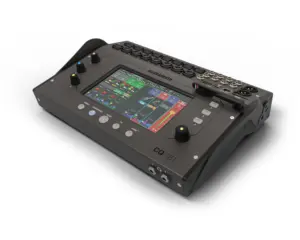
- Allen & Heath CQ-12T: 10 mic/line inputs plus a stereo input, 6 monitor outputs and a 7″ touchscreen. Enough for a play with a few radio mics.
- Allen & Heath CQ-18T: 16 mic/line inputs plus a stereo line input, built-in dual-band Wi-Fi for app control, a 24×22 USB audio interface and a 7″ touchscreen.
- Allen & Heath CQ-20B: the same 16 mic/line inputs with two stereo line inputs, but no built-in touchscreen. Allen & Heath designs it to be controlled from the CQ MixPad app over its built-in Wi-Fi, so you need a tablet or laptop at every show.
- Allen & Heath Qu-5 and Qu-6: 16 and 24 mic/line inputs, motorised faders, a 7″ touchscreen, a 32×32 USB-C audio interface and an XLR talkback socket. These suit a medium hall, a musical with a band, or a society that wants physical faders for every actor.
Every CQ model has an Automatic Mic Mixer (AMM) on its inputs, which Allen & Heath pitches at speech and small-scale theatre; the Qu series has one too. It helps when several mics are open at once, but it is not a substitute for a volunteer who knows the script and mutes the mics that are not in the scene. The CQ and Qu ranges also have a Feedback Assistant; our guide to stopping feedback covers the basics.
Speakers: column or a pair of boxes
In a reverberant hall with a flat floor, a column speaker often makes speech easier to follow, because it puts its sound towards the audience rather than the ceiling. Our column PA vs box speakers guide explains the trade-offs. Two options from opposite ends of the scale:
- HK Audio POLAR 8 MK2: a compact column with an 8″ sub, 120° x 45° coverage, two combo inputs and Bluetooth. Fine for speech, playback and a small cast in a small hall.
- Electro-Voice Evolve 50M: a larger column with a 12″ sub, 120° x 40° coverage and a built-in 8-channel digital mixer with four mic/line combo inputs. It can run a simple event on its own, though for a show you would still feed it from the main mixer.
- A pair of Electro-Voice ELX200-12P powered 12″ speakers (90° x 60° coverage) on stands is the conventional alternative. The column guide compares output, bass extension and weight model by model.
Two columns or two boxes, one each side of the stage, is the usual layout. Mount and position speakers only as the manufacturer allows; flying them from the hall structure is a job for a competent rigger, not a volunteer.
Radio mics, headsets and area mics
Headsets for actors
For musicals and pantos, the usual answer is a bodypack transmitter with a headset (or a lavalier hidden in the hair or costume) for each principal. Our wireless microphone buying guide covers the systems, radio mics for a school musical or am-dram show covers how many you need and where to place them, and wireless licensing in the UK explains the Ofcom side, which you need to sort before the first show.
- Sennheiser EW-D. The EW-D ME3 Set comes with an EW-D EM receiver, an EW-D SK bodypack and an ME 3 cardioid headset. To add channels, add an EW-D EM receiver and EW-D SK bodypack per actor. The SK takes 3.5mm jack microphones, and Sennheiser lists the omni HSP Essential (also in beige) as compatible.
- Shure SLX-D+. The SLXD4Q+ is a four-channel receiver; Shure says up to three of them (12 channels) can share one pair of antennas. The SLXD4D+ is a dual receiver in a half-rack chassis. Each actor needs an SLXD1+ bodypack, which takes TA4F (TQG) microphones such as the Shure WH20 TQG headset.
Connectors are the trap: a headset wired for one brand of bodypack will not plug into another. Check before you buy, using our headset, lavalier and bodypack connectors guide. Budget for batteries or rechargeables too; see radio mic batteries.
Area and chorus mics
A chorus or ensemble is usually covered by a few hanging or float mics rather than a radio mic each. The Audio-Technica PRO45 is a cardioid hanging condenser with a 7.6m attached cable, an XLR at the end and a steel hanger included; it runs on phantom power. The Audio-Technica U853R is a step up, with a supplied in-line power module that includes an 80 Hz high-pass filter. Our guide to miking a choir covers placement and how many to use. Hanging them from a bar or ceiling is for a competent person; the mics themselves are light, but the fixing points are not a volunteer decision.
Area mics pick up the whole stage, so they need more gain than a headset and are more prone to feedback. Expect them to lift the chorus, not to make every spoken line clear. Our microphone technique guide covers headset placement and the rest.
Sound effects and music playback
Most societies run effects and pre-show music from a laptop. Show-control software such as QLab (macOS only) lets you build a cue list and fire each effect with one key press, which is far safer than hunting through a playlist mid-scene. Windows users have other cue-list programs; the principle is the same.
The simplest connection is USB straight into the mixer: every CQ model and every Qu model has a USB audio interface built in, so the laptop appears on the desk as its own channels. Where the laptop has to sit away from the mixer, or plugs into a column speaker’s inputs, a USB-to-balanced-XLR box such as the Interspace Industries USB-C BB3 gives you a proper balanced feed. Turn off system sounds and notifications on the show laptop. Gov.uk says using sound recordings in a theatrical production, including effects, usually needs TheMusicLicence; see music licensing for UK venues.
Lighting: LED fixtures and a simple desk
A first rig for a hall stage is usually front light (to see faces) plus colour wash. Our first lighting rig guide covers the order to buy in, and LED profiles and fresnels for theatre explains which fixture does what.
- Front light: fresnels or profiles. A fresnel gives a soft-edged pool that blends easily. The warm white Chauvet Ovation F-145WW-2 draws 73W at 230V, and Chauvet says its 70W LED gives output comparable to a 650W incandescent fresnel. A profile gives a hard, shapeable beam that can be cut off the proscenium or used for a tight special; options include the ADJ Encore Profile 1000 WW (144W maximum), the Elumen8 Virtuoso 600 WW (172W), and full-colour profiles such as the Chauvet Ovation E-2 FC and Elumen8 Virtuoso 600 RGBAL.
- Colour: LED pars and colour fresnels. Pars such as the Chauvet COLORdash Par H7X, the IP65-rated COLORdash Par H12X IP or the Elumen8 Virtuoso 900 Par IP put washes of colour on the stage and cyc. A colour fresnel such as the Elumen8 MP75 RGBL gives a softer, more even colour wash across the acting area.
LED fixtures do not go on a dimmer channel
LED fixtures need constant (non-dimmed) power and take their brightness from DMX. If your hall’s lighting sockets are fed from a dimmer rack, providing constant power to them is a change to the fixed installation and is for a competent electrician. See dimmers, relay packs and LED fixtures.
The desk and DMX cable
An LED fixture uses several DMX channels, so a desk with a fixture library is far easier for volunteers than an old two-preset board. ChamSys describes QuickQ as aimed at the novice user. The ChamSys QuickQ 10 outputs one DMX universe and has 20 fixture faders; the QuickQ 20 outputs two universes. One universe carries 512 channels, which covers a typical hall rig. Our ChamSys MagicQ range explained guide compares the family, and lighting desk basics covers patching and cues.
Run DMX from the desk to the first fixture and daisy-chain from there, using DMX cable rather than microphone cable: for example a 10m 5-pin DMX cable for the run to the bar and 3m 3-pin DMX cables between fixtures that use 3-pin. Check whether your fixtures and desk use 3-pin or 5-pin before ordering; where they differ you will need an adaptor or a cable with one of each. DMX explained covers addressing and termination.
Hanging fixtures on bars, booms or truss, and choosing the clamps and safety bonds, is rigging and should be done or signed off by a competent person. This guide does not cover it.
Talkback
Even a one-act play goes more smoothly when the stage manager can call cues to the lighting and sound operators. Wireless headset systems are the simplest way to do it in a hall, because there is no cable to run from the wings to the back of the room. Our Hollyland Solidcom intercom guide covers the range in depth.
- Hollyland Solidcom SE-2S Global: a two-person headset kit on 2.4GHz with no base station, rated by Hollyland at 350m line of sight. Enough for a stage manager and one operator.
- Hollyland Solidcom C1 Pro 4S-DH: a four-person, double-ear version of the C1 Pro, on the 1.9GHz band (1880-1900 MHz in Europe), also rated by Hollyland at 350m line of sight. Hollyland says a C1 Pro system without a hub supports two to eight headsets.
There is also a simple wired option at the sound desk. The Qu mixers have a dedicated XLR talkback socket with its own preamp and phantom power; when the Talk key is pressed (it can also be set to latch), Allen & Heath routes the talkback mic to whichever mixes you assign, such as a backstage or foldback speaker. The CQ mixers do not list a dedicated talkback socket. A dynamic push-to-talk mic such as the sE Electronics V7 PTT suits that socket: sE designed it as a talkback mic for engineers and crew, with a push-to-talk button so a talkback mic is not left open by accident. This is one-way, desk to stage; the wireless headsets above are what let crew talk back.
Power and safety basics
Plan for where the power comes from before buying more kit. Many small hall rigs run from ordinary 13A sockets, and an LED rig draws far less than the tungsten it replaces, but check what your own hall’s circuits are rated for with whoever looks after its electrics. Our event power distribution guide explains the connector types and ratings, and PAT testing for event equipment covers inspecting and testing portable kit.
Design, installation and testing of any fixed electrical work, including new sockets, circuits for lighting bars or changes to a dimmer rack, is for a competent electrician. We supply equipment; we do not give wiring advice. Keep cable runs tidy and taped down where the audience walks, and keep fire exits and their signage clear.
Consider a hearing loop
Community halls serve audiences with hearing aids, and a hearing loop lets aid users hear the show directly through the telecoil setting on their aids. A loop is fed from the mixer and is usually a fixed installation, so it is a building project rather than a show purchase. Ampetronic rates its ILD122 half-rack driver at up to 200 square metres under stated conditions, which matter: metal in the floor or walls reduces what a driver can cover. Read hearing loops for UK venues before buying anything, and have the design and installation done by a competent installer.
Kit list: small hall and medium hall
Two typical starting points, built from kit we stock. “Small hall” here means a straight play or panto with a few principals on headsets and up to around 100 seats; “medium hall” means a musical with a band, more headsets and a bigger lighting rig. Adjust quantities to your shows.
| Item | Small hall | Medium hall |
|---|---|---|
| Mixer | Allen & Heath CQ-12T or CQ-18T | Allen & Heath Qu-5 or Qu-6 |
| Speakers | 2 x HK Audio POLAR 8 MK2 | 2 x EV Evolve 50M or 2 x EV ELX200-12P |
| Radio mics | 2 to 4 channels of Sennheiser EW-D ME3 Set | Shure SLXD4Q+ receivers with SLXD1+ bodypacks, 8 to 12 channels |
| Headsets | ME 3 (included) or HSP Essential | Shure WH20 TQG or other TA4F headsets |
| Area mics | 2 x Audio-Technica PRO45 | 3 x Audio-Technica U853R |
| Playback | Laptop over USB into the CQ | Laptop over USB into the Qu, Interspace BB3 as backup |
| Front light | 4 x Chauvet Ovation F-145WW-2 | 4 to 6 x Elumen8 Virtuoso 600 WW plus fresnels |
| Colour | 4 x Chauvet COLORdash Par H7X | 6 to 8 x Elumen8 Virtuoso 900 Par IP plus Elumen8 MP75 RGBL |
| Lighting desk | ChamSys QuickQ 10 | ChamSys QuickQ 20 |
| DMX | 10m 5-pin plus short links | As small hall, plus spares |
| Talkback | Hollyland Solidcom SE-2S Global | Hollyland Solidcom C1 Pro 4S-DH plus sE V7 PTT |
| Hearing loop | See the hearing loop guide | Ampetronic ILD122 (installed by a competent person) |
Popular picks from the shop
Allen & Heath CQ-18T Digital MixerView product → Allen & Heath Qu-5 Digital MixerView product → Shure SLXD1+ Bodypack TransmitterView product → Audio-Technica PRO45 Hanging MicrophoneView product → ChamSys QuickQ 10 Lighting ConsoleView product → Chauvet Ovation F-145WW-2 LED FresnelView product → Elumen8 10m 5-Pin DMX CableView product → Hollyland Solidcom SE-2S IntercomView product →
Frequently asked questions
What sound equipment does an amateur dramatic society need?
Typically a compact digital mixer, a pair of powered speakers or columns, radio headset mics for principals, a few hanging mics for the chorus, and a laptop for sound effects. A straight play in a small hall may need only the speakers and a laptop; musicals need the radio mics.
How many radio mics do we need for a musical?
Count the principals who sing or speak while moving, then decide whether minor roles can share or use area mics. Each channel needs its own bodypack and a receiver channel, and your mixer needs an input for each. Many societies start with 4 to 8 channels and add more.
Can LED stage lights plug into our old dimmer sockets?
Not while those sockets are being dimmed. LED fixtures need constant power and take their brightness from DMX, and Elumen8, for one, tells users not to connect its LED profiles to a dimmer pack. Whether your existing sockets can provide constant power, and any change to the fixed installation, is for a competent electrician.
What is the easiest lighting desk for volunteers?
A good starting point is a desk with a fixture library and a touchscreen, such as the ChamSys QuickQ range, which ChamSys aims at the novice user. You pick fixtures and colours rather than individual DMX channels.
Do we need a licence for radio mics in a village hall?
Possibly. It depends on the frequencies your system uses. Our wireless licensing guide explains Ofcom licensing and Channel 38 before you buy.
Should a village hall have a hearing loop?
A loop is worth serious consideration for any hall serving the public. It is a fixed installation, so plan it with a competent installer and read our hearing loops guide first.
Shop this guide
Mixers, speakers, radio mics, lighting and talkback for halls and societies. Tell us about your hall and your shows and we will help put a kit list together.
Digital Mixing Desks Column PA Systems Wireless Microphone Systems Fresnel Lights Lighting Desks & Consoles Wireless Intercom



