

Home » Guides » Rigging & Trussing »
Global Truss Series Explained: F14 to F45, Standard vs PL
Eleven truss series, two connection systems and one rule that prevents every expensive mistake. How to choose a profile for the job, why the connection system matters more than the truss, and which parts to keep in the truck.
~10 min read · Updated August 2026 · By the Stage Supply team
In this guide: Short answer · Standard vs PL · The series · Comparison · Beyond straight runs · Consumables · Picks · FAQ
Scope of this page. This is a product range reference only. Stage Supply does not advise on rigging, lifting, load calculation, structural design, inspection duties or safe systems of work, and nothing here should be relied on to plan or carry out a lift or a build. Specification, load paths, suspension and statutory duties are matters for a competent person: work from the manufacturer’s own documentation and involve a qualified rigger.
Aluminium truss looks interchangeable in photographs, which is how people end up with a garage of parts that do not connect. The Global Truss catalogue we stock across the truss department runs from decorative single tube to five-chord heavy sections, in two connection systems that do not mix. Get those two decisions right (profile for the job, one connection system for the fleet) and everything else is shopping.
The short answer
For a first production truss inventory: F34 square, in either the classic Standard conical system or the PL system, and stay loyal to whichever you pick. F34’s catalogue is deep enough that odd spans, corners, circles and towers are stock items. Below it, F24 covers exhibition and DJ builds and F14 pure display; above it, F44 and F45 exist for engineered spans. Decorative work is F31 single tube’s territory, and bracing inside big structures belongs to F32 ladder.
Standard vs PL: the decision that outlasts every purchase
Global Truss joins sections two ways. The Standard system is the classic conical coupler with bullet pins and R clips, the industry’s default handshake, shared with compatible truss from other makers. The PL system is Global Truss’s own connection, running across F31 PL to F45 with its own conicals, hinge parts and accessories. Both are excellent. What they are not is compatible: Standard hardware and PL hardware do not interchange, and a mixed fleet is two fleets that share a paint colour. Buying into an existing stock? Match it. Starting fresh? F34 PL is the strongest single candidate, square section, and a parts catalogue that answers most layouts without improvisation.
The series, small to large
F14, display
The smallest series: totems, shop displays and lightweight decor, with its own box corners, half coupler and 100–250 mm bases for free-standing verticals.
F24, compact structure
A step up that still keeps out of the way visually: retail installs, exhibition builds, DJ booths and small stage rigs where full-size truss would dominate the room.
F31, single tube
The simplest structural element: straight runs joined by dice (Standard) or PL conicals, circle segments for rings and curves, base plates for verticals. In stage black it reads as part of the set, which is why designers specify it for drape bars and scenic lines.
F32, ladder, the quiet workhorse
Flat two-chord ladder that does the unglamorous jobs: Z braces from 0.5 to 4 m, roof claws and vertical corners doing diagonal and horizontal bracing inside bigger structures rather than headlining on its own.
F33, triangle, mind the apex
Three chords mean a definite up and down, so corners and T pieces come in apex-up, apex-down and apex-out versions, and three-way corners are handed left and right. Sketch every junction’s apex direction before ordering; it is the one truss range where geometry homework is unavoidable.
F34, the default, in three flavours
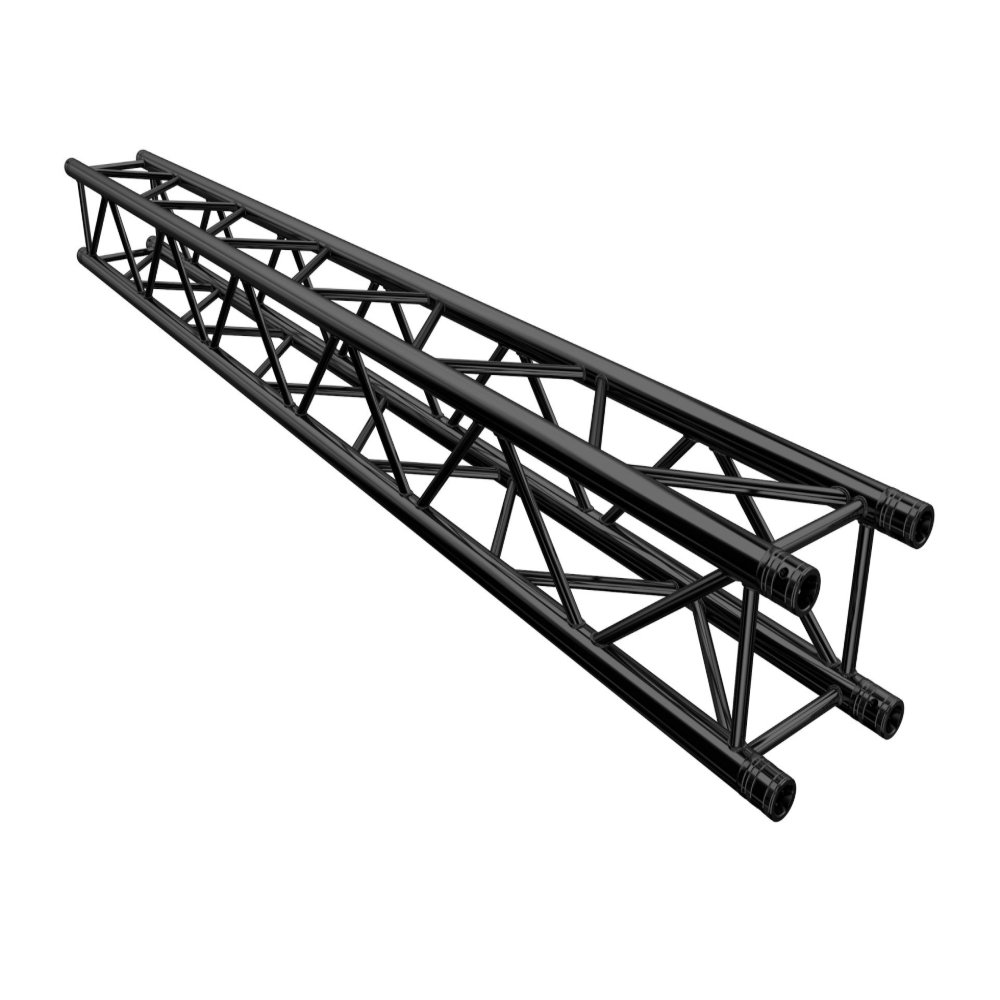
Square four-chord truss and the centre of most UK inventories. F34 Standard runs 0.21 m makeup pieces to 3.5 m lengths with every corner variant; F34 PL adds straights to 4 m, circles to 4 m diameter and tower parts for vertical builds; and the DNA series winds helix bracing along the same family for exposed-truss looks, with transition pieces back to plain F34. Whichever flavour, the short makeup lengths are the quiet heroes: runs rarely land on round numbers.
F35, the screen carrier
A five-chord PL development with the fifth chord running along the bottom face under ladder bracing, a dedicated, consistent mounting line for LED screens and fixture-dense runs where F34’s four chords put hardware in awkward spots.
F44 and F45, the heavy end
F44 P takes over when spans and loads outgrow F34 (roofs, long goalposts, heavy structure) with straights to 4 m and matching bases and box corners. F45 is the specialist: a 400 mm square section in 50 mm, 4 mm-wall tube with a supported fifth chord, answering engineered requirements. Specification at this tier is done from the manufacturer’s load tables by whoever is engineering the structure. Call us and we will point you at the documentation.
Series at a glance
| Series | Profile | Job |
|---|---|---|
| F14 | Mini tri | Displays, totems, decor |
| F24 | Compact quad | Exhibitions, retail, DJ booths, small rigs |
| F31 | Single tube | Drape bars, scenic lines, curves |
| F32 | Ladder | Bracing inside structures |
| F33 | Triangle | Display & production geometry (handed parts) |
| F34 / DNA | Square | The production default; deepest catalogue |
| F35 PL | Square + 5th chord | LED screen and fixture-dense runs |
| F44 P | Heavy quad | Bigger spans, roofs, heavy structure |
| F45 | 400 mm five-chord | Engineered heavy-duty requirements |
Beyond straight runs
The catalogue’s depth is in what surrounds the sections. Ground support (screwjacks, sleeve blocks, outriggers) turns truss into towers; pre rig truss travels with the fixtures inside on matching dollies; roof systems ship with structural reports; covers and sleeves dress it; and corner braces are stocked alongside them. Anything involving suspension or lifting is rigging work for a competent person.
The consumables rule
Conical couplers, bullet pins and R clips walk off every site, and a build that is missing three pins is a build that is not happening. Keep spares of your system’s connection hardware in the truck (both flavours have dedicated spares categories) along with a couple of short makeup lengths and a truss tool for cold-morning strikes.
Popular picks from the shop
Global Truss Standard F34 3.0m TrussView product → Global Truss Standard F34 3.0m Truss, Stage BlackView product → Global Truss Standard F34 4.0m TrussView product → Global Truss Standard F34 3.5m Truss, Stage BlackView product →
Frequently asked questions
What is the difference between the F24 and F34 catalogues?
F34 is the deeper of the two: square four-chord section with the widest range of lengths, corners, circles and tower parts. F24 is a compact quad section with a smaller catalogue, specified where a full-size profile would dominate the room. Which section any given structure calls for is answered by the manufacturer’s load tables and the person engineering it.
Can I mix Standard and PL truss?
Not within a structure: the connection systems do not interchange, and adaptors are not how load paths should be improvised. Pick one system per fleet and standardise; if you inherit both, keep them as separate inventories.
How much weight can truss hold?
That is answered only by the manufacturer’s load table for the specific series, span and loading pattern, read by a competent person. We do not publish load figures and we do not advise on them.
Natural aluminium or stage black?
Black disappears in theatres and dressed venues and reads as set; natural suits exhibitions and daylight. Most series run both finishes through the full parts list, so it is an aesthetic call, not a structural one, though black sells out faster, so order early for tours.
What spares should I carry?
Conicals, bullet pins and R clips for your connection system, a short makeup length or two, and a truss tool. It is the cheapest insurance in the trailer, the build that stops for want of a £2 pin never stops only once.



