


Home » Guides » Lighting & Effects »
Stage Wash Lighting: LED Battens, PARs and Uplighters Compared
How to light a stage, room or event space evenly, which colour engine actually matters, and how many fixtures the job really needs.
~11 min read · Updated July 2026 · By the Stage Supply team
In this guide: The wash toolkit · RGB vs RGBW vs RGBA · Reading the spec sheet · Battens in depth · Uplighting a room · Control options · Power and data · Common mistakes · What to buy · FAQ
A wash is the base layer of any lighting design: broad, even colour across a stage, a dance floor or the walls of a room. Get the wash right and everything else (movers, effects, followspots) sits on top of it. Get it wrong and no amount of clever programming hides the patchy, oversaturated result. This guide compares the three workhorse wash fixtures, LED PAR cans, battens and uplighters, explains what the colour-engine acronyms actually buy you, and gives practical numbers for covering real spaces.
The Wash Toolkit
LED PAR cans
The modern LED PAR is the default wash fixture: a round head with a cluster of colour-mixing LEDs behind a lens, a fixed or manually swappable beam angle, and a double-bracket yoke so it can floor-stand or hang from a bar. PARs are cheap per unit, easy to rig anywhere, and interchangeable, so you can start with four and grow to sixteen without redesigning anything. Their weakness is that each one is a single point source: washing a wide stage evenly takes several of them, carefully spaced and cross-focused.
Battens and bars
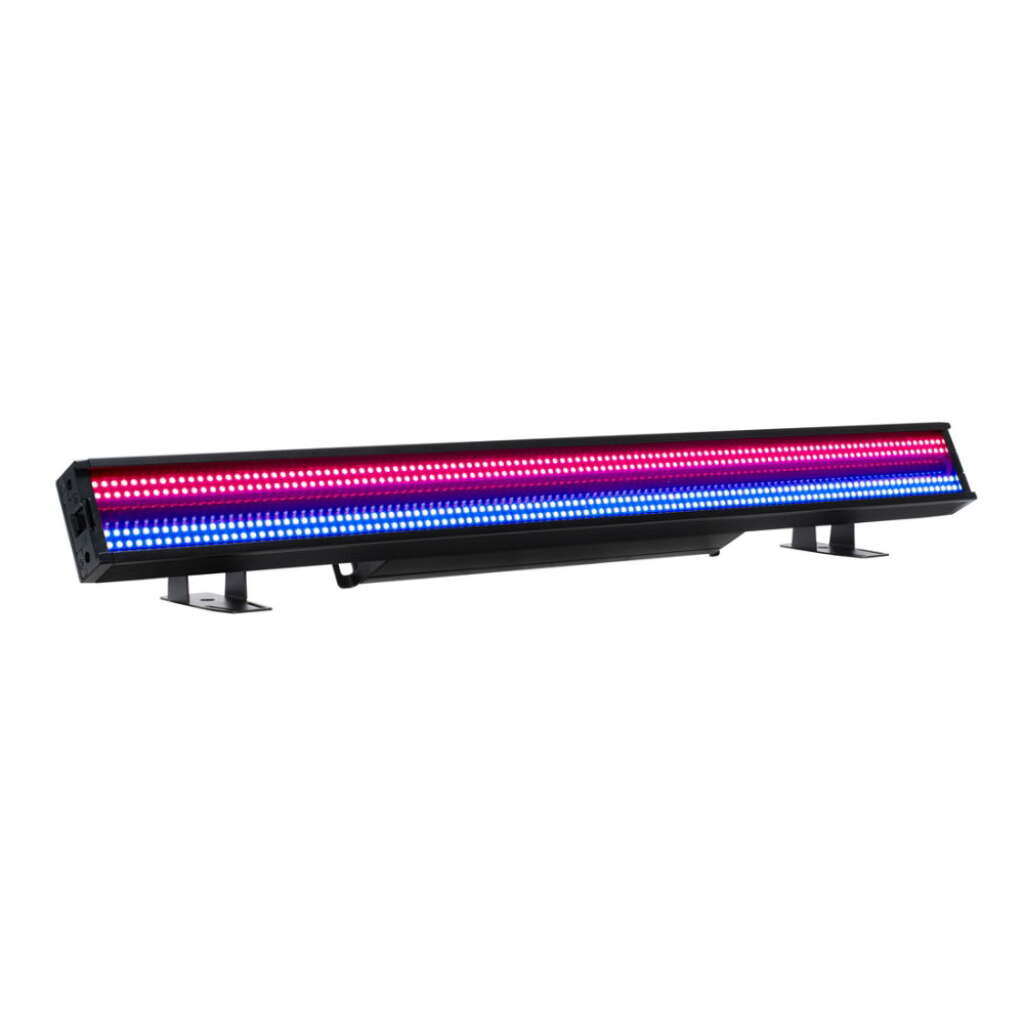
An LED batten is a linear strip of colour-mixing LEDs, typically around 1m long. Because the source is spread along a line rather than concentrated in a point, a batten produces a naturally even sheet of light: ideal for washing a backdrop, footlighting a stage front, or grazing a wall. Most battens are divided into individually controllable segments, which unlocks pixel chases and effects a PAR simply cannot do. They are covered in depth below.
Uplighters
An uplighter is a PAR-type fixture packaged to sit on the floor and fire up a wall. The event-industry standard is the battery version: built-in rechargeable battery, wireless DMX or infrared remote, no cables across the floor at all. Mains uplighters are cheaper and never run flat, but every unit needs a discreet cable run, which matters in a wedding venue. Battery life on a full-brightness saturated colour is much shorter than the headline figure (which is usually quoted for a single colour at reduced output), so check the runtime spec against your event length.
Fresnels, briefly
The fresnel is the traditional theatre wash light: a stepped lens giving a soft-edged beam that adjusts from spot to flood, shaped with barn doors. LED fresnels remain the right answer for theatre and studio key light where you need a soft, controllable, high-CRI white beam. For colour washes at event scale, PARs and battens do the same job for less money and weight, which is why fresnels are now a specialist rather than a default choice.
When moving washes earn their money
A moving-head wash adds motorised pan, tilt and usually zoom to the same colour engine. That buys you repositionable washes from a console: the same four fixtures wash the band during the set, the dance floor afterwards, and the cake table for the speeches. If your rig is static and the looks never move, fixed wash lights give more output per pound. If you re-aim lights during a show, or rig where a ladder is impractical, movers pay for themselves fast. Our moving head buying guide covers spot vs wash vs beam in detail.
| LED PAR | Batten / bar | Uplighter | Moving wash | |
|---|---|---|---|---|
| Coverage | Round pool from a point source; several needed for even cover | Even linear sheet; joins end to end into a seamless wash | Vertical fan up a wall; one column of colour per unit | Round pool, repositionable; zoom varies pool size live |
| Mounting | Floor, stand, bar or truss via double bracket | Floor along stage edge, or bar/truss on brackets | Free-standing on the floor against a wall | Truss, bar or heavy-duty floor plate |
| Control | DMX, auto, sound-to-light, master/slave | DMX with per-segment pixel modes plus auto programs | Wireless DMX, IR remote, auto; often app pairing | DMX console realistically required to get the value out |
| Cabling | Mains + DMX daisy chains | Mains + DMX daisy chains | None (battery models); mains models need runs to each unit | Mains + DMX daisy chains |
| Best for | General stage wash, band lighting, budget rigs that grow | Backdrops, cycs, stage fronts, wall grazing, pixel chases | Room transformation: weddings, corporate, venue perimeters | Rigs where looks move: function bands, clubs, hire stock |
Colour Mixing Generations: RGB to Full Spectrum
Every acronym on a wash fixture describes which LED colours sit inside it. This matters more than wattage, because it decides which colours the fixture can physically make, and how good people look standing in them.
RGB mixes red, green and blue. Saturated primaries and secondaries look great, but the “white” you get from full RGB is a cold, blue-tinted approximation with poor colour rendering, and pastels come out muddy because there is no white light to dilute the colour with. Warm tones suffer most: the ambers and golds that flatter skin sit in a part of the spectrum RGB emitters cover weakly.
RGBW adds a dedicated white LED. This is the single most useful upgrade: real whites for stage wash and worklight, and proper pastels (soft pinks, lavenders, mint) made by mixing white into a colour. For most buyers RGBW is the sensible floor.
RGBA swaps white for amber. Amber fills the warm gap in the RGB spectrum, so warm mixes (candlelight, gold, sunset tones) come out rich instead of orange-brown, and skin tones under warm washes look far more natural. The trade-off is no true white channel.
RGBWA and RGBWA-UV combine both, with the 6-in-1 version adding UV for blacklight effects: fluorescent decor, white shirts glowing on the dance floor. On a mobile DJ or event rig the UV channel is a genuinely useful extra rather than a gimmick, since it saves carrying separate UV cannons.
CCT / tunable-white and full-spectrum engines take a different approach. A CCT fixture mixes warm and cool white emitters so you can dial white colour temperature to match a room’s house lights or a camera’s white balance. Full-spectrum colour engines (adding lime and other emitters to the mix) chase both goals at once: high-quality whites plus a wide colour gamut. They cost more and matter most where cameras are involved or where the wash doubles as key light.
| Engine | Strengths | Weaknesses |
|---|---|---|
| RGB | Cheapest; punchy saturated colours; fine for effect washes and decor | Harsh blue-ish “white”; muddy pastels; weak ambers; unflattering on skin |
| RGBW | Real white channel; clean pastels; the sensible baseline for stage work | Warm golds and ambers still limited; single fixed white point |
| RGBA | Rich warm tones; natural skin under warm washes; strong for theatre colour | No true white; cool pastels weaker than RGBW |
| RGBWA-UV | Widest one-box palette: whites, warms, pastels, plus UV blacklight effects | Output split across six colours, so each channel is individually less powerful at a given fixture size |
| CCT / full spectrum | Tunable, high-CRI whites; matches camera white balance; best skin rendering | Highest cost; CCT-only fixtures make no colour at all |
Common mistake
Buying RGB-only fixtures to light people. RGB is fine for washing walls and decor in saturated colour, but anywhere faces matter (stages, top tables, presentations) the missing white and amber content shows immediately. Spend the small premium on RGBW or better for anything pointed at a person.
Reading the Spec Sheet
LED count x wattage is not output
“12 x 10W” tells you what the LEDs could theoretically consume, not what leaves the lens. Real output depends on how hard the LEDs are actually driven, the efficiency of the optics, and how the colours are mixed. Two “180W” PARs from different manufacturers can differ enormously on a wall. The numbers worth comparing are lumen output and, better still, lux at a stated distance (for example “lux @ 3m”), because that accounts for the beam angle too. If a spec sheet quotes only the LED arithmetic, treat the fixture as unproven.
Beam angle and throw
Beam angle decides how the light spreads: a 25 degree PAR at 4m makes a tighter, more intense pool than a 45 degree PAR at the same distance, which spreads the same light over a much larger area. Light also falls off with the square of distance, so doubling the throw quarters the intensity. Practical rule: wide angles (35-45 degrees and up) for close-range washing and uplighting, narrower angles (15-25 degrees) when the fixture hangs further from the stage. Some PARs and washes offer zoom, which buys flexibility at a price.
CRI and TLCI for camera work
CRI (Colour Rendering Index) scores, out of 100, how faithfully a light source renders colours compared with a reference source. TLCI (Television Lighting Consistency Index) is a broadcast-industry equivalent that models how a television camera, rather than the human eye, sees the light. Eyes are forgiving; cameras are not. A wash that looks acceptable in the room can render skin grey-green on a livestream. For any work in front of cameras, look for CRI 90 or above (or a high TLCI where quoted) on the fixtures providing white light on people.
Refresh rate and flicker
LED fixtures dim by switching their emitters on and off very fast (PWM). Eyes cannot see it, but cameras can: if the fixture’s refresh rate is low, it beats against the camera’s shutter and produces rolling bands or strobing in the footage. Look for a quoted refresh rate of at least 1kHz or higher for video work; better fixtures let you adjust the PWM frequency in the menu to tune out flicker against a specific camera. Budget fixtures often omit the spec entirely, which usually means it is low.
Dimming curves
How a fixture behaves between 0% and 10% intensity separates good LED fixtures from cheap ones. Poor fixtures snap on abruptly, step visibly through low levels, or shift colour as they dim. Better fixtures offer selectable dimming curves (linear, square law, S-curve) so fades feel like the smooth bottom-end of a tungsten lamp, and 16-bit dimming modes for fine control. If your work includes slow theatrical fades or quiet church services, this spec matters more than raw brightness.
Streaming churches: the two specs that matter
If your services go out on camera, prioritise CRI/TLCI and refresh rate over everything else. High-CRI white light (CRI 90+) on the platform keeps skin tones natural on stream without colour-grading heroics, and a high, ideally adjustable, PWM refresh rate prevents the banding that makes footage look broken. A modest rig of camera-friendly white key light plus RGBW colour washes behind the platform will stream far better than a bright rig of cheap RGB fixtures. Test with your actual cameras before the first live service: pan across every fixture at each shutter speed you use.
Battens in Depth
Pixel zones and segments
Most LED battens can run in a simple mode (the whole bar as one fixture) or in segmented modes where the bar splits into 4, 8 or more individually controllable zones. Segments turn a batten from a wash light into an effects surface: colour chases running along the bar, ripples across a row of battens, audience blinders sweeping left to right. The channel count climbs quickly (an 8-segment RGBW batten in full pixel mode uses 32 channels), so check your controller has the capacity before you commit to pixel modes across a large rig. Our DMX explained guide covers addressing and universe maths.
Joining battens into a seamless wash
Because battens are linear, they tile: butt them end to end along a stage edge or the base of a backdrop and the individual sources disappear into one continuous band of colour. For the join to be invisible, keep the units the same model (colour calibration differs between brands and even between generations), keep spacing consistent, and keep them the same distance off the surface they are washing. Many battens include linking brackets or end plates for exactly this.
Cyc lighting
Washing a cyclorama or backdrop cloth evenly from top to bottom is the classic batten job. A row of battens along the floor, 1-2m out from the cloth and tilted up, grazes colour up the surface; larger stages add a second row from above. Purpose-built cyc fixtures use asymmetric optics that throw more light towards the far end of the cloth to even out the fall-off; standard battens manage smaller drops well if you keep the distance-to-height ratio sensible. Even lighting on a cyc is what sells the “infinite” background look on stage and on camera.
Uplighting an Event Space
Uplighting transforms a room by washing its walls and architectural features in colour from floor level. The single biggest factor in whether it looks professional or half-finished is quantity and spacing, not fixture quality. Columns of light every 1.5-2m read as a designed, continuous wash; four lonely uplighters in the corners of a large hall read as an afterthought.
| Space | Typical size | Accent look | Full perimeter wash |
|---|---|---|---|
| Small function room | up to ~10m x 8m | 6-8 units on key walls and features | 10-16 units |
| Medium venue / marquee | ~15m x 10m | 10-14 units | 18-26 units |
| Large hall / ballroom | ~25m x 15m and up | 16-20 units | 30-40+ units |
| Rule of thumb | One unit per 1.5-2m of wall for a continuous wash; halve the count for accents on columns, alcoves and feature walls. High ceilings and dark wall finishes push you towards the top of each range. | ||
Treat the table as planning guidance, not gospel: pale walls in a low room need fewer, brighter units; a tall dark-panelled hall swallows light and needs more. Where possible, test with a pair of units in the actual room before quoting a full install.
Battery power and wireless DMX freedom
Battery uplighters with built-in wireless DMX are the reason uplighting became a standard event product: thirty units placed around a room in twenty minutes, zero cables, all colour-changing together from one transmitter. The practical disciplines are charging (build a charging rota into your workflow, and remember runtime drops with full-on saturated colours and full brightness) and radio management (most systems run in the 2.4GHz band, so pair units to your transmitter before doors, and keep line of sight where you can in venues thick with Wi-Fi).
IP ratings for outdoor work
Standard uplighters are IP20: dry, indoor use only, and a marquee with condensation or an open doorway does not count as dry. For gardens, courtyards and building facades you need IP65 (protected against dust and water jets), which covers rain in normal use. IP54 fixtures tolerate splashes but are a compromise for anything left outside overnight. If any part of your work is outdoors, buy IP65 from the start; “we will bring them in if it rains” fails the first time it actually rains mid-event.
Control Options
Standalone, auto and sound-to-light. Every wash fixture in this guide runs without any controller: pick a static colour from the menu, run a built-in program, or let the fixture chase to music through its microphone. Master/slave linking makes a chain of identical fixtures follow one unit. This is genuinely enough for a lot of uplighting jobs and small DJ rigs, and it is free.
DMX scenes from a simple controller. The step up is a compact DMX controller: programme a handful of scenes (warm wash for dinner, saturated look for the party, blackout) and step between them on buttons or faders. This is the sweet spot for venues, churches and schools where a volunteer or duty manager needs to recall looks reliably without understanding the rig.
Full console or software. Once the rig includes movers, pixel-mode battens or shows that change song to song, you need a proper console or PC/tablet software with fixture profiles, playbacks and effects engines. That is a bigger topic than this guide; the addressing and cabling fundamentals underneath it are covered in DMX explained.
Power and Data Chaining
Most mains wash fixtures have power in and out sockets so you can daisy-chain them from one supply. Two rules keep this safe and reliable:
- Respect the manufacturer’s chain limit. The manual states the maximum fixtures per power chain; it is set by the through-connector rating, not the wall socket. Never exceed it, and remember a UK 13A socket supplies about 3kW in total across everything plugged into it.
- Match your connectors. Fixtures ship with IEC, PowerCON or PowerCON TRUE1 style connectors depending on age and grade. Standardise your link-lead stock or carry adaptors, and note that only TRUE1-type connectors are rated for connection under load.
- DMX chains in one line, terminated. Data daisy-chains out of one fixture into the next, up to 32 unit loads per line, with a 120 ohm terminator in the last fixture’s output. No Y-splits without a proper splitter.
- Use DMX cable, not mic leads. DMX is 110 ohm data cable; XLR mic cable mostly works until the day it does not, usually mid-show. Larger rigs and temporary event power fall under BS 7909 practice; if in doubt, get the power design checked.
Common Mistakes
Too few units, aimed too far apart
The most common wash failure is stretching four fixtures across a job that needs ten. You get bright hotspots with dark gaps between them, and turning the fixtures up just makes brighter hotspots. Even coverage comes from overlap: adjacent pools or columns should merge where they meet. Budget the fixture count first, then choose the model.
RGB-only where people stand
RGB fixtures cannot make flattering white or warm light. Fine on a wall; a problem on a face. Anywhere a person is lit, specify RGBW as the minimum, RGBA or better where warm looks dominate, and high-CRI white engines where cameras are involved.
Ignoring flicker until the first livestream
A rig bought purely on brightness and price frequently bands or strobes on camera because nobody checked the PWM refresh rate. If there is any chance of video (and for churches, schools and corporate spaces there always is), verify refresh rate specs before buying and test with a camera before the first streamed event, not during it.
What to Buy: By Buyer
Mobile DJ
- 4-8 RGBWA-UV PARs on stands or a bar as the core wash
- A pixel batten or two for chases behind the booth
- Battery uplighters as a paid add-on service for venues
- Sound-to-light for parties, simple DMX scenes for the meal
Venue or church
- High-CRI (90+) white front light on the stage or platform
- RGBW washes or battens for backdrop and depth
- High refresh rate throughout if you stream or record
- Scene-based DMX controller a volunteer can operate
Event stylist
- A fleet of matching battery wireless uplighters, sized to your usual venues (see the room-size table)
- RGBWA or better for wedding-friendly whites, blushes and golds
- IP65 units if any work goes outdoors
- Chargers and flight cases counted into the budget from day one
School or hall
- RGBW PARs on existing bars for a flexible stage wash
- Battens at the stage front and on the backdrop for productions
- Smooth low-end dimming for theatrical fades
- A simple scene controller staff and students can both use
If your looks need to move during the show, add a pair of moving washes on top of the static rig rather than instead of it; the moving head guide explains how to choose them.
Popular picks from the shop
FAQ
What is the difference between RGB and RGBW?
RGB mixes red, green and blue only; its “white” is a cold blue-tinted mix and pastels come out muddy. RGBW adds a dedicated white LED, giving genuine white light and clean pastels by diluting colours with white. For lighting people rather than walls, RGBW is the practical minimum.
How many uplighters do I need for a wedding venue?
Plan roughly one unit per 1.5-2m of wall for a continuous perimeter wash. In practice that means around 10-16 units for a small function room, 18-26 for a medium venue or marquee, and 30 or more for a large ballroom. For accent lighting on columns and feature walls only, roughly halve those counts. Dark walls and high ceilings need more.
Are LED battens better than PAR cans?
Neither is better; they cover differently. A batten spreads light along a line, so it excels at even washes on backdrops, cycs and stage fronts, and its segments allow pixel chases. A PAR is a point source that is easier to rig anywhere and cross-focus onto people. Most stage rigs use both: PARs for the stage wash, battens for the backdrop.
What CRI do I need for livestreaming?
Aim for CRI 90 or above (or a high TLCI where the manufacturer quotes it) on the white light hitting people. Also check the fixture’s refresh rate: 1kHz or higher, ideally adjustable, prevents the rolling bands cameras pick up from low-frequency PWM dimming.
Can I use battery uplighters outdoors?
Only if they carry a suitable ingress protection rating. Standard IP20 uplighters are for dry indoor use only. For gardens, courtyards and facades choose IP65-rated units, which are protected against dust and water jets and handle rain in normal use.
Do I need a DMX controller, or will sound-to-light do?
For a party dance floor, built-in auto and sound-to-light modes are genuinely fine. The moment you need specific looks at specific times (a warm wash for dinner, a colour matching a theme, a blackout on cue) you want a simple DMX controller with saved scenes. Full consoles only become necessary with moving lights, pixel effects or show-to-show programming.
How many fixtures can I daisy-chain?
Two separate limits apply. For DMX data, the standard allows up to 32 unit loads on one line, terminated at the end. For power, follow the fixture manual’s stated maximum per chain, and keep the total load on any UK 13A socket under about 3kW. The power limit is almost always reached before the data limit on high-output fixtures.
Shop this guide
UK stock and fast delivery on wash lighting for stages, venues and events.


