


Home » Guides » DJ & Events »
Silent Disco: How It Works and What Equipment You Need
Everything venues, event companies, schools and DJs need to know before buying silent disco equipment: how the RF broadcast system actually works, what range and capacity to expect, the licensing position in the UK, and the kit checklist that stops your first event going wrong.
~11 min read · Updated July 2026 · By the Stage Supply team
In this guide: How it works · Channels and DJ battles · Range and capacity · Frequencies and licensing · Use cases · The business case · Kit checklist · Hygiene and maintenance · Common mistakes · FAQ
How a Silent Disco Actually Works
A silent disco replaces the PA system with radio. Instead of pushing sound into the room through speakers, each audio source feeds a small RF transmitter, and every guest wears a pair of wireless silent disco headphones that receives the broadcast. Walk into the room without headphones and you hear shuffling feet and three hundred people singing off key. Put the headphones on and you are inside a full-volume club night.
Three pieces of hardware make it happen:
- Transmitters: small broadcast units, one per audio stream. Each takes a line-level feed from a DJ mixer, laptop, media player or microphone and broadcasts it on one of the system’s channels. Mains-powered desktop units are the norm; battery-powered Bluetooth transmitters with headset mics exist for walking tours and fitness classes.
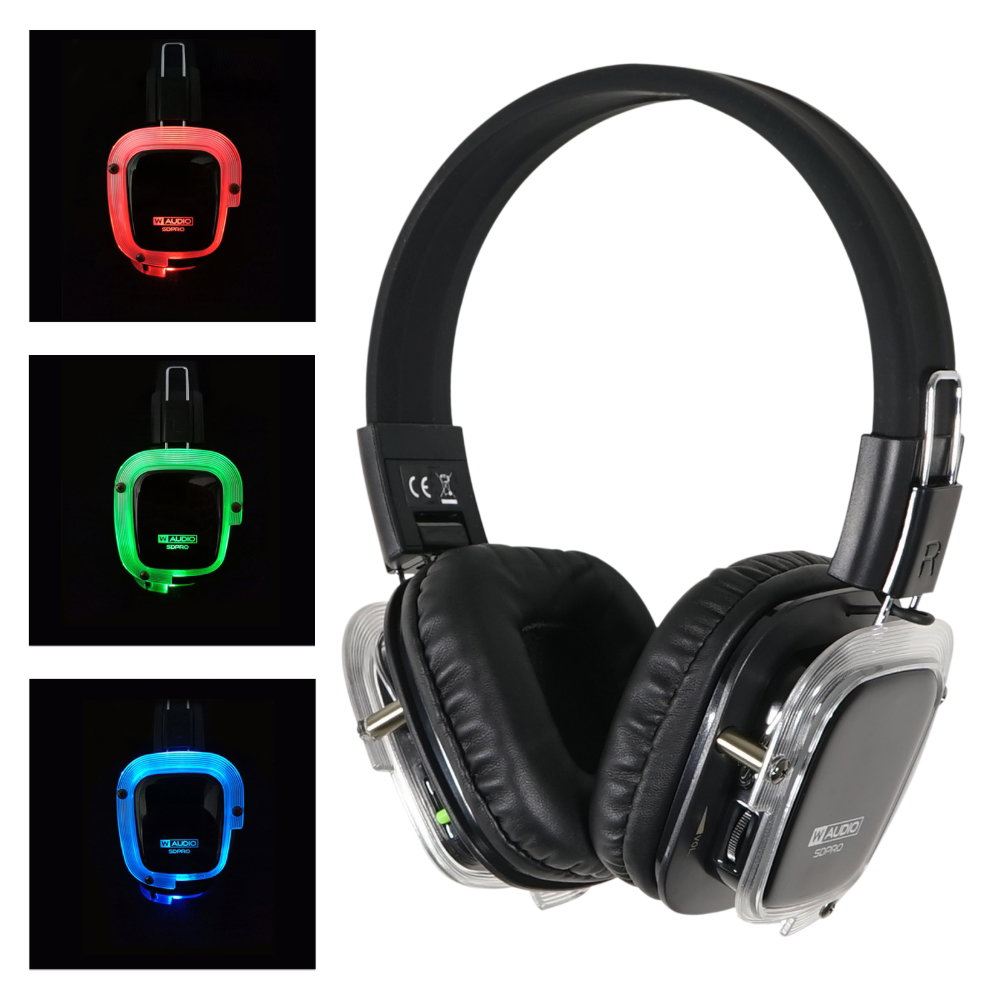
- Wireless headphones: each headset has a channel selector and LED ear cups that change colour to match the channel it is tuned to. Typically red, green and blue for channels 1, 2 and 3. The LEDs are not decoration: they are how the crowd, the DJs and your staff can all see at a glance which stream each person is listening to.
- The source gear: whatever feeds the transmitters. For a DJ battle that is two or three DJ setups, each routed to its own transmitter. For a headphone cinema it is a single media player. For a spin class it is the instructor’s mic and music feed.
The point that matters when you are planning capacity: the headphones are receivers, not paired devices. The transmitter broadcasts one to many, like a radio station, so it makes no difference whether ten headsets or a thousand are tuned in. There is no pairing process, no connection limit and no degradation as you add listeners. Your capacity is set purely by how many headphones you own and can charge, never by the transmitter.
Channels and the Multi-DJ Battle Format
Most professional silent disco systems are 3-channel. Run one transmitter and everyone hears the same stream. Run two or three transmitters, one per channel, and guests flick between streams on the headset. This is the classic silent disco battle: two or three DJs playing simultaneously, each fighting to pull the crowd onto their colour. The DJ whose colour dominates the ear cups on the dancefloor is visibly winning, which turns the channel selector into part of the entertainment.
Two channels is the workable minimum for a battle. Three is the sweet spot and the standard commercial format: typically one DJ on current chart and dance, one on throwbacks and cheese, and a third stream that can be another DJ, a genre playlist or a quiet channel. Beyond entertainment, multiple channels also solve practical problems: a multi-room event can run a different stream per zone from one central rack, and a corporate event can run presentation audio in two languages simultaneously.
On the source side, treat each transmitter exactly like a small PA input. A DJ mixer’s booth or record output into the transmitter’s line input is the standard hookup. Keep levels sensible: the limiter behaviour of budget headsets is not something to lean on, and ear fatigue arrives faster on headphones than through a room PA.
Range and Capacity: What the Numbers Really Mean
Transmitter range figures vary by manufacturer and power mode, and the quoted numbers are line-of-sight outdoor figures. As a real example from a current UK-market system, the W Audio SDPROTX transmitter is rated up to 200 metres in its switchable low power mode and 400 metres plus in high power mode. Indoors, expect solid walls, crowds and metal structures to reduce that considerably, but for a single function room, marquee or school hall any professional system has range to spare. The low power mode is not a compromise feature: on multi-zone sites it deliberately keeps each zone’s broadcast from bleeding into the next.
| Question | What sets the limit | Practical answer |
|---|---|---|
| How many guests? | Headphones owned and charged | Unlimited per transmitter; buy headsets for your typical event size plus spares |
| How many audio streams? | Transmitters, one per channel | Usually up to 3 on a 3-channel system |
| How big a space? | Transmitter power mode and building construction | Manufacturer ratings of roughly 200 m to 400 m plus line of sight; ample for any single venue space |
| How long can it run? | Headphone battery life | Typically 8 to 10 hours per charge on current headsets, comfortably a full event |
Battery figures worth planning around, verified from the SDPRO range we stock: headphones run 8 to 10 hours from a roughly 3 hour charge, and beltpack receivers (used where guests plug in their own earphones, for tours and conference formats) run 16 to 20 hours. A fully charged fleet will always outlast the event; the risk is the fleet that was never put on charge, which is covered under mistakes below.
Frequencies and Legality in the UK
Silent disco systems sold for the UK market typically operate in licence-free spectrum. Many UHF systems, including the W Audio SDPRO range, transmit on 863 to 865 MHz within Channel 70, which is licence-exempt in the UK: no Ofcom licence is needed to run events, at any size, on any night. Other systems use the 2.4 GHz band, which is also licence-free. Either way there is no paperwork, which is a genuine operational advantage over licensed radio microphone channels.
Two practical notes. First, Channel 70 is shared spectrum: licence-free radio mics and in-ear systems also live at 863 to 865 MHz, so if your event runs licence-free wireless microphones alongside the silent disco, plan frequencies together rather than discovering the clash at soundcheck. A well-designed FM-modulated silent disco system coexists happily with radio mics and IEMs running on other frequencies. Second, licence-free does not mean noise-rules-free: the disco is silent, but a courtyard full of guests singing along at 1am is not, so late-night outdoor events still need a word with the venue about crowd noise.
Check the band on the spec sheet
Frequency bands differ between manufacturers and between regional variants of the same product. Before buying, confirm the system is a UK or EU variant operating in a licence-free band such as 863 to 865 MHz or 2.4 GHz. Imported systems built for other markets can sit in spectrum that is not legal to use in the UK.
Where Silent Disco Earns Its Keep
Venues with noise curfews and limiters
This is the killer application. A venue with an 11pm noise condition, a nervous neighbour or a hair-trigger sound limiter can keep the dancefloor going for hours after the PA has to come down. Weddings are the obvious win: the band or DJ finishes at 11pm to satisfy the licence, headphones go out, and the party continues to 1am without a decibel crossing the boundary fence. If your venue is fighting a limiter every weekend, read our small venue PA system guide for how limiters behave and why headphones sidestep the whole problem.
Schools, colleges and youth events
School halls are acoustically awful and often sit in residential streets. Silent disco solves both, and the channel format has a bonus: staff can monitor exactly what is being played on every stream by picking up a headset. Volume is also under each listener’s control, which makes safeguarding hearing simpler than with a PA pushing one level at everyone.
Corporate events and conferences
Beyond the party use, the same hardware runs silent conferences: multiple breakout sessions in one exhibition hall, each presenter on a different channel, no sound bleed between stages. Beltpack receivers with a 3.5mm jack suit this format where headphone hygiene or branding matters less than turnaround speed.
Headphone cinema and quiet events
Outdoor and rooftop cinema in noise-sensitive locations runs the film soundtrack through one channel. One transmitter, one media player, and the audience hears clean stereo regardless of wind, traffic or distance from a screen-side speaker stack.
Gyms, spin studios and fitness classes
An instructor with a headset mic feeding a portable transmitter cuts through better than any room PA, at lower level, in a space shared with other classes. Battery-powered Bluetooth transmitters with built-in headset mics exist specifically for this and for guided walking tours.
The Business Case: Silent Disco as a Revenue Stream
Silent disco kit has one of the better payback profiles in event hardware, for a simple reason: it is hired out per headset, per night, and the hardware is small, robust and cheap to store and ship. A venue that owns its own fleet stops paying a hire company for every curfew-buster night and starts charging for it instead: silent disco upgrades on wedding packages, ticketed battle nights on quiet weekdays, dry hire to other local venues in the off season. Event companies add it as a line item that packs into a few flight cases and does not need a van or a rigger.
The costs that matter are not the headline hardware cost:
- Charging logistics: every hire cycle ends with the whole fleet needing a charge. Multi-way charging racks (20-way units are the standard building block) determine how fast you can turn the kit around. If you run Friday and Saturday hires, you need enough charger slots to recharge the full fleet overnight, not over a week of trickle charging in tens.
- Attrition: headsets walk, get sat on and get dropped in drinks. Sensible operators price a loss and breakage percentage into every hire and hold a spares margin of around 10 percent over their advertised capacity.
- Labour: handing out, collecting and counting several hundred headsets takes staffed time at both ends of the night. Build it into the price rather than discovering it in overtime.
Because the transmitters serve unlimited receivers, scaling up later is cheap: you add headphones and chargers, not a new system. Start with a fleet sized for your typical event and grow it with demand.
The Kit Checklist
- Wireless headphones: one per guest plus roughly 10 percent spares. Look for multi-channel selection, LED channel indication, individual volume control and a folding, wipeable design. Rechargeable lithium batteries are universal on professional headsets.
- Transmitters: one per audio stream, so two or three for a battle format. Mains-powered desktop units for fixed positions; a battery Bluetooth transmitter with headset mic if tours or fitness classes are on your menu. Keep the spare power supply question in mind for multi-room setups.
- Charging: multi-way charging racks with enough total slots to recharge your whole fleet in one overnight cycle. This is the item first-time buyers undercount.
- Source gear: DJ mixers, media players or laptops with a line output per channel, plus the 3.5mm or RCA leads to reach each transmitter. Any standard DJ setup works unchanged; the transmitter simply replaces the amplifier feed. DJs monitoring on their own DJ headphones cue exactly as they would on a PA gig.
- Transport and counting: cases or crates that make a headset count fast and obvious at load-in and load-out.
- Lighting: a silent room with no light show is a strange room. See common mistakes below.
Packaged systems bundle these in sensible ratios: for example, complete packs pairing 20 to 300 headphones with two or three transmitters and matched multi-chargers, so the charging maths is done for you.
Hygiene, Batteries and Loss Management
Cleaning between events
Headsets go on hundreds of heads. Wipe ear pads and headbands with antibacterial wipes or a soft cloth and a mild disinfectant after every event, as part of the count-in rather than as a separate job. Avoid soaking foam pads and keep solvents away from printed markings and LED windows. Ear pads are consumable: they compress, split and absorb hairspray, so budget replacement sets and check whether pads for your chosen system are available separately before you standardise on it.
Battery care
The lithium polymer packs in headsets prefer being stored part-charged rather than flat. Charge the fleet after every event rather than before the next one, and give long-stored kit a top-up cycle every couple of months. Rotate stock so the same twenty headsets are not doing every small gig while the rest of the fleet ages in a case. When runtime on a headset drops noticeably below the fleet’s norm, retire it to the spares crate before it dies mid-event.
Loss management
Count out, count in, every time, with the number written down. For public events, exchange a headset for something the guest wants back: ID, a card behind the bar, or a cash deposit. For private hires, agree a per-unit loss charge in the contract before the event. Numbered headsets make disputes short. None of this is complicated, but operators who skip it consistently lose a small percentage of the fleet every event, and that is the difference between the kit paying for itself and not.
Common Mistakes to Avoid
- Buying one transmitter: a single channel works for cinema and fitness, but the battle format is what sells silent disco tickets. Two channels minimum for parties, three for the full experience. Adding a transmitter later is easy; explaining a one-stream “battle” to a booked client is not.
- No charging plan: the fleet that arrives at 60 percent because half of it never went on the rack is the most common silent disco failure. Match charger slots to fleet size, charge after every event, and make someone responsible for it by name.
- Forgetting the visual show: people dance to what they can see as much as what they can hear, and in a silent room the lighting is doing all of the atmosphere. A few LED PARs or battens and some colour movement transform the event from a room of people in headphones into a party. Our LED battens, PARs and uplighters guide covers a compact rig that packs into one case alongside the headphones.
- Ignoring the other wireless on site: licence-free UHF silent disco shares Channel 70 with licence-free radio mics. Coordinate before doors, not during the first dance speech.
- No spares margin: headsets fail and walk. Carry roughly 10 percent above the guest count and the night never notices.
- Skipping the count: uncounted kit shrinks. Count out, count in, in writing.
Popular picks from the shop
Frequently Asked Questions
How does a silent disco work?
Each audio source (usually a DJ) feeds an RF transmitter, and the transmitter broadcasts that stream to every wireless headphone tuned to its channel. Guests switch between channels on the headset, with LED ear cups showing which stream each person is on. There is no speaker system, so the room itself stays quiet.
How many headphones can one transmitter support?
There is no limit. The transmitter broadcasts like a radio station rather than pairing with individual headsets, so ten or a thousand receivers make no difference. Capacity is set entirely by how many headphones you own and can charge.
Do I need a licence to run a silent disco in the UK?
Not for the radio side, provided the system operates in a licence-free band. Many UK-market UHF systems run at 863 to 865 MHz within Channel 70, which is licence-exempt, and 2.4 GHz systems are also licence-free. Always confirm the band on the spec sheet, especially on imported kit. Normal event licensing (premises licence, TENs and so on) still applies to the event itself.
Can a silent disco run after a venue’s noise curfew?
Yes, and that is its most common commercial use. Because there is no amplified sound in the room, headphones let the party continue after an 11pm noise condition or in venues with aggressive sound limiters. Crowd singing is still audible, so outdoor spaces late at night still need managing.
How long do silent disco headphones last on a charge?
Current professional headsets typically run 8 to 10 hours from a full charge of around 3 hours, which covers any single event. Beltpack receivers used for tours and conferences typically last longer, in the 16 to 20 hour region. The practical risk is not battery life but forgetting to charge the fleet between events.
How many channels do I need?
One channel works for headphone cinema, fitness classes and tours. For parties, two channels is the minimum for the battle format and three is the commercial standard: most professional systems are 3-channel, with one transmitter needed per stream.
Will a silent disco interfere with wireless microphones?
A well-designed UHF silent disco system coexists with radio mics and in-ear monitors on other frequencies. The caution is licence-free kit sharing Channel 70 (863 to 865 MHz): if your radio mics are also licence-free Channel 70 units, coordinate frequencies before the event rather than troubleshooting interference on the night.
Can guests use their own headphones?
Not with standard silent disco headsets, which are self-contained receivers. The exception is beltpack receivers with a 3.5mm output, which let guests plug in their own earphones. These suit conference and tour formats, and educational settings where issuing personal earbuds is preferable for hygiene.
Shop this guide
UK stock of silent disco headphones, transmitters, chargers and complete packaged systems for venues, schools, event companies and hire operators.


