


Home » Guides » Staging & Drapes »
Pipe and Drape: Room Draping for Events, Weddings and Exhibitions
How freestanding drape systems actually work, how to plan a run that looks full rather than flat, which fabrics to choose, and what UK venues expect on flame retardancy.
~10 min read · Updated July 2026 · By the Stage Supply team
In this guide: How the system works · Planning a run · Fabric choices · UK flame retardancy · Uplighting drapes · Stability · Transport & storage · Hire vs buy · Common mistakes · FAQ
How Pipe and Drape Works
Pipe and drape is a freestanding curtain wall. Nothing screws into the venue, nothing hangs from the ceiling, and the whole system goes up and comes down with no tools. That is the entire appeal: you can turn a sports hall into a wedding venue, split an exhibition floor into aisles of stands, or hide a scruffy back wall behind a clean black or white backdrop, and hand the room back exactly as you found it.
Every run is built from the same four parts, repeated:
- Base plates: flat steel plates that sit on the floor and provide the footprint. A typical plate is around 450 x 450mm. Most plates take a separate spigot, a short pin (around 150mm) that bolts through the centre of the plate and is what the upright actually slides over. Check whether the plate you are buying includes the spigot; many are sold separately.
- Uprights: the vertical poles. Fixed uprights come in set lengths and are quick and rigid. Telescopic uprights adjust over a range, commonly around 1.8m to 4.2m, with a locking collar or button clips to hold the height. Telescopic is the stylist’s default because one set of poles covers backdrops, dividers and tall reveals.
- Crossbars: telescopic horizontal bars that span between two uprights and carry the fabric. Common adjustment ranges are roughly 1.3m to 2.1m and 2.1m to 3.6m. Each end has a flat hook that drops into a slot on top of the upright. For a corner, or where two runs meet, a top hat (a slotted cap that sits on the upright) gives you extra slots so one upright can accept crossbars from two or more directions, or two bars side by side for a double layer of drape, such as a sheer over a blackout.
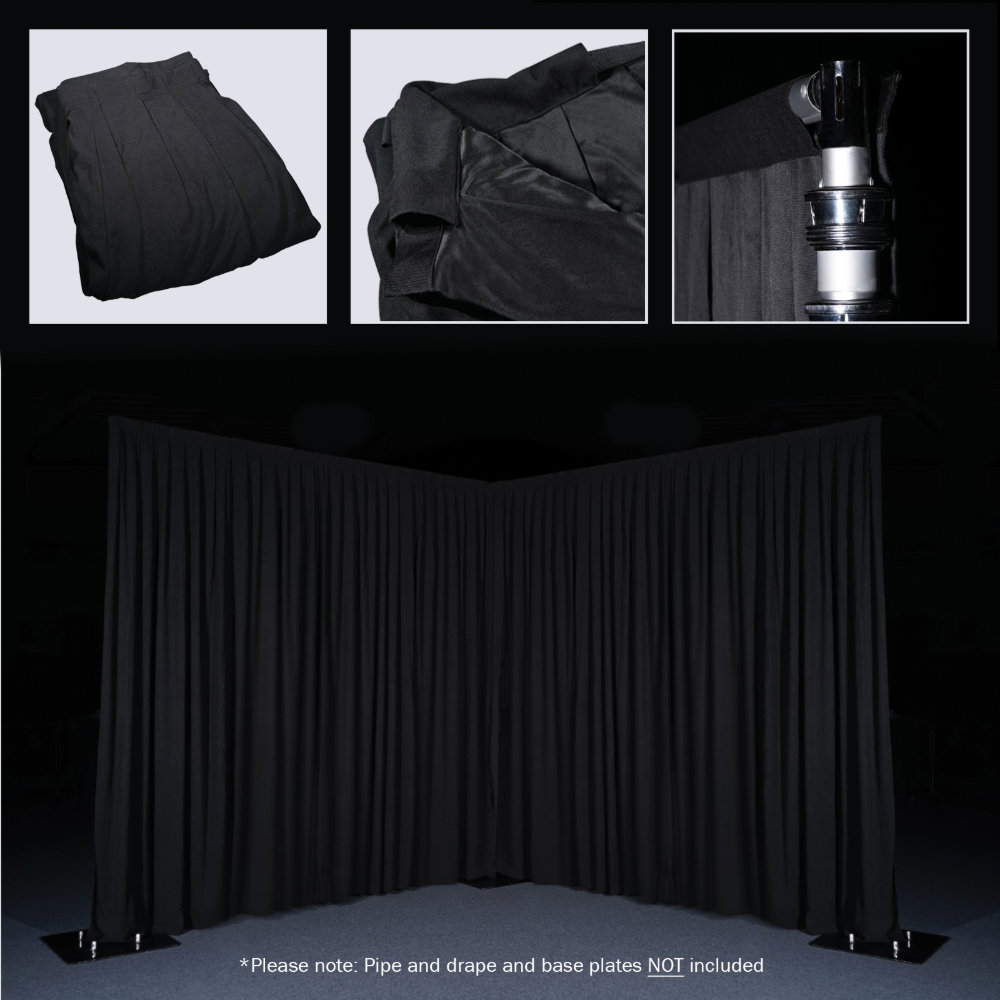
- Drape panels: the fabric itself. Panels made for pipe and drape have a sewn pocket along the top edge; you thread the crossbar through the pocket before lifting the bar onto the uprights. Gravity does the rest.
Assembly order for one bay: plate down, spigot in, upright over the spigot, thread the panel(s) onto the crossbar, then lift the bar and drop the hooks into the upright slots. Two people make life much easier at anything above about 2.5m. A long run is just this bay repeated, with each intermediate upright carrying the end of one bar and the start of the next.
Planning a Run: Measuring, Fullness and Heights
Measure the run, then add fullness
Start with the wall length or divider line you need to cover, in metres. That gives you the crossbar count: telescopic bars mean you do not need the venue to divide neatly into fixed panel widths, you just set each bay to suit and let the bars take up the slack.
Fabric is where people go wrong. If the total width of your drape panels only equals the length of the run, the fabric hangs flat and looks like a bedsheet. The gathered, pleated look that reads as “event styling” comes from fullness: hanging more fabric width than the run is long, so the panels bunch on the bar. As working guidance, aim for around 75 to 100 percent extra fabric width for a properly gathered look, so roughly 7 to 8 metres of panel width on a 4 metre run. Around 50 percent extra reads as lightly gathered; treat anything under that as a flat, projection-style hang rather than styling. These are conventions rather than a formal standard, so if a client shows you a reference photo, count the folds and budget accordingly.
Heights for each job
| Application | Typical height | Notes |
|---|---|---|
| Exhibition booth walls, modesty screens | 0.9m to 2.4m | Short fixed uprights are fine; shell-scheme style dividers rarely need telescopics |
| Wedding and stage backdrops | 2.4m to 3m | Tall enough to clear heads in photos; 3m is the standard drape drop, so panels hang just off the floor or with a slight break |
| Room dividers, hiding walls in halls | 3m to 4.2m | Go as high as the ceiling allows; a divider that stops a metre below the ceiling line draws the eye straight to what it was meant to hide |
| Full room wraps and ceiling transitions | 4m and up | Wall drape at maximum telescopic height, with any ceiling swagging rigged separately; pipe and drape itself is a wall system, not a ceiling one |
Panels are sized as width x drop. Match the drop to your set height plus a little: a 3m drop on uprights at 2.9m gives a clean floor break, while a 3m drop on 4m uprights leaves a gap at the bottom that no amount of styling fixes. For very tall reveals, hang two panels with the upper pocket on a second bar via a double top hat rather than stretching one panel past its drop.
Fabric Choices
Wool serge and molton: the blackout workhorses
Wool serge is the traditional theatre drape fabric: dense, matte, inherently flame retardant, and very good at killing both light and echo. Molton (a brushed cotton, typically around 300gsm and up in stage weights) does a similar job at a friendlier price and weight. Both hang heavy, which is exactly what you want: weight pulls the folds straight and gives that deep, light-absorbing black that makes a stage or backdrop look professional. Black serge and molton are the default for masking walls, backdrops behind stages, and anywhere you need genuine blackout. They are also kind on sound, which matters in echoey halls and sports venues.
Velour
Velour adds a pile, so it catches light with a soft sheen and reads as more luxurious than serge. It is the classic front-of-house and awards-night fabric. It is heavier and more expensive per metre, and the pile marks if it is packed badly, so it earns its keep on hero backdrops rather than utility masking.
Voile: the sheer layer
Voile is a lightweight sheer, usually white or ivory, and it is the wedding stylist’s signature fabric. On its own it softens rather than hides; its real trick is with light. Place uplighters behind or below a voile wall and the fabric glows as a solid wall of colour, and layering voile in front of a white or black blackout drape gives depth that a single fabric cannot. Because it is so light, voile needs generous fullness (the top end of the range above) or it looks like netting.
Pleated vs flat panels
Panels are sold either flat (a plain rectangle with a pocket, sometimes listed as “pocket drape”) or sewn pleated, where the fullness is stitched in permanently at the top. Sewn pleats always hang the same, look tidy with less on-site fussing, and are the right call for hire stock that different crews will hang. Flat panels are cheaper for the coverage and more flexible: the same panel can hang flat for projection or masking, or be bunched on the bar for a gathered look. If you buy flat and want the gathered look, that is why the fullness rule above exists.
UK Flame Retardancy: IFR, DFR and What Venues Expect
Any fabric you bring into a licensed venue in the UK is a fire-safety item, and venues, councils and exhibition organisers are entitled to ask for evidence. The two terms that matter:
- IFR (inherently flame retardant): the fibre itself does not readily burn. Wool serge and IFR-specified polyester drapes fall into this camp. The property is permanent and survives washing, which is why IFR fabric is the safe default for anything you will own and reuse for years.
- DFR (durably flame retardant, i.e. chemically treated): a flammable base fabric (typically cotton, such as molton) treated with a flame-retardant finish. Perfectly acceptable when certificated, but the treatment has a service life and can be degraded by washing or steaming with the wrong process, so treated drapes need re-testing or re-treatment over time.
The standards you will see referenced on certificates for curtains and drapes are BS 5867 (the British standard for flame-retardant curtain and drape fabrics) and EN 13773 (the European classification for curtains). You do not need to memorise clauses; you need the supplier’s certificate naming the fabric and the standard, kept somewhere you can produce it on site. Venues and exhibition organisers routinely ask for this paperwork at load-in, and “it’s fire retardant, trust me” does not pass a duty manager who has an inspection due.
Keep certificates with the kit
Put a copy of each drape’s flame-retardancy certificate in the drape bag and a scan on your phone. The moment you cannot prove a panel is FR, a strict venue is within its rights to refuse it, and that conversation always happens two hours before doors.
Uplighting Drapes
Draping and uplighting are one product as far as the client is concerned. A white voile or blackout wall is a blank canvas: a row of LED uplighters at the base, aimed up the fabric, turns it into a wall of any colour the couple or brand wants, and battery uplighters mean no cables crossing the run. Practical rules that keep it looking expensive:
- Space uplighters evenly, roughly every 1.5m to 2m along the run, all set to the same colour and intensity; scallops of light between fixtures are part of the look, random gaps are not.
- Light sheer voile from behind for a glow, and opaque white from the front; black drape mostly swallows uplighting, so save the fixtures for the fabric that rewards them.
- Keep fixture lenses a hand’s width off the fabric. LED runs cool, but folds of fabric resting on any fixture is bad practice and a venue will call it out.
For choosing the fixtures themselves, including battery vs mains and colour control, see our LED battens, PARs and uplighters guide.
Freestanding Stability
A pipe and drape wall stands up because the steel base plates are heavy and the fabric load is light and centred. That balance is easy to break. Tall runs, heavy velour, double layers and anywhere the public will brush past all push you towards more ballast: put additional weight on the base plates (purpose-made base weights, or the plates from spare bases stacked on the in-use ones) rather than trusting a bare plate at full telescopic height. If a run feels wobbly when you shake the upright gently, it is not ready for the public.
Doorways and entrances deserve special care. A draped entrance arch is two short runs with a gap, and people will grab the fabric as they pass. Ballast both flanking bases generously, keep the fabric hemline clear of the floor at the walkway so nobody treads on it, and never let drape cover or obstruct a fire exit or exit signage; venues will (rightly) fail you on this at inspection.
Wind: not an outdoor system
A drape wall is a sail. Unballasted pipe and drape has no place outdoors, and even ballasted runs in a marquee doorway or courtyard need a genuine wind plan agreed with whoever manages the site. If the job is truly outdoors and exposed, the answer is a rated structure, not more base weights.
Transport, Storage and Creases
- Hardware: base plates stack flat and are the heavy item, so keep them low in the van and lift with your knees, not your ego. Uprights and crossbars travel in padded pole bags; loose poles in a van chew their finish and each other’s locking collars.
- Fabric: fold panels loosely and carry them in breathable drape bags, one size or colour per bag, labelled. Never store fabric damp; a drape bagged wet after a marquee job comes out mildewed and is usually a write-off.
- Creases: serge and molton mostly hang out overnight, but voile and anything packed tight will need a garment steamer on site. Steam top to bottom with the panel hung, and build steaming time into the schedule for white sheers, they show every crease on camera. Check the care guidance for treated (DFR) fabrics first, since aggressive washing or steaming regimes can degrade the treatment over time.
- Labelling: mark drops and widths on the pocket hem of each panel. Ten identical-looking black panels with three different drops will otherwise cost you twenty minutes per job, every job.
Hire vs Buy for Stylists
Pipe and drape is one of the best own-your-kit investments in event styling, because the hardware never goes out of fashion and never becomes obsolete: a base plate is a base plate for the next twenty years. The economics usually break down like this:
- Buy the core once you are draping more than a handful of jobs a year: enough bases, telescopic uprights and crossbars for your typical backdrop, plus your most-used fabric (white voile and either black or white blackout for most wedding stylists). Hire charges on a system you use twice a month overtake the purchase cost quickly, and owning removes the collection and return legwork from every job.
- Hire the exceptions: the one-off 40m exhibition run, a colour you will use once, or the extra ten bays for the biggest job of the year. Cross-hire tops up owned stock rather than replacing it.
- Fabric wears, hardware does not: budget to replace or add panels as they mark, snag and date, while the steel and aluminium keep working. This is also why buying decent hardware first time is cheap in the long run.
Common Mistakes
- Too little fullness: the single most common failure. Panel width equal to run length looks flat and cheap; budget 75 to 100 percent extra width for the gathered look clients are imagining.
- Unweighted bases on tall runs: fine in the showroom, a slow-motion topple in a room full of guests. Ballast anything tall, layered or public-facing.
- Non-FR fabric in venues: dress fabric from a haberdashery has no place on a drape run, whatever it cost. If it has no flame-retardancy certificate, a licensed venue can refuse it and you have no answer.
- Wrong drop for the height: a gap between hem and floor, or a foot of fabric puddled where people walk, both read as mistakes. Match the drop to the set height and decide deliberately whether you want a clean break or a styled puddle.
- Missing spigots and top hats: the small parts kill jobs. Count spigots against plates and carry top hats for every corner and double-layer bay before the van leaves.
- Covering exits: never drape across fire exits or signage, and keep escape routes at full width. This is the first thing a venue checks.
Popular picks from the shop
FAQ
How does pipe and drape attach to the room?
It does not. The system is fully freestanding: weighted steel base plates on the floor, uprights on spigots, telescopic crossbars hooked into the tops of the uprights, and fabric threaded onto the bars through a sewn pocket. No fixings, no tools, no marks on the venue.
How much fabric do I need for a 6m backdrop?
For a gathered look, plan around 75 to 100 percent extra width, so roughly 10.5 to 12 metres of total panel width across a 6m run, for example three 4m-wide panels. For a flat hang (projection surfaces, plain masking), panel width equal to the run is enough.
What height should a wedding backdrop be?
Between 2.4m and 3m suits most rooms: tall enough to clear standing guests in photographs, short enough for normal ceilings. Panels with a 3m drop on uprights set just below 3m give a clean line at the floor. Telescopic uprights let you fine-tune to the room on the day.
Can I use pipe and drape outdoors?
Not unballasted, and generally not in exposed positions at all. A drape run is effectively a sail, and wind will take an unweighted run over. Sheltered marquee use with generous ballast and a wind plan is the realistic limit; genuinely outdoor walls need a rated, engineered structure.
Do my drapes need to be flame retardant?
For licensed venues, exhibition halls and most professional work in the UK, treat it as mandatory. Buy fabric sold as IFR (inherently flame retardant) or with a valid DFR treatment certificate, referencing standards such as BS 5867 or EN 13773, and keep the certificate with the kit so you can produce it at load-in.
What is the difference between serge, molton and voile?
Serge is a dense, inherently flame-retardant wool used for blackout masking and stage backdrops. Molton is a heavy brushed cotton doing a similar blackout job, usually flame-retardant treated. Voile is a lightweight sheer, typically white or ivory, used for soft wedding looks and for glowing colour walls when lit with uplighters.
How many people does it take to set up?
One person can build low runs, but two is the practical minimum above about 2.5m: one to steady the uprights and one to lift the loaded crossbar into the slots. A practised pair will wall off a room surprisingly quickly because there are no tools or fixings involved.
Should a stylist hire or buy?
Buy the core kit once you are draping regularly: hardware lasts decades and hire fees on frequently used equipment overtake the purchase price quickly. Hire only the exceptions, such as unusually long runs or one-off colours, and budget for fabric replacement over time while the hardware keeps earning.
Shop this guide
UK stock of pipe and drape hardware, serge and molton drapes and staging, with fast delivery for stylists, venues and production companies.


