

Home » Guides » Wireless Mics & In-Ear Monitoring »
Shure PSM 300 vs Sennheiser EW IEM G4: Which In-Ear System?
The two wireless in-ear systems UK bands and venues actually cross-shop. How they differ in sound path, earphone bundles, expansion and battery life, and which one fits a first IEM rig against a growing monitor world.
~8 min read · Updated August 2026 · By the Stage Supply team
In this guide: Short answer · PSM 300 · EW IEM G4 · Earphones · Scaling up · Head to head · Picks · FAQ
Once a band decides the wedges are coming down, the shortlist is usually two systems: Shure’s PSM 300 and Sennheiser’s EW IEM G4. Both are stereo wireless in-ear platforms at a similar price, both are stocked in UK Channel 38 variants, and both will transform a stage. The differences are real but specific, and if you have not yet decided whether wireless in-ears are the right move at all, start with our in-ear monitor systems guide and come back.
The short answer
Sound quality will not decide this: both are professional systems that beat any wedge for clarity. Choose PSM 300 for its 24-bit digital audio path, CueMode (an engineer can step through every mix from one pack) and the tidy earphone bundles. Choose EW IEM G4 if you already run Sennheiser wireless (shared accessories, racks and RF habits), want the Twin set economics of two packs on one transmitter, or plan to grow into Sennheiser’s deep RF-distribution ecosystem.
Shure PSM 300 in practice
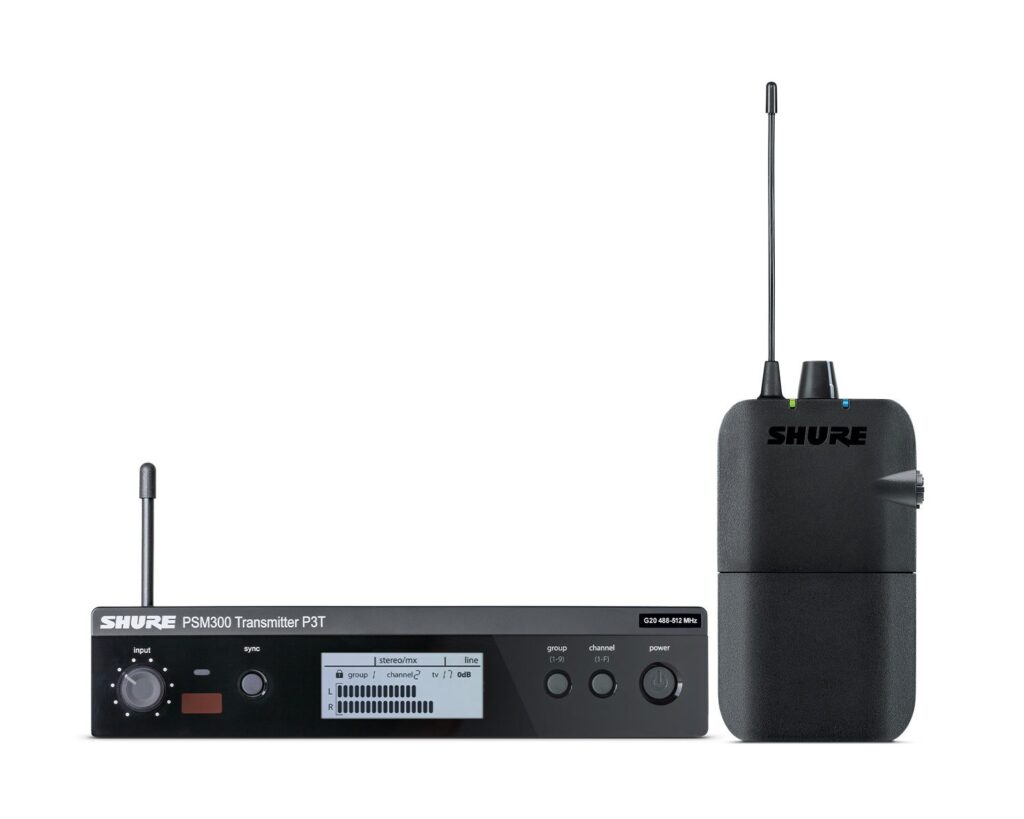
A half-rack stereo transmitter and rugged bodypack with a 24-bit digital audio path. Working features that matter on real stages: CueMode lets one pack step through every transmitter’s mix, the monitor engineer’s walkaround tool; MixMode lets a musician blend the two channels (say, band mix against their own vocal) on the pack itself. The premium P3TRA variants add the metal P3RA receiver with frequency scanning. Bundles ship bare, with SE112 earphones, or with SE215s in the premium sets, and dual bundles put two full systems in one box for a rhythm section.
Sennheiser EW IEM G4 in practice
The IEM arm of the evolution wireless family: SR transmitter, EK bodypack, GB-band for Channel 38, IE4 earphones in the box. Its quiet advantages are ecosystem ones, the same racks, power distribution, antenna hardware and muscle memory as the evolution mics half of UK venues already own, plus the G4 Twin set that runs two bodypacks from a single transmitter on one mix: the cheapest way to put two musicians on ears. Unlike the microphone side of G4 (now transitioning to EW-D/EW-DX), the G4 IEM platform remains Sennheiser’s current standard, buy it without transition anxiety.
The earphones matter more than the electronics
Whichever system wins, budget for the ears: isolation does more for a monitor mix than any transmitter spec, and the bundled earphones (SE112, IE4) are starting points. Stepping to SE215s or better, with foam tips that actually seal, is the single biggest upgrade either platform can receive. The full earphone logic lives in the IEM guide.
Scaling past two channels
Multi-channel IEM rigs live or die on transmit RF: multiple transmitters need an antenna combiner and a proper antenna, not a row of whips fighting each other. Sennheiser’s AC-series combiners and the wider antenna hardware give the EW ecosystem the deeper bench here; Shure’s distribution covers the PSM side too. Either way, plan combining from channel three onwards: the discipline is in antennas and RF distribution, and every transmitter needs coordinating under the same Ofcom Channel 38 licence as your mics: see the licensing guide.
Head to head
| Factor | Shure PSM 300 | Sennheiser EW IEM G4 |
|---|---|---|
| Audio path | 24-bit digital | Analogue FM, evolution heritage |
| Engineer features | CueMode mix stepping, MixMode blend | Ecosystem integration, Twin economics |
| Two performers cheaply | Dual bundles (2 full systems) | G4 Twin: 2 packs, 1 transmitter, 1 mix |
| Bundled earphones | None / SE112 / SE215 tiers | IE4 included |
| Upgrade path | PSM 900 / PSM 1000 | 2000 / 6000 series, AC combiners |
| UK band | K3E | GB (Ch38) |
Popular picks from the shop
Shure PSM 300 P3TR Wireless IEM SystemView product → Shure PSM 300 Premium Set with SE215 EarphonesView product → Sennheiser EW IEM G4 (GB) In-Ear Monitor SetView product → Sennheiser EW IEM G4 Twin Dual SetView product →
Frequently asked questions
Is PSM 300 or EW IEM G4 better?
Neither outright. PSM 300 brings a 24-bit digital path and engineer tools (CueMode); EW IEM G4 brings evolution-ecosystem integration and the Twin’s two-packs-one-transmitter economics. Existing Sennheiser houses should stay Sennheiser; clean-sheet buyers weighing features usually land PSM 300.
Do these need an Ofcom licence?
The stocked variants (K3E and GB) operate in the Channel 38 territory covered by Ofcom’s shared wireless microphone licence, the same licence covering your radio mics. Details in the licensing guide.
Can two singers share one system?
On the same mix, yes: the Sennheiser G4 Twin runs two bodypacks from one transmitter, and any system can feed multiple packs tuned to it. Different mixes need one transmitter each, and antenna combining from channel three.
Are the included earphones good enough?
Good enough to start, not to finish. Isolation is the real spec: upgrading to well-sealed earphones (SE215 upwards) with foam tips transforms either system more than any electronics change. See the IEM guide.



