


Home » Guides » Wireless Mics & In-Ear Monitoring »
Shure BLX vs SLX-D+: Which Wireless System Should You Buy?
The classic step-up decision in Shure wireless: proven analogue BLX or 24-bit digital SLX-D+. We compare audio quality, channel count in Ch38, build, batteries and racking, explain what the discontinued SLX-D is still worth while stocks last, and tell you honestly when the cheaper system is the right call.
~10 min read · Updated July 2026 · By the Stage Supply team
In this guide: The short answer · BLX in brief · SLX-D+ in brief · Head to head · The SLX-D run-out · Channel count in Ch38 · Build, batteries, racking · Which should you buy · UK bands and licensing · The rest of the range · Common mistakes · FAQ
Ask any UK dealer which two wireless microphone systems get cross-shopped most and the answer is the same: Shure BLX against the first rung of Shure’s digital ladder. That rung changed in 2026. SLX-D+ replaced SLX-D, which Shure discontinued from 1 February 2026, so the live decision today is BLX against SLX-D+, with run-out SLX-D stock still around at keen prices. One is the entry point into serious wireless, the other is the first properly networkable digital system, and the price gap between them is big enough that “just buy the better one” is not automatic advice. Both are excellent at what they were designed for. The trick is knowing what each was designed for, and being honest about which one you actually are. This guide compares the two on the things that matter in real use: audio path, how many channels you can genuinely run in UK spectrum, build and racking, batteries, and long-term flexibility.
The short answer
If you need one or two channels of dependable vocal or presenter wireless, and it will live on a shelf or in a bag rather than a rack, BLX does the job for a lot less money and nobody in the audience will ever know. If you need four or more channels, want rack-mount metal receivers, plan to grow the system, or are tired of feeding AA batteries to a fleet of transmitters, SLX-D+ is worth every penny of the step up. Most of the regret we see comes from multi-channel buyers who chose BLX on price and outgrew it within a year.
What changed in 2026
Shure announced SLX-D+ at NAMM in January 2026 and discontinued SLX-D from 1 February 2026, so remaining SLX-D is run-out stock. SLX-D+ keeps the same 24-bit digital core and adds a much wider tuning range, slightly lower latency and AES-256 encryption. Useful detail if you already own SLX-D: SLX-D+ transmitters will work with SLX-D receivers, but only with SLX-D features.
Shure BLX in brief
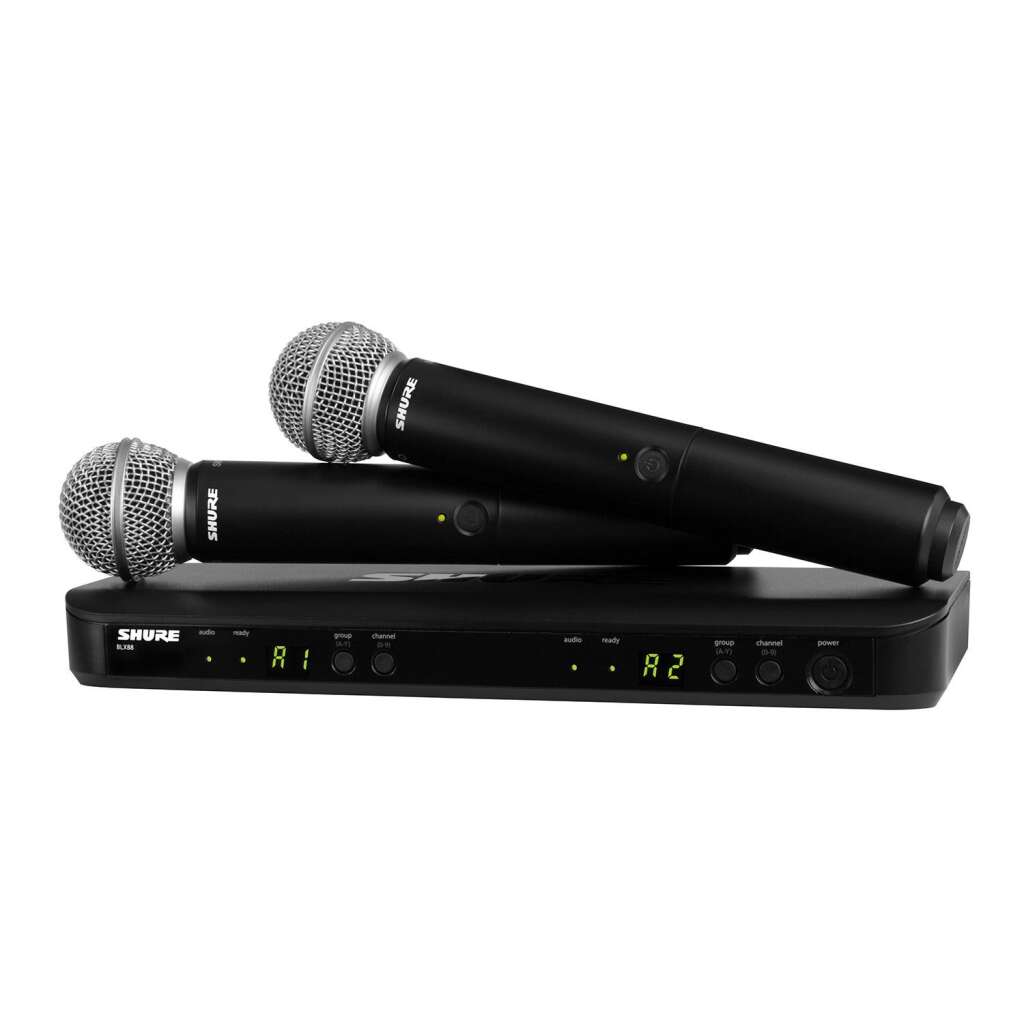
BLX is Shure’s entry-level analogue UHF wireless family. The UK variant is the K3E band, 606 to 630 MHz, transmitting at 10 mW. It is the natural first wireless system: you get genuine Shure capsules (PG58, SM58, Beta 58A and others, depending on the configuration), microprocessor-controlled internal antenna diversity, and one-touch QuickScan that finds a clean frequency for you. Shure quotes up to 12 compatible systems per frequency band, dependent on region and RF environment, a working range of 91 m line of sight, and up to 14 hours from two AA alkaline batteries, which is honestly class-leading stamina and a direct benefit of the simpler analogue circuitry.
The compromises are equally clear. The audio path is analogue FM with a quoted frequency response of 50 Hz to 15 kHz and around 100 dB dynamic range, against 20 Hz to 20 kHz and 118 dB for the digital SLX-D and SLX-D+ platform. The standard BLX4 single and BLX88 dual receivers are moulded ABS plastic boxes designed for tabletop use, not rack life (the BLX4R is the exception, a rack-mountable single receiver). There is no Shure rechargeable battery ecosystem for BLX: it is AA batteries or nothing. And the receiver display and controls are deliberately minimal, which is fine for a set-and-forget single system and limiting for anything more ambitious.
Shure SLX-D+ in brief
SLX-D+ is the 2026 replacement for SLX-D, and it is an evolution of the same digital platform rather than a clean-sheet design. Audio is transparent 24-bit digital, extended 20 Hz to 20 kHz response (microphone dependent), with latency trimmed to 2.8 ms from 3.2 ms on SLX-D. The two headline gains are spectrum and security: the UK variant is the K55 band, 606 to 694 MHz, which is an 88 MHz tuning window against 44 MHz on the old K59 SLX-D, and SLX-D+ adds AES-256 encryption, which SLX-D did not have. Shure quotes up to 85 compatible systems per band on the widest bands, which is a radio capability rather than something you will see in a single UK TV channel (more on that below). Digital predictive switching diversity keeps the RF link stable, every receiver includes a Guided Frequency Setup for group scan, channel assignment and IR sync, and receivers link over Ethernet for a group scan across the whole rack in one pass.
Hardware is a proper step up from BLX. The SLXD4+ single and SLXD4D+ dual receivers are both half-rack steel units and rack-ready with the included hardware, there is a quad SLXD4Q+ in 1U for dense channel counts and a Dante-equipped SLXD4QDAN+ for networked installs, and the antenna connections work with Shure’s UHF antenna and distribution accessories. Transmitters run on two AA batteries for up to 8 hours, or on the SB903 lithium-ion rechargeable battery carried over from SLX-D, with single-bay, dual-bay and 8-bay rack-drawer chargers, which transforms the running cost of a multi-channel fleet. The SLXD2+ handheld takes interchangeable Shure capsules, so an SM58 system can become a Beta 87A or Nexadyne system later without replacing the electronics.
Head to head
| Factor | Shure BLX | Shure SLX-D+ |
|---|---|---|
| Audio path | Analogue FM, 50 Hz to 15 kHz, 100 dB dynamic range | 24-bit digital, 20 Hz to 20 kHz, 2.8 ms latency (SLX-D was 3.2 ms) |
| UK band | K3E, 606 to 630 MHz | K55, 606 to 694 MHz (88 MHz tuning window); SLX-D was K59, 606 to 650 MHz |
| Channel count | Up to 12 compatible systems per band (region and environment dependent) | Up to 85 per band on the widest bands (band dependent). In Ch38 the ceiling is Ofcom’s channel plan, not the radio |
| Frequency setup | One-touch QuickScan, manual group and channel matching on the transmitter | Guided Frequency Setup, group scan across linked receivers, IR sync |
| Receiver build | Moulded ABS tabletop (BLX4 single, BLX88 dual); BLX4R rack option | Steel, rack-native (SLXD4+ and SLXD4D+ half-rack, full-rack SLXD4Q+ quad, Dante option) |
| Batteries | 2 x AA only, up to 14 hours (alkaline) | 2 x AA up to 8 hours, or SB903 Li-ion rechargeable with dock chargers |
| Encryption | None | AES-256 |
| Working range | 91 m line of sight | 100 m (Shure’s published SLX-D figure) |
| Networking and control | None | Ethernet linking, Wireless Workbench, ShurePlus Channels app, Dante on SLXD4QDAN+ |
| Future-proofing | Fixed capsule per system, no growth path beyond adding more standalone units | Interchangeable capsules, rack expansion, antenna distribution, quad and Dante receivers |
The SLX-D run-out: is discontinued stock a bargain?
Because SLX-D was discontinued from 1 February 2026, remaining stock is being sold through rather than replenished, and that can make it genuinely good value. It is the same well-proven digital system it was in January. What you give up against SLX-D+ is the wider tuning window (44 MHz on K59 against 88 MHz on K55), the slightly lower 2.8 ms latency, and AES-256 encryption.
Run-out SLX-D makes sense if you are buying a fixed number of channels for a known job that lives in Channel 38, you have no plans to expand into coordinated spectrum above 614 MHz, and encryption is irrelevant to you. A school hall or a church running four handhelds in Ch38 is a good example. It makes less sense if you expect to grow the system over several years, because you will eventually be mixing a discontinued range with current stock, or if you need encryption for confidential meetings, which is exactly where AES-256 earns its place.
One practical compatibility note in your favour either way: SLX-D+ transmitters work with SLX-D receivers, though only at SLX-D feature level, so an existing SLX-D rack can be extended with current transmitters rather than stranded.
Channel count in the real world: what fits in Ch38
Spec-sheet channel counts assume you can use the whole band. In the UK you usually cannot. Most working systems live in Channel 38 (606 to 614 MHz) under an Ofcom shared licence, which is a single 8 MHz TV channel. That reframes the comparison completely.
Shure specified SLX-D at up to 12 compatible systems in one 8 MHz TV channel (and 10 in a 6 MHz channel), thanks to the tighter spectral behaviour of digital transmission, and SLX-D+ inherits that behaviour. Treat around ten as your working ceiling in Ch38 regardless of the headline band figure, because Ofcom publishes a ten-channel plan for the shared licence and the 8 MHz of spectrum is the real constraint, not the radio. BLX’s headline figure of up to 12 systems applies across the full 24 MHz K3E window under favourable conditions; squeeze BLX into Ch38 alone and you will fit considerably fewer before intermodulation starts eating your clean frequencies. For a solo act or a two-mic pub band this is academic. For a school musical, a conference room or a church wanting six or eight channels in Ch38, it is the whole argument: the digital system packs more reliable channels into the spectrum you are licensed to use, and its group scan will coordinate them for you in seconds.
Build, batteries and racking
Receivers
The BLX4 and BLX88 are light ABS boxes with fixed antennas, made to sit on a table or shelf. They are perfectly durable in that role, but they do not rack without third-party trays, and a stack of them looks and works like a stack of separate products. The SLXD4+ and SLXD4D+ are both steel half-rack units, designed from the start to bolt into a 19-inch rack and share antennas through a distribution amplifier, and the full-rack SLXD4Q+ puts four channels in 1U. If the system will tour in a case or live in an installed rack, SLX-D+ is the one engineered for it. The BLX4R exists as a middle path if you want to rack a single BLX channel.
Batteries
BLX’s 14 hours from two AAs is the best endurance figure here, and for an occasional user that is genuinely convenient: fresh alkalines on show day and you will never think about power. The economics flip as channel count and frequency of use rise. Eight transmitters used three nights a week burn through an unpleasant amount of disposable batteries. The SB903 lithium-ion battery, carried over from SLX-D to SLX-D+, drops into any transmitter in place of the AAs, charges in dedicated dual-bay docks or an 8-bay rack-drawer charger, and reports accurate runtime to the receiver. Fleet operators, schools and venues standardise on it for good reason. BLX has no equivalent: there is no Shure rechargeable pack or dock for it.
Growing the system
A BLX purchase is complete on day one: the capsule is part of the system you chose, and expansion means buying another self-contained system. SLX-D+ behaves more like infrastructure. Handheld capsules unscrew and interchange (SM58 today, Beta 87A or Nexadyne later), bodypacks take the full range of Shure lavalier, headset and instrument microphones, receivers gang up in racks behind shared antennas, and the range runs up to quad and Dante-equipped receivers in the same family. If you can see a bigger system in your future, SLX-D+ lets you buy it in stages instead of replacing everything.
Which should you buy?
Choose BLX if
- You need one or two channels: a solo vocalist, a duo, a presenter with a lavalier or headset.
- The system lives in a bag or on a shelf, not in a rack.
- Battery cost is trivial because you use it occasionally, and 14-hour AA life suits you.
- The budget is fixed and a second-hand digital system is not on the table. A church or community hall that needs two reliable vocal mics is better served by new BLX than by stretching to a single SLX-D channel and having no spare.
- You want the simplest possible operation for volunteer users: one scan button, match the channel, done.
Choose SLX-D+ if
- You are running four or more channels now, or will be within a couple of years. The Ch38 channel density argument alone settles it.
- The system goes in a rack: touring bands, installed venues, conference rooms, theatres.
- You want rechargeable power across a fleet of transmitters, with docks in the rack.
- You are a school or theatre running many bodypacks in one TV channel, where the coordinated group scan and digital channel density earn their keep on every show.
- You value the cleaner, quieter 24-bit audio path, particularly with quality condenser capsules or lavaliers where analogue compander artefacts are most audible.
- You want a growth path: interchangeable capsules, antenna distribution, quad and Dante receivers.
- You need encryption. AES-256 on SLX-D+ matters for confidential meetings, council chambers and anything where a scanner in the car park is a real concern.
BLX is not a lesser product, it is a smaller one. Where buyers go wrong is buying the smaller product for a bigger job. If you are hesitating between a dual BLX system and starting an SLX-D+ rack, ask how many channels you will want in three years, not how many you need this weekend.
UK bands and licensing
Both systems are sold in UK-legal variants: BLX in K3E (606 to 630 MHz), SLX-D+ in K55 (606 to 694 MHz), and run-out SLX-D in K59 (606 to 650 MHz), with S50 (823 to 865 MHz) variants also available for some models. All of those include Channel 38 (606 to 614 MHz), which is the standard UK home for licensed radio microphones under an Ofcom shared licence. This is the part buyers most often get wrong: only Ch38 is covered by that shared licence. The rest of the K55 range up to 694 MHz is interleaved spectrum needing a coordinated licence for the venue or event, so SLX-D+’s wider window is an advantage only if you hold coordination, or if you tour to venues that do. K55 stops below the cleared 700 MHz band, so nothing in it is off-limits spectrum in principle. The rules are identical for analogue and digital systems, so licensing should not sway your BLX versus SLX-D decision. For the full picture, including what the shared licence costs and how to apply, see our Ch38 UK wireless microphone licensing guide.
Where BLX and SLX-D sit in Shure’s range
For completeness: Shure’s current wireless families run BLX, GLX-D+ Dual Band, SLX-D+, QLX-D, ULX-D and Axient Digital. GLX-D+ Dual Band sits beside BLX and SLX-D rather than between them: it is digital and rechargeable but operates licence-free in 2.4 and 5.8 GHz with automatic frequency management, which makes it brilliant for a self-contained act and unsuitable for high channel counts in busy RF environments. QLX-D and above are the professional tier, with higher channel density and deeper networked control for touring and broadcast. If you are still weighing up system types more broadly, our wireless microphone buying guide covers the whole landscape.
Common mistakes to avoid
- Buying a non-UK band from a marketplace. BLX and SLX-D+ are made in many regional bands (K14, H10, J10 and others) for other markets. Grey imports in those bands can be illegal to operate in the UK and useless in UK spectrum. Buy K3E for BLX and K55 for SLX-D+ (K59 on run-out SLX-D, or S50 where appropriate), from a UK dealer.
- Mixing BLX and SLX-D+ expecting shared parts. A BLX transmitter will not pair with an SLX-D+ receiver or vice versa, and the SB903 rechargeable battery and its chargers are for the SLX-D and SLX-D+ transmitters only. SLX-D+ transmitters do work with SLX-D receivers, at SLX-D feature level. The two families can share a stage, with frequencies coordinated, but they share no hardware.
- Choosing BLX for a growing multi-channel system. Two or three BLX systems bought separately cost real money and hit a channel ceiling in Ch38 quickly. Price the SLX-D+ dual-receiver route before committing.
- Forgetting the licence. Whichever system you buy, operating in Ch38 needs the Ofcom shared licence. It is inexpensive and quick to obtain, and operating unlicensed risks interference complaints and enforcement.
- Ignoring antennas on rack builds. If you rack four SLX-D+ receivers, budget for antenna distribution rather than a forest of rear-panel whips inside a metal case.
Check the band code before you buy
The band is printed on the box and on each transmitter and receiver. For UK use you want K3E on BLX and K55 (606 to 694 MHz) on SLX-D+, or K59 (606 to 650 MHz) on run-out SLX-D. If a marketplace listing shows K14, H10, J10 or another code, it is stock for a different region and may be illegal to switch on here.
Popular picks from the shop
Shure BLX288/SM58 (K3E) Dual Wireless Vocal SystemView product → Shure BLX14/CVL (K3E) Wireless Presenter SystemView product → Shure SLXD24+/SM58 (K55) Wireless Vocal SystemView product → Shure SLXD24D+/SM58 (K55) Dual Wireless Vocal SystemView product →
Frequently asked questions
Is SLX-D+ really worth the extra over BLX?
For one or two channels used occasionally, usually not: BLX sounds professional and works reliably. The value of SLX-D+ scales with channel count, hours of use and rack integration. At four channels and above, or with weekly use, the rechargeable batteries, channel density and steel rack receivers repay the difference quickly.
Can I use BLX and SLX-D+ together on the same stage?
Yes. They are separate RF systems, so each pairs only with its own transmitters, but they can operate simultaneously provided the frequencies are coordinated so they do not clash. Shure’s free Wireless Workbench software will coordinate frequencies across both families.
Do BLX and SLX-D+ need an Ofcom licence in the UK?
Both are sold here in bands that include Channel 38, which requires the low-cost Ofcom shared licence. The requirement is identical for both systems. See our Ch38 licensing guide for the details and how to apply.
Can BLX be rack-mounted?
The standard BLX4 and BLX88 receivers are tabletop units. Shure offers the BLX4R, a rack-mountable single-channel receiver, for installations that want BLX pricing in a rack. If you are racking more than a couple of channels, SLX-D+ is the better platform.
How do the rechargeable batteries work?
The SB903 lithium-ion battery replaces the two AAs inside any SLX-D or SLX-D+ transmitter. It charges in the SBC10-903 single-bay or SBC203 dual-bay dock, or the SBC80-903 8-bay cradle that fits a rack drawer, and the transmitter reports remaining runtime. AAs remain a drop-in fallback at any time.
Are the microphone heads interchangeable between the two systems?
The SLXD2+ handheld is designed around interchangeable Shure capsules, so you can change the microphone element without changing the system. BLX handhelds are sold as fixed configurations. Either way, a capsule swap never makes a BLX transmitter compatible with an SLX-D+ receiver: the radio links are separate.
What is the range difference?
On paper they are close: 91 m line of sight for BLX, 100 m for the digital system. In practice both cover any normal venue. Range is rarely the deciding factor between them; channel count and features are.
Should I buy discontinued SLX-D while it is cheap?
It can be a sound buy for a fixed job that lives in Channel 38, with no plans to expand and no need for encryption. You are giving up the wider K55 tuning window, the 2.8 ms latency and AES-256. If the discount is real and the system is right-sized for the job, run-out SLX-D is still a good digital system. See the run-out section above for the full trade-off.
Will 606 to 694 MHz stay legal for wireless microphones in the UK?
Channel 38 and the surrounding interleaved spectrum remain the UK’s allocated home for PMSE radio microphones following the 700 MHz clearance, and K3E, K55 and K59 systems sold today all sit within it, below the cleared 700 MHz band. Nothing is guaranteed forever in spectrum policy, but buying current UK-band stock from a UK dealer is the safest position available.
Shop this guide
Browse the full ranges below, or talk to us about speccing a multi-channel system, frequency coordination or trade pricing for schools, venues and production companies.
Wireless Systems All Shure Handheld Transmitters Antennas & Distribution


