


Home » Guides » Mixers & PA Systems »
Allen & Heath Qu vs SQ vs Avantis: Which Digital Mixer Do You Need?
A dealer’s comparison of Allen & Heath’s three live mixing ranges, so bands, churches, venues, schools and hire companies buy the right desk first time.
~11 min read · Updated July 2026 · By the Stage Supply team
In this guide: At a glance · Comparison table · Qu range · SQ range · Avantis · Stageboxes & expansion · Personal monitoring · Which to buy · FAQ
Allen & Heath’s live console line-up splits into three ranges below the touring flagship dLive: Qu, SQ and Avantis. All three now run 96kHz XCVI FPGA processing, all three connect to the same Everything I/O family of stageboxes over SLink, and all three can feed the same ME personal monitoring system. That shared DNA is exactly why buyers get stuck: the ranges overlap on paper, and the differences that matter are in channel counts, control surface, expansion headroom and processing add-ons rather than headline features.
This guide compares the current second generation Qu (Qu-5, Qu-6, Qu-7), the SQ range (SQ-5, SQ-6, SQ-7, plus the newer SQ+ models) and Avantis (including Avantis Solo). Every spec here has been verified against Allen & Heath’s published data. If you are stepping up from an analogue mixer, any of the three will feel like a different world; the question is how much desk you actually need, and how much room to grow you should pay for now.
The Three Ranges at a Glance
Qu is no longer the 48kHz range
Most “Qu vs SQ” advice online was written about the original Qu-16/24/32, which ran at 48kHz. The current second generation Qu-5, Qu-6 and Qu-7 use the same 96kHz XCVI FPGA core technology as SQ and Avantis. Sample rate is no longer the dividing line between the ranges; channel count, buses, FX engines, control surface and expansion headroom are. If a comparison you have read leads with “SQ is 96kHz, Qu is 48kHz”, it is out of date.
The short version of the hierarchy:
- Qu is the fast, approachable range: 38 inputs to mix, 12 mixes, 6 FX engines, a 7″ touchscreen and one fader per onboard preamp. Built for people who mix occasionally and need it to be obvious.
- SQ is the working engineer’s desk: 48 channels, 8 FX engines, an option card slot for Dante/MADI/Waves, and DEEP processing add-ons. The default choice for busy venues, larger churches and dry hire.
- Avantis is dLive technology in a standalone console: 64 channels (96 with dPack), 42 buses (56 with dPack), twin 15.6″ Full HD touchscreens and two 128×128 I/O ports. For productions that outgrow SQ.
Qu vs SQ vs Avantis: Full Comparison Table
Figures below are for the ranges as published by Allen & Heath. Where models within a range differ (preamps, faders, outputs), the spread across the range is shown.
| Feature | Qu (Qu-5/6/7) | SQ (SQ-5/6/7) | Avantis / Avantis Solo |
|---|---|---|---|
| Processing core | 96kHz XCVI | 96kHz XCVI | 96kHz XCVI, 0.7ms latency |
| Inputs to mix | 38 (32 mono + 3 stereo) | 48 | 64, or 96 with dPack |
| Mix buses | 12 mixes + 4 matrices + LR | 12 stereo mixes + 3 stereo matrices + LR | 42 configurable, or 56 with dPack |
| FX engines | 6 multi-FX with stereo returns | 8 stereo FX with returns (SQ+ adds 4 RackUltra FX) | 12 RackExtra FX (RackUltra FX available) |
| Faders / layers | 17 / 25 / 33 motorised, 4 layers | 16+1 / 24+1 / 32+1, 6 layers | 24 faders, 6 layers (Solo: 12 faders, 6 layers) |
| Screen | 7″ capacitive touchscreen | 7″ capacitive (SQ+: 9″) | Twin 15.6″ Full HD (Solo: single 15.6″) |
| Local mic preamps | 16 / 24 / 32 combi | 16+1 / 24+1 / 32+1 | 12 XLR (Solo: 6 XLR) |
| Local XLR outputs | 12 / 16 / 20 | 12 / 14 / 16 (+2 TRS, AES out) | 12 XLR + 2 stereo AES out (Solo: 6 XLR) |
| Expansion | 128×128 intelligent SLink port; D models add 16×16 Dante | SLink port + one 64×64 option card slot (Dante, Waves, MADI, SLink) | SLink port + two 128×128 I/O ports (Dante, MADI, gigaACE) |
| Recording | 32×32 USB-C interface; SD card 16×16 at 96kHz or 32×32 at 48kHz | 32×32 96kHz USB interface; SQ-Drive 16ch at 96kHz or 32ch at 48kHz to USB | Via I/O port cards (Dante/MADI to a recording rig) |
| DEEP processing | DEEP ready | DEEP add-ons available | dPack adds dLive DEEP suite, Dyn8, channel/bus expansion |
| Typical buyer | Bands, small churches, schools, small venues | Venues, mid-size churches, hire stock, engineers | Large churches, theatres, production and hire companies |
Qu (Qu-5, Qu-6, Qu-7): The Fast, Friendly One
The second generation Qu is built around a simple idea: one physical fader for every onboard preamp, so the desk never hides your show behind bank switching if you do not want it to. Qu-5 gives you 16 combi mic/line inputs and 17 faders, Qu-6 gives you 24 inputs and 25 faders, and Qu-7 gives you 32 inputs and 33 faders. All three share the same 96kHz XCVI core with 38 inputs to mix (32 mono/linkable plus 3 stereo), 12 mixes, 4 matrices and 6 multi-FX engines with dedicated stereo returns.
This is the range we point volunteer teams at. A school hall, a small church, a function band running its own front of house from stage: Qu’s layout means the person mixing on Sunday morning does not need to remember which layer the vocals live on. The 7″ capacitive touchscreen handles processing, and the free Qu-MixPad app (Windows, macOS, iOS, Android) covers walk-the-room mixing and musician-controlled monitor mixes via Qu4You.
What you get across the Qu range
- 96kHz XCVI core, 38 inputs to mix on every model
- 100mm motorised faders, 4 layers, one fader per local preamp
- 128×128 intelligent SLink port into the Everything I/O stagebox family
- 32×32 USB-C audio interface plus SD card multitrack (16×16 at 96kHz, 32×32 at 48kHz)
- Qu-5D/6D/7D variants add a 16×16 Dante port at 48 or 96kHz
- DEEP processing ready, remote apps free on all platforms
Where Qu runs out of road: 12 mixes is generous for its class but finite. A church running six stereo in-ear mixes, delay fills and a livestream feed will eat all of them. And 38 inputs to mix is the hard ceiling regardless of how much stagebox I/O you hang off the SLink port. If your channel list is already touching the mid-30s, buy SQ.
SQ (SQ-5, SQ-6, SQ-7): The Working Standard
SQ is the desk you will see most often in UK venues, mid-size churches and hire fleets, and there is a reason for that. Every SQ model carries 48 input channels at 96kHz, 12 stereo mixes plus LR, 3 stereo matrices, and 8 stereo FX engines with dedicated returns. The three models differ in surface, not brain: SQ-5 has 16+1 faders and preamps in a compact footprint, SQ-6 has 24+1 plus 16 SoftKeys and 4 soft rotaries, and SQ-7 has 32+1 with 8 soft rotaries. All run 6 fader layers, so even the little SQ-5 will happily mix a 48-channel show.
The feature that separates SQ from Qu in real installs is the 64×64 option card slot. Drop in a Dante card and the desk sits on a networked campus; a Waves card opens SoundGrid; MADI feeds broadcast or recording; an SLink card gives you a second expander port with its own sample rate conversion, so you can run two different stagebox protocols at once. On top of that, SQ-Drive records multitrack straight to a USB drive (16 channels at 96kHz or 32 at 48kHz), and the 32×32 96kHz USB interface handles virtual soundcheck without extra hardware.
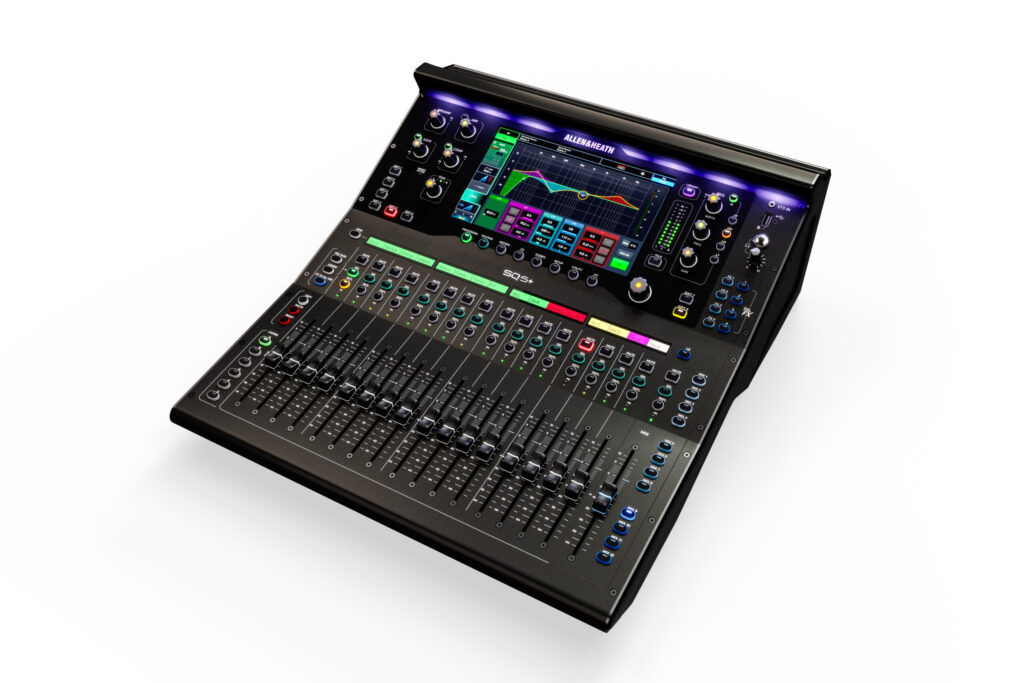
In 2025 Allen & Heath extended the range with the SQ5+, SQ6+ and SQ7+. Same 48-input 96kHz core, but with a larger 9″ touchscreen, four RackUltra FX engines developed for dLive (reverbs, vocal tuning, pitch, amp modelling, saturation) and more headroom for the latest DEEP add-ons. If you are buying new and the budget stretches, the plus models are the ones to future-proof with; classic SQ remains current, supported and plentiful.
Why engineers default to SQ
- 48 channels and 8 FX engines on every model, including the SQ-5
- 64×64 option card slot: Dante, Waves, MADI or a second SLink
- DEEP processing add-ons embed compressors and preamp models in the channel, without inserting FX slots
- SQ-Drive USB multitrack plus 32×32 USB interface for virtual soundcheck
- Dual 24-channel automatic mic mixers for conference and panel work
- SQ+ models add a 9″ screen and four dLive RackUltra FX engines
SQ-5 vs SQ-6 vs SQ-7 is a surface decision, not a capability one. Buy the surface that matches how you mix: if the desk lives in a rack case and tours with a stagebox on the other end of a Cat cable, the SQ-5 footprint is a gift. If it sits at front of house in a venue and multiple engineers guest on it, the SQ-6’s extra faders, SoftKeys and rotaries earn their space. The SQ-7 suits monitor world and channel-heavy one-desk shows where you want a fader per input across two layers, not four.
Avantis and Avantis Solo: dLive Thinking, Standalone Console
Avantis takes the XCVI FPGA architecture from dLive and puts it in a standalone console: 64 input channels, 42 configurable mix buses and 12 RackExtra FX engines at 96kHz with 0.7ms latency. The control surface is a genuine step up, with twin 15.6″ Full HD capacitive touchscreens, 24 faders over 6 layers (144 strips), 24 assignable SoftKeys and 16 DCAs. Local I/O is deliberately lean at 12 XLR in and 12 XLR out plus AES, because a desk at this level is expected to live on stageboxes and networks.
Expansion is where Avantis pulls clearly ahead: alongside the SLink port it carries two I/O ports, each capable of 128×128 at 96kHz, taking Dante, MADI and gigaACE cards. That is a monitor split, a broadcast feed and a 64-track record rig without touching the stagebox port. The dPack upgrade then expands the engine itself from 64 to 96 input channels and 42 to 56 buses, and adds the dLive DEEP suite: Dyn8 dynamics (24 instances), DEEP compressors, expanders, NEQ12 and the Dual Stage Valve Preamp model.
Avantis Solo shrinks the surface, not the engine: the same 64-channel core (96 with dPack) behind a single 15.6″ Full HD screen, 12 faders, 18 SoftKeys and 6 local XLR ins and outs, with the same two 128×128 I/O ports. For theatres and churches with a tight FOH position, or hire companies that want dLive-grade output from a one-operator desk, it is a seriously compact amount of console.
- 64 input channels and 42 buses standard; 96 and 56 with dPack
- Twin 15.6″ Full HD touchscreens (single on Solo)
- Two 128×128 96kHz I/O ports for Dante, MADI, gigaACE cards
- 12 RackExtra FX engines, with RackUltra FX available
- dPack brings dLive DEEP models: Dyn8, compressors, NEQ12, valve preamp
- 0.7ms latency XCVI core, 16 DCAs
Stageboxes and Expansion: How SLink Actually Works
All three ranges share the Everything I/O expander family, connected over a single Cat cable to the console’s SLink port. The port is intelligent: it automatically detects and switches between three protocols. dSnake expanders (AR84, AB168, AR2412) run at 48kHz; DX expanders (DX168, DX164-W, DX012, DX88 and the 48-in/16-out GX4816) run at 96kHz; and gigaACE/GX links carry high channel counts between systems. The console’s SLink port has built-in sample rate conversion, so 48kHz dSnake boxes still work on these 96kHz desks, with audio up-sampled into the core and down-sampled on the way back out.
That flexibility matters for budgets: a church can start with an affordable AB168 on day one and move to a GX4816 later without changing console. Run the link on proper touring-grade Cat cable; the stagebox link is the one cable your whole show hangs off. There are Dante-native expanders too (DT168, DT164-W and others) for consoles fitted with Dante ports or cards.
Common mistake: treating all stageboxes as equal
Buyers regularly pair a 96kHz SQ or Avantis with a cheap second-hand AR or AB series box and assume they are getting the full 96kHz signal path. They are not: dSnake expanders run at 48kHz and get sample rate converted at the SLink port. That is fine for utility inputs, but if you bought the desk for its 96kHz preamp-to-master path, put your critical channels on DX or GX series boxes, which run natively at 96kHz. Also note the per-port limits: dSnake and DX protocols support a maximum of two remote audio units per SLink port, so plan split stages around that (or add an SLink option card on SQ, or use the DX Hub on the bigger systems) rather than assuming you can daisy-chain boxes indefinitely.
Common mistake: buying too few local preamps
A stagebox is brilliant when the desk is at front of house, but plenty of Qu and SQ desks spend half their life as the whole system: rehearsal rooms, corporate jobs where the desk sits side of stage, dry hires where the stagebox went out on another job. If you regularly plug straight into the back of the desk, buy the model whose local preamp count covers your channel list on its own. The gap between an SQ-5 (16+1 preamps) and SQ-6 (24+1) or a Qu-5 (16) and Qu-6 (24) is much cheaper at purchase than adding a stagebox you did not otherwise need.
Personal Monitoring: ME-1 and ME-500 Work With All Three
One of the strongest arguments for staying inside the Allen & Heath ecosystem is the ME personal mixing system, which works across Qu, SQ and Avantis. The ME-500 is the simple one: a 16-channel personal mixer with level and pan per channel, powered over PoE or mains, daisy-chainable or run through standard PoE Ethernet switches. The ME-1 steps up to 40 sources with 16 assignable keys and an OLED screen, and on SQ and Avantis it automatically picks up channel names from the console. For other consoles, or larger rigs, the ME-U hub distributes feeds and takes MADI and Dante option cards for up to 40 sources from third-party systems.
For bands and churches this changes the monitoring conversation entirely: musicians mix themselves, the engineer gets their bus count back, and stage volume drops. Pair ME mixers with wired in-ears or feed a wireless IEM transmitter from the console’s aux outs; our in-ear monitor systems guide covers the licensing and frequency side, and you will find hardware in our monitoring category.
Which Should You Buy?
Strip away the spec sheets and the decision comes down to three questions: how many inputs and mixes does your worst-case show need, who operates the desk, and what does it need to plug into over the next five years?
Choose Qu if
- Your channel list stays under about 32 and 12 mixes covers monitors plus sends
- Volunteers or students operate the desk and one-fader-per-input matters
- You want built-in SD multitrack and a 32×32 USB interface out of the box
- Dante is nice-to-have, covered by a 16×16 D model rather than a card slot
Choose SQ if
- You need 48 channels, or headroom to grow into them
- The option card slot earns its keep: Dante, Waves, MADI or a second SLink
- Guest engineers will mix on it; SQ is the desk most of them already know
- You want DEEP add-ons, and RackUltra FX via the SQ+ models
Choose Avantis if
- Shows run past 48 inputs, or bus demands exceed SQ’s 12 stereo mixes
- You need two 128×128 card ports: splits, broadcast, big multitrack
- dLive-grade DEEP processing via dPack is part of the plan
- Hire stock needs a rider-friendly desk below dLive money (Solo where space is tight)
If you are specifying a complete rig around the console (speakers, amps, stageboxes, monitoring), our small venue PA system guide walks through the rest of the signal chain, and the full console range is in our digital mixing systems category.
Popular picks from the shop
Frequently Asked Questions
Is the new Qu 96kHz like SQ?
Yes. The second generation Qu-5, Qu-6 and Qu-7 all run a 96kHz XCVI core, the same FPGA technology family as SQ and Avantis. The old 48kHz limitation belonged to the original Qu-16/24/32. The remaining differences are capacity and features: Qu mixes 38 inputs with 6 FX engines and 12 mixes, where SQ runs 48 channels, 8 FX engines and adds the 64×64 option card slot.
SQ-5 vs SQ-6: what am I actually paying for?
Surface, not capability. Both are 48-channel, 96kHz desks with identical processing, the same option card slot and the same SLink port. The SQ-6 adds eight more faders and preamps (24+1 vs 16+1), 16 SoftKeys instead of 8, four soft rotaries and two more XLR outs. If the desk is racked and fed from a stagebox, buy the SQ-5. If people mix on the surface every day, the SQ-6’s extra hands-on control is worth it.
What is the best digital mixer for a church in the UK?
For most UK churches with volunteer teams, Qu-6 or Qu-7 hits the sweet spot: enough preamps for the band, one fader per input, SD card recording for the sermon and podcast, and apps for mixing in-ears from the stage. Churches with larger productions, multiple services with different bands, or a livestream broadcast mix should step up to SQ for the 48 channels and the Dante card slot. Big multi-venue churches running past 48 inputs are Avantis territory.
Avantis vs SQ: when is the step up worth it?
When you hit any of SQ’s three ceilings: 48 input channels, 12 stereo mixes, or the single 64×64 card slot. Avantis gives you 64 channels (96 with dPack), 42 fully configurable buses (56 with dPack), and two 128×128 I/O ports, plus twin Full HD touchscreens and dLive DEEP processing via dPack. If none of those ceilings is in sight within five years, keep the money and buy SQ plus better stageboxes.
Do old Qu or dLive stageboxes work with these desks?
Largely yes, and this is a major strength of the platform. The SLink port on Qu, SQ and Avantis auto-detects dSnake (AR84, AB168, AR2412 at 48kHz), DX (96kHz) and gigaACE/GX protocols, with sample rate conversion built in. So an AB168 from an original Qu rig will plug into a new SQ and work. The caveats: dSnake boxes run their preamps at 48kHz even on a 96kHz console, and dSnake/DX allow a maximum of two remote units per port.
Can I multitrack record without a computer?
On Qu and SQ, yes. Qu records to SD card (16×16 at 96kHz or 32×32 at 48kHz) and both ranges present a 32×32 USB audio interface to a computer. SQ-Drive records 16 channels at 96kHz or 32 channels at 48kHz direct to a USB drive. Avantis handles recording through its I/O ports, typically a Dante or MADI card into a recording system, which suits its production-scale use but does mean extra hardware for a simple archive recording.
What is DEEP processing and do I need it?
DEEP embeds boutique processor models (compressors, preamps and more) directly inside the channel and mix strips, so they add no system latency and do not consume FX slots. SQ offers DEEP add-ons, the SQ+ models add processing headroom for the newest generation, and on Avantis the dPack bundle brings the dLive DEEP suite including Dyn8 dynamics and the Dual Stage Valve Preamp. A volunteer-run Qu rig does not need it; an engineer chasing a polished broadcast or FOH sound will use it constantly.
Do I need special cable for stageboxes and ME mixers?
SLink runs point-to-point over Cat5e or better, and ME personal mixers run over standard Ethernet with PoE support. For anything that leaves an equipment rack, use touring-grade cable with locking connectors rather than office patch leads; the stagebox link carries every channel of your show. See our network cables and stage boxes ranges.
Shop this guide
UK stock and fast delivery on Allen & Heath consoles, stageboxes and monitoring. Not sure which model fits your channel list? Get in touch and we will spec it with you.
Digital Mixing Systems Stage Boxes Monitoring Network Cables


