

Home » Guides » Wireless Mics & In-Ear Monitoring »
Radio Mics for a School Musical or Am-Dram Show: How Many, Headset or Lav, and Mic Placement
How to plan radio mics for a school or amateur musical: how many channels you need and what Channel 38 allows, headset or hairline lavalier, where the mic goes and how it stays there, sweat and make-up, batteries, and mixing a big cast on an Allen & Heath desk. With a kit list built from systems we stock.
~15 min read · Updated October 2026 · By the Stage Supply team
In this guide: The short answer · How many mics · Channel 38 and licensing · Headset or lavalier · Mic placement · Sweat, make-up and spares · Batteries · Mixing a big cast · Hire or buy · Kit list · Popular picks · FAQ
The short answer
Give a radio mic to every performer who sings or speaks solo lines, cover the chorus with area or hanging mics, and plan the number of channels before you plan the brand. On the shared UK Channel 38 licence, Ofcom says “users can typically achieve 10 radio microphones in this range operating in the same place at the same time”. Beyond that you need extra, coordinated frequencies, or you share mics between actors.
For most school and amateur musicals the practical choice is an omnidirectional mic worn on the head: either a light headset with its boom near the cheek, or a miniature lavalier fixed at the hairline. In Shure’s theatre placement article, sound engineer Zoe Milton prefers a position between the temples, just forward of the hairline. Whatever you choose, the mic’s connector has to match the bodypack, the packs need fresh batteries or charged packs every show, and the desk needs DCAs and scenes so one operator can keep up with the script.
This guide covers the show-specific planning. For the systems themselves see the wireless microphone buying guide; for the rest of a hall rig see the am-dram and village hall starter kit and the school AV guide.
How many radio mics does a musical need?
Count from the script, not the cast list. Go through scene by scene and mark who sings or speaks alone, and who is on stage at the same time as whom. That gives two numbers:
- Mics open at once: the largest number of named performers who need to be heard in any one scene. This is the minimum number of channels.
- Mics worn in total: everyone who ever needs individual reinforcement. If this is higher than the channel count, some actors share a pack, swapping in the wings between their scenes.
- Spares: at least one spare bodypack and mic, set up and labelled, so a failure in Act 1 does not lose a lead for the night.
Ensemble numbers rarely need a radio mic each. A few hanging or float mics lift the chorus; see miking a choir. Every open mic adds spill and feedback risk, so more channels is not automatically better.
Mic swaps cost time and need a written plan: who hands which pack to whom, in which scene change. If the plot needs more swaps than your backstage team can manage reliably, that is the sign you need more channels, and possibly the licensing step below.
Channel 38, licensing and the 10-mic question
Most UK radio mics for theatre work in UHF, and the usual home for a school or society is Channel 38 under Ofcom’s UK Wireless Microphone Licence. Ofcom sets out the essentials:
- The licence covers 606.500 to 613.500 MHz, for one or two years, UK-wide.
- It is shared and non-protected: access is not restricted to specific frequencies, users can retune to any usable frequency within the range, and Ofcom notes that shared frequencies may be subject to interference from other users on the same frequency.
- Ofcom says “users can typically achieve 10 radio microphones in this range operating in the same place at the same time”, adding that this can differ case by case.
- If you need frequencies coordinated with other users, Ofcom issues a Standard Licence, which lists the assigned frequencies with the location or area of operation and the times and dates.
Manufacturers quote higher counts per 8 MHz TV channel (Shure says up to 14 SLX-D+ systems), but the Channel 38 licence is only 7 MHz wide, so Ofcom’s 10 is the planning number for one venue. For a cast that needs 12 or 16 open mics, read planning a multi-channel wireless system before you buy anything. The licence basics are in our Channel 38 licensing guide, and Standard and other licences are compared in licensing beyond Channel 38.
Whatever you buy, check the band. The Shure K55 band (606 to 694 MHz), Sennheiser EW-D S1-7 (606.2 to 662 MHz) and EW-DX S1-10 (606.2 to 693.8 MHz) all include Channel 38; anything outside 606.5 to 613.5 MHz in those ranges needs its own licence.
Headset or lavalier?
Both are body-worn mics plugged into a bodypack transmitter. The difference is where the capsule sits and how visible it is.
| Headset (neckband or ear-worn boom) | Miniature lavalier at the hairline | |
|---|---|---|
| Where it sits | On a boom near the cheek or the corner of the mouth | Clipped in the hair at the hairline, between the temples, or lower towards the ear |
| Level before feedback | Higher: the mic is closer to the mouth | Lower: further from the mouth, so it needs more gain |
| Visibility | Visible boom, available in black or beige | Nearly invisible under hair or a wig |
| Fitting time | Quick, and young performers can learn to put it on | Slower; someone has to fit and secure it every show |
| Consistency | Good, if the boom is set to the same position each time | Very good once the position is fixed, with the mic on bone |
| Typical use | Schools, pantos, shows with little backstage help | Shows with a wig or hair team and time for fittings |
Omni or cardioid?
DPA’s Mic University says that for a controlled environment such as a stage set for a musical, the omnidirectional headset is preferred, for its more natural tone, lack of proximity effect and less critical placement. It recommends an omni where the mic is used by untrained people, and a directional (cardioid) mic where background noise or feedback is the problem, placed a few centimetres from the corner of the mouth and pointed at it.
In practice that means omni for most actors, and cardioid for a performer with a quiet voice standing near loud speakers or a band. Stocked examples:
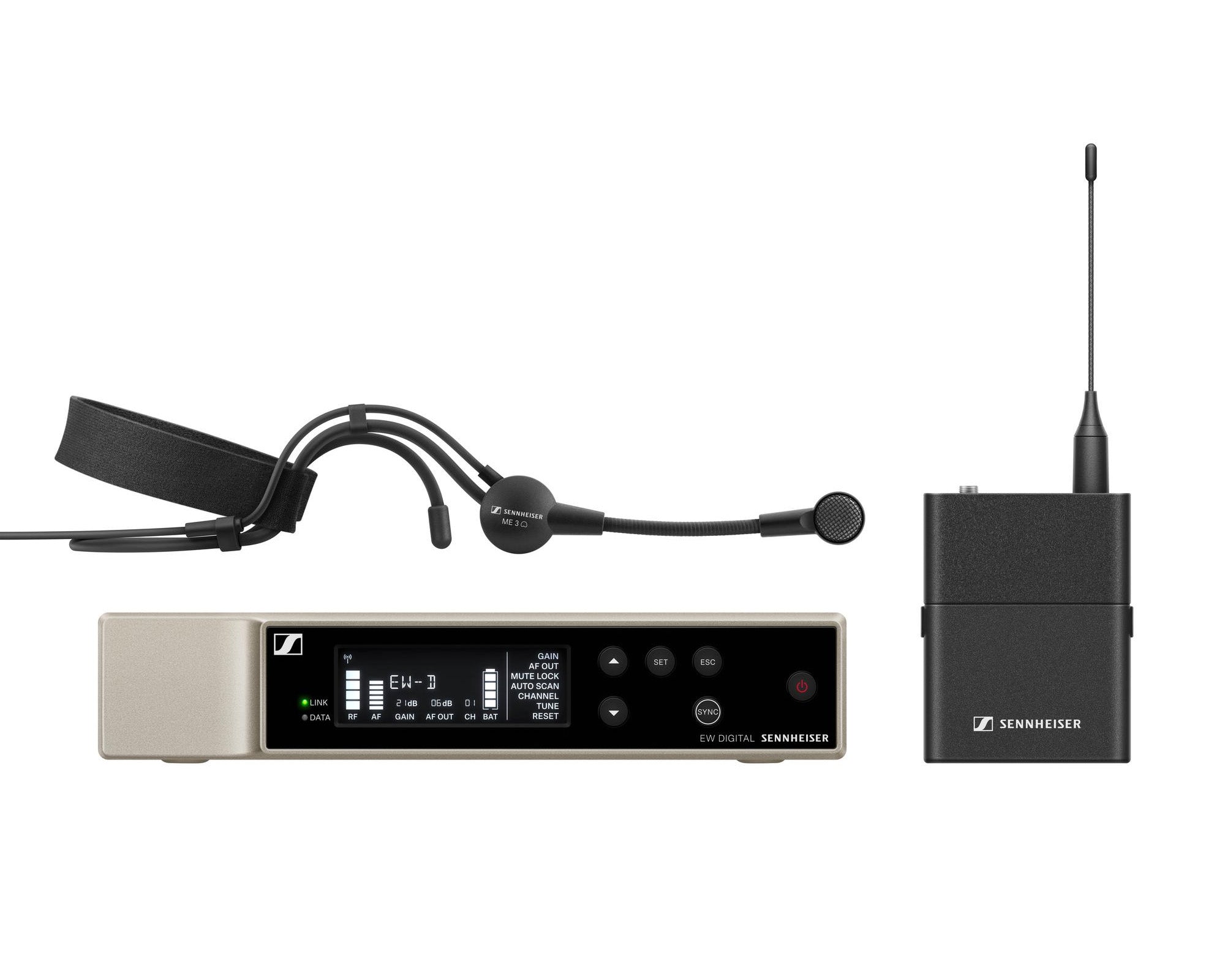
- Omni headset: the Sennheiser HSP Essential, neckband-worn, with a boom that can go left or right. Sennheiser lists it in black and beige, with 3.5mm jack or 3-pin connectors.
- Cardioid headset: the Sennheiser HSP 4-EW-3 (beige, 3.5mm), which Sennheiser specifies with excellent feedback rejection, and the Sennheiser ME 3. For EW-D and the 3.5mm EW-DX SK, Sennheiser’s published microphone list names the ME 3 but not the HSP 4-EW; the 3-pin HSP 4 is listed for the EW-DX SK 3-PIN. For Shure packs, the Shure PGA31 is a cardioid condenser headset on a TA4F (TQG) plug.
- Omni miniature for the hairline: the Sennheiser MKE 2 EW Gold (4.8mm capsule) for Sennheiser 3.5mm packs, or the Shure WL93 subminiature omni lavalier with a TA4F plug for Shure packs.
The Shure WH20 TQG is a dynamic cardioid with a wireframe headband. It is rugged but obvious on stage, so it suits a narrator, a band vocalist or a teacher on the mic better than a costumed lead.
Check the connector before you order
A headset or lav wired for one brand of bodypack will not plug into another. Shure SLX-D+ packs take TA4F (TQG) mics; Sennheiser EW-D and the EW-DX SK take 3.5mm jack mics; the EW-DX SK 3-PIN takes 3-pin versions. The full table is in our headset and lavalier connectors guide.
Mic placement: hairline, forehead, cheek
The placement advice below comes from Shure’s article “Top mic placement tips for theater” by UK sound engineer Zoe Milton, DPA’s theatre application page and DPA’s Mic University. General technique for headsets and lapel mics is in our microphone technique guide.
Hairline and forehead
In Shure’s article, sound engineer Zoe Milton says she prefers placing mics on the performer’s head, “between the temples just forward of the hairline”. The mic then sits on the bone, which in her experience “improves the bass response and creates a fuller, more natural sound”. She avoids taping mics directly onto the face, as it is often too uncomfortable for performers. DPA describes its miniature lavaliers as almost invisible when “mounted inconspicuously on a costume or hidden in the hairline”.
She secures lavaliers to the hair with clips, fixed with milliner’s elastic so they can be moved as needed, and typically uses three:
- After making a parting so the mic sits flat, a toupee clip secures the mic head, pointing at the performer’s mouth.
- A second clip reinforces and anchors that position. The article warns that if you get this one wrong, the mic will never sit in the right place.
- A third clip at the nape of the neck keeps the cable tidy. It can be taped, but the article says that is not always necessary, especially with a collar and a performance that is not particularly physical.
Clips come in several colours or can be painted to match the hair; she recommends matte spray paint rather than gloss, as it does not glisten under the lights. Clips need enough hair to stay secure. If hair or costume rules out the position between the temples, the article suggests moving the clips down towards the ear, and if that does not work, an ear hanger. As the mic moves away from the bone of the temples the sound gets muddier, which can be countered with desk EQ or with caps that boost the top end. As she puts it, “a centimeter either way in wireless mic terms is a massive difference and can ruin an entire scene”.
Cheek and corner of the mouth
A headset boom puts the capsule on the cheek. DPA’s Mic University gives the typical placement of a DPA directional headset as just a few centimetres from the corner of the mouth, and says directional headsets are best pointed at the mouth. It says positioning an omni is less critical. Either way, set the boom the same way every show.
Consistency matters more than the exact spot
Shure’s article says consistency has become one of the most important microphone placement techniques in theatre: if a mic is positioned the same way every night, EQ, gain and overall sound quality stay more consistent through the run. It also stresses talking early to make-up, wardrobe and wigs. A simple way to keep placement consistent is to photograph each actor’s fitting and pin the photos up in the dressing room.
Bodypacks
For most performances, the article puts the transmitter in a pouch on the waist, secured with a two-inch wide elastic band fastened at the front with Velcro. For difficult costumes, transmitters have been hidden in pouches in the hair or wig, which the article says has become much easier as transmitters have got smaller. Route the cable so it cannot be pulled by a costume change.
Sweat, make-up and spares
Sweat and make-up are a constant hazard for body-worn mics, so it pays to choose mics with protection built in. Here is what the manufacturer says about the ones we stock:
- Sennheiser says the MKE 2 has a dual-diaphragm design that “virtually eliminates sweat-outs” and is sweat protected by an ultralight Umbrella Diaphragm, and supplies it with three make-up protection caps.
- Sennheiser describes the HSP Essential as sweat resistant “thanks to patented umbrella diaphragm and rubber sealing ring”, and says all its parts can be replaced and ordered separately. A spare HSP Essential boom and cable (3.5mm, beige) means a boom bent in a quick change does not cost you the whole headset.
- The HSP 4 has a detachable cap that acts as a wind and pop shield, and its connection cable can be changed.
Wipe mics and booms down after each show, let packs and cables dry before they go back in the case, and keep a labelled spares box: a spare headset or lav on each connector type, a spare pack, clips, and batteries.
Batteries for a run of shows
Shure quotes up to 8 hours on 2 AA batteries for SLX-D+ transmitters, or the Shure SB903 rechargeable, charged in the SBC203 dock or other Shure chargers. Sennheiser EW-D and EW-DX packs run on AA batteries or the BA 70 pack.
For a run of evening performances the simple rule is a full charge or fresh cells before every show, and the dress rehearsal too. Set the battery type in the transmitter menu so the meter reads correctly, and never put half-used cells in a lead’s pack. Runtimes, chargers and which chemistries each system accepts are covered in radio mic and IEM batteries; a box of Procell Constant AA is the simplest disposable option.
Mixing a big cast: DCAs and scenes
With ten or more radio mics, the operator’s job is to have the right mics open at the right time, and every unused mic down. Two desk features make that manageable. Here is how Allen & Heath describes them on the desks we sell most for hall theatre:
- DCAs control the level and mutes of several channels from one fader. They are control only and carry no audio. Put the actors in a scene on a DCA and one fader rides the whole scene.
- Scenes store and recall the mix state; Allen & Heath says they can be used for the different scenes of a theatre production, which is where the name comes from.
| Desk | DCAs / mute groups | Scenes per show | Theatre-relevant notes (Allen & Heath) |
|---|---|---|---|
| CQ-18T (and the CQ range) | 4 / 4 | 100 | 16 mono mic/line inputs on the CQ-18T; scenes store preamp, names, processing, send levels, FX and soft key assignments |
| Qu-5 / Qu-6 | 8 / 8 | 300 | Scenes store DCA assignments and levels; Cue List with a Go button and Auto Increment; channel safes and recall filters |
| SQ-5+ | 8 / 8 | 300 | Channel safes and global and per-scene recall filters; the SQ Reference Guide (firmware 1.6) lists DCA assignments and levels as stored in each scene, with a Cue List (stored in the show), Go and Auto Increment |
Because a Qu or SQ scene can store DCA assignments, you can build one scene per script cue, each putting that scene’s actors on the DCAs, and step through them with Go. Use recall filters or safes to keep anything you adjust live, such as a singer’s EQ, from being overwritten on recall.
Every CQ, Qu and SQ+ has an Automatic Mic Mixer, which Allen & Heath designed for multi-mic speech such as conferences and meetings. It can help in a dialogue-heavy play, but it is not a substitute for an operator following the script, and it is not aimed at sung numbers.
Open mics are the main feedback risk in a hall. Keep unused mics down, high-pass every body mic, and see how to stop feedback.
Hire or buy?
This depends on your circumstances rather than a rule. Points worth weighing:
- How often you use them. A school with assemblies, concerts and a show every year uses radio mics far more than a society with one musical a year.
- Peak versus everyday channel count. Some groups own enough channels for most events and hire extra for the musical. That works best when the hired kit is the same system, or at least coordinated with yours.
- Connectors and spares. If you own headsets, check they fit the hired packs. Ask what spares come with the hire.
- Frequencies. Ask the hire company which band and frequencies the kit uses, and whether it is set up for Channel 38 or other licensed frequencies.
- Who looks after it. Owned kit needs someone to charge, clean, store and test it between shows.
Kit list: three ways to build it
All three routes use stocked Channel 38-capable bands. Pick one ecosystem: transmitters only work with receivers from the same system. For the differences between them see EW-D vs SLX-D+ and EW-D vs EW-DX.
| Item | Shure SLX-D+ | Sennheiser EW-D | Sennheiser EW-DX |
|---|---|---|---|
| Receivers | SLXD4Q+ quad (cascade up to three quads, 12 channels, on one antenna pair) or SLXD4D+ dual | EW-D EM, one per channel | EW-DX EM 2 dual or EW-DX EM 4 Dante quad (cascade up to four, 16 channels) |
| Bodypacks | SLXD1+ (TA4F mics) | EW-D SK (3.5mm mics) | EW-DX SK (3.5mm) or EW-DX SK 3-PIN |
| Headsets | PGA31 (cardioid), WH20 TQG (dynamic cardioid) | HSP Essential (omni), ME 3 (cardioid) | As EW-D on the 3.5mm SK; HSP Essential 3-pin on the SK 3-PIN |
| Hairline lav | WL93 (omni, TA4F) | MKE 2 EW Gold (omni) | MKE 2 EW Gold, or MKE Essential 3-pin on the SK 3-PIN |
| Power | SB903 + SBC203, or 2 AA | BA 70 charging set (L 70 USB), or 2 AA | BA 70 + CHG 70N-C kit, or 2 AA |
| Antennas | Built into the SLXD4Q+ cascade | EW-D ASA splitter for several EMs | Built into the EM 4 Dante; EW-D ASA for EM 2s |
For a small show, a few EW-D ME3 sets (receiver, SK bodypack and ME 3 headset in each box) is the simplest start. For 8 to 12 channels, quad receivers save rack space and antenna clutter. Add one spare pack and mic per connector type either way.
Popular picks from the shop
Sennheiser EW-D ME3 Wireless Headset Set (S1-7)View product → Shure SLXD4Q+ 4-Channel Wireless Receiver (K55)View product → Shure SLXD1+ Wireless Bodypack Transmitter (K55)View product → Sennheiser EW-D SK Bodypack Transmitter (S1-7)View product → Sennheiser HSP Essential Omni Headmic, 3.5mm, BeigeView product → Shure PGA31 Cardioid Headset Mic, TQGView product → Sennheiser MKE 2 EW Gold Omni Lavalier, BeigeView product → Allen & Heath CQ-18T Digital MixerView product →
Frequently asked questions
How many radio mics can I use on Channel 38?
Ofcom says “users can typically achieve 10 radio microphones in this range operating in the same place at the same time”, though this can differ case by case. For more, plan coordinated frequencies under a Standard Licence, or share packs between actors.
Do schools need a licence for radio mics?
Channel 38 equipment needs Ofcom’s UK Wireless Microphone Licence, a shared, UK-wide licence for 606.5 to 613.5 MHz. Our Channel 38 licensing guide covers the details.
Should actors wear headsets or lavaliers?
Headsets are quicker to fit and get more level before feedback. A miniature lav at the hairline is nearly invisible but needs someone to fit it each show. Many productions use both: hairline lavs for leads with wig or hair support, headsets for everyone else.
Where should a theatre mic go on the head?
In Shure’s theatre placement article, sound engineer Zoe Milton prefers between the temples, just forward of the hairline, with the mic head held by a toupee clip, a second clip reinforcing it and a third keeping the cable tidy at the nape of the neck. Headset booms sit on the cheek. Whichever you use, put it in the same place every show.
How do I stop sweat killing radio mics?
Choose mics built for it. Sennheiser says the MKE 2’s dual-diaphragm design virtually eliminates sweat-outs and supplies it with three make-up protection caps; it describes the HSP Essential as sweat resistant thanks to an umbrella diaphragm and rubber sealing ring. Then dry everything after each show and keep spares.
Can I mix Shure and Sennheiser radio mics in one show?
Yes, as separate systems, but transmitters only work with receivers from their own system, and headsets are wired for one brand’s pack. All frequencies still need coordinating together within your licensed spectrum.
Shop this guide
Radio mic systems, headsets, lavaliers and mixers for school and society shows. Send us your cast list and venue and we will help work out the channel count.
Wireless Mic Systems Headset & Lavalier Mics Bodypack Transmitters Wireless Receivers Wireless Accessories Digital Mixers



