

Home » Guides » Lighting & Effects »
Followspots for Schools, Theatres and Events: LED Wattage, Throw and Choosing the Right One
The followspots we stock from Chauvet DJ and LDR, compared on light source, colour temperature, CRI, zoom, iris, colour, control, weight and what comes in the box. Plus how to match one to your venue using the throw distances and lux figures the manufacturers publish.
~10 min read · Updated October 2026 · By the Stage Supply team
In this guide: The short answer · What makes a followspot · The range compared · Throw, lux and venue size · Colour temperature and colour · Stands, position and power · Accessories · Checklist · Popular picks · FAQ
The short answer
Start with one number: the distance from where the followspot will stand to the furthest point on stage you need to light. That is your throw. Then pick a followspot whose manufacturer quotes a throw range that covers it.
- Throws up to about 10m: the LDR Astro 100 RGBW (LDR quotes a typical throw of 2 to 10m and names amateur theatres and school stages) or the Chauvet DJ Followspot 200ST, which comes with its own tripod (Chauvet publishes lux figures at 2m and 5m rather than a throw range).
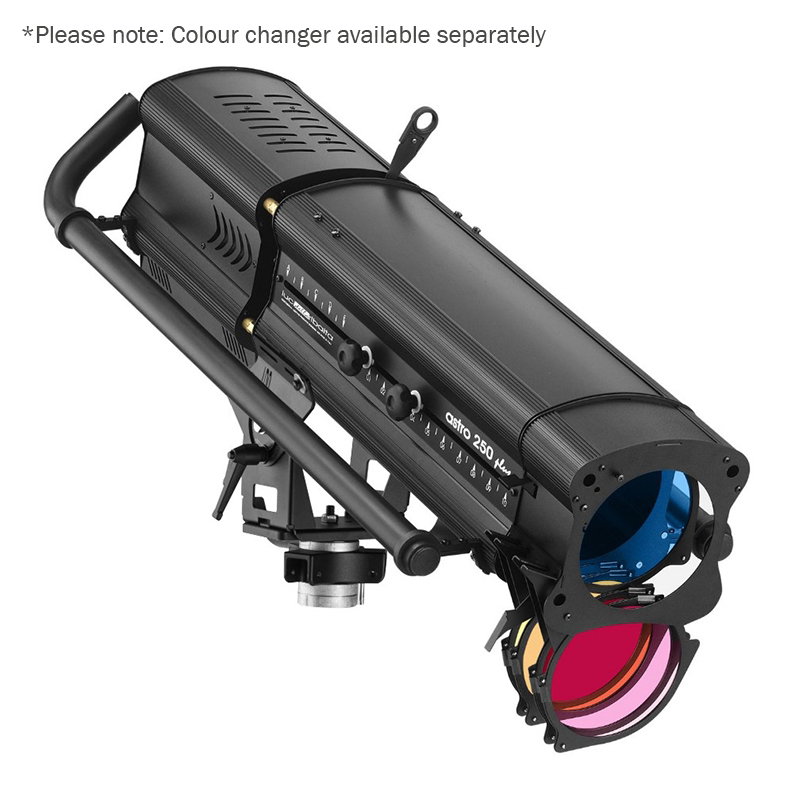
- Throws of roughly 10 to 25m: the LDR Astro 250 RGBW Wi-Fi MK2 (4 to 25m) for colour, or the LDR Astro 250 HP MK2 (5 to 40m) for a brighter white beam.
- Throws beyond 25m: the LDR Astro 600 (20 to 60m), or the discharge LDR Canto 1200 MSD/MSR MK2 (10 to 40m).
Then check three things: whether you need colour from the unit or white only, whether the colour temperature matches the rest of your rig, and whether a stand is in the box.
What makes a followspot different from a profile
A followspot is a hard-edged, profile-type light built to be pointed by hand from a stand while the show runs. LDR describes its Astro 100 as an “LED profile followspot”. What sets it apart is the operator kit:
- Zoom to set the beam from a tight head-and-shoulders pick-up to a wider pool. On every LDR Astro and Canto we stock, zoom (beam size and edge softness) is adjusted with slide controls on the side.
- Iris to shrink the beam without changing the zoom. Chauvet quotes the 200ST iris down to 5° at its tightest zoom. LDR supplies an iris diaphragm as standard on the Astro range, and a 20-leaf iris on the Canto 1200.
- A dimmer the operator can reach. LDR supplies a clamp-on dimmer that slides along the side bars on the Astro 250 RGBW Wi-Fi and Astro 600; on the Astro 250 HP it is an accessory. The Canto 1200 is supplied with a mechanical dimmer (dowser).
- Colour, from a colour wheel, a colour changer or RGBW mixing.
- Handles and a stand mount so the operator can pan and tilt smoothly.
How profiles, fresnels and PARs differ is covered in our stage lighting fixture types guide, and where a followspot sits alongside front, side and back light is in lighting a stage: front, back and side.
The range compared
All figures are from the manufacturers’ own datasheets. A dash means the manufacturer does not state it.
| Model | Source | Colour temp | CRI | Zoom | Typical throw | DMX | Weight |
|---|---|---|---|---|---|---|---|
| Chauvet DJ Followspot 200ST | 200W cool white LED | 13,000K; 4,000K with built-in CTO | – | 12° to 17° | – (lux quoted at 2m and 5m) | 3 ch, 3-pin XLR | 6.6kg |
| LDR Astro 100 RGBW | 120W RGBW LED | Any, from RGBW mixing | >90 | 12° to 24° | 2 to 10m | 6 or 7 ch, 5-pin XLR, RDM | 10.1kg |
| LDR Astro 250 RGBW Wi-Fi MK2 | RGBW LED | RGBW plus 10 preset whites, 2,700K to 5,800K | >90 | 8° to 22° | 4 to 25m | 6 or 7 ch, 5-pin XLR, RDM, Wi-Fi | 21.0kg |
| LDR Astro 250 HP MK2 (5,600K) | 230W white LED (COB) | 5,600K (also made in 3,200K) | >90 | 8° to 23° | 5 to 40m | 1 to 3 ch, 5-pin XLR, RDM | 19.5kg |
| LDR Astro 600 (6,000K) | 600W white LED (COB) | 6,000K (also made in 3,200K) | Ra >90, R9 >80 | 7° to 12° | 20 to 60m | 1 to 3 ch, 5-pin XLR, RDM | 31.0kg |
| LDR Canto 1200 MSD/MSR MK2 | 1200W discharge lamp, G22, external ballast | 5,900K to 7,200K depending on lamp | – | 8° to 22° | 10 to 40m | – (mechanical dimmer) | 19.8kg plus 16.5kg ballast |
Chauvet DJ Followspot 200ST
The lightest and most self-contained option. Chauvet supplies it with a tripod (0.8 to 1.2m), a power cord and a quick reference guide. It has a 7-colour wheel plus open, a built-in CTO filter that drops the 13,000K beam to 4,000K to sit closer to tungsten, a manual 12° to 17° zoom, a mechanical iris, strobe and 3 DMX channels on 3-pin XLR. Chauvet also points to backlit buttons for working in the dark. Power draw is 258W at 230V. Chauvet does not publish a CRI figure or a throw range for it.
LDR Astro 100 RGBW
LDR’s compact followspot, aimed in its own words at “short-throw applications in amateur theatres, and small stages in schools, worship venues, city halls, clubs, concerts or events”. A 120W RGBW source with CRI above 90, 12° to 24° zoom and a supplied iris. Intensity can be set from the rear panel or over DMX (6 or 7 channels), with RDM. The fan has Silent, Auto and Constant modes. Standard delivery includes the iris, a tripod spigot and a 2m powerCON mains cable; the tripod itself is an accessory.
LDR Astro 250 RGBW Wi-Fi MK2
An RGBW LED followspot with CRI above 90 and an 8° to 22° zoom. Colour can be picked on a phone or tablet over the unit’s own Wi-Fi access point (Android or iOS, one device, 12m range), or from the lighting desk over DMX. A dedicated DMX channel selects 10 preset whites from 2,700K to 5,800K. LDR supplies a clamp-on digital dimmer, a clamp-on phone holder, a USB charging port, the iris and the spigot.
LDR Astro 250 HP MK2
The high-output white version of the Astro 250. LDR describes it as the high-performance version of the Astro, fitted with new custom-designed optics to increase light output. A single 230W white COB, which LDR says gives no colour shift when fading, CRI above 90, 8° to 23° zoom, 16-bit dimming and 1 to 3 DMX channels with RDM. The iris and spigot are standard; the colour changer, clamp-on dimmer and tripod are accessories, or come together in LDR’s kit version.
LDR Astro 600
LDR’s long-throw LED followspot, with a single-source 600W COB, a 7° to 12° zoom and quoted throws up to 60m. LDR publishes Ra above 90, R9 above 80 and R12 above 75. It has four dimming speeds (Slow, Normal, Fast and Snap) and supplies a removable 6-colour changer, a sizing iris, a clamp-on digital dimmer and a spigot with an integrated fluid head as standard.
LDR Canto 1200 MSD/MSR MK2
A conventional discharge followspot that LDR calls the most popular in the Canto range, for medium to large venues. It takes a 1200W G22 lamp: LDR lists the Philips 1200 MSR (5,900K, 800 hours), 1200 MSD (6,000K, 3,000 hours) and 1200 MSR/2 (7,200K, 800 hours). It runs from a separate electromagnetic ballast with its own on/off switch, and is dimmed mechanically. It comes with a 20-leaf iris, the mechanical dimmer, the ballast and a spigot. The version we stock is specified for a 250V AC supply to the ballast. If you are replacing an old discharge spot like for like, it is a familiar choice; if you would rather not change lamps, look at the Astro range.
Throw, lux and venue size
Measure the throw before you choose. In a school hall that is usually from the back of the hall, a balcony or a control position to the downstage edge and to the back of the stage. Use the longer figure.
Followspot datasheets give two kinds of help: a typical throw range, and a photometric table showing the light level (lux) in the centre of the beam and the beam diameter at set distances. Below are the narrow-zoom figures exactly as each manufacturer publishes them. LDR’s RGBW figures are with all four colours at full.
| Model | Published centre lux, narrowest zoom (beam diameter where given) |
|---|---|
| Chauvet DJ Followspot 200ST (12°) | 54,569 lux at 2m; 8,731 lux at 5m |
| LDR Astro 100 RGBW | 1,932 lux at 5m (1.1m); 483 lux at 10m (2.1m) |
| LDR Astro 250 RGBW Wi-Fi MK2 | 3,598 lux at 8m (1.1m); 886 lux at 16m (2.2m); 400 lux at 24m (3.1m) |
| LDR Astro 250 HP MK2, 5,600K | 3,980 lux at 10m (1.6m); 995 lux at 20m (3.1m); 442 lux at 30m (4.7m); 249 lux at 40m (6.3m) |
| LDR Canto 1200 MSR | 1,204 lux at 24m (3.4m); 770 lux at 30m (4.2m); 434 lux at 40m (5.6m) |
| LDR Astro 600, 6,000K | 2,940 lux at 20m (2.4m); 1,306 lux at 30m (3.7m); 735 lux at 40m (4.9m); 323 lux at 60m (7.3m) |
Two cautions. First, compare within one manufacturer’s tables rather than across brands, since the measuring conditions are not necessarily the same. Second, lux on paper is not the whole story: your followspot has to stand out against the general stage wash, so a brightly lit stage needs more from the spot than a dark one.
LDR’s own narrow-zoom tables let you compare its range at 30m: 442 lux from the Astro 250 HP, 770 lux from the 1200W Canto and 1,306 lux from the Astro 600.
Matching the throw to the venue
| Your throw | Models whose quoted range covers it |
|---|---|
| Up to 10m | Astro 100 RGBW (2 to 10m); Astro 250 RGBW Wi-Fi (from 4m); Followspot 200ST (lux published at 2m and 5m) |
| 10 to 25m | Astro 250 RGBW Wi-Fi (to 25m); Astro 250 HP (5 to 40m); Canto 1200 (from 10m) |
| 25 to 40m | Astro 250 HP (to 40m); Canto 1200 (to 40m); Astro 600 (from 20m) |
| 40 to 60m | Astro 600 (to 60m) |
Where the manufacturer names venue types, LDR does so model by model on its datasheets: the Astro 100 for short throws on theatres, stages, schools, worship venues and clubs; the Astro 250 RGBW Wi-Fi for theatres, TV studios, permanent shows, worship venues, music bars and restaurants, and sports halls; the Astro 250 HP for theatres, TV studios, permanent shows, worship venues, circuses, arenas, multi-purpose halls and rental; the Astro 600 for theatres, TV studios, auditoriums, sports halls, arenas and worship venues; and the Canto 1200 for medium to large-scale theatre. Venue types vary a lot in size, so decide on the measured throw, not the type of building.
Check the beam size too. At its narrowest, LDR’s table puts the Astro 250 HP’s beam at 1.6m across at 10m and 3.1m at 20m. A beam much wider than a person spills onto the set; zoom and iris pull it in. How beam angle turns into coverage is explained in our beam angles and coverage guide.
Colour temperature and colour
A followspot that is much cooler than the rest of the rig makes the person in it look blue. Decide what your stage lights run at and match it.
- Warm tungsten or warm-white LED rig: the Astro 250 RGBW Wi-Fi’s 2,700K to 5,800K preset whites give the most flexibility; the Chauvet 200ST’s CTO brings it to 4,000K. LDR also makes 3,200K versions of the Astro 250 HP and Astro 600.
- Cool white, TV or daylight-balanced rig: the 5,600K Astro 250 HP or the 6,000K Astro 600.
- Colour from the spot itself: the RGBW Astros mix any colour; the 200ST has a 7-colour wheel; the Astro 600 comes with a 6-colour changer, and the Astro 250 HP and Canto 1200 take an LDR 5- or 6-colour changer.
For skin tones, CRI matters. LDR quotes above 90 for every Astro we stock, and for the Astro 600 also gives R9 (saturated red) above 80. CRI and its alternatives are explained in our LED profiles and fresnels for theatre guide.
Stands, operator position and power
Only the Chauvet 200ST includes a stand. The LDR models come with a spigot to fit a followspot tripod, and the tripod is bought separately (LDR lists a tripod in the kit versions of the Astro 250 HP and Canto 1200). Use the stand the manufacturer specifies, set up to its instructions. We do not give advice on stand loading or rigging; follow the manufacturer’s documentation and your venue’s own procedures.
When choosing a position, think about the operator as well as the light:
- A clear sightline to the whole stage, with no heads or balcony rails in the beam.
- Room to pan across the full stage width without moving the stand.
- Cable routes that keep power and DMX out of walkways and away from the audience.
- A way to hear cues: most operators wear a headset to the stage manager or lighting desk.
- For the Canto, space for the separate ballast as well as the head.
Power. LDR’s Astro 100 manual says it needs continuous mains power because an internal dimmer controls the intensity, and warns that a phase-control dimmed supply may damage it. Check the manual of any LED followspot for the same requirement. In older halls where the sockets near the control position come from a dimmer rack, check this before buying. The design, installation and testing of electrical systems is a job for a competent person.
Control. Every followspot here is pointed by hand, but DMX lets the lighting desk set intensity or colour and fade the spot with the cue. Addressing and cabling are in DMX explained. Note that the Chauvet uses 3-pin XLR and the LDR Astros 5-pin.
For the rest of the school rig, see our school AV guide and the am-dram and village hall starter kit.
LDR accessories worth knowing about
These are listed by LDR on the datasheets of the followspots above.
- LDR black followspot tripod (part 20102401): listed for every LDR followspot here.
- LDR spigot with fluid head (20102100): supplied with the Astro 600, an option for the Astro 250 models and the Canto 1200. A spare plain spigot (20102200) is also listed.
- LDR 6-colour changer (20105206) and 5-colour changer (20105106): listed for the Astro 250 HP, Astro 600 and Canto 1200.
- LDR clamp-on dimmer (20702071): an accessory for the Astro 250 HP, supplied with the Astro 250 RGBW Wi-Fi and Astro 600.
- Spare iris diaphragm (20100707): listed for all of them.
Checklist before you order
- Measure the longest throw from the operator position to the stage.
- Pick a model whose quoted throw range covers it, then check the beam diameter at that distance.
- Match colour temperature to your rig, or choose RGBW or preset whites.
- Decide on white plus colour changer, colour wheel or RGBW mixing.
- Check whether the tripod, dimmer and colour changer are included, and add what is not.
- Confirm an undimmed supply at the operator position for LED models.
- Decide whether the desk needs DMX control, and check 3-pin or 5-pin.
- Plan the operator’s sightline, cable route and cue communication.
Popular picks from the shop
Chauvet DJ Followspot 200ST LED Followspot with TripodView product → LDR Astro 100 RGBW LED FollowspotView product → LDR Astro 250 RGBW Wi-Fi MK2 LED FollowspotView product → LDR Astro 250 HP MK2 5,600K LED FollowspotView product → LDR Astro 600 6,000K LED FollowspotView product → LDR Canto 1200 MSD/MSR MK2 Discharge FollowspotView product → LDR Black Followspot TripodView product → LDR 6-Colour Changer for Astro and CantoView product →
Frequently asked questions
What followspot do I need for a school hall?
Measure from where the operator will stand to the back of the stage. Under about 10m, LDR quotes the Astro 100 at 2 to 10m and names small school stages among its uses. Between roughly 10 and 25m, the Astro 250 RGBW Wi-Fi covers LDR’s quoted 4 to 25m, and the Astro 250 HP goes further, to 40m, if you need a brighter white beam.
Is an LED followspot as bright as a discharge one?
It depends on the model. In LDR’s own tables at 30m, the 230W Astro 250 HP gives 442 lux, the 1200W discharge Canto gives 770 lux and the 600W Astro 600 gives 1,306 lux. LED also avoids lamp changes: LDR rates the Astro LEDs at 50,000 hours, against 800 or 3,000 hours for the Canto’s lamps.
Does a followspot come with a stand?
The Chauvet DJ Followspot 200ST includes a tripod. The LDR followspots come with a spigot, and LDR’s followspot tripod is sold separately; LDR lists one in the kit versions of the Astro 250 HP and Canto 1200.
What colour temperature should a followspot be?
Close to the rest of your stage lighting, so the person in the spot does not look a different colour. For a warm rig, choose an RGBW model with preset whites, a 3,200K version, or use the 200ST’s CTO filter. For a daylight or TV rig, 5,600K or 6,000K.
Can I plug an LED followspot into a dimmer channel?
Not without checking the manual first. LDR says the Astro 100 needs continuous mains power because it dims internally, and warns that a phase-control dimmed supply may damage it. Plan on a non-dim supply, and have a competent person check anything you are unsure about.
Do I need DMX on a followspot?
Not to run it, since the operator controls it by hand. DMX is useful if you want the lighting desk to fade the spot or set its colour in the cue. The LED models here all have it; the Canto 1200 is dimmed mechanically.
Shop this guide
Followspots, profiles and the accessories to go with them. Tell us your throw distance and we will help narrow it down.
Profile & Follow Spots Spot Accessories Theatre Lighting Lighting Stands Lighting Desks & Consoles



