


Home » Guides » Guitar & Bass Strings »
Changing Strings: The Tools, the Order, and Making a Set Last
Most tuning problems are not the guitar. They are a string wound badly round a post, or a nut slot that grips. Ten minutes, done in the right order, and the problem goes away.
~8 min read · Updated September 2026 · By the Stage Supply team
In this guide: Short answer · The tools · The order · Making a set last · Humidity · Shop the range · FAQ
Changing strings is a ten minute job that most people do badly, and the consequences show up as a guitar that will not hold tuning for a set. What follows is the kit that earns its place in a case, the order the job goes in, and the handful of habits that get another week or two out of every set.
The short answer
Change one string at a time if the bridge floats, cut the old string before you unwind it, get two or three tidy wraps down the post, stretch the set properly before you judge the tuning, and put a drop of lubricant in the nut slots. A Pro-Winder and a decent cutter turn it from a chore into a routine.
The tools that earn their place
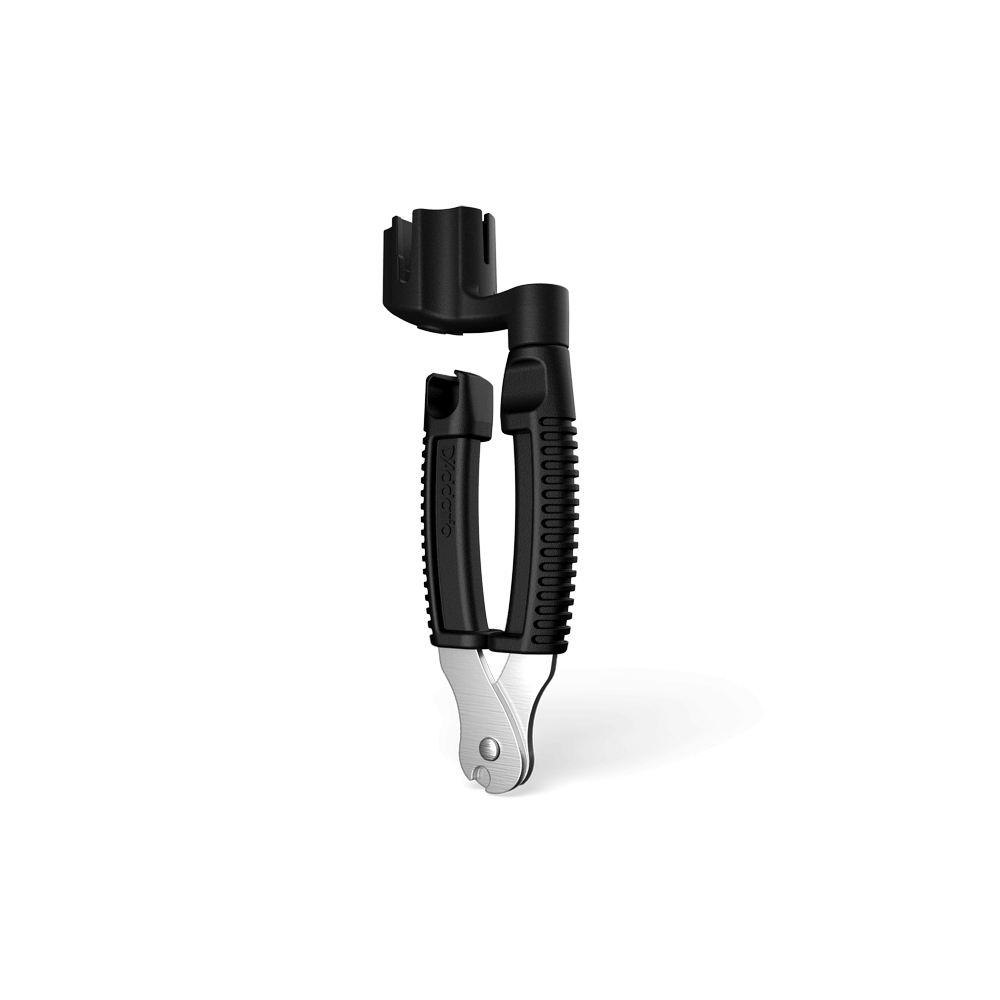
- Pro-Winder. A peg winder, a string cutter and a bridge pin puller in one, which is why it is the one to own if you own nothing else. It fits guitars, banjos, ukuleles and mandolins, and it goes in a case pocket. Also in white if you are colour-coding a tech box.
- Tour-Grade String Cutter. A compound-action cutter with hardened blades, rated by D’Addario at over seven times the cutting force of standard pliers. If you cut a lot of strings, or you cut wound bass strings, this is the one that does not chew them.
- Guitar and bass multi-tool. Ten tools in one: three imperial hex keys (0.05, 1/8, 3/16), four metric (1.5mm, 2.5mm, 3mm, 4mm), two Phillips and one slotted driver, all in heat-treated S2 steel. That covers truss rods, saddles and most hardware on most instruments.
- String height gauge. Stainless steel, imperial and metric, for action, pickup height and neck relief. The difference between adjusting a guitar and guessing at it.
- LubriKit. A syringe of lubricant with two swabs, for nut slots, saddles and any contact point on a floating bridge. Friction is the root cause of most tuning problems, and this is the cheapest fix for it.
- XLR8. Wipe-on string cleaner and lubricant. Cleans the gunk out of the windings, reduces finger squeak, and extends the useful life of a set.
The order to do it in
- Decide whether to do one at a time. On a hardtail or a wraparound bridge, take them all off and clean the fretboard. On a floating tremolo, change one string at a time, or the bridge will pull back and every string you have already fitted will go out.
- Slacken, then cut, then unwind. Cutting a string at tension sends a sharp end flying and can mark the finish. Slacken first, cut the old string at the twelfth fret, then unwind both halves.
- Clean while it is bare. The one moment you can get at the fretboard and the underside of the strings’ path. On acoustics, the Pro-Winder‘s bridge pin puller gets the pins out without levering them with a coin.
- Fit with a locking wrap or two to three neat turns. The turns should stack downwards towards the headstock face, not cross over each other. Crossed windings slip under tension, and slipping windings read as a guitar that will not stay in tune.
- Stretch the set. Pull each string away from the fretboard along its length, retune, repeat until it stops going flat. Three or four passes on a new set. Skipping this is the main reason a fresh set seems to go out constantly for the first hour.
- Lubricate the friction points. One drop of LubriKit in each nut slot and on each saddle. Do this on any guitar with a tremolo, and on any guitar where a particular string always drifts.
- Cut the ends and check intonation. Then tune up properly and check the twelfth fret harmonic against the fretted note if you have changed gauge.
Making a set last
Strings die from three causes: corrosion from sweat, grinding of the windings against the frets, and dirt packing into the wrap. You can do something about all three.
- Wipe the strings down after playing. Nothing else here buys you as much. Most string death is your own perspiration, and it works on the string overnight while the guitar sits in its case.
- Wash your hands before you play. Unglamorous and genuinely effective, particularly if you have eaten.
- Use XLR8 between changes. It lifts the dirt out of the windings and leaves the strings slick, which also makes position shifts quieter on a recording.
- Keep spares sealed. D’Addario ship in corrosion-inhibiting bags for a reason. A set left loose in a gig bag pocket is oxidising before it goes anywhere near the guitar.
Humidity, and why UK venues are harder on acoustics than you think
This one only applies to acoustic and hollow instruments, but it matters more than string choice ever will. A wooden top is a moving part, and it responds to the relative humidity around it. Too dry and the top sinks, the action drops, the frets start to feel sharp at the edges, and in the worst case the top cracks. Too damp and the top swells and the tone goes muddy.
The risky environment is not a damp autumn, it is a heated room in winter, which is exactly what a venue in January is. The Humidipak system handles this without any guesswork: it is a two-way system that both adds and removes moisture to hold the case at 45 to 50 per cent relative humidity, so there is nothing to refill and nothing to adjust for the season. Packs last between two and six months, and replacement packets come in threes.
Two caveats. It only works in a sealed environment, so a hard case, not a gig bag hung on a wall. And if an instrument is already dry, D’Addario recommend bringing it back with the Restore product first, because using maintenance packets on a genuinely dry guitar and case will use them up very quickly.
The restringing kit
D'Addario Pro-Winder, winder, cutter and pin pullerView product → Tour-Grade String CutterView product → Guitar and bass multi-tool, 10 in 1View product → Humidipak two-way humidity controlView product →
Shop the range
The restringing tools, and the strings to put on once you have them.
Stocked in our own warehouse for next-day UK delivery, with trade counter collection available. Anything in the D’Addario, Evans, ProMark or PureSound catalogue that we do not shelve, we can order in, so ask us if you cannot see it.
Frequently asked questions
Should I take all the strings off at once?
On a fixed bridge, yes, and use the opportunity to clean the fretboard. On a floating tremolo, no: change one at a time so the spring tension never drops, or you will spend longer rebalancing the bridge than you spent on the strings.
How many wraps should I put round the post?
Two to three for wound strings, three to four for plain ones, wound downwards so they stack neatly towards the headstock. Too few and the string can slip, too many and the pile itself compresses and reads as tuning drift.
My guitar goes out of tune on one string only. Why?
Almost always the nut. The string is binding in the slot, holding tension behind the nut, and releasing it when you bend. You will often hear it as a faint ping. A drop of LubriKit fixes most cases; a slot that is genuinely too narrow for the gauge needs filing.
Does stretching strings damage them?
No, if you pull along the string rather than yanking it sideways at one point. You are seating the windings and taking up the slack at the post, both of which would otherwise happen gradually during your first set.
Do I need a humidifier for an electric guitar?
Far less so. A solid body has no thin soundboard under tension, so the failure mode is much less dramatic. Extremes still move a neck, but Humidipak is aimed at acoustic and hollow instruments.


