


Home » Guides » Guitar & Bass Strings »
D’Addario String Ranges Explained: XL Nickel, NYXL and Phosphor Bronze
XL Nickel, NYXL, Phosphor Bronze. The names sound like marketing and are not. Each is a different core wire and a different wrap alloy, and that is what you are choosing between.
~7 min read · Updated September 2026 · By the Stage Supply team
In this guide: Short answer · XL Nickel · NYXL · Phosphor Bronze · Bass · Pack formats · Shop the range · FAQ
D’Addario make a lot of strings. The names are not arbitrary, though, and once you know what separates the three families we stock, the choice takes about ten seconds. This guide covers XL Nickel, NYXL and Phosphor Bronze: what each one is physically made of, what it is for, and which pack format to buy.
The short answer
XL Nickel for electric guitar and bass, and it is the right default. NYXL when tuning stability and break strength matter more than cost, which on a touring stage they usually do. Phosphor Bronze for steel-string acoustic, because electric strings have the wrong wrap alloy to drive a wooden top.
XL Nickel: the default
XL Nickel has been in production since 1974 and is D’Addario’s best-selling electric set. Construction is a high-carbon steel hexagonal core with a nickel-plated steel wrap wire. The hex core is the part that matters mechanically: a round core lets the wrap creep, a hex core grips it, which is why these sets intonate consistently and why one EXL110 feels like the next.
Tonally, nickel-plated steel is bright and even without being harsh, which is exactly why it became the reference point. If you have ever read a string review that compared something to “a standard set”, this is the standard set it meant. We stock it in 9-42, 9-46, 10-46, 10-52 and 11-49.
NYXL: the premium uncoated set
NYXL is the same idea executed with different metal. Against XL Nickel, three things change, and D’Addario are specific about all of them.
- NY Steel core. A higher break strength core wire, so the strings take more abuse before they snap. That is the headline for anyone who breaks a top E mid-set.
- Fusion Twist. A process applied to the plain strings that improves tuning stability against the standard sets. In practice it means less drift after a bend and less settling time on a fresh set.
- Premium nickel-plated steel wrap. Voiced with more mid-range presence, which is what makes them cut through a band mix rather than sit under it.
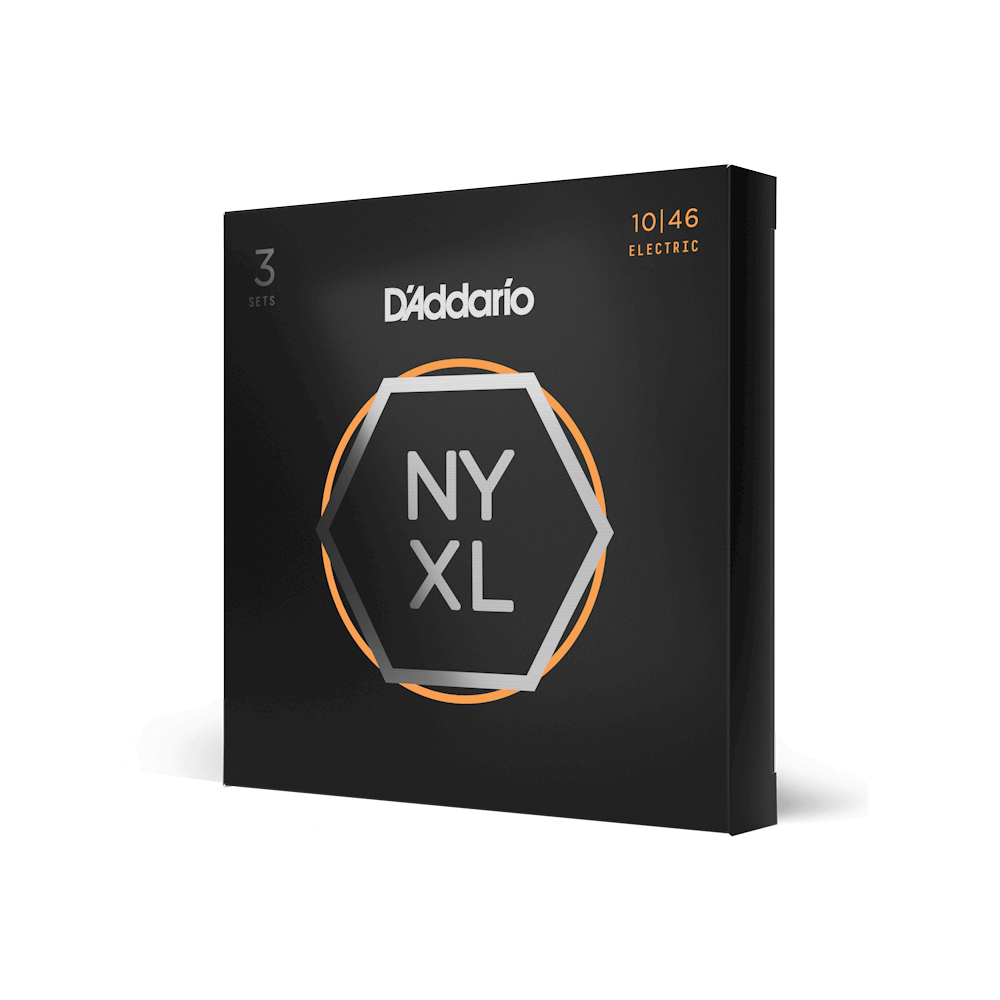
This is the set touring players reach for, and the reason is not tone so much as not having to think about the strings. We keep NYXL 9-42 and NYXL 10-46 for guitar and NYXL 45-105 for bass.
One point of confusion: NYXL is uncoated. It is not D’Addario’s answer to a coated string, it is their answer to a stronger and more stable one. If what you want is corrosion resistance because you sweat through a set in one show, that is the XT and XS lines, which we order in rather than shelve.
Phosphor Bronze: the acoustic standard
D’Addario were first to use phosphor bronze in acoustic strings, in 1974, and it is now the default alloy for steel-string acoustic across the industry. The construction is phosphor bronze wrap wire over the same hexagonal high-carbon steel core, and the result is warmer and more balanced than the 80/20 bronze that came before it.
The practical point is that acoustic and electric strings are not interchangeable. An electric set on an acoustic will sound thin and quiet, because nickel-plated steel is chosen for what a magnetic pickup does with it, not for what a spruce top does with it. We stock phosphor bronze in 10-47, 11-52, 12-53 and 13-56.
Bass: XL Nickel and NYXL
The same two families run through the bass range. XL Nickel bass is nickel-plated steel over a hex core, bright and tight, and it is the industry reference in the same way the guitar set is. NYXL bass adds the NY Steel core and a reengineered core-to-wrap ratio, which D’Addario describe as giving accentuated harmonics, and in use it means a more open top end on a bass that is otherwise voiced dark.
Bass sets come in twin packs (the TP suffix), because basses get restrung far less often than guitars. The gauge choices are covered in bass strings: gauge, scale length and five-string sets.
Pack formats, decoded
| Suffix | Means | Example | Who buys it |
|---|---|---|---|
| -3D | Three sets | EXL110-3D | Players. The normal retail unit |
| -10P | Ten sets | EXL110-10P | Bands, teaching studios, techs |
| -B25 | Twenty-five sets | EXL110-B25 | Backline hire, festivals, workboxes |
| TP | Twin pack, two sets | EXL170TP | Bass players |
| -3P | Three sets (NYXL) | NYXL1046-3P | Players |
The ten-packs we hold are electric 9-42, 9-46, 10-46, 10-52 and 11-49, and acoustic 11-52 and 12-53. The twenty-five set boxes are electric 9-42 and 10-46, which are the two gauges that actually get consumed at that rate.
All of these sets are made in the USA, at D’Addario’s New York facility, and all arrive in the corrosion-inhibiting sealed bags that keep an unopened set fresh on a shelf for years. That last point matters more than it sounds if you are buying a box of twenty-five.
One of each family
XL Nickel 10-46, the reference electric setView product → NYXL 10-46, premium uncoatedView product → Phosphor Bronze 12-53, the acoustic standardView product → XL Nickel bass 45-100, twin packView product →
Shop the range
The full XL Nickel, NYXL and Phosphor Bronze range we hold.
Stocked in our own warehouse for next-day UK delivery, with trade counter collection available. Anything in the D’Addario, Evans, ProMark or PureSound catalogue that we do not shelve, we can order in, so ask us if you cannot see it.
Frequently asked questions
Is NYXL worth the extra over XL Nickel?
If you break strings or fight tuning after bends, yes, and obviously so. If you play at home through a small amp and change strings twice a year, the difference is real but you will not be the one paying attention to it. Touring players buy NYXL for the break strength more than the tone.
What is the hex core and why does everyone mention it?
The core wire inside a wound string is hexagonal in section rather than round. The corners bite into the wrap wire so it cannot rotate or slip along the core. That is what gives consistent intonation and consistent feel from one set to the next, and it is standard across every D’Addario electric, acoustic and bass set we stock.
Can I use electric strings on an acoustic?
They will fit and they will tune up, but they will sound weak. An acoustic gets its volume from the string driving the top, and the phosphor bronze wrap is chosen for that job. Nickel-plated steel is chosen for what a magnetic pickup makes of it.
Do you stock XT, XS, flatwounds or classical strings?
Not on the shelf. Our stocked range is the uncoated roundwound lines above, which is what covers the overwhelming majority of what a working player or tech actually goes through. Anything else in the D’Addario catalogue we can order in, usually within a few days.


