


Home » Guides » Guitar & Bass Strings »
Bass Strings: Gauge, Scale Length and Five-String Sets
Bass strings get bought less often and thought about less carefully than guitar strings. That is how so many basses end up running a set that does not suit them.
~7 min read · Updated September 2026 · By the Stage Supply team
In this guide: Short answer · The gauges · Scale length · Five-string sets · When to change · Shop the range · FAQ
There are only three decisions to make: gauge, scale length and how many strings. Get the second one wrong and the set physically will not fit, which is the failure that catches people out on a through-body bridge. This guide takes each decision against the sets we actually hold.
The short answer
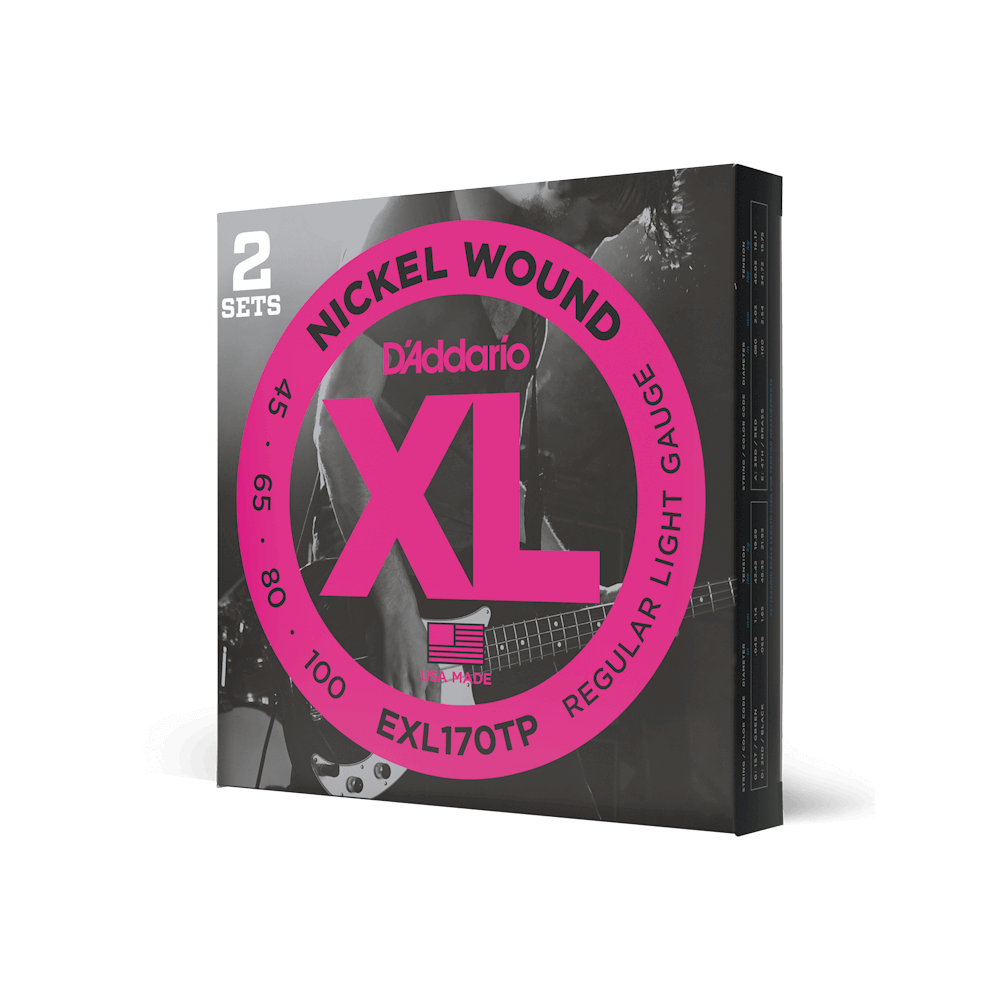
EXL170, 45-100 is the default four-string set and D’Addario’s most popular bass gauge. Go to EXL165, 45-105 if you want a tighter low E without stiffening the top strings, and EXL160, 50-105 if you want the whole set firmer. Five-string players want EXL170-5, 45-130. All are long scale.
The four-string gauges
| Set | Gauges | Name | Character |
|---|---|---|---|
| EXL170 | 45-100 | Light | The most popular bass gauge. The blend of response and playability everything else is judged against |
| EXL165 | 45-105 | Light top, medium bottom | A tighter low end with a comfortably balanced, bright top. The hybrid set, and a very common choice for pick players |
| EXL160 | 50-105 | Medium | Higher tension throughout, giving increased low-end response and output. Detuned playing, hard fingerstyle, slap |
| NYXL45105 | 45-105 | Light top, medium bottom | The EXL165 gauge in the premium NYXL construction. Single set rather than a twin pack |
The 45-105 hybrid deserves a word, because on paper it looks like a minor variation and in the hand it is not. Moving the low E from 0.100 to 0.105 firms up the string that does the most work without touching the G and D, which is where most of your fretting hand effort goes. If your low E sounds floppy but the rest of the bass feels fine, that is the set.
Scale length, and why “long scale” is not a formality
Every bass set we stock is long scale. Long scale is the standard 34 inch bass, which covers the great majority of instruments made since the 1950s, including almost all Fender-style and most modern production basses.
What actually determines whether a set fits is not the scale number on its own but the winding length: the distance the wound portion of the string has to cover, from the ball end at the bridge to where it reaches the nut. Two designs can push a nominally long scale bass past what a standard set covers.
- String-through-body bridges. The string enters at the back of the body and travels further before it reaches the saddle, so the winding has to start further back. A set that fits a top-loaded bass can end up with wrap wire sitting over the nut on the same instrument strung through the body.
- Long headstocks. Some five-string and extended-range designs place the low B tuner a long way past the nut, which adds to the distance again.
If you are unsure, measure from the ball end to the nut on the existing strings before ordering, and compare it against the winding length D’Addario publish for the set. The symptom of getting it wrong is unmistakable: the tapered part of the string sits in the nut slot, and the string will not intonate or hold tuning.
Five-string sets and the B string
EXL170-5 is the 45-100 set with a 0.130 low B added. That gauge is the conventional answer for a 34 inch five-string, and it is a compromise: a B string is being asked to hold pitch over a scale length that was designed for an E, so it will always be the loosest string on the instrument.
More useful than buying different strings: set the B string’s saddle and nut slot properly, since a B is far less tolerant of a binding nut than a G. Then play it slightly lighter than the rest, because a slack string struck hard goes sharp on the attack. If the B still sounds indistinct after that, the limitation is usually the instrument’s scale length rather than the string.
When to change them
Bass strings last far longer than guitar strings, and a large part of the bass world deliberately runs them dead, because a broken-in roundwound is the thumpy sound on a great many records. So the honest answer is that there is no schedule.
What does force a change: a string that will not intonate any more (the windings have flattened where you fret most, so the vibrating length is no longer even), visible corrosion or pitting, or a dead spot that has appeared where there was not one before. Twin packs exist precisely because this is a job people do rarely and then want a spare on the shelf for.
Between changes, a wipe down after playing does most of the work, and XLR8 cleans and lubricates the windings, which also cuts the finger squeak that a fresh roundwound bass set produces on a close-miked recording.
The bass sets we stock
EXL170 XL Nickel 45-100, twin packView product → EXL165 XL Nickel 45-105, twin packView product → EXL170-5 XL Nickel 45-130, five string, twin packView product → NYXL 45-105, premium uncoatedView product →
Shop the range
All four bass sets, long scale, most of them in twin packs.
Stocked in our own warehouse for next-day UK delivery, with trade counter collection available. Anything in the D’Addario, Evans, ProMark or PureSound catalogue that we do not shelve, we can order in, so ask us if you cannot see it.
Frequently asked questions
Will a long scale set fit my short scale bass?
Not properly. On a 30 or 32 inch bass the wrap wire will run past the nut and the string will not seat or intonate. Short scale sets are a different product and we order them in rather than stock them.
What is the difference between EXL165 and NYXL45105?
Same gauges, different build. EXL165 is XL Nickel on a high-carbon hex core and comes as a twin pack. NYXL45105 uses the NY Steel core with a reengineered core-to-wrap ratio for higher break strength and more harmonic content, and comes as a single set.
Do I need to change all the strings at once?
If one breaks, you can replace one, but it will sound obviously brighter than the other three for a while. If you are changing because the set is dead, change the set, or you are only moving the problem.
Why does my low B sound dull compared with the E?
Because it is at much lower tension for the same scale length. Check the nut slot is not pinching and the saddle is set back far enough, play it slightly lighter than the other strings, and accept that a 34 inch five-string will never make a B feel like an E.


