


Home » Guides » Drums & Percussion »
Tuning and Damping a Drum Kit: Keys, Gels, Rings and Pads
A well-tuned kit with no damping beats a badly tuned kit smothered in gels. So the order matters: get the head even first, then damp only what is still wrong.
~8 min read · Updated September 2026 · By the Stage Supply team
In this guide: Short answer · The routine · Drum keys · The damping ladder · Pedal patches · Shop the range · FAQ
A well-tuned kit with no damping usually sounds better than a badly tuned kit with a lot of it, so the order of work matters: tune first, damp second, and only damp what is still wrong. This guide covers the tuning routine, the keys that make it quicker, and the full ladder of damping options from a gel the size of a coin to a bass drum pad.
The short answer
Seat the head, finger-tighten every rod, then bring them up in opposite pairs a half turn at a time until the pitch is even all the way round. Only then reach for damping, and start with the smallest thing that works: a gel before a ring, a ring before a pad.
The tuning routine
- Clean the bearing edge. With the head off, wipe the edge. Dust and old grime under a head is a real cause of uneven pitch, and this is the only moment you can reach it.
- Seat the head. Drop it on, fit the hoop, and finger-tighten all the tension rods until they just bite. Then press the palm of your hand into the centre of the head firmly. You will hear a few creaks as the head settles onto the collar. This is normal and it is the step people skip.
- Retighten by hand, because seating will have loosened everything slightly.
- Tune in opposite pairs. Go a half turn at a time, crossing the drum each time in a star pattern, never round the drum in sequence. Going round the circle pulls the head unevenly and you will never get the pitch to match.
- Check at each rod. Tap about an inch in from the hoop next to each tension rod. You are listening for the same pitch at every one. Where one is flat, bring it up; where one is sharp, come down and then back up, because a rod approached from above holds differently to one approached from below.
- Set the overall pitch last. Once it is even, raise or lower every rod by the same amount to move the whole drum.
- Do the resonant head too. Tuning the bottom head to roughly the same pitch as the top gives the most sustain; tuning it higher shortens the note and raises the pitch bend; tuning it lower gives a downward pitch drop. That relationship is the biggest tonal control you have on a tom, and it costs nothing.
Drum keys
The free key that came with the kit works. These are faster and more repeatable, which starts to matter when you are changing heads regularly or tuning under time pressure.
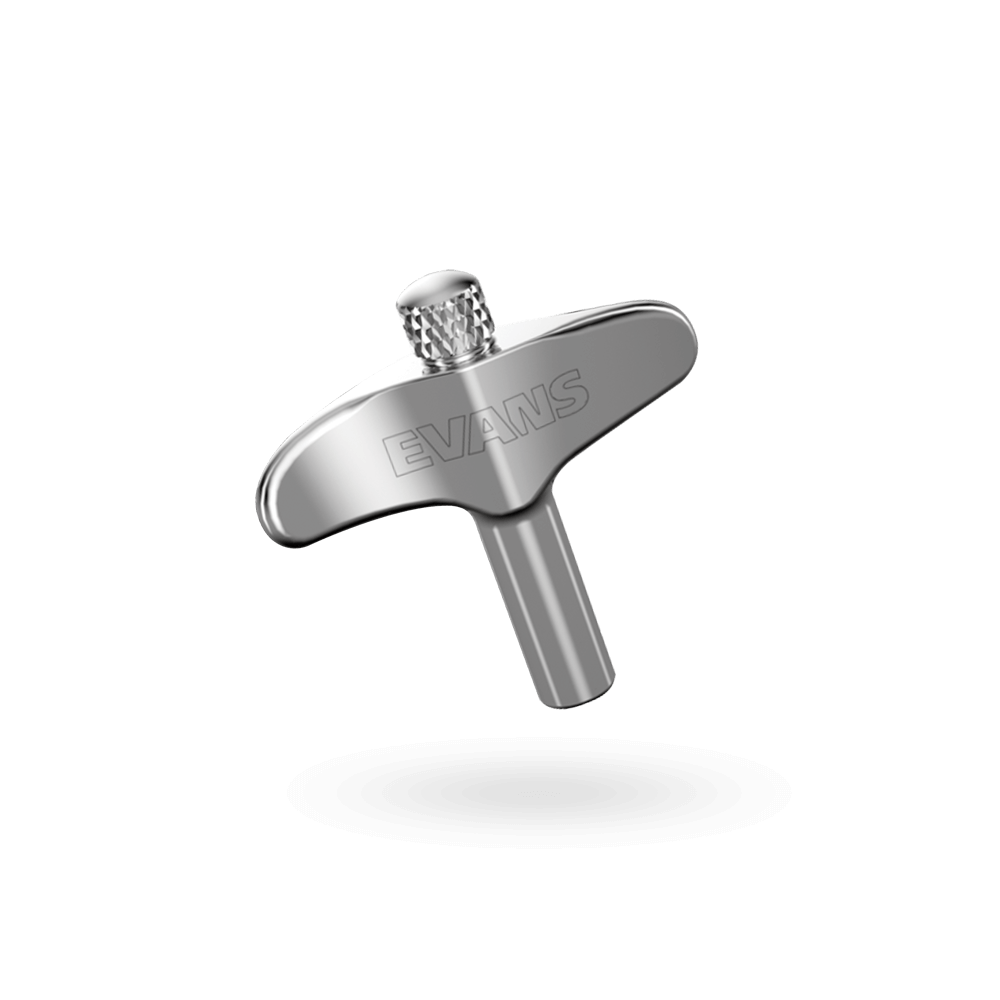
- Magnetic Head Drum Key. Drop-forged with a magnetic head that holds onto the tension rod instead of falling off, and a knurled knob for spinning rods down quickly. It also grips tightly enough to sit on a rod during playing without rattling, which is the detail that makes it the one that stays in the stick bag. Designed with Ned Steinberger.
- Torque Key. The handle can be set to a chosen tension and then slips once it reaches it, so every rod gets the same torque. That is how you get a genuinely even head without doing it by ear, and how you reproduce a tuning you liked last week.
- Pull Cord Drum Key. Two key heads on a retractable pull cord pulley, so you can run tension rods up and down at close to the speed of a power drill, plus a third fixed head for fine tuning. Rated for hundreds of head changes. If you change heads across a backline or a hire fleet, this is the time saver. The colour ring tells you which way it is set: red ring facing up removes the rod, white ring facing up applies it.
The damping ladder
Work upwards, and stop as soon as the problem is solved. Over-damping is how a kit ends up sounding like cardboard in the room and disappearing in the mix.
| Level | Product | What it does | Where it goes |
|---|---|---|---|
| 1 | Mini EQ Pods | Takes the edge off a single ringing overtone | Snare and small toms |
| 2 | EQ Pods | More mass, more damping. Six medium gels and one large in the tin | Toms, snare, front bass head |
| 3 | E-Rings | A floating ring that damps evenly all the way round and flattens the head’s sound | Any drum, and the option that makes tuning easier |
| 4 | EQ Pad | Hinged bass drum pad, velcroed to the shell | Bass drum only |
A word on each.
- EQ Pods are polymer gels with a Teflon-coated top, which is the part that matters: they stay clean, hold their shape and do not leave residue, so you can move them around while you experiment. The standard tin has six medium gels and one large; the Mini tin has twelve mini and two medium. Position is a real control, not just presence: near the edge damps gently, further in damps hard.
- E-Rings sit loose on top of the head rather than sticking to it, so they lift on the strike and settle back, removing overtones and flattening the sound without killing the attack. They also make a drum noticeably easier to tune, which is why they end up on hire and school kits. Packs are sized by drum, listed in which drum head sizes do I need.
- EQ Pad attaches to the inside of the bass drum shell with velcro, and the pad is hinged so it bounces away from the head on the strike, letting the note start, then returns to damp it. That is why it sounds less dead than a pillow jammed against the head. There is a smaller pad on the opposite end for smaller drums or lighter damping, so turning it round changes the amount.
- EMAD rings. If your bass batter is an EMAD head, you already have adjustable damping built into the head and should use that before adding anything inside the drum. See the Evans range guide.
Bass drum pedal patches
A beater striking bare film in the same spot all night will wear a hole through it, and that is an entirely preventable head failure. A patch protects the impact point and changes the attack at the same time. Both types come two to a pack.
- Black nylon (single pedal, double pedal) softens the attack without affecting sustain or low end. Evans note on the single nylon patch that it is not recommended with soft fleece or felt beaters.
- Clear plastic (single pedal, double pedal) increases the attack, again without affecting sustain or low end. This is the one for a click-forward modern kick sound.
The tuning and damping kit
Evans magnetic head drum keyView product → Evans torque keyView product → Evans EQ Pods damper gelsView product → Evans EQ Pad bass drum damperView product →
Shop the range
Keys, gels, rings and pads, plus the heads to put them on.
Stocked in our own warehouse for next-day UK delivery, with trade counter collection available. Anything in the D’Addario, Evans, ProMark or PureSound catalogue that we do not shelve, we can order in, so ask us if you cannot see it.
Frequently asked questions
Why does my drum sound different at each tension rod?
Because the head is not evenly tensioned, which is almost always caused by tuning round the drum in sequence instead of in opposite pairs. Back everything off to finger tight and start again in a star pattern.
Should the bottom head be tighter or looser than the top?
Same pitch gives the longest, most open sustain. Tighter than the top gives a shorter note that bends upward. Looser gives the downward pitch drop heard on a lot of rock records. There is no wrong answer, and it is the fastest way to change a tom’s character without buying anything.
Do I need a torque key?
Not to tune a kit, but it makes an even head quick and repeatable, and it means you can write down a tuning and get back to it. For hire fleets, schools and anyone tuning kit they did not set up, it pays for itself in time.
Are gels better than tape?
Yes, for two reasons. They can be moved and reused while you find the right position, and they do not leave adhesive on the head. Tape damps by adding weight and glue, and it takes the coating with it when it comes off.
How much damping is too much?
If the drum sounds good on its own in an empty room but disappears in the band, you have over-damped it. Overtones are what let a drum carry. Damp until the objectionable ring has gone, then stop.


