


Home » Guides » Drums & Percussion »
Drum Heads Explained: Batter, Resonant, Plies and Coatings
A drum head is a sheet of polyester film stretched over a hoop. Learn to read the ply count and the thickness off the packet and the wall of heads in any shop stops being confusing.
~9 min read · Updated September 2026 · By the Stage Supply team
In this guide: Short answer · Batter and resonant · Plies and mils · Control rings · Coated or clear · Bass drum heads · Level 360 · Shop the range · FAQ
Ply count, film thickness and surface finish are the three variables, and manufacturers print all of them on the box in a shorthand nobody explains. This guide translates that shorthand, then says which head belongs on which drum and why the one underneath matters as much as the one you hit.
The short answer
Single ply heads are open, bright and sustain for a long time. Twin ply heads are darker, shorter and much more durable. Coated heads are warmer and focused, and they are the only ones you can use brushes on. Clear heads are brighter and more open. For a working kit: twin ply on tom batters, single ply on tom resonants, a coated head on the snare, and a dedicated bass drum head with damping built in.
Batter and resonant: the two heads on every drum
Every drum has two heads and they do different jobs. The batter is the one you hit. The resonant is the one underneath, and it is not there to be struck. It controls how long the drum rings and how much of the note comes back out.
- Toms. Batter on top, resonant underneath. The resonant is usually a thinner, single ply head, because its job is to sustain rather than to survive.
- Snare. The batter takes every rimshot you will ever play. The resonant is a completely different item: a very thin snare side head that the snare wires sit against. Our Clear 300 is a single ply of 3mil film, which is roughly a third the thickness of a tom batter, and it is thin precisely so the wires respond.
- Bass drum. Batter at the back, front head (or reso) at the front, usually with a port cut in it for a microphone.
People replace batters constantly and resonants almost never, which is reasonable, but a resonant head that has been on for a decade is muffled and dead and is quietly costing the whole kit its sustain.
Plies and mils
Head thickness is given in mil, which is one thousandth of an inch. A 10mil head is 0.010 inches thick. Manufacturers quote both the number of plies and the thickness of each, and that pair of numbers tells you most of what you need.
| Construction | Example | Sound | Durability |
|---|---|---|---|
| Single ply, 10mil | Evans G1 | Open and expressive, bright, long sustain, wide tuning range | Average |
| Twin ply, 2 x 7mil | Evans G2 | Balanced attack, average sustain, slightly bright | Moderate |
| Twin ply 7mil with control rings | Evans EC2S | Defined attack, short sustain, semi-dark, reduced high frequencies | Enhanced |
| Single ply 3mil | Evans 300 snare side | Not a batter. Controlled snare response at all dynamic levels | Snare side only |
The trade-off is consistent: every bit of thickness you add buys durability and takes away sustain. A single ply head sings, and it also dents. A twin ply head is shorter and punchier, and it survives a tour. There is no head that is both, and a manufacturer claiming otherwise is selling you a control ring.
Control rings, dots and vents
Between plain single ply and plain twin ply sits a whole category of heads with something extra built in to kill overtones without adding a third ply. All three approaches are in the range we hold.
- Control rings. A ring of film bonded to the underside near the edge. Evans call the system Sound Shaping Technology, and the EC2S is the example: two plies of 7mil with SST rings that pre-EQ the head, taking out the muddy mid-range and leaving a focused attack.
- Centre dots. An extra disc of film in the middle where the stick lands. The EC Reverse Dot snare head puts a 3mil dot on the underside rather than the top, which adds durability, focus and attack at the centre without changing the feel of the playing surface.
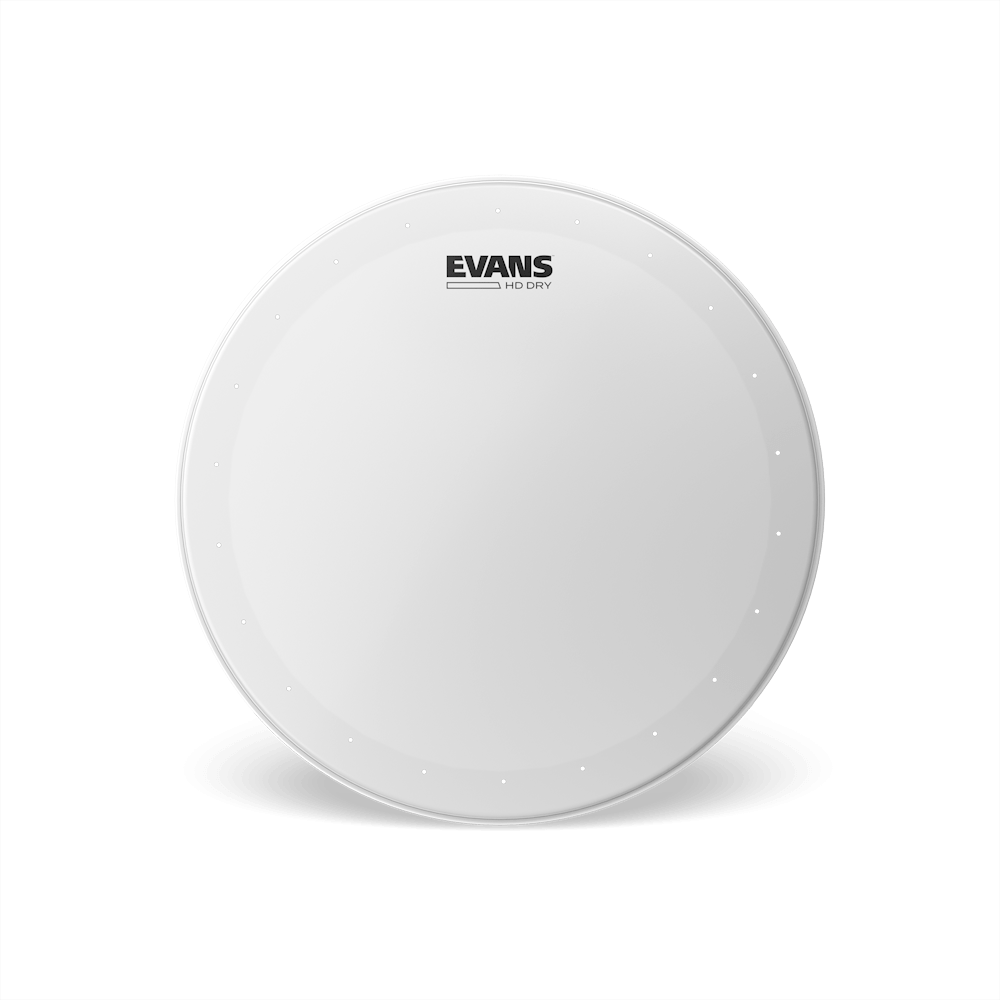
- Vents. Small holes drilled around the perimeter that let air escape and kill ringing. The HD Dry combines all three ideas: a 5mil outer ply, a 7.5mil inner ply, a 2mil control ring underneath and precision-drilled dry vents around the edge. That is why it is the standard studio and touring snare batter for anyone who wants a dry, cracking sound with no ring to gate out.
A head with built-in control is generally a better answer than a plain head plus a wallet full of gaffer tape, because the damping is even all the way round rather than concentrated at one point. Where you do want adjustable damping, see tuning and damping a drum kit.
Coated or clear
The white coating on a drum head is not decoration. It adds mass and it adds surface friction, and both change the result.
- Coated heads are warmer, more focused and slightly deeper than the same head in clear. They are also the only heads you can play with brushes, because a brush needs texture to sweep against. Standard on snare batters for that reason.
- Clear heads are brighter and more open, with more attack. Standard on tom batters in rock and on bass drum batters.
- UV-cured coating is Evans’ answer to the one real complaint about coated heads, which is that the coating flakes and wears through where you play. The UV1 uses a patented UV-cured coating on a single ply of 10mil, so you get single ply openness with much better durability, and a texture that brush players like.
Bass drum heads are their own category
A bass drum batter is asked to do something no other head is: produce a short, defined thump with no ring, while taking a beater strike in exactly the same spot several thousand times a night. That is why bass heads come with damping systems attached rather than expecting you to stuff a pillow in.
Evans’ system is EMAD, which stands for Externally Mounted Adjustable Damping. A channel around the outside of the head takes interchangeable foam rings, so you can change how much the head is damped in about thirty seconds without opening the drum. A narrow ring for more sustain, a wide one for a tighter, drier thump.
| Head | Construction | Sound | Sizes we stock |
|---|---|---|---|
| EMAD Clear | Single ply 10mil plus EMAD rings | Power, punch and low end, short sustain, moderately dark | 22 inch |
| EMAD2 Clear | Twin ply, 7mil outer and 10mil inner, plus EMAD rings | Very defined attack, short sustain, moderately dark | 20 inch and 22 inch |
| EMAD Heavyweight | Twin ply, 2 x 10mil, plus EMAD rings | Defined attack, short sustain, semi-bright. Built for heavy hitters | 22 inch |
If you are replacing both bass drum heads at once, the EMAD2 System Pack is the sensible buy: it pairs the EMAD2 batter with an EMAD resonant head that has an offset 4 inch microphone port already cut, with its own foam ring around the port. That saves you cutting a port yourself, which is the kind of job that goes wrong once and stays wrong.
Level 360, and why heads used to be a fight to fit
Every Evans head we stock carries Level 360. It is a collar design that extends the flat playing surface right out to the edge of the drum and gives the head even contact with the bearing edge all the way round. The practical effect is that the head drops onto the shell and seats properly instead of needing to be forced, and it tunes evenly and over a wider range once it is on. If you last fitted drum heads twenty years ago and remember it as a wrestling match, this is what changed.
A working kit, in four heads
Evans HD Dry 14 inch, the touring snare batterView product → Evans EC2 Clear 12 inch, tom batterView product → Evans G1 Clear 12 inch, tom resonantView product → Evans EMAD2 Clear 22 inch, bass drum batterView product →
Shop the range
Every Evans head we hold, sorted by the drum it goes on.
Stocked in our own warehouse for next-day UK delivery, with trade counter collection available. Anything in the D’Addario, Evans, ProMark or PureSound catalogue that we do not shelve, we can order in, so ask us if you cannot see it.
Frequently asked questions
How often should drum heads be changed?
By wear, not by date. A snare batter takes the most punishment and is the fast mover, often every few shows for a hard-hitting player. Tom batters last considerably longer, and resonant heads can run for years. The signals are a visible dent or stretch at the centre, a head that will not hold a tuning, and a drum that has lost its pitch definition.
What does mil mean?
One thousandth of an inch. A 10mil head is 0.010 inches thick. It is a thickness measurement, not a metric millimetre, which trips people up constantly.
Can I put a batter head on the bottom of a tom?
It will physically fit, but you lose the point of a resonant head. A thick twin ply underneath chokes the drum. Use a single ply such as G1 for resonants, and keep the twin ply on top where the stick lands.
Do I need a special head for the snare side?
Yes, and it is not optional. A snare side head is around 3mil, far thinner than any batter, so the snare wires respond to the drum. Fitting anything thicker underneath kills the snare response entirely.
Coated or clear on toms?
Clear for attack and brightness, which is why it dominates in rock. Coated for warmth and focus, and the only option if brushes are involved. Both are correct; it is a tonal choice, not a quality one.


