


Home » Guides » Instrument Accessories »
Instrument Cable vs Speaker Cable: Why They Are Not Interchangeable
Both end in a quarter inch jack. Inside they are entirely different products, and putting the wrong one between a valve head and a cabinet is how an output transformer dies.
~7 min read · Updated September 2026 · By the Stage Supply team
In this guide: Short answer · What is inside · Swapping them · Capacitance and length · Patch and solderless · The rest of the box · Shop the range · FAQ
Instrument cable and speaker cable both end in a quarter inch jack plug, they are both sold in similar lengths, and they are completely different products inside. Using one for the other is one of the most common mistakes on a stage and one of the easiest to avoid. This guide explains what is actually inside each, what goes wrong, and what else lives in the same corner of the backline box.
The short answer
An instrument cable carries a tiny signal and is built around one thin conductor wrapped in a shield, because the enemy is noise. A speaker cable carries amplifier power and is built from two heavy conductors with no shield at all, because the enemy is resistance. Guitar to amp: instrument cable. Amp head to speaker cabinet: speaker cable. They are never interchangeable.
What is actually inside each
| Instrument cable | Speaker cable | |
|---|---|---|
| Construction | Coaxial: one centre conductor surrounded by a shield that is also the return path | Two conductors of equal size, twisted together, no shield |
| Conductor size | Thin. Classic Series uses 24 AWG oxygen-free copper | Heavy. Custom Series uses 14 AWG oxygen-free copper |
| Shielding | Essential. Dense spiral shield | None, and none needed |
| Signal level | Millivolts, high impedance | Tens of volts, high current, low impedance |
| What matters | Capacitance and noise rejection | Resistance and current capacity |
What goes wrong if you swap them
- Instrument cable between an amp head and a cabinet. This is the dangerous direction. A 24 AWG conductor and a thin braided shield are being asked to carry the full output of a power amplifier. The cable heats up, it wastes power as heat rather than delivering it, and if the shield breaks down or the connection fails, a valve amplifier can be running with no load, which damages the output transformer. If a lead is not clearly marked as a speaker cable, do not put it between a head and a cab.
- Speaker cable between a guitar and an amp. Not dangerous, just bad. With no shield, the cable acts as an aerial. You get hum, radio breakthrough and buzz that changes as you move around the stage, and people usually blame the guitar or the venue’s power.
The fix is boring and effective: label both ends of every lead, and keep speaker cables physically separate in the box. Gaffer tape and a marker pen solve more stage problems than most equipment does.
Capacitance, and why a long guitar lead sounds dull
Every instrument cable has capacitance between the centre conductor and the shield, and that capacitance forms a filter with the guitar’s pickups. The longer the cable, the more capacitance, and the more top end you lose before the signal ever reaches the amp. This is a real, measurable effect and it is why a 6 metre lead sounds slightly different from a 3 metre one on a passive guitar.
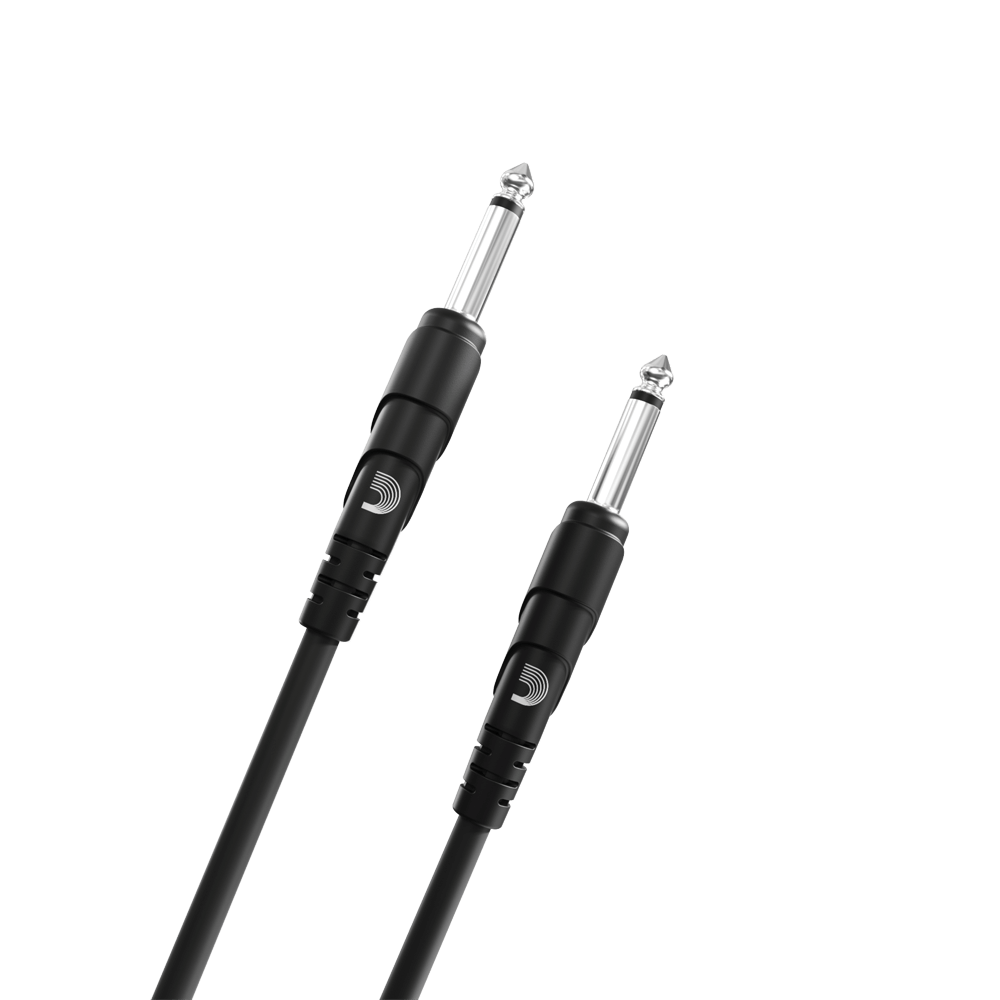
Two practical conclusions. Use the shortest lead that lets you work, which for most stages means 10 feet or 15 feet rather than reaching for the longest one in the box. And if you need a long run, that is the argument for a low capacitance cable rather than the cheapest one, which is exactly what the Classic Series is designed around. It also uses a double-moulded plug for strain relief, which is where cheap leads fail first: at the joint, not in the middle.
Cable lengths we stock, straight to straight: 10 feet, 15 feet and 20 feet. With a right angle plug for side-mounted jacks and pedalboards: 10 feet and 20 feet.
Patch cables and solderless plugs
On a pedalboard the cable problem inverts: the runs are inches rather than metres, so capacitance stops mattering and physical space starts to. Our 6 inch patch cables come in threes and use the same low capacitance construction as the long leads.
For boards where the spacing is awkward, solderless plugs let you build cables to exactly the length you need with no iron and no measuring twice. Ours carry D’Addario’s Circuit Breaker latching switch, which mutes the cable so you can unplug and change instruments on stage without the bang through the PA. Straight and right angle versions, and a complete DIY kit with 40 feet of cable and ten plugs for anyone wiring a whole board.
The rest of the cable box
- Custom Series speaker cable, 10 feet. 14 AWG oxygen-free copper with gold-plated plugs. The correct cable between a head and a cabinet.
- Headphone extension, 10 feet. Quarter inch female to quarter inch male, shielded, with oxygen-free conductors and gold-plated connectors. For anyone who has ever been tethered to a headphone amp by a 1.5 metre lead.
- Elastic cable ties, 10-pack. They clamp onto the cable, so they are permanently attached and cannot be lost, and they stretch to hold a coil up to 50 feet. The cheapest item in this guide and the one that does most to stop cables dying, because most cable failure is kinking and stress at the plug, not wear.
For the wider picture on connectors and looking after leads across a whole rig, see audio connectors explained and looking after your cables.
The cables we stock
Classic Series instrument cable, 10 feetView product → Classic Series, right angle plug, 10 feetView product → Custom Series speaker cable, 10 feetView product → Classic Series patch cables, 6 inch, 3-packView product →
Shop the range
Instrument leads, patch cables, speaker cable and solderless plugs.
Stocked in our own warehouse for next-day UK delivery, with trade counter collection available. Anything in the D’Addario, Evans, ProMark or PureSound catalogue that we do not shelve, we can order in, so ask us if you cannot see it.
Frequently asked questions
How do I tell an instrument cable from a speaker cable by looking?
You often cannot, which is the problem. Speaker cable is usually thicker and less flexible, and instrument cable is usually marked as such on the jacket. If it is unmarked and you are not certain, do not use it between an amp head and a cabinet.
Will an instrument cable damage my amp?
Used between a guitar and an amp, no, that is what it is for. Used between a valve head and a speaker cabinet it can, because if the connection fails the amp is running without a load. Solid state amps are more tolerant, valve amps are not.
Does cable length really change the tone?
On a passive guitar, yes, measurably. Cable capacitance rises with length and rolls off the top end. With active pickups or a buffer in front of the run, the effect is much smaller.
What does the latching switch on the solderless plugs do?
It mutes the cable. Flick it before you unplug and you change guitars without the loud pop that otherwise goes through the PA. Useful for anyone swapping instruments mid-set.
Why do cables always fail at the plug?
Because that is where the bending is concentrated. Good strain relief, which is what the double-moulded plug is for, spreads that load. Coiling cables properly and using ties rather than knotting them does the rest.


