


Truss and Rigging Basics: A Practical UK Guide

Stage Supply Guides
Truss and Rigging Basics: A Practical UK Guide
What the different truss types and clamps actually do, how loading works in plain English, and where UK law draws the line between DIY and a competent rigger.
~11 min read · Updated July 2026 · By the Stage Supply team
This guide explains the kit and the rules of thumb. It is not a rigging qualification. Structural design, load calculations and any lifting operation must be planned and signed off by a competent person. We are a dealer, not a rigging course.
In this guide: Truss types · Structure formats · Clamps & couplers · Loading basics · Safety bonds · UK law & LOLER · Ground support · Inspection habits · Buying guidance · FAQ
Truss Anatomy and the Main Types
Aluminium truss is a lattice of main tubes (chords) joined by diagonal bracing. The bracing is what turns a few tubes into a structure: it spreads bending forces along the length, which is why a 3m stick of truss holds far more than a 3m scaffold pole ever could, and also why damage to a single brace matters so much.
Most event truss on the UK market connects with conical couplers: tapered aluminium sleeves that sit half in each truss end, locked with steel pins and secured with R-clips or safety clips. Pushed home and pinned correctly, the joint is as strong as the truss itself. A missing pin or a half-seated coupler is not a cosmetic issue, it is a structural one.
Truss is named by its cross-section, and each profile has a job:
| Profile | Rigidity | Typical use | Transport |
|---|---|---|---|
| Ladder / flat (2-chord) | Strong in one plane only | Light decorative runs, banners, small fixture bars where the load direction is fixed | Lightest and flattest, packs tight |
| Triangle (3-chord) | Good all-round, one flat face | Exhibition stands, retail displays, lightweight lighting runs, apex-up or apex-down | Lighter than box, nests reasonably |
| Box / square (4-chord) | Strong and stiff in both planes | The event workhorse: lighting rigs, goalposts, grids, ground support, PA flying frames | Bulkiest per metre but stacks square in dollies |
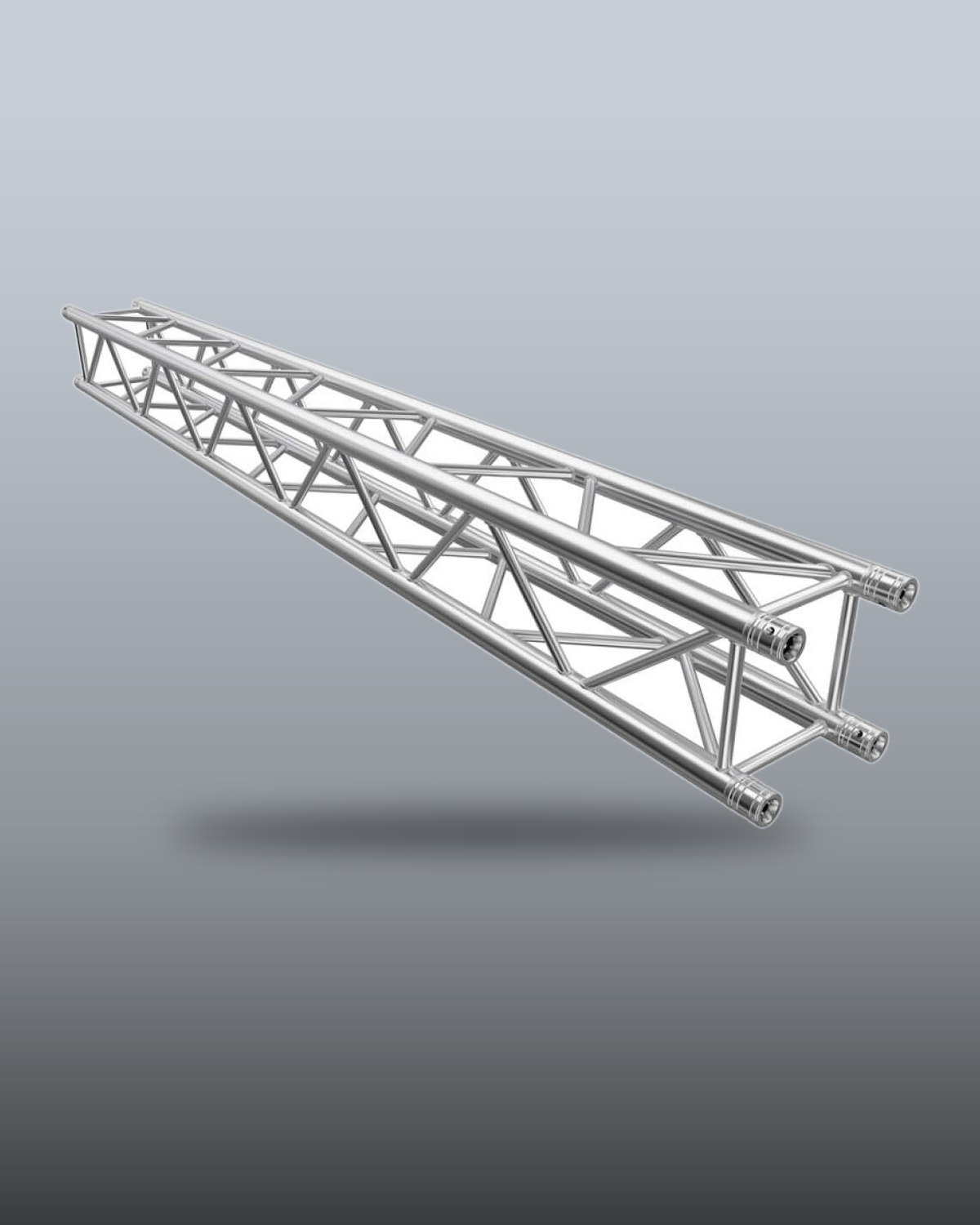
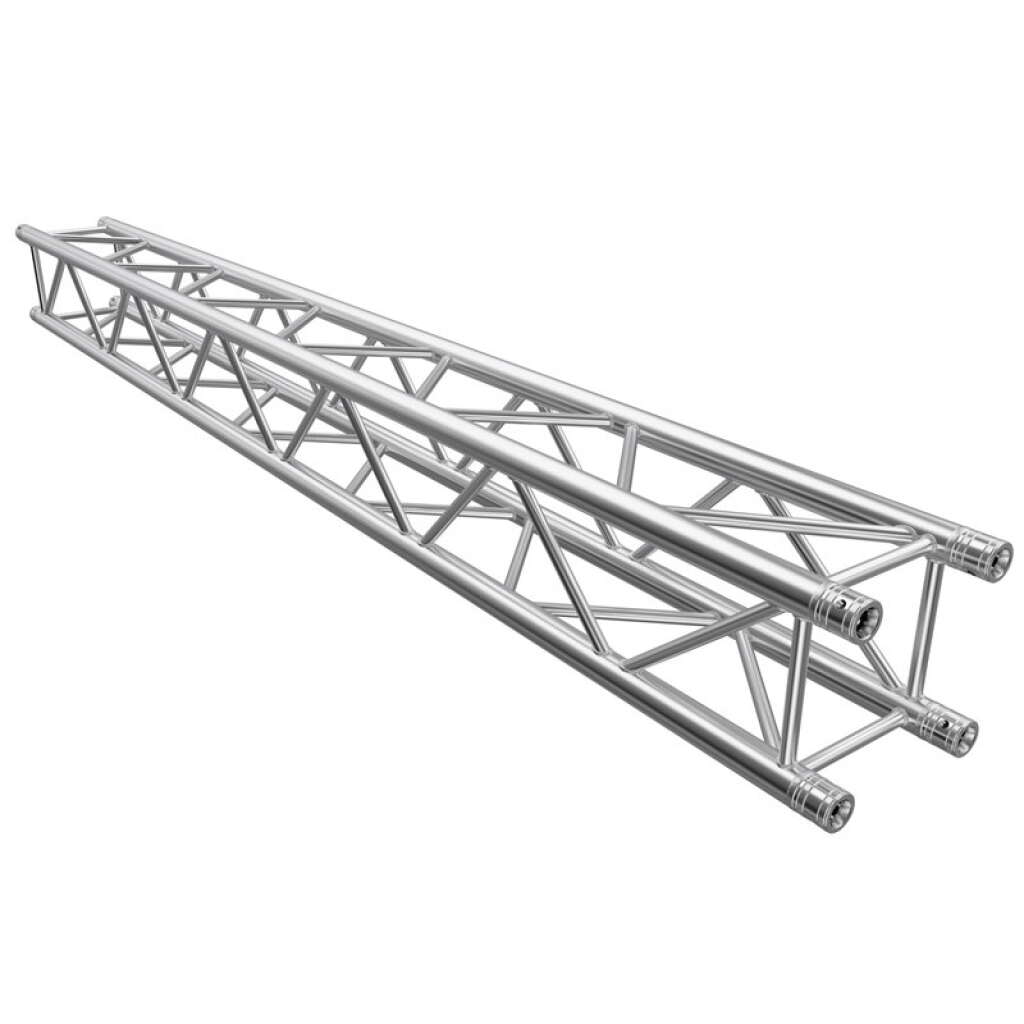
The de facto UK standard for general event work is 290mm box truss in the F34 class (roughly 290 x 290mm, 50mm main chords), the format made famous by Global Truss and Duratruss F34 and matched by many compatible ranges. It takes half couplers and hook clamps directly on its 50mm chords, corners and junctions exist for every angle you can think of, and it is what most hire stock and most truss sold for club, conference and mobile production work is built around. Smaller 220mm-class quad and the mini 100mm-class decorative truss exist below it; heavier 400mm-plus truss exists above it for long spans and touring roofs, firmly competent-person territory.
Common Structure Formats and When Each Fits
Lighting bars and T-bars
The simplest option is not truss at all: a wind-up or push-up lighting stand with a T-bar across the top. Two stands and a short truss ladder between them gets a mobile DJ four to eight fixtures at head height and packs into a car. If that describes your show, start with stands and brackets before you commit to truss and all the hardware that comes with it.
Goalpost
Two vertical towers (truss legs on base plates, or heavy-duty lifting stands) with a horizontal truss span across the top. This is the classic mobile-production and small-venue format: fixtures hang on the crossbar at a proper trim height, cables dress down the legs, and the whole thing is free-standing so you never touch the venue ceiling. The span is where the engineering lives: how much a given truss can carry across a given distance is a manufacturer-table question, not a guess, so the loading plan needs a competent person even at this scale.
Box grid
Four spans and four corners forming a square or rectangle overhead, either flown from the venue structure on chain hoists or sat on towers. Grids give you fixture positions on all four sides plus the ability to hang centrepieces, which is why clubs and mid-size venues love them. A flown grid is unambiguously a lifting operation: hoists, slings, steels and a rigger who plans the picks.
Ground support towers
Free-standing towers with sleeve blocks that let a grid or roof climb the towers on hoists. This is how outdoor stages and venues with no fly points get a full rig in the air. Powerful, and firmly professional territory: covered in more detail below.
T-bar / stands if
- You carry 4-8 lightweight fixtures
- One-person load-in, car-sized transport
- Different venue every night
Goalpost if
- You need a clean overhead bar at real trim height
- The venue has no rigging points
- Moving heads and a backdrop share one structure
Grid if
- It is a permanent or semi-permanent install
- You need fixture positions on all four sides
- A rigger is designing and installing it anyway
If the point of the structure is to fly moving heads, our moving head lights buying guide covers the fixture side: weights, hanging brackets and what a typical head asks of the bar it hangs on.
Clamps and Couplers Explained
Every fixture, every accessory and every joint between structures goes through a clamp, and the clamp is only as good as its rating. Legitimate rigging hardware carries a marked WLL (Working Load Limit) stamped or cast into the body. That number already includes the manufacturer’s safety factor: it is the maximum load the item is designed to carry in service, and it is the number a competent person works from. No marking means no rating, which means it does not go overhead. Full stop.
| Hardware | How it grips | Best for | Watch for |
|---|---|---|---|
| Half coupler | Full wrap around the tube, bolted closed | Anything that stays put: fixtures on installs, truss accessories, the default choice for security | Slower on and off; needs a spanner or wing nut per move |
| Hook clamp (C-clamp) | Open hook over the bar, single bolt tightens | Fast focus sessions and frequent refits on bars and truss | Open side must face the right way; less contact area than a half coupler |
| Trigger / quick clamp | Spring-loaded jaw, snaps over the tube one-handed | Mobile DJs and one-person rigs where speed at height matters | Convenience hardware: check the WLL suits the fixture, and check the jaw is fully closed |
| Swivel coupler | Two couplers joined on a rotating spindle | Joining tubes or truss chords at an angle: bracing, outrigger legs, angled bars | Rated lower in some orientations; the spindle is a wear point to inspect |
| TV spigot / stud adaptor | 28mm or 16mm spigot on a coupler body | Mounting TV brackets, follow-spot seats and spigoted accessories to truss | Match the spigot size to the receiver; the accessory’s own rating still applies |
Buy clamps sized for the tube they grip: 48-51mm for standard truss chords and scaffold-size bars, 35mm for lighting stands and smaller tube. A 50mm clamp cranked down onto 35mm tube is not “close enough”, it is deformed and unrated. The full range of clamps and couplers lists the tube size and WLL on every product for exactly this reason.
Loading Concepts, Without the Numbers
You will not find load figures for specific truss in this guide, and that is deliberate. Capacity depends on the exact truss series, the span, how it is supported, and how the load is arranged, and the only valid source is the manufacturer’s loading table read by someone who knows how to apply it. What you can usefully understand is the vocabulary:
Point load vs UDL
A UDL (uniformly distributed load) is weight spread evenly along the span, like a row of small fixtures or a run of cable. A point load is concentrated in one place, like a single heavy moving head or a hoist pick. The same truss carries far less as a centre point load than as the same total weight spread out, which is why loading tables quote both and why “it is only 60kg total” tells a rigger almost nothing until they know where that 60kg sits.
Span and deflection
Capacity falls sharply as span grows: doubling the distance between supports does much worse than halve what you can hang. Deflection is the visible sag under load. All truss deflects a little; the manufacturer’s table says how much is normal for a given span and load. Sag beyond that, or sag that stays after the load comes off, means the truss is overloaded or damaged.
Dynamic loads
Static weight is only part of the picture. A hoist starting and stopping, a fixture shock-loading as a strop snaps tight, moving heads whipping through position changes, wind on an outdoor structure: all of these multiply the effective load for a moment. Rated hardware and manufacturer tables account for normal service dynamics, but unusual dynamic loading is exactly the kind of judgement call that belongs to a competent person.
The non-negotiable bit
Manufacturer loading tables plus competent-person sign-off are not best practice, they are the baseline. A competent person is someone with the training, knowledge and experience to design the structure, apply the tables correctly and take responsibility for the result. If nobody on your team can honestly claim that, hire someone who can. We will happily talk you through what hardware does, but we will not size your rig for you over the phone, and you should be suspicious of any supplier who will.
Safety Bonds on Every Fixture
A safety bond (safety wire) is a rated steel wire rope that loops from the fixture, around the truss or bar, back to itself. It does nothing all night, every night, until the day a clamp bolt works loose or a bracket fails, and then it is the only thing between a moving head and the dancefloor.
Secondary suspension: the rules
Every fixture flown overhead gets its own rated safety wire, attached to a designated safety point on the fixture, around the structure itself (not around cable or another fixture), as short as practical so a falling unit drops millimetres, not half a metre of shock load. Bonds are rated items: match the bond’s rating to the fixture weight, and retire any bond that is kinked, frayed, crushed or has a deformed carabiner. Barn doors, colour frames and other loose accessories need securing too.
UK Law and Your Duty of Care
If you rig equipment over people at work, several sets of regulations apply. This is an awareness-level summary, not legal advice:
LOLER 1998 (Lifting Operations and Lifting Equipment Regulations) covers lifting equipment and lifting operations. Chain hoists, slings, steels and shackles used for lifting fall under it. Lifting operations must be properly planned by a competent person, supervised, and carried out safely. Under Regulation 9, lifting equipment needs periodic thorough examination by a competent person: the default intervals are every 6 months for lifting accessories (and any equipment that lifts people) and every 12 months for other lifting equipment, unless a written examination scheme sets different intervals. Reports of thorough examination must be kept and produced on request.
PUWER 1998 (Provision and Use of Work Equipment Regulations) sits underneath everything: all work equipment, truss and clamps included, must be suitable for the job, maintained in a safe condition, inspected where appropriate, and used only by people with adequate training and instruction.
The Work at Height Regulations 2005 apply the moment someone climbs a ladder, tower or truss to rig it. Work at height must be planned, supervised and carried out by competent people, with falls prevented before they are mitigated.
For the entertainment industry specifically, the BS 7905 and BS 7906 series cover the design and the safe use of lifting equipment for performance and broadcast, with dedicated parts for trusses and towers; newer European standards (the BS EN 17206 machinery standard and BS EN 17115 for truss design) are progressively superseding parts of the older series. You do not need to own these documents to hang four par cans, but the riggers you hire will work to them, and venues and production insurers increasingly expect it.
Chain hoists
Chain hoists come in two flavours: manual (hand chain) blocks, ideal for lifting goalpost crossbars and small grids at a controlled pace, and electric chain hoists for heavier structures and anything raised and lowered regularly. Both are lifting equipment under LOLER: they need thorough examination on the intervals above, pre-use checks every time, and operations planned by a competent person. Entertainment work has extra wrinkles (hoists running inverted, loads moving over people) that standard industrial practice does not cover, which is exactly why the specialist standards and specialist riggers exist. If your structure needs a hoist, it needs a rigger. Slings, steels and shackles to connect hoists to structures live in our rigging range, every item with a marked WLL.
Ground Support and Free-Standing Structures
Free-standing truss trades the venue-ceiling problem for a stability problem. The physics is simple: a tall, top-heavy structure wants to fall over, and everything in ground support design exists to stop it.
Base plates give a tower its footprint. Bigger and heavier is more stable, and the plate must sit flat: packing wedges on uneven floors, and spreader boards on soft ground or staging decks that were never meant to take a point load from a tower leg.
Outriggers widen the effective footprint the way feet steady a ladder. On taller goalposts and towers they are not optional extras; the manufacturer’s specification says when they are required, and that specification wins.
Ballast is dead weight that anchors the structure against overturning. How much and where is a calculation based on the structure, the loads it carries and the wind it might see. Water barrels that arrive empty, or lighting cases pushed against a leg, are not ballast; they are wishful thinking.
Wind changes everything outdoors. Banners, backdrops and scrims turn truss into a sail, and wind loading rises steeply with speed. Any outdoor free-standing structure needs a wind management plan: a stated operational wind speed, a way of measuring it, and a pre-agreed action (strike banners, lower the structure, evacuate the area) when the trigger is hit. This is competent-person work under any reading of the regulations.
Common mistake: no ballast because “it is only up for the afternoon”
Most outdoor truss failures are overturns, not structural collapses, and short events are not exempt from gusts. A goalpost with a banner across it in a beer garden is a wind problem from the moment it goes up. If there is no ballast calculation and no wind plan, the structure should not be outside.
Inspection Habits That Cost Nothing
Formal thorough examination is the competent person’s job. The daily habit that catches most problems is the pre-use check: two minutes of looking, every load-in, by whoever is building the rig.
- Sight down each truss chord: straight, no dents, no kinks
- Check welds where braces meet chords: no cracks, no broken paint lines hinting at movement
- Conical couplers seat fully; every pin in, every clip fitted
- Clamps: threads clean, bolts tighten smoothly, WLL marking legible, no deformed jaws
- Safety bonds: no kinks, frays or crushed sections; carabiners close and lock
- Hoist chains run free, no twisted or nicked links; hooks have working safety catches
- Base plates flat and full contact; outriggers deployed per spec; ballast in place before anything goes up
- Thorough examination reports in date for all LOLER items
Damaged truss is quarantine, not “the spare”
A dent in a chord or a crack near a weld is not cosmetic: the lattice works as a system, and one damaged member changes how the whole length carries load. Tag damaged truss out of service immediately, store it away from the good stock so it cannot get picked by accident, and have it assessed by a competent person or scrapped. Aluminium truss is not economically repairable in most cases, and “it was only a small dent” appears in accident reports with depressing regularity.
Buying Guidance: Compatibility and Used Truss
The single best buying decision you can make is to pick one truss series and stay in it. Within a series (F34-class 290mm quad, for example) every stick, corner and junction shares the same coupler system and the same loading tables, and your inventory grows into one coherent kit. Across brands, “compatible” ranges often do mate mechanically, but mixing makes the loading data murkier and gives an examiner more to question. Buy the series that your local hire companies stock if you ever expect to cross-hire.
Common mistake: unrated hardware from auction sites
Unbranded clamps with no WLL marking, “truss” with no manufacturer identity, and hoists with no documentation are cheap for a reason: nobody stands behind them. Under PUWER you must provide suitable, maintained equipment; an unmarked clamp fails that test before it ever leaves the flight case. If it has no marked WLL and no traceable manufacturer, it does not go overhead.
Used truss deserves real caution. You are buying its history: every drop off a truck, every overload, every badly drilled hole for a bolt that should never have been there. Unknown history plus aluminium’s habit of hiding fatigue damage means used truss needs a proper inspection by someone competent before it carries anything, and a price that reflects that risk. There is a sensible used market between reputable hire companies who can document their stock’s life; a pallet of mystery truss from a liquidation auction is a different proposition.
Buying new from a dealer gets you the manufacturer’s loading tables, a warranty, a known-zero service history, and hardware whose ratings mean something. That is the boring answer, and for kit that hangs over people’s heads, boring is the correct aesthetic.
Popular picks from the shop
FAQ
Box truss vs triangle truss: which should I buy?
Box (4-chord) if the structure carries real load or might grow into goalposts and grids: it is stiff in both planes and the whole accessory ecosystem is built around it. Triangle (3-chord) if the job is lighter and partly visual, like exhibition stands and retail displays, where its lower weight and price are the point. If in doubt, 290mm F34-class box truss is the format you will never regret owning.
Does LOLER apply to my truss?
LOLER applies to lifting equipment and lifting operations, so hoists, slings, steels and shackles are squarely covered, and raising a structure with a hoist is a lifting operation that must be planned by a competent person. Static truss itself is generally treated as work equipment under PUWER (suitable, maintained, inspected) rather than lifting equipment, though truss used as part of a lifting system gets swept into the LOLER regime. Either way the practical answer is the same: documented inspections, rated hardware, competent-person oversight. Ask your examiner or rigger how your specific setup is classified.
Can I build a goalpost truss myself as a DJ?
Physically assembling a manufacturer’s goalpost kit to its instructions is within reach of a careful two-person crew. What you cannot improvise is the design side: whether that span carries your fixture load, whether it needs outriggers or ballast, and whether the whole thing is safe over a dancefloor. Buy a kit specified for your load, follow the manufacturer’s manual exactly, and get a competent person to check your loading plan. If you are deviating from the manual at all, you have left DIY territory.
What is the difference between WLL and breaking load?
Breaking load is where the item actually fails in testing. WLL (Working Load Limit) is the maximum load it is designed to carry in service, set well below breaking load by the manufacturer’s safety factor. You work from WLL, always. Hardware marked only with a breaking load, or with nothing at all, is not entertainment rigging hardware.
Do I really need a safety wire on every fixture?
Yes. Every fixture flown overhead gets an independent rated safety bond regardless of how good the clamp is, and loose accessories like barn doors need securing too. It is the cheapest item in the entire rig and the only one whose entire job is saving someone’s life.
Manual or electric chain hoist?
Manual blocks suit occasional lifts of modest structures: cheaper, nothing to power, naturally slow and controlled. Electric hoists earn their keep when the structure is heavy, goes up and down regularly, or multiple points must lift together. Both are LOLER lifting equipment needing thorough examination and planned operations, so the hoist choice never removes the need for a rigger; it just changes how hard your arms work.
Is second-hand truss ever worth it?
From a reputable hire company with a documented service history, inspected by a competent person before use: possibly. From an auction listing with no provenance: you are buying unknown fatigue history in a material that hides damage well. Price the inspection into the deal, and walk away from anything with dents, drilled holes or repairs.
Reminder: everything above is background knowledge for buyers. Structural design, load calculations and lifting operations must be carried out and signed off by a competent person under LOLER, PUWER and the Work at Height Regulations. When in doubt, hire a rigger.
Shop this guide
UK stock of F34-class truss, rated clamps and rigging hardware, with trade accounts and fast delivery for installers, venues and production companies.




