

Home » Guides » Cases & Brands »
Peli Case Sizes Explained: 1510 Carry-On to 1650, and Which Fits Your Kit
Interior and exterior dimensions for the Peli Protector cases people ask about most, from the palm-sized 1120 to the wheeled 1650, plus the 1510 and 1535 Air carry-on question, how Protector, Air and Storm differ, and which interior to choose.
~9 min read · Updated October 2026 · By the Stage Supply team
In this guide: The short answer · Size table · Carry-on cases · Protector vs Air vs Storm · Foam, dividers and TrekPak · Will my kit fit? · Popular picks · FAQ
The short answer
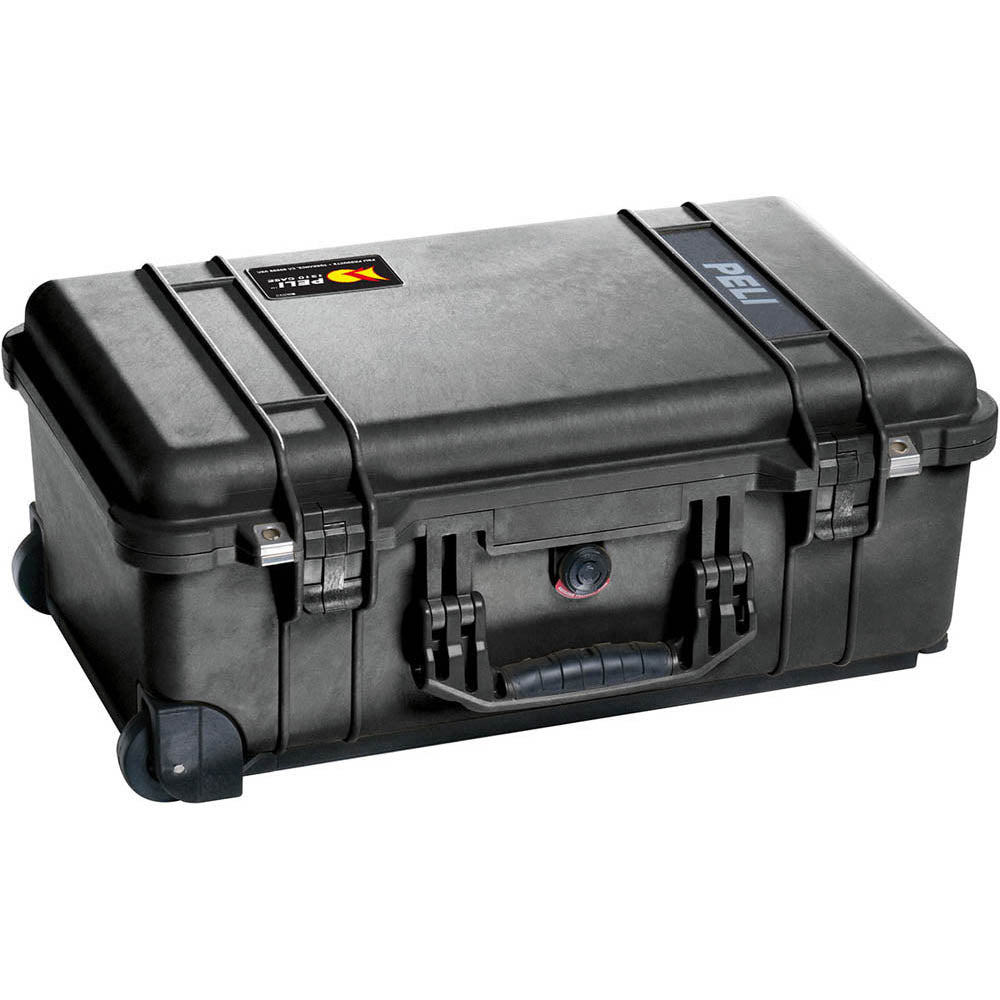
The Peli 1510 Protector Case measures 50.2 x 27.9 x 19.3 cm inside and 55.9 x 35.1 x 22.9 cm outside, according to Peli. It weighs 5.44 kg empty and 6.17 kg with foam, and has two wheels and a retractable trolley handle. Peli sells it as its carry-on Protector case, but tells buyers to check the size limit with their airline before travelling.
The Peli model number gives you a rough idea of size. In the table below, the 11xx to 14xx cases are the small ones (about 18 to 30 cm long inside), the 15xx cases are medium (about 42 to 51 cm), and the 16xx cases are large (about 55 to 73 cm). The number does not tell you exact sizes, though. The 1520 is shorter but wider than the 1510, and the 1600 is less than a centimetre deeper than the 1550 despite its much bigger footprint. Use the interior dimensions below, not the model number.
For the same carry-on footprint at less weight, the Peli 1535 Air is 51.8 x 28.4 x 18.3 cm inside and weighs 3.94 kg empty. For general case types, rack cases and what each one protects, see our flight cases and racks guide.
Peli Protector case sizes
All figures come from Peli’s official product pages for the standard (US-made) versions of each case, which are the versions we stock, and are given as length x width x depth in centimetres. Peli lists the lid depth and base depth separately; together they make up roughly the interior depth. Weights are for the empty case with no foam. Peli also sells some sizes as EU-made versions, whose published dimensions differ by a few millimetres.
| Model | Interior (cm) | Exterior (cm) | Lid / base depth (cm) | Empty (kg) | Wheels |
|---|---|---|---|---|---|
| 1120 | 18.5 x 12.1 x 8.5 | 21.4 x 17.2 x 9.8 | 1.3 / 6.5 | 0.61 | No |
| 1150 | 21.1 x 14.7 x 9.5 | 24.0 x 19.8 x 10.9 | 1.9 / 7.3 | 0.73 | No |
| 1200 | 23.6 x 18.1 x 10.5 | 27.1 x 24.8 x 12.3 | 3.0 / 7.4 | 1.16 | No |
| 1300 | 23.3 x 17.8 x 15.6 | 27.2 x 24.8 x 17.5 | 3.0 / 12.6 | 1.41 | No |
| 1400 | 30.0 x 22.5 x 13.2 | 34.0 x 29.5 x 15.2 | 3.0 / 10.2 | 1.8 | No |
| 1450 | 37.2 x 26.0 x 15.5 | 41.8 x 33.0 x 17.3 | 4.4 / 11.1 | 2.5 | No |
| 1500 | 42.5 x 28.4 x 15.5 | 47.0 x 35.7 x 17.6 | 4.6 / 10.9 | 3.23 | No |
| 1510 | 50.2 x 27.9 x 19.3 | 55.9 x 35.1 x 22.9 | 4.5 / 14.7 | 5.44 | Yes |
| 1520 | 45.9 x 32.7 x 17.1 | 50.2 x 40.1 x 18.8 | 4.5 / 12.5 | 3.76 | No |
| 1550 | 47.3 x 36.0 x 19.6 | 52.5 x 43.7 x 21.3 | 4.4 / 14.9 | 4.8 | No |
| 1560 | 50.6 x 38.0 x 22.9 | 56.1 x 45.5 x 26.5 | 5.1 / 17.8 | 7.71 | Yes |
| 1600 | 54.6 x 42.0 x 20.3 | 62.0 x 49.2 x 22.3 | 4.4 / 15.5 | 5.9 | No |
| 1610 | 55.3 x 42.4 x 27.0 | 63.1 x 50.0 x 30.2 | 5.2 / 21.8 | 8.85 | Yes |
| 1650 | 72.6 x 44.5 x 27.1 | 80.2 x 52.0 x 31.6 | 4.6 / 22.5 | 10.9 | Yes |
Some patterns stand out:
- The 1200 and 1300 share a footprint. Both are about 23.5 x 18 cm inside. The 1300 is 15.6 cm deep with a 12.6 cm base, against 10.5 cm and 7.4 cm for the 1200, so the 1300 is the one to pick when an item is too tall for the 1200’s base.
- The 1500 and 1520 are briefcase-sized. The 1500 is 42.5 x 28.4 cm inside and the 1520 is 45.9 x 32.7 cm. Neither has wheels.
- The 1510 and 1560 are the wheeled medium cases. The 1560 is almost the same length as the 1510, but it is 10 cm wider and 3.6 cm deeper inside. Peli does not sell it as a carry-on case, and at 56.1 x 45.5 x 26.5 cm outside it is well beyond the 1510’s carry-on footprint.
- The 1600 and 1610 have nearly the same footprint. Both are about 55 x 42 cm inside. The 1610 is 6.7 cm deeper and has wheels and a trolley handle; the 1600 has neither.
- The 1650 is the long one. At 72.6 cm long inside, the 1650 takes items that will not fit in a 1600 or 1610. Peli fits it with four wheels and a retractable handle.
Every case in the table is listed by Peli as IP67, with an O-ring seal, an automatic pressure equalisation valve and a temperature range of -40°C to 88°C.
Carry-on cases: 1510, 1535 Air and iM2500
Each of Peli’s three main ranges includes a carry-on case. The interiors of these three are within a few centimetres of each other. The real differences are weight, latches and material.
| Case | Interior (cm) | Exterior (cm) | Empty (kg) | Wheels |
|---|---|---|---|---|
| 1510 Protector | 50.2 x 27.9 x 19.3 | 55.9 x 35.1 x 22.9 | 5.44 | Yes |
| 1535 Air | 51.8 x 28.4 x 18.3 | 55.8 x 35.5 x 22.8 | 3.94 | Yes |
| iM2500 Storm | 52.1 x 29.2 x 18.3 | 55.1 x 35.8 x 22.6 | 5.03 | Yes |
The airline sets the limit, not Peli. Peli describes the 1510, 1535 and iM2500 as built to the maximum airline carry-on size. On every carry-on page it still tells you to check with your airline before you fly. Cabin bag limits differ between carriers, routes and fare types, and some airlines count wheels and handles in the measurement. The 1510 and 1535 are both about 55.8 to 55.9 cm long outside, so a limit of 55 cm is already tight. Check the exterior figures against your airline’s published limit, and check the weight allowance too. A loaded 1510 can easily go over a cabin allowance.
Batteries are covered by separate airline and dangerous-goods rules, whatever case they are in. If you are flying with wireless packs or lithium batteries, check the airline’s battery rules as well.
Protector vs Air vs Storm
Peli’s own descriptions of the three ranges:
- Protector is the classic polypropylene case with double-throw latches and a temperature range of -40°C to 88°C. Peli says it has been in use since 1976. Of the three carry-on cases above, the 1510 Protector is the heaviest.
- Air uses Peli’s HPX² polymer, which Peli says makes it up to 40% lighter than traditional cases, and Press & Pull latches. It is still IP67 rated. On the carry-on size, that saves about 1.5 kg empty compared with the 1510. Peli lists a narrower operating range of -18°C to 60°C.
- Storm (iM) is described by Peli as having the “same legendary DNA” as the Protector. The main difference is the Press & Pull latch, which locks automatically and opens with a light touch. It is made from HPX resin, is IP67 rated, and has a listed range of -29°C to 60°C.
For gear that lives in a van, gets stacked and goes out in all weathers, the Protector is the safe default. If you lift the case a lot or fly with it, the Air range saves weight. If you open and close the case all day and find double-throw latches slow, look at Storm or Air, which both use Press & Pull latches. Our 1535 Air and iM2500 sit alongside the full Air and Storm ranges.
Foam, padded dividers, lid organisers and TrekPak
Most cases come in a few configurations, and you can buy the inserts separately to change or replace them later.
- No foam. An empty shell. Use it for cables and tools, or if you plan to fit your own insert.
- Pick N Pluck foam. Foam pre-scored into small cubes that you pull out to shape a pocket. Peli lists a convoluted (egg-crate) lid layer, one or more Pick N Pluck layers and a solid base layer. The cube size varies by case: on the 1510 they are 0.75 x 0.5 inch, and on the 1200 and 1300 they are 0.5 x 0.5 inch. The bigger cases come with two layers of Pick N Pluck, and the 1610 has three. Replacement sets are sold per case, for example the 1510 foam set and the 1535 foam set.
- Padded dividers. Padded dividers that you can move around. They suit kit that changes from job to job, such as a mic kit or a camera body with lenses. For the 1510 there is the 1510 padded divider set, and you can also buy the case with dividers already fitted.
- TrekPak. Peli’s rigid divider system. It is made of perimeter pieces and dividers that you cut to length and fix with pins, using a cutting tool supplied in the kit. Inserts are sized per case, for example the 1510 TrekPak insert and the 1535 TrekPak insert.
- Lid organisers. Pockets that fit inside the lid for paperwork, spare batteries, adaptors and small parts. They are model-specific, for example the 1510 lid organiser and the 1600/1610/1620 lid organiser.
Foam, dividers and lid organisers are sized for one model, or for a small group of models that share a footprint. Always buy them by the case’s model number.
Will my kit fit? Working it out from the interior
The question is not whether the item is smaller than the case. It is whether the item fits with enough foam around it. Here is how to work it out:
- Measure the item at its biggest points. Include knobs, faders, antennas, connectors that stick out and any cable you want to leave plugged in.
- Compare the item’s height with the base depth, not the total depth. The total interior depth is split between the lid and the base. On the 1510, the 19.3 cm total is 4.5 cm in the lid and 14.7 cm in the base. An item taller than the base depth sits proud of the base and has to press into the lid foam.
- Leave a wall of foam on every side. If you pluck right up to the case wall, the item has nothing to cushion it against the shell. A case slightly bigger than you think you need is usually the better buy.
- Check the weight as well as the size. Dense kit can add up quickly, especially in a case you will carry by its handle.
Some typical examples, worked out from the dimensions:
- Handheld wireless mic systems. A receiver, two handhelds and their packs usually call for a medium case. A 1450 (37.2 x 26.0 x 15.5 cm) or 1500 is a sensible starting point. Lay the parts out flat and measure them before you choose. A half-rack receiver is wider than a single handheld, so it usually sets the case width. For planning the system itself, see our wireless guides.
- Small mixers and rack-width units. A 19-inch rack panel is 48.26 cm wide by standard, so it only fits a case whose interior is longer than that. The 1510 (50.2 cm), 1560 (50.6 cm), 1600, 1610 and 1650 are all long enough. The 1500, 1520 and 1550 are not. Then check the unit’s depth against the case width, and its height against the base depth.
- IEM packs, adaptors, spares and DI boxes. The small cases from 1120 to 1400 work well as grab boxes inside a bigger case or a bag. Our spares kit guide covers what is worth carrying.
If you are close to the limit on any dimension, send us the measurements of the item and the case you are looking at, and we will check it against Peli’s figures.
Popular picks from the shop
Peli 1510 Protector Carry-On Case, No FoamView product → Peli 1510 Replacement Foam Set (1511)View product → Peli 1510 Padded Divider SetView product → Peli 1535 Air Carry-On Case with FoamView product → Peli iM2500 Storm Case with FoamView product → Peli 1450 Protector Case with FoamView product → Peli 1560 Protector Case with FoamView product → Peli 1650 Protector Case with FoamView product →
Frequently asked questions
What are the Peli 1510 dimensions?
According to Peli, the interior is 50.2 x 27.9 x 19.3 cm, with a 4.5 cm lid and a 14.7 cm base. The exterior is 55.9 x 35.1 x 22.9 cm. It weighs 5.44 kg empty and 6.17 kg with foam.
Is the Peli 1510 carry-on approved?
Peli designs the 1510 to a carry-on size, but each airline sets its own cabin bag limits, and Peli tells you to check with your airline first. Compare the 55.9 x 35.1 x 22.9 cm exterior and the packed weight with your airline’s published allowance for your route and fare.
What is the difference between the Peli 1510 and 1535 Air?
The interiors are close: 50.2 x 27.9 x 19.3 cm for the 1510 and 51.8 x 28.4 x 18.3 cm for the 1535 Air. The 1535 Air is about 1.5 kg lighter empty (3.94 kg against 5.44 kg) because it uses Peli’s HPX² polymer. The 1510 is the classic polypropylene Protector with double-throw latches and a wider temperature rating.
What is the difference between the Peli 1510 and 1560?
Both have wheels and are about 50 cm long inside. The 1560 is 38.0 cm wide and 22.9 cm deep inside, against 27.9 cm and 19.3 cm for the 1510, so it holds much more. Peli does not sell the 1560 as a carry-on case.
What is the biggest Peli 1600 series case?
Of the 16xx cases covered here, the 1650 has the largest interior at 72.6 x 44.5 x 27.1 cm. The 1600 and 1610 share a footprint of about 55 x 42 cm. The 1610 is 27.0 cm deep and has wheels; the 1600 is 20.3 cm deep and has no wheels.
Can I buy replacement Pick N Pluck foam for my Peli case?
Yes. Replacement foam sets, padded dividers, TrekPak inserts and lid organisers are made for each case model. Buy them by your case’s model number so they fit the interior.
Shop this guide
The Peli Protector, Air and Storm ranges, plus replacement foam, dividers and lid organisers. Send us your kit dimensions and we will help match a case.
Peli Cases Protector Cases Air Cases Storm Cases Foam Sets Dividers



