

Home » Guides » Wireless Mics & In-Ear Monitoring »
Shure PSM 300 vs PSM 900: When the In-Ear Upgrade Is Worth It
What the extra money for PSM 900 actually buys over PSM 300: receiver RF performance, more compatible channels per band, CueMode and a proper parametric EQ. Plus the UK frequency bands, rechargeable options, and a short comparison with Sennheiser’s EW IEM G4.
~9 min read · Updated October 2026 · By the Stage Supply team
In this guide: The short answer · What is in each system · Side by side · RF performance · Channel counts and bands · Bodypack features · Batteries and charging · Mixing and matching · PSM 900 vs EW IEM G4 · Popular picks · FAQ
The short answer
PSM 300 is the simpler, lower-cost of Shure’s two stereo wireless in-ear systems and it is a capable one: the same 90 m operating range on paper, same patented Audio Reference Companding, and one-touch scan and IR sync. For a band running two to four mixes in normal venues, it does the job.
PSM 900 is worth the upgrade when the RF gets crowded or the channel count goes up. Its P9RA+ bodypack has noticeably better published rejection figures (adjacent channel, intermodulation and blocking), the transmitter is built for up to 20 compatible channels per band against PSM 300’s 15, and you get CueMode for the monitor engineer, a four-band parametric EQ on the pack and XLR inputs on the transmitter. If you are a covers band in pubs and function rooms, PSM 300 is usually enough. If you share stages with other wireless, run more than a handful of mixes, or tour festivals, PSM 900 earns its place.
For PSM 300 against Sennheiser’s EW IEM G4, see our PSM 300 vs EW IEM G4 guide. For the basics of how in-ear systems work, start with the in-ear monitor systems buying guide.
What is in each system
PSM 300
- P3T transmitter. Single-channel, half-rack, all-metal, with 6.35 mm (1/4″) balanced TRS inputs and loop outputs and a Stereo-MX/Mono switch. Rack kit included.
- P3R bodypack. The standard receiver: simple volume and mix controls, scan button, runs on two AA batteries.
- P3RA bodypack. The premium receiver: all-metal housing, LCD menu, two-band shelving EQ, volume limiter, and it takes a Shure SB900-series rechargeable battery as well as AAs.
In the UK, PSM 300 comes in the K3E band (606 to 630 MHz). We list it as the P3TRA system with P3RA receiver, the P3TRA215CL with SE215 earphones, the P3TRA215TWP twin pack with two P3RA packs and two pairs of SE215, and the P3RA receiver on its own for adding performers.
PSM 900
- P9T transmitter. Half-rack, with combination XLR and 1/4″ TRS balanced inputs, loop outputs, a front-panel RF mute switch and front- or rear-mountable antennas.
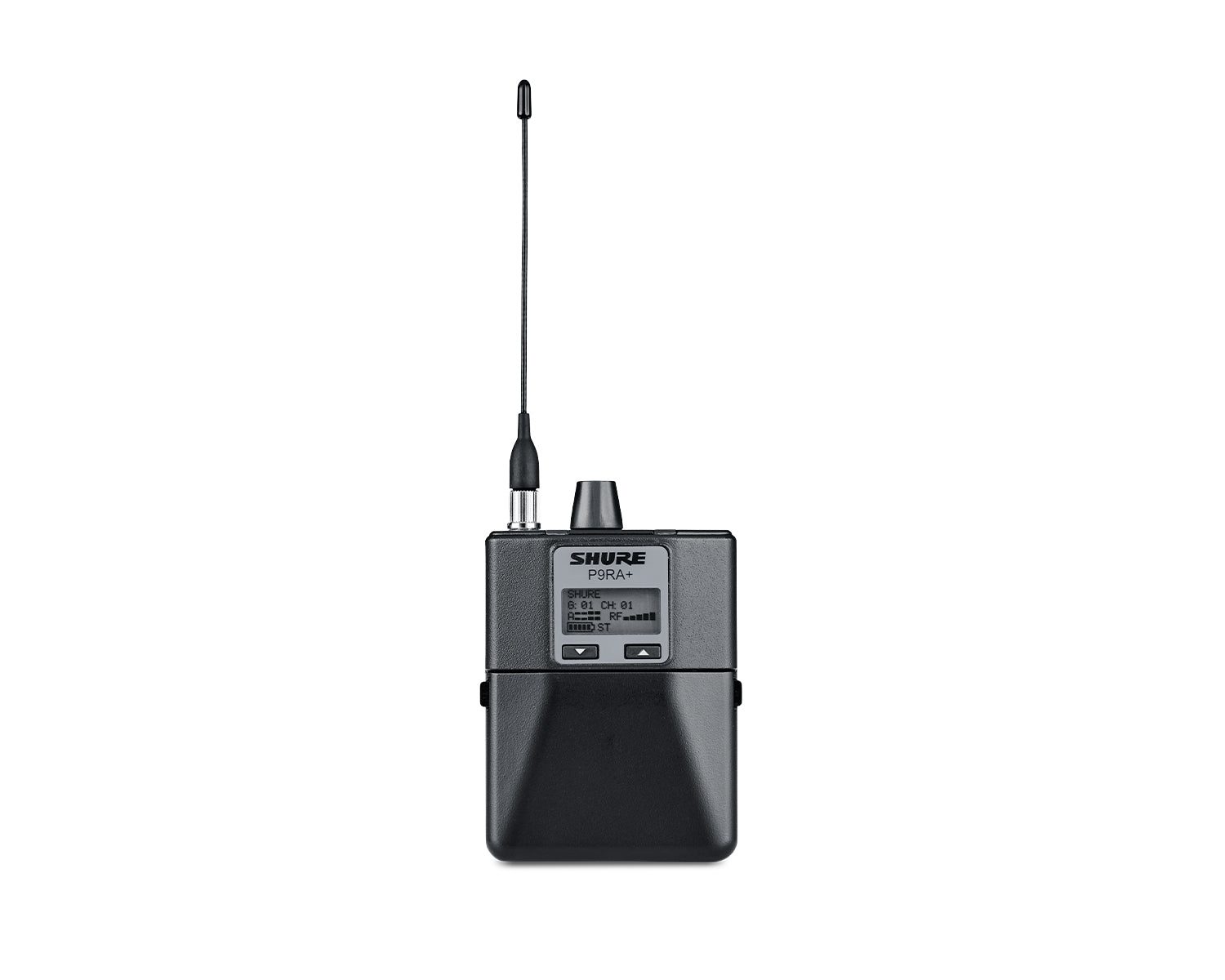
- P9RA+ bodypack. Stereo receiver with what Shure calls a hybrid analogue/digital architecture, precision front-end RF filtering, CueMode, four-band parametric EQ, volume limiter and volume lock. Runs on AAs or a Shure SB900B rechargeable.
- P9HW. A wired (hardwired) bodypack personal monitor in the PSM 900 family. Not one we currently list.
We list the P9RA+ receiver in K1E (596 to 632 MHz). Shure UK also offers PSM 900 in the G6E, G7E and L6E bands. PSM 1000 (P10T dual-channel full-rack transmitter, P10R+ diversity bodypack) sits above both and is shown as discontinued on Shure’s UK site, so it is not covered further here.
Side by side
Figures from Shure’s PSM 300, P3RA and PSM 900 user guides. Receiver RF figures are for the P3R and P3RA (identical in Shure’s specifications) and the P9RA+.
| PSM 300 | PSM 900 | |
|---|---|---|
| Compatible frequencies per band | Up to 15 | Up to 20 |
| Tuning bandwidth | 24 MHz maximum (varies by region) | 36 to 40 MHz (varies by region) |
| Transmitter RF output | 10, 20, 30 mW (varies by region) | 10, 50, 100 mW selectable (varies by region) |
| Operating range | 90 m (environment dependent) | 90 m (environment dependent) |
| Audio frequency response | 38 Hz to 15 kHz | 35 Hz to 15 kHz (±1 dB) |
| Signal-to-noise ratio | 90 dB typical (A-weighted) | 90 dB typical (A-weighted) |
| Latency | Under 0.7 ms | 0.37 ms (P9RA+) |
| Transmitter inputs | 1/4″ TRS, balanced | Combination XLR and 1/4″ TRS, balanced |
| Maximum input level (+4 dBu setting) | +22 dBu | +29.2 dBu |
| Receiver adjacent channel rejection | >60 dB | >70 dB |
| Receiver intermodulation attenuation | >50 dB | >70 dB |
| Receiver blocking | >60 dB | >80 dB |
| Receiver EQ | P3RA: two-band shelving (100 Hz and 10 kHz) | Four-band parametric |
| CueMode | Not offered | Yes, up to 20 transmitters stored |
| Rechargeable option | P3RA only | P9RA+ |
RF performance: where the money goes
On paper the two systems look alike: same 90 m range, same 2.2 µV RF sensitivity on the receiver, same 90 dB signal-to-noise. The difference is in how the receiver copes with everything else on the air.
- Adjacent channel rejection of >70 dB on the P9RA+ against >60 dB on the P3R and P3RA. This is how well the pack ignores a strong signal close to its own frequency, such as another IEM channel in the same rack.
- Intermodulation attenuation of >70 dB against >50 dB. Intermodulation products are the phantom signals created when several transmitters run together, and they are one of the main limits on how many channels you can fit in a band.
- Blocking of >80 dB against >60 dB: resistance to being swamped by a strong out-of-channel signal.
- Front-end filtering and RF gain control. Shure specifies the P9RA+ front-end filter at -3 dB at 30.5 MHz from the centre of each band, and its active RF gain control at 31 dB, against 20 dB on the P3RA.
Shure also credits the P9T’s transmitter linearity with reducing intermodulation, which is how it gets to 20 compatible channels per band. In a quiet room with one or two systems the difference is unlikely to matter. It matters more on a busy festival stage, in a theatre with a full radio mic rack, or near a strong TV transmitter, where the higher rejection figures give the receiver more margin.
Antennas and RF distribution matter too, whichever system you choose; see our antennas and RF distribution guide. For PSM 300, Shure’s PA411 combiner combines and powers up to four PSM 300 transmitters through one antenna, covering 470 to 865 MHz.
Channel counts and UK frequency bands
PSM 300 offers up to 15 compatible frequencies per band within a tuning range of up to 24 MHz. PSM 900 offers up to 20 per band across 36 to 40 MHz. Those are best-case figures from Shure: what you get on the night depends on what else is transmitting, which is why both systems include a scan.
The UK bands Shure offers for each system, with the range and output power Shure lists for each:
| System | Band | Range | RF output |
|---|---|---|---|
| PSM 300 | K3E | 606 to 630 MHz | 30 mW |
| PSM 900 | G6E | 470 to 506 MHz | 10/50 mW (below 50 mW ERP) |
| PSM 900 | G7E | 506 to 542 MHz | 10/50 mW |
| PSM 900 | K1E | 596 to 632 MHz | 10 mW |
| PSM 900 | L6E | 656 to 692 MHz | 10/50 mW (below 50 mW ERP) |
Two things are worth knowing. First, K3E and K1E both take in Channel 38 (606 to 614 MHz), the UK band set aside for wireless microphones and in-ear monitors under a nominal-fee Ofcom licence. Frequencies outside Channel 38 are licensed differently. Our UK wireless licensing guide and licensing beyond Channel 38 explain the options. Second, Shure lists the K1E version of PSM 900 at 10 mW only, so the higher power settings are not available in that band.
The Channel 38 licence covers only 606.5 to 613.5 MHz and is shared with every other licensee nearby, so you will not get the full 15 or 20 channels inside it. If you need more than a few IEM mixes plus radio mics, plan on a band beyond Channel 38.
Bodypack features
Stereo and MixMode on both
Both systems send two channels. In stereo, the bodypack control sets left/right balance. In MixMode, the pack combines the two channels into both ears and the control blends between them, typically the performer’s own vocal or instrument on one input and the band on the other. Both transmitters can also send mono. On the P3R, MixMode is chosen by holding GROUP while powering on; the P3RA and P9RA+ set it from the menu.
CueMode (PSM 900 only)
CueMode stores up to 20 transmitters in a list on one P9RA+, so the monitor engineer can step through every performer’s mix from a single pack. On a multi-mix show it is the feature engineers miss most when it is not there.
EQ, limiting and lock
The P3R keeps to simple volume and mix controls. The P3RA adds two shelving controls, low at 100 Hz and high at 10 kHz, each up to +6 dB, and a volume limiter. The P9RA+ has a four-band parametric EQ with selectable frequency and Q on the two mid bands, a volume limiter that narrows the knob’s range without compressing the audio, and a volume lock setting (P9RA+ and P10R+ only) that limits how far the volume knob can take the level.
Earphones
Neither system’s sound reaches the performer without good earphones and a proper seal. Shure packages PSM 300 with SE112 or SE215 earphones depending on the kit, and offers PSM 900 with SE425. The SE215 is the usual step up from an earphone that came in the box. Fit matters more than driver count; our IEM ear tips guide covers why.
Batteries and charging
Shure’s runtime figures, continuous use:
| Bodypack | AA alkaline | Shure rechargeable |
|---|---|---|
| P3R | 5 to 7 hours | Not supported |
| P3RA | 5 h 30 min | 8 h 10 min (SB900C) |
| P9RA+ | 6 h at volume 4, down to 3 h 15 min at volume 8 | 8 h at volume 4, 6 h 45 min at 6, 6 h at 8 (SB900B) |
Runtimes depend on volume, earphone impedance and settings, and Shure’s test conditions differ between the two guides, so treat the figures as a guide rather than a like-for-like comparison. The SB900C is the lithium-ion battery Shure designs for its PSM systems (as well as Axient Digital, ULX-D and QLX-D), and the SBC200 dual docking charger works with the P3RA and P9RA+ bodypacks as well as SB900B batteries, which suits a pair of packs at the side of the stage.
Mixing and matching
- P9RA+ with P9T: yes, and with the PSM 1000 P10T.
- P9RA+ with a P3T: Shure lists the P9RA+ as compatible with P9T and P10T transmitters. It does not list the P3T, so treat PSM 300 and PSM 900 as separate systems.
- Several packs on one transmitter: fine on both systems, as long as everyone wants the same mix. Each pack can still be in stereo or MixMode independently.
- Mixed old and new PSM 900 packs: the P9RA+ has an input EQ preset called Match that matches the frequency response of legacy PSM receivers.
- Point to point: a P9T can transmit to a Shure UHF-R receiver for a racked, mains-powered wireless audio link.
If you are likely to grow from two mixes to six or eight, consider starting on PSM 900 rather than replacing a PSM 300 rig later, as Shure does not list the bodypacks as cross-compatible.
PSM 900 vs Sennheiser EW IEM G4
The two are often considered for the same jobs. The EW IEM G4 pairs the SR IEM G4 transmitter with the EK IEM G4 bodypack and IE 4 earphones. The UK version is the GB range, 606 to 648 MHz.
| Shure PSM 900 | Sennheiser EW IEM G4 | |
|---|---|---|
| Compatible channels | 20 per band | Up to 16 |
| Tuning bandwidth | 36 to 40 MHz | Up to 42 MHz |
| Transmitter RF output | 10/50/100 mW (band dependent) | 10/30/50 mW switchable (country dependent) |
| Range | 90 m | Up to 100 m |
| Compander | Shure Audio Reference Companding | Sennheiser HDX |
| Audio frequency response | 35 Hz to 15 kHz | 25 Hz to 15 kHz |
| Receiver adjacent channel rejection | >70 dB | Typically ≥65 dB |
| Receiver intermodulation attenuation | >70 dB | Typically ≥70 dB |
| Receiver blocking | >80 dB | ≥80 dB |
| Bodypack EQ | Four-band parametric | High boost (+8 dB) |
| Engineer’s cue | CueMode, up to 20 mixes | Not listed |
| Rechargeable | Shure SB900-series | Sennheiser BA 2015 accupack |
| Software | Not covered here | Sennheiser WSM |
The receiver RF figures are close; manufacturers measure slightly differently, so small gaps do not mean much. Where PSM 900 pulls ahead is the parametric EQ and CueMode on the bodypack, the extra compatible channels per band, and a choice of four UK bands. Where G4 has the edge on paper is the bodypack: Sennheiser specifies adaptive diversity reception for the EK IEM G4, which Shure does not list for the P9RA+, and a wider published frequency response. Individual G4 parts are available too: the SR IEM G4 transmitter, the EK IEM G4 receiver and the EW IEM G4 Twin with two packs on one transmitter.
Popular picks from the shop
Shure PSM 900 P9RA+ Bodypack Receiver (K1E)View product → Shure PSM 300 P3TRA System with P3RA (K3E)View product → Shure PSM 300 P3TRA215CL System with SE215 (K3E)View product → Shure PSM 300 P3RA Bodypack Receiver (K3E)View product → Sennheiser EW IEM G4 In-Ear Monitor Set (GB)View product → Shure SE215 Sound Isolating EarphonesView product → Shure SBC200 Dual Docking ChargerView product → Shure PA411 Antenna Combiner for PSM 300View product →
Frequently asked questions
Is PSM 900 worth it over PSM 300?
Yes if you work in crowded RF, need more than a handful of mixes, or have a monitor engineer who will use CueMode. The P9RA+ has better published adjacent channel, intermodulation and blocking figures, and PSM 900 supports up to 20 compatible channels per band against 15. For a small band in quiet venues, PSM 300 is usually enough.
Can I use a PSM 900 bodypack with a PSM 300 transmitter?
Shure lists the P9RA+ as compatible with the P9T and P10T transmitters, not the P3T. Plan PSM 300 and PSM 900 as separate systems.
Which is better, PSM 900 or Sennheiser G4?
They are close on receiver RF figures. PSM 900 adds CueMode, a four-band parametric EQ on the pack and more compatible channels per band; EW IEM G4 has a diversity bodypack and up to 42 MHz of tuning range. Choose on features and which band suits your licence.
What is the difference between the P3R and P3RA?
The P3RA has an all-metal housing, an LCD menu, two-band shelving EQ, a volume limiter and support for Shure SB900-series rechargeable batteries. The P3R is the simpler AA-only pack. Both work with the P3T.
Do I need a licence for PSM 300 or PSM 900 in the UK?
The K3E (PSM 300) and K1E (PSM 900) bands both include Channel 38, which needs an Ofcom licence for a nominal fee. Other bands use spectrum licensed differently. Our licensing guide covers which licence you need.
Can several performers share one PSM transmitter?
Yes, on both systems, if they are happy with the same mix. Tune extra bodypacks to the same frequency; each can still set its own stereo balance or MixMode blend.
Shop this guide
Shure and Sennheiser in-ear systems, bodypacks, earphones and antennas. Tell us your band, venue and how many mixes you run and we will help pick the right system and frequency band.
Complete IEM Systems IEM Transmitters IEM Bodypack Receivers IEM Earphones IEM Antennas & Combiners



