

Home » Guides » Lighting & Effects »
Confetti, Streamers and CO2 Effects: A Practical Guide
What each effect looks like in a room, which consumables to buy, how a CO2 jet really works, and the venue permission, clean-up and safety realities behind it.
~13 min read · Updated July 2026 · By the Stage Supply team
In this guide: The effect families · How a CO2 jet works · Consumables · Venue permission and clean-up · Coverage and aiming · Safety and compliance · Control and timing · Hire vs buy · Maintenance · Common mistakes · FAQ
The effect families, and what each looks like in the room
Handheld and manual cannons
A cardboard tube you twist or shake, which fires a few metres and is then finished. The burst photographs well from close up and vanishes from wide shots: ideal for guest participation, useless for hitting a cue, because the timing belongs to whoever holds it.
Electric blowers and cannon launchers
Two products share this name, and the difference decides running costs. A blower has a fan in it: load loose confetti into a barrel and it throws continuously while triggered, a sustained shower rather than a bang, refilled from a bag and needing only mains power.
A cannon launcher is a base with a clamp, and the payload is a single-use tube, typically 50 cm or 80 cm long on a standard 55 mm bore, pre-filled with confetti or streamers. Compressed air fires it and the tube is spent. The throw is harder and more vertical, which is what a high-ceilinged room needs.
DMX-triggered confetti machines
Once a machine is on DMX it stops being a party gadget: patch it, put the trigger on a cue, and it fires on the beat rather than on human reaction time. Some units have independently fired pods that rotate and tilt, so one machine throws two shots in different directions. Our DMX guide covers the basics.
Streamer cannons
Streamers are paper or metallic ribbons, usually in 10 m rolls, fired from the same launchers. Confetti hangs and drifts; streamers arc, unroll and then hang off lighting bars and PA tops, which reads far better from the back of a big room. An empty 80 cm refillable tube takes roughly 40 to 45 rolls of paper streamers, or about 35 of metallic.
CO2 jets
The odd one out, with no physical payload: a short white column that appears instantly, travels several metres and vanishes, leaving nothing to sweep. It is the only effect here involving a pressurised gas cylinder, and it gives a burst rather than an atmosphere. For visible beams you want haze; see our smoke, haze and low fog guide.
How a CO2 jet actually works
The white plume is not smoke: no combustion, no fluid, nothing burning. Carbon dioxide sits in the cylinder as a liquid under its own vapour pressure, and when the jet’s solenoid opens it drops to atmospheric pressure, below its triple point. European Industrial Gases Association guidance describes the result: the liquid “is transformed to dry ice and gas”, producing “a dense white fog of powdery solid carbon dioxide particles and vapour”. The expansion also chills the air and condenses ambient water vapour into the plume, which is why the same jet looks fatter on a humid night.
Why the cylinder must have a dip tube
A jet must draw the liquid from the bottom of the cylinder, not gas from the top, because gas alone gives a hiss and nothing to look at. That needs a siphon cylinder, with an internal dip tube running from the valve to the base.
This is a stated manufacturer requirement. The MagicFX CO2 Jet manual says the jet “must be connected to a carbon dioxide (CO2) bottle with dip pipe”, and under a danger warning, “Exclusively use approved CO2 bottles (liquid carbon dioxide with dip pipe)”. Its troubleshooting section gives the diagnosis: no white plume means the wrong cylinder or a failed dip pipe. Ask your gas supplier explicitly for a siphon cylinder for stage effects, and never tilt or invert a non-siphon cylinder to force liquid out. Consumption is high: that manual specifies 0.5 kg per second, so a cylinder holds seconds of screen time, not hours.
We do not sell CO2 jets or CO2 gas
This is here because the wrong cylinder is the commonest reason a hired jet “does not work”. Gas supply, cylinder handling and firing the effect need a competent operator working to the supplier’s instructions.
Consumables: cuts, materials and lengths
Cut size decides the look more than the machine does. A small square around 10 by 10 mm floats longer, drifts wider and gives a soft sustained fall; a large rectangle around 17 by 55 mm has more mass, falls faster and is over sooner. If you stock one thing, a mixed-colour small square covers jobs where the scheme is unknown.
Material is where venues get involved. Paper and tissue confetti is matte, soft-falling and relatively easy to sweep. Metallic confetti is not household foil: manufacturers state the material plainly as polyvinylchloride (PVC), a plastic film. It is brighter and tints to whatever colour the rig throws at it, which is why it is the standard awards-night look, but it is also what venues object to most and the hardest to get out of carpet.
Flame retardancy and biodegradable claims
Stage confetti is normally sold flame retardant and certified to DIN 4102-1 Class B1, the professional market’s standard. Be accurate about what that is: UK entertainment licensing conditions impose flame retardancy duties on scenery, cloths, drapes and fabric decorations, and the widely used model rules of management for places of public entertainment do not mention confetti at all. Buy certified material because venues expect it, not because a UK regulation names it. ABTT guidance also notes that although the materials inside confetti devices are “flame proofed”, they are best fired last, after any flame or spark effects.
Paper confetti is the plausible end of the biodegradable market, and some products carry genuine certification. Two cautions. The certifications are not interchangeable: EN 13432 and the TUV Austria “OK compost” marks test compostability, while TUV’s separate “OK biodegradable” marks test something else, so quote the mark the product holds. And claims are policed: the CMA’s Green Claims Code requires claims to be substantiated, and the ASA has ruled against products sold as biodegradable where only one component was certified.
Venue permission and the clean-up reality
This is the part that costs people money, and it has nothing to do with the equipment. Ask the venue first, in writing, every time. UK restrictions are common and inconsistent.
- Large arenas frequently list confetti and glitter bombs among prohibited items in their venue terms.
- Councils running civil ceremony venues routinely ban plastic or foil confetti because it will never biodegrade, and some ban brightly coloured confetti because the dye stains historic stonework. Others allow biodegradable confetti outside the building only.
- Wedding and hospitality venues commonly permit only petals or bubbles, ban confetti cannons outright, or allow biodegradable confetti while reserving the right to charge for cleaning.
Get permission before you sell the effect, in a form you can show someone later, then budget the clear-up: metallic confetti in a carpeted room is a vacuuming job, not a sweeping job. If you quote for the effect, quote the clean-up with it.
Clean-up is a safety issue too
The Workplace (Health, Safety and Welfare) Regulations 1992 require that, so far as is reasonably practicable, every floor is kept free from any article or substance which may cause a person to slip, trip or fall. A dance floor covered in metallic confetti is exactly that: sweep the traffic routes before the crowd moves, not after.
Coverage, placement and aiming
Do not take throw figures on trust from anywhere, including here: height and distance vary enormously between a blower and a launcher, and between a 50 cm and an 80 cm tube. Check the machine’s rated throw in the manufacturer’s own documentation, then check it against the room.
- Aim over an audience, never at one. Launch above head height on a trajectory that lets the payload lose energy and then fall, with nobody in the launch path. Confetti falling on people is the effect; anything hitting people at close range is an incident.
- Measure the ceiling before choosing the tube. An 80 cm cannon in a low room puts the payload into plaster or a chandelier and drops it in a lump; use a blower or a shorter tube.
- Plan for the drift. Small cuts travel a long way sideways and find air conditioning, open doors and stairwells.
- Keep it out of the rig, and keep the operator clear of the output. Confetti in fixtures or on hot surfaces is a fire-risk conversation you do not want.
Safety and compliance: what you need to know
This is awareness level on purpose: it names the hazards and who to involve, and gives no ventilation, gas or rigging figures, because those need a competent person.
Permission and a risk assessment are not optional
Every effect here needs the venue’s agreement and a risk assessment, and UK licensing conditions often make that explicit: local authority model conditions commonly require advance written notice before smoke, fog, dry ice and cryogenic fog effects, and separate conditions frequently require consent before compressed gas cylinders are used at all.
The Purple Guide’s Special Effects chapter opens with the point: special effects “need careful management by suitably trained and competent operators as they can pose a serious risk if mismanaged”. Anything pyrotechnic or pyrotechnic-adjacent belongs with a competent person and is outside this guide. Electric confetti cannons are attractive precisely because they are not pyrotechnic, which is why some venues that refuse pyro permit them.
CO2 is an asphyxiant and it collects at low level
This is the most serious hazard on the page. HSE is direct: fatalities from asphyxiation have occurred where high concentrations of carbon dioxide entered confined spaces such as tanks, sumps or cellars and displaced oxygen. CO2 is heavier than air, so it does not disperse upwards and away. The model rules used across UK licensed venues name the spaces that matter, basements, understage areas, orchestra pits and auditorium stalls, and state that where there is any doubt, oxygen and carbon dioxide levels must be measured before the effect is used in performance.
An oxygen-depletion monitor is not a CO2 monitor
Industry gas guidance states that for carbon dioxide, fatal concentrations arise well before inert gas asphyxia conditions bite, so oxygen content alone is not a comprehensive indicator of danger, and that oxygen depletion monitors are not suitable as carbon dioxide alarms. Monitoring for CO2 needs a CO2 sensor.
Cylinders: pressure equipment, restraint and cold
A CO2 cylinder is pressure equipment: a transportable pressure receptacle subject to periodic inspection and re-test, and the hose and regulator assembly it feeds can constitute a pressure system under the Pressure Systems Safety Regulations 2000. Which duties land on you is a question for a competent person.
The handling rules are unambiguous. Cylinders are tall, heavy and easily toppled, and industry codes of practice require that means are provided to secure them against falling over, that they are kept upright, and that valve protection is fitted before moving them. Guidance on CO2 cylinders at users’ premises is direct about the in-use case: vertical, valve uppermost, firmly secured against a wall or suitable support, sited outdoors or in a ventilated space with CO2 detection, and turned so the valve does not point at the public.
Cold burns are real, not theoretical. The solid CO2 formed when liquid CO2 depressurises is around minus 78.5 degrees C, and industry guidance states it can cause frostbite if touched with bare hands and severe injury if it reaches the eyes. Pipes carrying liquid CO2 do the same, and during discharge the cylinder and valve become very cold, so nobody should be near the nozzle when the jet fires. Dry ice can also form inside hoses and build pressure until a plug is forcibly ejected, which is why a stated maximum burst duration is not a suggestion.
Control, timing and mounting
- Onboard button. Fine for one machine you stand next to, useless if you need to be at the mixer.
- Wireless remote. The mobile DJ default. Test it in the actual room before guests arrive.
- DMX. The right answer for more than one machine, or anything that has to hit a beat.
- A dedicated firing controller. For multi-cannon shows, a purpose-built FX controller gives channel-per-cannon firing with a master safety key and per-channel arm switches, so nothing fires until it is deliberately armed.
If the cue is the last chorus, fire on the downbeat rather than when you hear the chorus start, because the payload takes time to leave the machine, travel and begin falling. Rehearse once with the real machine and track and you will find the offset. Then fire once: repeat bursts turn a moment into a mess.
On mounting: these machines have real recoil, and a launcher with an 80 cm tube fitted is long and top-heavy. Use the manufacturer’s own mounting points and follow its instructions exactly. Flying a machine, clamping it to truss or fixing it overhead is rigging work for a competent person, and this guide gives no rigging advice. On the floor, keep it level and secured so it cannot topple under its own recoil.
Hire or buy?
Hire if
- Confetti comes up a handful of times a year and is not part of your standard offer.
- The job needs a scale you do not own, such as a large stage covered by several machines.
- The effect involves gas or is pyrotechnic: bring in a competent operator with the right insurance.
Buy if
- Confetti is a paid add-on you sell regularly. An electric machine needs no gas, so consumables are the only running cost.
- You want to match a client’s colour scheme rather than take whatever a hire company stocks.
- You need repeatability: your own machine and rehearsed cue beats unfamiliar kit on the night.
- You already run a DMX lighting show, so adding a machine is a small step. Our mobile DJ starter setup guide covers the rest of that rig.
Maintenance
- Clean after every use. Clear paper dust from the barrel, hopper and fan before the machine goes back in the van, and keep the intake grilles clear: a choked intake is the start of an overheating problem.
- Store dry and label it. Damp confetti clumps and will not fly, damp streamers do not unroll, and cuts look identical in a half-empty bag.
- Test at load-in, not during the first dance: power up, check the trigger path and remote, confirm the DMX address matches your show file.
- Cylinder checks, if you run gas. Per your supplier’s instructions: within its inspection date, valve and cap sound, hose and fittings undamaged and correctly rated, restraint in place before the valve is opened.
Common mistakes
- Metallic confetti in a venue that bans it. Default to paper if the answer is vague.
- No clean-up plan or budget. The effect lasts eight seconds; the vacuuming lasts an hour.
- CO2 in a small unventilated room. Ventilation matters: it pools at low level and kills in confined spaces.
- Firing into a low ceiling, which puts the payload into the plaster and drops it in a heap.
- Firing at faces instead of over heads. Keep everyone out of the launch path, doubly so for a CO2 nozzle.
- Forgetting the venue’s permission and the risk assessment. Many areas require notice before special effects or gas cylinders are used at all.
- Buying a machine and no consumables. A launcher with no tubes is a paperweight.
- Expecting a CO2 jet to do a hazer’s job. For beams all night you want haze.
Popular picks from the shop
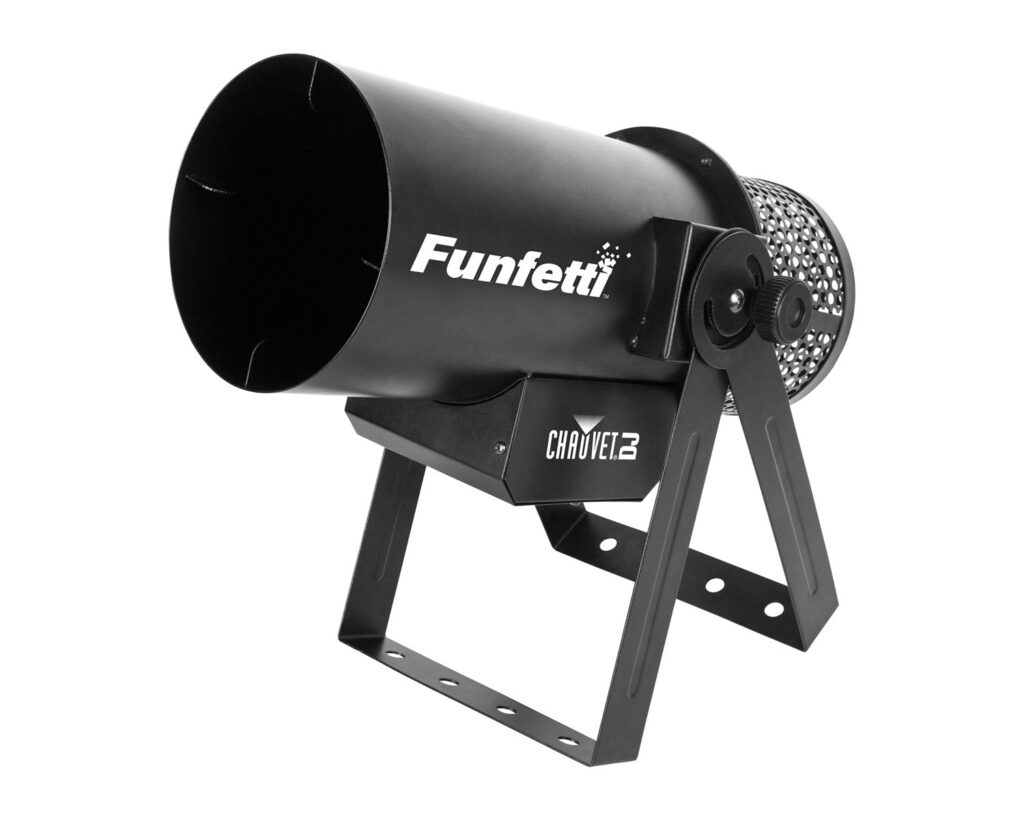
Chauvet DJ Funfetti Shot Pro Confetti LauncherView product → Equinox Confetti Burst Compact Confetti CannonView product → Equinox Twin Shot MKII Dual Confetti/Streamer CannonView product → Equinox Detonator 4-Channel FX Cannon ControllerView product →
Frequently asked questions
Do I need a special CO2 cylinder for a CO2 jet?
Yes, a siphon cylinder with an internal dip tube, so the jet can draw liquid from the bottom; a standard cylinder delivers gas from the top and gives almost no visible plume. The MagicFX manual states the dip pipe as a requirement and lists a missing plume as the symptom.
Can I use a CO2 jet indoors?
Only with the venue’s agreement, a risk assessment and a competent operator. CO2 is an asphyxiant, heavier than air, and it collects in basements, understage areas and orchestra pits; HSE guidance records fatalities from CO2 displacing oxygen in confined spaces. Monitoring needs a CO2 sensor, not an O2 meter.
Is confetti allowed at my wedding venue?
Ask, and get the answer in writing. Some venues ban confetti entirely, some allow only petals or bubbles, some allow biodegradable confetti outdoors only, and many prohibit plastic or foil confetti. Several reserve the right to charge for cleaning.
What is the difference between a confetti cannon and a confetti machine?
A machine, or blower, has a fan and throws loose confetti continuously while triggered, refilled from a bag. A cannon launcher fires a single-use pre-filled tube with compressed air: one hard bang, higher and further.
How far does a confetti cannon throw?
It depends on the machine, and for launchers on the tube length. Check the manufacturer’s rated projection, then check it against your ceiling height.
Is biodegradable confetti better, and does it have to be flame retardant?
Paper confetti is a genuinely different material from metallic, which is plastic film (PVC), and it is what most restricted venues accept. Check which certification a product holds: EN 13432 and the TUV “OK compost” marks test compostability, while the separate “OK biodegradable” marks test something else. Stage confetti is normally certified flame retardant to DIN 4102-1 Class B1 and venues expect it, but that is an industry norm rather than a UK regulation.
Shop this guide
Electric confetti cannons, launchers, loose confetti and streamer tubes, in stock and ready to ship.
Confetti Cannons Special Effects Smoke Machines Haze Machines DMX Controllers



