

Home » Guides » Mixers & PA Systems »
NEXO P+ Series Guide: P8 vs P10 vs P12 vs P15, and the L15 & L18 Subs
NEXO’s point-source range explained for UK buyers: what the coaxial design actually buys you, how the four sizes differ in practice, which sub pairs with which top, and why the amplifier decision matters as much as the boxes.
~9 min read · Updated August 2026 · By the Stage Supply team
In this guide: Short answer · Why coaxial · The four sizes · L15 and L18 subs · Powering P+ · Comparison table · Which to buy · Picks · FAQ
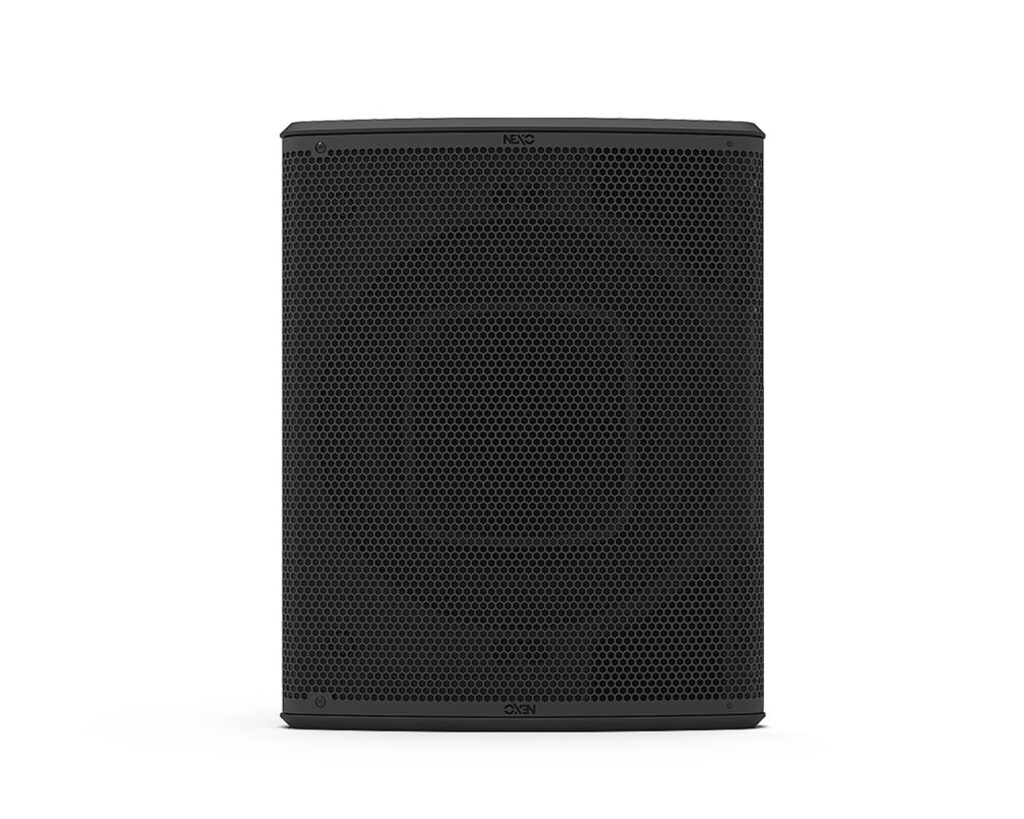
Most compact PA speakers at this level are two-way trapezoid boxes with a woofer below and a horn on top. NEXO’s P+ Series takes a different route: a coaxial driver in a curved plywood shell, one acoustic centre, and a cabinet that works as happily on its side as a stage wedge as it does flown as a main PA. That double life is the reason the range has become a fixture in UK theatres, churches and hire stock, one box on the shelf covers FOH, fills and monitors.
The short answer
The four tops are the same idea at four sizes: the bigger the driver, the more output and low-end reach, the bigger and heavier the box. The P8 and P10 are the theatre, corporate and fill boxes; the P12 is the do-everything box for bands and mid-size venues; the P15 is the flagship for high-output rooms that want point-source rather than a line array. Pair the L15 sub with the P12 and the L18 with the P15: the cabinets are matched in footprint on purpose.
Why a coaxial box is worth having
In a coaxial design the HF section fires through the centre of the LF driver, so high and low frequencies leave the cabinet from the same point. Two things improve immediately. Coverage is symmetrical, the box sounds the same off-axis vertically and horizontally, so walking across a room does not walk you through a crossover lobe. And as a wedge monitor it behaves: point-source boxes put the whole mix in one place at the performer’s ear instead of splitting it between a woofer at their feet and a horn at their knees. That is why the P+ cabinets are shaped to lie down, NEXO expects half of them to spend their life as monitors.
The cabinets are custom bent plywood, birch and poplar, rather than moulded plastic, with neodymium drivers keeping weight sensible. Dispersion is adjustable: the P+ tops take interchangeable flange adapters (60×60 through 90×40 patterns depending on model) so an installer can match the box to the room instead of the other way round.
The four sizes in practice
P8, the install and fill box
An 8" coaxial in a cabinet small enough to disappear on a shelf or under a balcony. Front fills, delays, corporate rooms, theatres where sightlines rule. It is a serious box (this is not a background-music speaker) but it wants a sub or a big brother for full-range band work.
P10, the theatre all-rounder
A 10" coaxial with a useful step up in output and LF reach over the P8 in barely more box. The classic P10 jobs: main PA in a studio theatre, side fills, and premium wedges for acts that ask for “something better than the usual&rdquo.
P12, the one to shortlist first
The 12" coaxial (12" neodymium LF with a 3" diaphragm HF) is the range’s centre of gravity. Enough output for band PA in small and mid-size venues, compact enough to fly discreetly, and the wedge most UK monitor engineers would pick at this price point. If you are unsure which P+ box you need, price the P12 system first and adjust from there.
P15, the flagship
A 15" coaxial with a 3.5" voice-coil LF section, bass-reflex loading through two computer-optimised ports, and output that pushes into territory where most brands would sell you a small line array. Choose it for high-output rooms (live music venues, larger churches, dance-heavy events) where you want point-source simplicity: one box a side, no array design, no rigging maths. It is also, frankly, one of the best big wedges money buys.
The matching subs: L15 and L18
The L Series subs are designed as dedicated LF partners for the P+ tops, and the pairings are physical as well as acoustic. The L15 (15", 139 dB peak) matches the P12’s footprint; the L18 (18", reach down to 32 Hz, 140 dB peak) matches the P15’s. Stack the top on its sub and you get a clean, cable-tidy full-range system per side that reads as furniture rather than kit, a genuine selling point in churches and corporate rooms. Both subs also work flown and as drum-fill LF.
Powering P+: the bit people underestimate
P+ boxes are passive and NEXO intends them to be driven by its own electronics, which carry the factory presets, limiting and system management: the NXAMP4X1MK2 (4 × 1300 W, 2U), NXAMP4X2MK2 (4 × 2500 W, 2U) and the flagship NXAMP4X4MK2 (4 × 4500 W, 3U), all developed with Yamaha and all combining Class D amplification with the DSP that protects the drivers. For installs running third-party amplification, the DTD controllers provide the NEXO processing separately, with Dante variants for networked systems. Budget the electronics from day one: a P+ system quoted without its NXAMP is not really a NEXO quote.
Comparison at a glance
| Box | Driver | Role | Matching sub |
|---|---|---|---|
| P8 | 8" coaxial, neodymium | Fills, delays, compact install, tight wedges | eLS/L series as needed |
| P10 | 10" coaxial, neodymium | Studio theatres, side fills, premium wedges | L15 |
| P12 | 12" coaxial + 3" HF | Band PA, mid-size venues, the standard wedge | L15 (matched footprint) |
| P15 | 15" coaxial, 3.5" VC LF | High-output point source, big wedges | L18 (matched footprint, 32 Hz) |
Which should you buy?
- Theatre, corporate, church with sightline pressure: P8 or P10 tops, sub only if the programme needs it.
- Bands in venues to a few hundred capacity: P12 over L15 per side. This is the configuration we quote most.
- High-output rooms, DJ-led events, larger venues that do not want an array: P15 over L18.
- Monitor stock for a hire company: P12 wedges, with P15 for acts that ask for more, both double as FOH between monitor jobs, which is the whole economic argument.
If you are weighing point source against a compact line array for a wide or deep room, the deciding factors (throw, coverage shaping, budget and rigging) are covered in our subwoofer guide and amplifier matching guide, or call us and we will talk it through against your room drawings.
Popular picks from the shop
NEXO P12 12" Coaxial LoudspeakerView product → NEXO P15 15" Coaxial LoudspeakerView product → NEXO L18 18" SubwooferView product → NEXO NXAMP4X2MK2 Power Amplifier & ControllerView product →
Frequently asked questions
What is the difference between the NEXO P12 and P15?
Scale. Both are coaxial point-source boxes in curved plywood cabinets; the P15’s 15" driver with a 3.5" voice coil delivers more output and more low-frequency reach, in a bigger, heavier box. The P12 covers bands in small and mid-size venues; the P15 pushes into territory where other brands would propose a compact line array. As wedges, the P12 is the standard choice and the P15 the statement one.
Do I need NEXO amplifiers to run P+ speakers?
You need NEXO processing. The NXAMP amplifier-controllers are the neat answer, amplification and factory presets in one box. Where third-party amps are already installed, a DTD controller supplies the NEXO DSP and protection separately. Running P+ boxes raw off a generic amp without the presets loses the protection and voicing you paid for.
Which subwoofer goes with which P+ top?
L15 with the P12 (matched footprints, 139 dB peak), L18 with the P15 (matched footprints, 32 Hz reach, 140 dB peak). Smaller systems built on the P8/P10 can use either L sub or the install-oriented eLS range depending on programme.
Can the P+ boxes be used as stage monitors?
That is half the point of the range. The coaxial driver puts the whole mix at one acoustic centre and the curved cabinet sits at a proper wedge angle on its side. P12 is the standard professional wedge of the range; P8 and P10 cover tight stages and the P15 covers loud ones.
Is the P+ Series suitable for permanent installation?
Yes. Dispersion-adjustable flanges, bracket and pole-mount accessories, white variants across the companion ePS/eLS install ranges, and the DTD controller route for integrating with installed amplification. We quote P+ for churches, theatres and venues weekly; send us the room and we will spec it.



