

Home » Guides » Microphones »
sE Electronics V7 Family Guide: Which V7, and Is It Better Than an SM58?
The V7 has become the strongest challenger to the old vocal-mic order. What the standard, Switch, X, MC capsules and signature editions each do, how the supercardioid pattern changes your stage, and an honest answer on the SM58 question.
~7 min read · Updated August 2026 · By the Stage Supply team
In this guide: Short answer · What the V7 is · The family · Wireless capsules · The SM58 question · Picks · FAQ
Every few decades a vocal microphone actually breaks into the live standard rotation. sE Electronics’ V7 has done it: you now see them on function stages, in churches and on riders that would have said Shure five years ago, helped by a colour range that lets a hire company or venue colour-code vocalists at a glance. This guide maps the whole family, because “V7” is now six products and two wireless capsules.
The short answer
The standard V7 is the buy for wired vocals, pick your finish. Add the Switch version where presenters need on-mic muting, the V7 X for instruments, and the MC1/MC2 capsules to put the same sound on your Shure or Sennheiser wireless. It is a supercardioid, so it wants slightly different monitor placement than an SM58, covered below.
What the V7 actually is
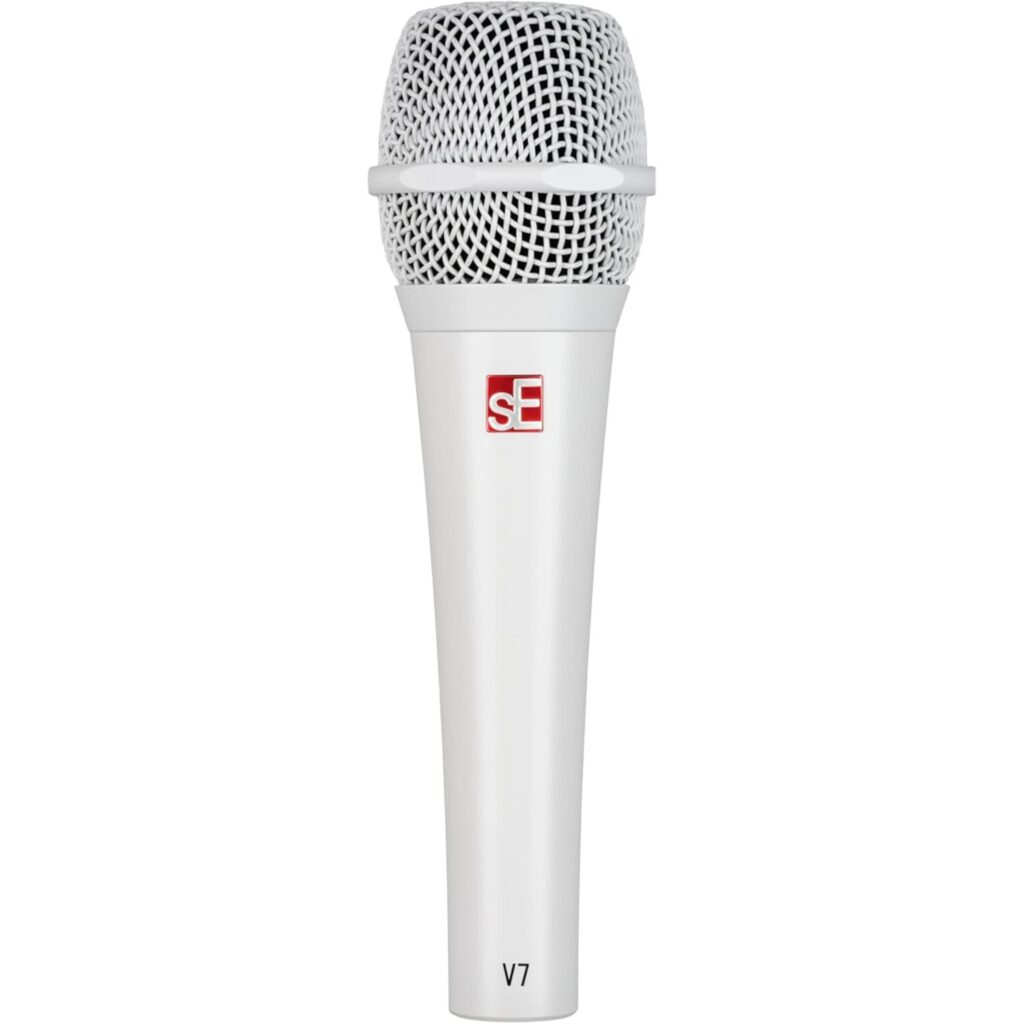
A supercardioid dynamic handheld built around sE’s custom DMC7 capsule with an aluminium voice coil. Three things define it on stage. The supercardioid pattern rejects more from the sides than a cardioid, buying gain-before-feedback on loud stages. The voicing is open and detailed up top, closer to what people expect from far pricier mics, without the proximity boom that muddies handhelds. And the build is genuinely roadworthy: all-metal, with a replaceable grille when a decade of drops catches up.
The family, one line each
- V7 (standard): the wired vocal mic, in black, white, chrome, silver, nickel, gold, red and the Vintage Edition, acoustically identical, so buy the look your stage needs.
- V7 Switch: same DMC7 capsule with an on/off slide switch, conferences, karaoke, worship and anywhere the user controls their own mute.
- V7 X: the instrument sibling, voiced full-bandwidth for guitar cabs, snares and brass rather than vocals.
- V7 MK (Myles Kennedy signature): the standard V7 sound in a roadworn signature finish.
- V7 PTT: push-to-talk version for talkback and announcements.
- MC1 / MC2 capsules: the V7 head for wireless handhelds, next section.
Wireless: MC1 for Shure, MC2 for Sennheiser
The clever part of the ecosystem: the MC1 threads onto Shure wireless handhelds (BLX, SLX-D, ULX-D bodies) and the MC2 onto Sennheiser handhelds, so a venue that standardised its wireless systems years ago can adopt the V7 sound for the cost of capsules, not systems. Both come in colour options for the same at-a-glance vocalist coding as the wired range.
The SM58 question, answered honestly
Is the V7 “better” than an SM58? Different, in ways that usually favour the V7 for lead vocals: more detail and air, better side rejection, less handling of proximity mud. The SM58 keeps two advantages that matter in the real world, a cardioid pattern that forgives sloppy monitor placement, and sixty years of muscle memory in every engineer’s hands. Practical placement note: a supercardioid’s null is behind-and-to-the-sides, not straight behind, so wedges belong slightly off-axis behind a V7 rather than dead centre. The full three-way comparison, including Shure’s newer Nexadyne, lives in SM58 vs Beta 58 vs Nexadyne, and the wider decision in choosing live microphones.
Popular picks from the shop
sE Electronics V7 Dynamic Vocal Microphone (White)View product → sE Electronics V7 SwitchView product → sE Electronics V7 X Instrument MicrophoneView product → sE Electronics V7 MC1 Capsule for Shure WirelessView product →
Frequently asked questions
Is the sE V7 better than the Shure SM58?
For most lead vocals, we would take the V7: more detail, tighter side rejection, comparable build. The SM58’s cardioid pattern is more forgiving of careless wedge placement, and familiarity counts for visiting engineers. Both are professional choices; the V7 is the one that surprises people.
Are the coloured V7s different mics?
No. Every finish is acoustically identical. The colours exist so venues and hire stock can code vocalists and returns at a glance.
Can I get the V7 sound on my wireless system?
Yes. The MC1 capsule fits Shure wireless handhelds and the MC2 fits Sennheiser. Thread standards are not universal, so buy by fitting: MC1 for Shure bodies, MC2 for Sennheiser bodies.
Where should monitors sit with a supercardioid?
Slightly off-axis behind the mic rather than dead centre: a supercardioid’s rejection nulls sit behind-and-to-the-sides. Get that right and the V7’s gain-before-feedback advantage is real; ignore it and you give the advantage back. More in how to stop feedback.



