

Home » Guides » Mixers & PA Systems »
Martin Audio Blackline XP vs BlacklineX: Powered or Passive?
The powered XP12, XP15 and XP118 against the passive X8, X10, X12, X15, X115, X118 and X218: what is identical, what the built-in amplifier and mixer give you, which VIA or iKON amplifier and DX processor a passive system needs, and which family suits portable PA, monitors and installs.
~10 min read · Updated October 2026 · By the Stage Supply team
In this guide: The short answer · The two ranges · Model for model · What the XP adds · Driving BlacklineX · Subwoofer pairing · Portable, monitors, install · Popular picks · FAQ
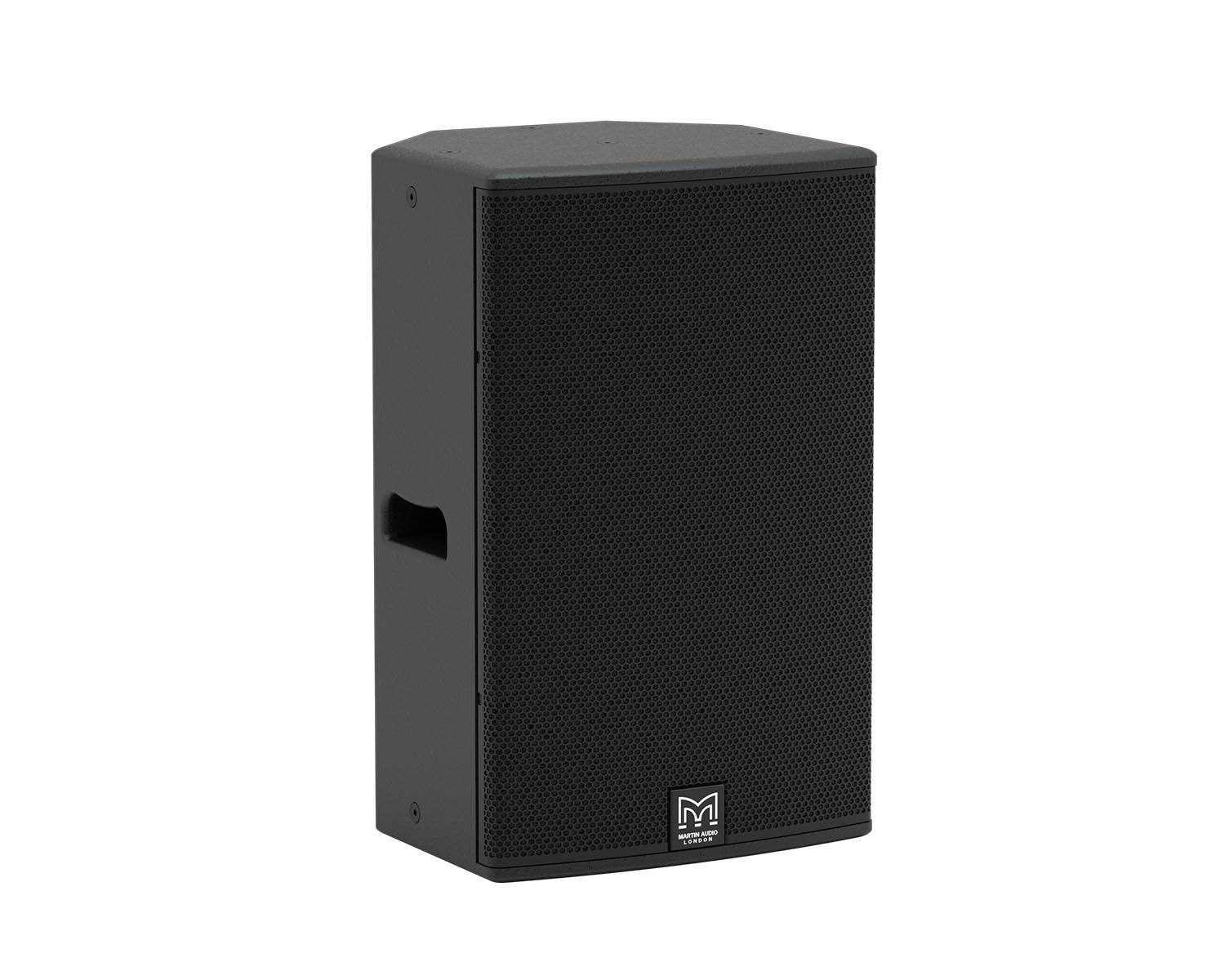
Martin Audio sells the same Blackline cabinet idea two ways. BlacklineX is the passive range: plywood boxes with NL4 connectors that need an amplifier and, ideally, a processor. Blackline XP (Martin calls it BlacklineX Powered) puts the amplifier, DSP and a small mixer inside three of those designs.
This guide compares the two families model for model, using Martin Audio’s own datasheets and user guides. The general case for powered versus passive is covered in our active vs passive PA speakers guide, so here we stick to what is specific to Martin’s ranges.
The short answer
- Choose Blackline XP if you set up and pack down for each job: mobile DJs, bands running their own PA, function and corporate work. Plug in mains and a signal and it works, with presets for full range, with-sub and monitor use, plus Bluetooth streaming and app control.
- Choose BlacklineX for installs, for systems where amplifiers live in a rack away from the speakers, and when you need a size the XP range does not offer: the 8″ X8, 10″ X10, 15″ X115 sub and twin-18″ X218 are passive only.
- Acoustically they are close. The XP12 and X12 share the same driver sizes, coverage pattern, frequency response and maximum SPL on Martin’s datasheets. The same is true of the XP15 and X15. The difference is where the amplifier and processing live.
The two ranges as Martin lists them
Martin lists seven passive BlacklineX models (four two-way tops and three subwoofers) and three Blackline XP models (two tops and one sub).
| Size | Passive (BlacklineX) | Powered (Blackline XP) |
|---|---|---|
| 8″ two-way | X8, 90° x 50° | No equivalent |
| 10″ two-way | X10, 90° x 50° | No equivalent |
| 12″ two-way | X12, 80° x 50° | XP12, 80° x 50° |
| 15″ two-way | X15, 80° x 50° | XP15, 80° x 50° |
| 15″ subwoofer | X115 | No equivalent |
| 18″ subwoofer | X118 | XP118 |
| 2 x 18″ subwoofer | X218 | No equivalent |
All the two-way models use a horn you can rotate by 90°, so the coverage pattern stays the right way round when the box lies on its side as a wedge or is mounted horizontally. The enclosures are symmetrical multi-angle designs in birch/poplar ply with a black textured finish. Martin’s BlacklineX user guide adds that white and custom RAL colours are available to order for the passive range.
Model for model: XP against X
Figures below are from Martin Audio’s datasheets for each model.
| Spec | X12 (passive) | XP12 (powered) | X15 (passive) | XP15 (powered) |
|---|---|---|---|---|
| LF driver | 12″, 2.5″ voice coil | 12″, 2.5″ voice coil | 15″, 3″ voice coil | 15″, 3″ voice coil |
| HF driver | 1″ exit, 44mm diaphragm | 1″ exit, 44mm diaphragm | 1″ exit, 44mm diaphragm | 1″ exit, 44mm diaphragm |
| Frequency response (±3dB) | 62Hz-20kHz | 62Hz-20kHz | 55Hz-20kHz | 55Hz-20kHz |
| Max SPL (continuous / peak) | 122 / 128dB | 122 / 128dB | 125 / 131dB | 125 / 131dB |
| Dispersion | 80° x 50° | 80° x 50° | 80° x 50° | 80° x 50° |
| Crossover | 2.3kHz passive | 2.3kHz active, 24dB/oct | 2.2kHz passive | 2kHz active, 24dB/oct |
| Power | 300W AES, 1200W peak (rating) | 1000W LF + 300W HF peak (built in) | 400W AES, 1600W peak (rating) | 1000W LF + 300W HF peak (built in) |
| Weight | 17kg | 18kg | 24kg | 26kg |
| Spec | X118 (passive) | XP118 (powered) |
|---|---|---|
| Driver | 18″, 4″ voice coil | 18″, 4″ voice coil |
| Frequency response (±3dB) | 42Hz-150Hz | 42Hz-150Hz |
| -10dB point | 36Hz | 38Hz |
| Max SPL (continuous / peak, half space) | 130 / 136dB | 131 / 137dB |
| Power | 800W AES, 3200W peak (rating)* | 2000W peak (built in) |
| Weight | 42kg | 44kg |
* The 800W AES / 3200W peak X118 rating is from Martin Audio’s current X118 datasheet and product page. The amplifier table in the BlacklineX user guide (v2.2) lists the X118 at 500W AES / 2000W peak, the same as the X115. If you are sizing amplification or limiters for X118s, use Martin’s BlacklineX presets and check the figure with us or Martin first.
Two things to read from this. First, on paper the XP12 and XP15 give up nothing in output or bandwidth against their passive twins, and the XP118 is within a decibel or two of the X118 (1dB more maximum SPL, a -10dB point of 38Hz rather than 36Hz); you pay for the amplifier inside the box and carry a kilo or two more. Second, the passive power figures are what the speaker can take, not what it delivers. A passive X12 only reaches its rated SPL with an amplifier and limiter settings that let it get there, which is the subject of the passive section below.
What the XP range adds
Each XP cabinet has a Class D amplifier module, a switch-mode power supply with power factor correction running from 100-240V, and DSP controlled by a rotary encoder and colour screen on the rear panel. Per Martin’s datasheets:
- A three-channel mixer. Two combo XLR/jack inputs for mic or line (the jack also accepts a guitar-level Hi-Z source without a DI box) plus a Bluetooth channel, each with three-band EQ. On the XP12 and XP15, inputs 1 and 2 also get a high-pass filter.
- Presets. The XP12 and XP15 have FULL RANGE, WITH SUB (adds an 80Hz high-pass) and MONITOR (low-frequency roll-off and EQ aimed at gain before feedback). The XP118 has WITH XP12 and WITH XP15, both with an 80Hz low-pass.
- Protection. Peak and RMS limiting (separately on the LF and HF drivers in the XP12 and XP15), plus amplifier thermal protection.
- Bluetooth. Martin lists Bluetooth control and streaming. Two XP cabinets can be linked over Bluetooth in Stereo or Zone mode, and the XP Connect iOS app can control up to two speakers.
- Mix Out. A male XLR carrying the mix of all three inputs, for chaining to another cabinet.
One detail catches people out: the Mix Out is post-gain and post-EQ. If you feed the XP118 first and link on to the tops, turning up the sub also turns up what the tops receive. Martin’s user guide recommends either an XLR splitter so each cabinet gets the same feed, or a separate sub send from the mixer.
Martin describes the XP15 and XP118 as designed for indoor use, and the user guide advises keeping the cabinets away from moisture. Full output is rated up to 35°C ambient. Each cabinet needs its own mains feed through an IEC inlet; Martin lists nominal consumption of 550W maximum for the XP12 and XP15 and 1000W maximum for the XP118. Mains distribution for a system should be planned, installed and tested by a competent person.
Driving BlacklineX: amplifiers and processing
Martin says the X8, X10, X12 and X15 can run without a controller as long as their AES and peak ratings are not exceeded and the amplifier is not clipped. For best results it recommends its DX0.4 (2 in, 4 out) or DX0.6 (2 in, 6 out) processor. A folder of BlacklineX presets comes with the free DX0.4/DX0.6 control software, and a parameter spreadsheet is on Martin’s site for other processors. The subwoofers are different: the X115 and X218 are designed for an active bi-amp system, so a processor or a DSP amplifier is needed to provide the crossover.
How much amplifier
Every BlacklineX model has a peak rating four times its AES rating. Martin’s guidance is that ideally the amplifier can deliver the full peak rating without clipping, and as a compromise at least twice the AES rating, without skimping on the sub amplifier. It also asks for amplifiers with a stated gain of 32dB, front-panel gain controls fully up when the processor’s limiters are in use, and the published limiter settings. More on matching watts and ohms is in our amplifier matching guide.
| Model | Impedance | AES / peak rating | Martin-recommended amplifiers |
|---|---|---|---|
| X8 | 8 ohms | 200W / 800W | VIA2502, VIA2004 |
| X10 | 8 ohms | 250W / 1000W | VIA2502, VIA2004 |
| X12 | 8 ohms | 300W / 1200W | VIA2502, VIA5002, VIA5004 |
| X15 | 8 ohms | 400W / 1600W | VIA5002, VIA5004 |
| X115 | 8 ohms | 500W / 2000W | VIA5002, VIA5004 |
| X118 | 8 ohms | 800W / 3200W* | VIA5002, iK42, iK81 |
| X218 | 4 ohms | 1600W / 6400W | VIA5002, iK42, iK81 |
The VIA amplifiers
Martin describes VIA as four cost-effective Class D amplifiers, primarily for installation but also suited to portable use. All are 2U and run from 100-240V, and Martin pairs them with the DX0.4 or DX0.6 (or the DX4.0 for larger, networked systems).
- VIA2004: four channels, 4 x 500W into 4 ohms. Martin recommends it for the X8 and X10.
- VIA2502: two channels, 2 x 1250W into 2 ohms or 1 x 2500W into 4 ohms bridged.
- VIA5002: two channels, 2 x 2500W into 4 ohms or 2 x 1600W into 8 ohms. Martin positions it for subwoofers.
- VIA5004: four channels, 4 x 1250W into 2 ohms or 2 x 2500W into 4 ohms bridged.
Martin’s BlacklineX user guide shows a tidy single-amp system: a DX0.6 feeding a VIA5004, with channels 1 and 2 driving a pair of tops and channels 3 and 4 bridged for one subwoofer. For more sub output it shows a second amplifier dedicated to the subs.
iKON amplifiers
The iKON iK42 (up to 5000W per channel into 2 ohms) and iK81 (1250W per channel into 2, 4 or 8 ohms, eight channels) are Martin’s higher-end networked amplifiers, with built-in DSP, Dante inputs and VU-NET network control. Martin recommends them for the X118 and X218, and the BlacklineX guide notes that an iKON amplifier can handle crossover and EQ for the X118 itself. For a small BlacklineX system they are more than you need; they make sense when the subs are part of a larger Martin rig.
Cabling details
The full-range models and the X218 have two NL4 connectors wired in parallel, so a short link lead takes the amplifier feed on to a second cabinet. The X115 and X118 add a LINK-B connector, which lets one four-core cable carry the sub feed on pins 1 and the top feed on pins 2 from separate amplifier channels, so the top can sit on the sub with only one cable back to the rack.
Subwoofer pairing
Within each family the pairings are set by Martin:
- XP12 or XP15 with XP118. Tops on WITH SUB, the XP118 on the preset matching the top. Both crossover filters sit at 80Hz.
- X8 and X10: Martin’s datasheets suggest the X115 (or the slimline SX210).
- X12: X115 or X118.
- X15: X115, X118 or X218.
The X118 and XP118 reach the same 42Hz at -3dB; the X115 is smaller and lighter (27kg) and reaches 45Hz. The X218 (88kg, 4 ohms) gets to 141dB peak and is the sub for when one 18″ is not enough. Placement, arrays and how many subs you need are covered in our guide to choosing and placing subwoofers.
Portable PA, stage monitors and installs
Portable PA
For a single act, a pair of XP12s or XP15s covers a lot: two mic or instrument inputs per box, Bluetooth for walk-in music, and no amp rack. Add XP118s when the music needs real low end. Passive BlacklineX makes more sense for hire stock and production companies that already run racks of amplifiers and processors, or that want to field X8 and X10 fills alongside the main boxes.
Stage monitors
Both families are built to work as wedges, with the multi-angle enclosure and rotatable horn. The XP12 and XP15 have a MONITOR preset tuned for gain before feedback, and each wedge has its own level and EQ on the back. Passive X10, X12 and X15 are listed for stage monitoring too (Martin calls the X8 a micro stage monitor), with each mix needing its own amplifier channel and processing. Mix planning is in our stage monitors guide.
Installs
Fixed installs usually favour passive. Amplifiers and the processor sit in a rack, the speakers need only a speaker cable, and BlacklineX has dedicated wall brackets: the WB6/8 for the X8, the WB10/12 for the X10 and X12, and the WB15 for the X15. Custom colours help too, and the X115 is also available in white. Powered XP cabinets can be installed, and Martin lists houses of worship among their uses, but each needs mains and a signal at the speaker. Martin’s guide notes the XP12 can be wall-mounted in portrait on the WB10/12 bracket, while the XP15 cannot be wall-mounted.
Popular picks from the shop
Martin Audio Blackline XP118 18″ Powered SubwooferView product → Martin Audio Blackline XP12 12″ Powered LoudspeakerView product → Martin Audio Blackline XP15 15″ Powered LoudspeakerView product → Martin Audio BlacklineX X115 15″ Passive SubwooferView product → Martin Audio BlacklineX X10 10″ Passive SpeakerView product → Martin Audio BlacklineX X118 18″ Passive SubwooferView product → Martin Audio VIA2004 Four-Channel AmplifierView product → Martin Audio DX0.4 Loudspeaker ProcessorView product →
Frequently asked questions
Is the Martin Audio XP12 just a powered X12?
Acoustically it is very close. Martin’s datasheets give both the same 12″ and 1″ drivers, 80° x 50° horn, 62Hz-20kHz response and 122dB continuous / 128dB peak maximum SPL. The XP12 adds a 1300W peak Class D amplifier, an active 24dB/octave crossover, limiters, a three-channel mixer, presets and Bluetooth, and weighs 18kg against 17kg. Our XP15 pair with Gravity stands bundles two of the larger model.
What amplifier do I need for Martin Audio BlacklineX?
Martin recommends the VIA2502 or VIA2004 for the X8 and X10, the VIA2502, VIA5002 or VIA5004 for the X12, the VIA5002 or VIA5004 for the X15 and X115, and the VIA5002, iK42 or iK81 for the X118 and X218. As a rule, aim for an amplifier that can deliver the speaker’s peak rating, or at least twice its AES rating, and add a DX0.4 or DX0.6 with the BlacklineX presets.
Can I use BlacklineX speakers without a processor?
The full-range X8, X10, X12 and X15 can run straight from an amplifier, according to Martin, provided you stay within their ratings and never clip the amplifier. A processor with Martin’s presets adds EQ and limiting. With a subwoofer you need a processor or a DSP amplifier for the crossover.
Do Martin Blackline XP speakers have Bluetooth?
Martin lists Bluetooth control and streaming for the XP12, XP15 and XP118. You can stream from a phone, link two cabinets in Stereo or Zone mode, and control up to two speakers with the XP Connect iOS app.
Which subwoofer goes with the Martin X12 or X15?
Martin pairs the X12 with the X115 or X118, and the X15 with the X115, X118 or X218. For the powered range, the XP118 has presets for the XP12 and XP15.
Can Blackline XP speakers be used outdoors?
Martin describes the XP15 and XP118 as designed for indoor use, and the XP user guide says to avoid exposing the cabinets to moisture. Full output is rated up to 35°C ambient.
Shop this guide
Martin Audio powered and passive speakers, subwoofers, amplifiers and processors. Tell us the venue and the job and we will help put a Blackline system together.
Active PA Speakers Passive PA Speakers PA Subwoofers Power Amplifiers Speaker Processors & DSP



