

Home » Guides » Wireless Mics & In-Ear Monitoring »
In-Ear Monitor Earphones Compared: Shure SE215 to SE846, Sennheiser IE 100 PRO and Audio-Technica ATH-E
The wired in-ear monitor earphones professionals actually plug into their bodypacks, side by side: driver type and count, impedance, sensitivity, isolation, cables and what comes in the box, all from the manufacturers’ own spec sheets. Then which one suits drummers and bass players, vocalists, and the spare pair in the drawer.
~9 min read · Updated October 2026 · By the Stage Supply team
In this guide: The short answer · Spec table · Shure SE range · Sennheiser IE 100 PRO and IE 4 · Audio-Technica ATH-E · Reading the spec sheet · Which suits whom · Popular picks · FAQ
This guide is about the earphones themselves. If you are still choosing the transmitter and bodypack, start with our in-ear monitor systems buying guide, then come back here.
The short answer
For most musicians starting on in-ears, a single-driver earphone is the right first pair: the Shure SE215, the Sennheiser IE 100 PRO or the Audio-Technica ATH-E40. All three use one dynamic driver, have a detachable cable and loop over the ear. Pick by fit first, because a pair that seals properly in your ears will outperform a dearer pair that does not.
Step up to multi-driver balanced-armature models (Shure SE425, SE535 and SE846, Audio-Technica ATH-E50 single armature and ATH-E70 triple armature) when you need more detail at the top end, a wider frequency range, or you are on in-ears most nights and the mix has a lot going on.
- Drummers and bass players: a dynamic-driver model with a strong seal (SE215, ATH-E40) or a bass-weighted multi-driver (Shure describes the SE535 as “spacious sound + rich bass”).
- Vocalists: fit and comfort over a long set matter most; the IE 100 PRO, SE215 and ATH-E50 are all sensible starting points.
- Budget or backup pair: the Sennheiser IE 4 or a second SE215 or IE 100 PRO, so the spare matches the cables and tips you already carry.
Spec table
Figures below are copied from each manufacturer’s user guide or product specification. Note the sensitivity units differ between brands, so compare within a brand rather than across them (more on that below).
| Model | Drivers | Impedance | Sensitivity | Frequency range | Isolation | Cable |
|---|---|---|---|---|---|---|
| Shure SE215 | 1 dynamic (Shure: “Single High-Definition MicroDriver”) | 17 Ω | 107 dB SPL/mW | 22 Hz–17.5 kHz | Up to 37 dB | Detachable, MMCX |
| Shure SE425 | 2 balanced armature | 22 Ω | 109 dB SPL/mW | 20 Hz–19 kHz | Not listed in guide | Detachable |
| Shure SE535 | 3 balanced armature | 36 Ω | 119 dB SPL/mW | 18 Hz–19 kHz | Up to 37 dB | Detachable, MMCX |
| Shure SE846 | 4 balanced armature | 9 Ω | 114 dB SPL/mW | 15 Hz–20 kHz | Up to 37 dB | Detachable, MMCX |
| Sennheiser IE 100 PRO | 1 dynamic, 10 mm | 20 Ω | 115 dB (1 kHz / 1 V rms) | 20 Hz–18 kHz | < 26 dB (as stated) | Detachable, IE PRO connector, 1.3 m |
| Sennheiser IE 4 | Dynamic | 16 Ω nominal | Not listed | Not listed | Not listed | Approx. 1.4 m |
| Audio-Technica ATH-E40 | Dynamic, dual phase push-pull | 12 Ω | 108 dB/mW | 20 Hz–20 kHz | Not listed | Detachable, 1.6 m, L-shaped 3.5 mm |
| Audio-Technica ATH-E50 | 1 balanced armature | 44 Ω | 107 dB/mW | 20 Hz–18 kHz | Not listed | Detachable, 1.6 m, L-shaped 3.5 mm |
| Audio-Technica ATH-E70 | 3 balanced armature | 39 Ω | 109 dB/mW | 20 Hz–19 kHz | Not listed | Detachable, 1.6 m, L-shaped 3.5 mm |
Shure SE range: SE215, SE425, SE535, SE846
Shure’s Sound Isolating range is the one most people have seen on stage. Every model is worn with the cable over the ear, and Shure’s guides say the earphones come with a detachable cable, adapters, a carrying case and a selection of sleeves.
SE215
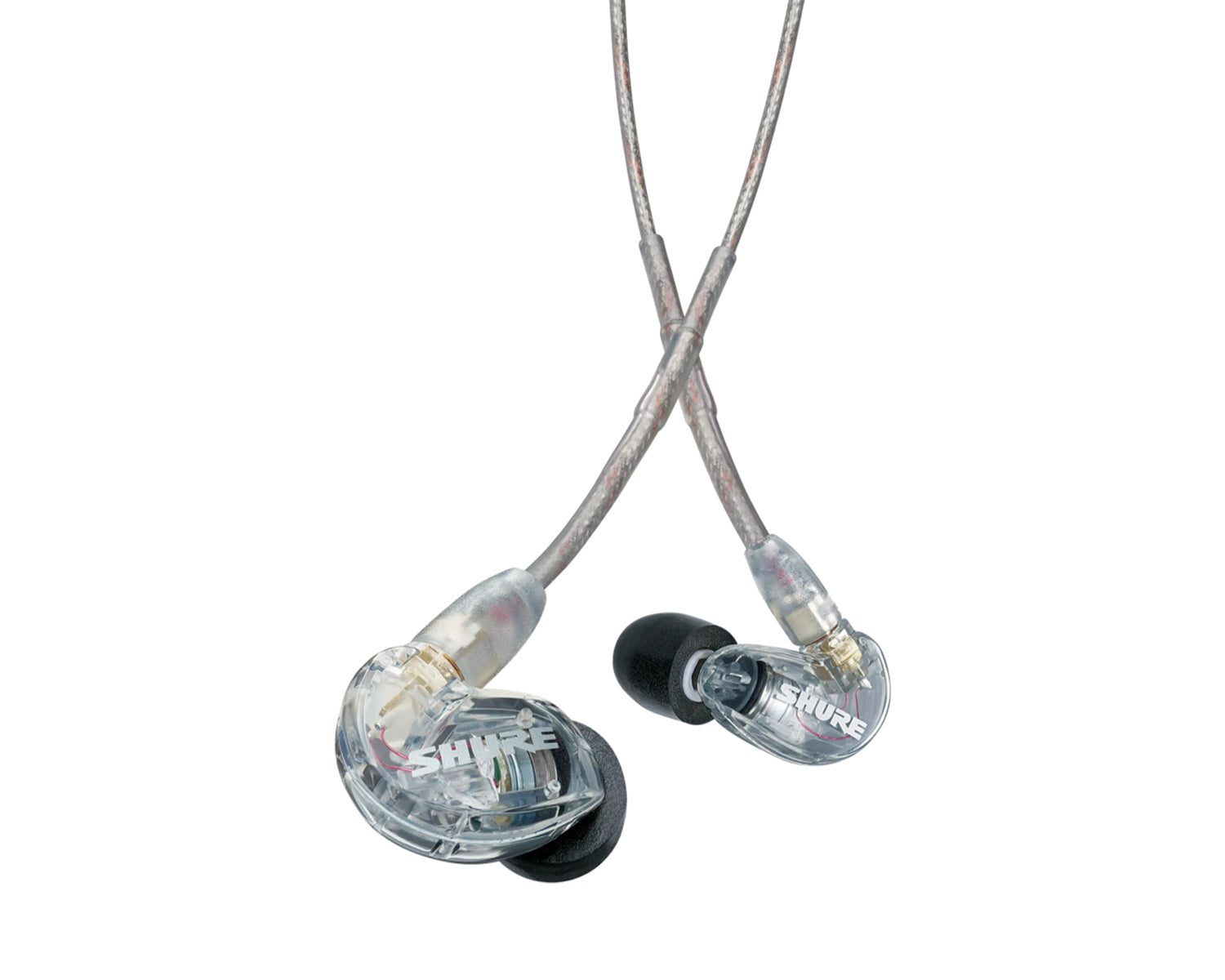
The SE215 in clear or black is the entry point to the Shure range covered here. One dynamic driver, 17 Ω, 107 dB SPL/mW and up to 37 dB of noise attenuation, with MMCX connectors so the cable can be swapped when it fails. Shure’s product page lists a 162 cm clear 3.5 mm cable, a soft zip case, and black foam and soft flex sleeves in small, medium and large in the box. Shure sums up the sound as “detailed sound + enhanced bass”.
SE425 and SE535
Both use balanced-armature drivers: two in the SE425, three in the SE535. The SE535 has the highest sensitivity of the four Shure models here at 119 dB SPL/mW, and its MMCX cable is detachable like the SE215’s. Shure’s user guide for both lists a gold-plated 3.5 mm plug with a 6.35 mm threaded adapter, and describes soft flex, soft foam and triple-flange sleeve options.
SE846
The flagship has four balanced-armature drivers, 9 Ω impedance and the widest quoted range in the family at 15 Hz–20 kHz. Its party trick is four interchangeable nozzle inserts that change the voicing: black (warm, −2.5 dB from 1 to 8 kHz), blue (balanced), red (extended, as shipped, +2 dB from 4 to 10 kHz) and white (bright, +2.5 dB from 1 to 8 kHz). Shure currently sells it as the SE846 Gen 2, and its product page confirms the same MMCX cable connection and four interchangeable nozzles.
Sennheiser IE 100 PRO and IE 4
The IE 100 PRO (also in clear and red) replaced the IE 40 PRO. Sennheiser says it keeps the same transducer and frequency response as its predecessor: a 10 mm dynamic driver, 20 Ω, 20 Hz–18 kHz. Sennheiser describes the sound as warm.
The cable is the main practical difference from Shure. The IE 100 PRO does not use MMCX; it shares Sennheiser’s own connector and internal cable duct with the IE 400 PRO and IE 500 PRO, so any IE PRO cable fits any IE PRO earphone. Options include a mono cable for one-ear monitoring and the IE PRO BT Connector, which turns it into a Bluetooth earphone. In the box: the 1.3 m black cable, foam and silicone ear adapters, a soft pouch and a cleaning tool.
Sennheiser sells replacement silicone and foam ear adapters for the IE 100 PRO in small, medium and large, such as these medium silicone tips and large silicone tips. Our IEM ear tips guide covers sizes and when to replace them.
The IE 4 is Sennheiser’s simpler dynamic earphone, pitched as a match for its wireless monitoring systems, with three sizes of silicone sleeves and a cable of about 1.4 m. Sennheiser publishes far fewer specs for it, which is a fair hint at its role: a straightforward, affordable pair, or a spare.
Audio-Technica ATH-E40, E50 and E70
Audio-Technica’s E-Series covers the same three steps as Shure’s range, all with a 1.6 m detachable Y cable using Audio-Technica’s own A2DC connector at the earpiece, an L-shaped gold-plated 3.5 mm plug, over-ear memory cable, a carrying case and silicone eartips.
- ATH-E40: dynamic, using what Audio-Technica calls a dual phase push-pull driver design. 12 Ω, 108 dB/mW, 20 Hz–20 kHz. Audio-Technica describes it as delivering powerful bass with balanced mids and highs.
- ATH-E50: one full-range balanced armature. 44 Ω, 107 dB/mW, 20 Hz–18 kHz. Pitched for stage use and as a consistent reference for producers on the road.
- ATH-E70: the flagship, with three balanced armatures. 39 Ω, 109 dB/mW, 20 Hz–19 kHz. Comply foam eartips are included as well as silicone.
Reading the spec sheet
Dynamic or balanced armature
A dynamic driver is a small moving-coil speaker; one driver covers the whole range. Balanced armatures are smaller, and multi-driver designs split the range between them. More drivers does not automatically mean better for you. It means a different tuning and a higher price, and the fit still decides how much bass you actually hear.
Sensitivity: watch the units
Shure and Audio-Technica quote sensitivity per milliwatt. Sennheiser quotes the IE 100 PRO at 1 V rms. Those are different reference points, so 115 dB for the IE 100 PRO is not “louder” than 107 dB for the SE215. Compare within a brand.
Isolation figures
Shure quotes “up to 37 dB” for the SE215, SE535 and SE846, and Sennheiser quotes “< 26 dB” for the IE 100 PRO. Audio-Technica publishes no figure. Manufacturers do not necessarily measure this the same way, and the number assumes a good seal, so treat it as a guide within one brand. Isolation matters for more than comfort: the better the seal, the less you need to push the level to hear yourself. Our noise at work guide covers exposure on stage.
Cables and connectors
Cables are what usually breaks. Shure SE models use MMCX connectors (stated by Shure for the SE215, SE535 and SE846), Sennheiser’s IE PRO models use their own shared connector, and Audio-Technica uses its proprietary A2DC connector, with a dedicated replacement cable for the ATH-E40 and ATH-E50. Shure and Sennheiser cables do not swap. If a band runs a mix of brands, carry spare cables for each.
Which suits whom
Drummers and bass players
You want low end you can feel and a tight seal against a loud backline. Shure’s own guidance is that a lack of bass means the sleeve is not sealing, not that the earphone is wrong, so try foam sleeves before upgrading. On the earphone side, the SE215 (“enhanced bass”) and ATH-E40 (“powerful bass”) are the sensible single-driver choices; the SE535 and SE846 are the step up.
Vocalists
Singers need to hear pitch clearly and wear the earphones comfortably for a whole set. Start with whichever of the IE 100 PRO, SE215 or ATH-E50 fits your ears best. If you want more top-end detail later, the ATH-E70 or SE535 are the multi-driver options.
Budget, backup and hire stock
For a spare pair, buy the same model the player already uses so tips and cables are interchangeable. For hire or shared stock, the IE 4 and IE 100 PRO are easy to keep in tips, and the IE 100 PRO’s shared IE PRO cables simplify spares.
When custom moulds make sense
If you are on in-ears most nights and cannot get a consistent seal from universal tips, custom-moulded sleeves or custom earphones, made from impressions taken by an audiologist, are the next step.
Comparing transmitter systems instead? See Shure PSM 300 vs Sennheiser EW IEM G4 and Shure PSM 300 vs PSM 900.
Popular picks from the shop
Shure SE215 Sound Isolating Earphones, ClearView product → Shure SE215 Sound Isolating Earphones, BlackView product → Sennheiser IE 100 PRO In-Ear Monitors, BlackView product → Sennheiser IE 100 PRO In-Ear Monitors, ClearView product → Audio-Technica ATH-E40 In-Ear MonitorsView product → Audio-Technica ATH-E50 In-Ear MonitorsView product → Audio-Technica ATH-E70 In-Ear MonitorsView product → Sennheiser IE 4 In-Ear MonitorsView product →
Frequently asked questions
What are the best in-ear monitors for singers?
There is no single best; the best pair is the one that seals and stays comfortable in your ears for a full set. The Sennheiser IE 100 PRO, Shure SE215 and Audio-Technica ATH-E50 are common starting points, with the ATH-E70 and Shure SE535 as multi-driver step-ups.
What earphones do musicians use for in-ear monitoring?
Wired, sound-isolating earphones that plug into an IEM bodypack, worn with the cable looped over the ear. Shure’s SE range, Sennheiser’s IE PRO range and Audio-Technica’s E-Series are the usual universal-fit choices, with custom-moulded earphones for full-time users.
Is the Shure SE215 good enough for live use?
Yes. It is a professional in-ear with a detachable MMCX cable, a single dynamic driver and up to 37 dB of noise attenuation quoted by Shure.
Shure SE215 or Sennheiser IE 100 PRO?
Both are single dynamic-driver earphones with detachable cables. The SE215 uses MMCX cables; the IE 100 PRO uses Sennheiser’s IE PRO connector, shared with the IE 400 PRO and IE 500 PRO, and has an optional Bluetooth connector. Choose the one that fits your ears better, or the one that matches the cables and tips your band already carries.
Do more drivers mean better in-ear monitors?
Not by themselves. Multi-driver balanced-armature models such as the SE535, SE846 and ATH-E70 offer different tuning and wider quoted ranges, but a poor seal will lose more bass than any driver count adds.
Can I use Shure cables on Sennheiser or Audio-Technica earphones?
Not between Shure and Sennheiser: Shure SE uses MMCX and Sennheiser IE PRO uses its own connector. Audio-Technica’s E-Series uses Audio-Technica’s own A2DC connector, so use Audio-Technica replacement cables.
Shop this guide
IEM earphones, ear tips, cables and complete in-ear systems. Not sure which pair to start with? Ask us.
IEM Earphones IEM Accessories Complete IEM Systems IEM Bodypack Receivers In-Ear Monitors



