

Home » Guides » Lighting & Effects »
UV Lighting for Events and Theatre: COB Floods, UV Bars and What Actually Glows
How UV (blacklight) fixtures differ, what the wavelength figures mean, which materials glow and which do not, and what the manufacturers say about using UV safely around performers and guests. With a side-by-side table of the UV fixtures we stock.
~10 min read · Updated October 2026 · By the Stage Supply team
In this guide: The short answer · UV, blacklight and nanometres · What actually glows · Types of UV fixture · UV fixtures compared · Choosing for your space · UV safety · Popular picks · FAQ
The short answer
For a stage, dancefloor or function room, a single high-power COB flood such as the LEDJ 150W UV COB Flood is the simplest way to wash a large area from one position. For an even wash along a stage edge, bar front or wall, use 1m UV battens like the LEDJ UV Spectra Batten or QTX UVB-24X. For a small party or a mobile DJ who just wants it on, a plug-and-play mini batten such as the Equinox UV Mini Batten 9 has no DMX to set up.
Whatever you buy, the UV fixture is only half the effect. It makes fluorescent materials glow: UV-reactive paint, fluorescent tape, white fabrics washed in brightener-containing detergent. Plain surfaces just look dim violet. Plan the “what glows” part as carefully as the lights.
Most of the UV fixture manuals we checked warn against looking into the light, and many also set a minimum distance for eye and skin exposure. Read the manual before you decide where the fixtures go.
UV, blacklight and the nanometre figures
“UV light”, “blacklight” and “black light” all mean the same thing in the events trade: a light that emits mostly near-ultraviolet, which you cannot see well, so the fixture looks dim while fluorescent objects in its beam light up. Older blacklights were mostly fluorescent tubes with dark filter glass. Today’s entertainment UV fixtures use LEDs.
The World Health Organization divides ultraviolet into three bands: UVA (315 to 400nm), UVB (280 to 315nm) and UVC (100 to 280nm). Entertainment UV fixtures sit at the top of the UVA band, right at the edge of visible light. ICNIRP notes there is no universally agreed boundary, but that the lower limit of visible light is generally taken to be somewhere between 360 and 400nm.
That is why manufacturers quote a wavelength, and why it matters:
- Around 395 to 405nm is where most of the fixtures we stock sit. LEDJ quotes 395 to 400nm for its 150W COB Flood; ADJ quotes 395 to 405nm for its ECO UV Bar DMX and UV COB Cannon; QTX quotes 398nm for the UVB-24X; Chauvet DJ quotes 405nm for the LED Shadow 2 ILS.
- Around 390 to 400nm: Chauvet DJ quotes 390 to 400nm for the COREpar UV120 ILS, and ADJ quotes 390 to 399nm for the UV PAR 100IP.
- 365nm fixtures exist too. Waveform Lighting, a UV LED manufacturer, explains that a 395nm LED gives off a pronounced violet glow while a 365nm LED gives very little visible light, and that many objects fluoresce most strongly at 365nm. None of the fixtures in the table below is a 365nm design.
In practice, the visible violet from a 395 to 405nm fixture is part of the look most people expect from “UV” at a party or club. If you want the glow with as little violet spill as possible, for example for a theatre reveal, ask the manufacturer about the spectrum before you buy, because the headline wavelength is all most spec sheets give.
What actually glows
Fluorescent materials absorb UV, which you cannot see well, and give it back out as visible light at a longer wavelength. The University of Arizona’s optical sciences outreach describes it neatly: “when UV light (that we cannot see) is absorbed, it emits in the visible.” Anything without a fluorescent pigment or dye simply reflects a little dim violet.
- Fluorescent gaffer and spike tape. Le Mark says its MagTape Xtra Matt fluorescent gaffer tape glows “under artificial UV/black light” and is used to mark stage points and prop marks; it also says Pro Tapes Pro Gaff Fluorescent has a “fluorescent neon glow under UV/black light”. Le Mark recommends the MagTape for short-term use, because exposure to UV, especially sunlight, may fade the colour. Our gaffer tape guide covers the tape ranges in more detail.
- UV-reactive paint, make-up and props. Anything sold as fluorescent or UV-reactive is designed to glow. Do not assume ordinary paint or fabric dye will glow, even in bright colours; check it is sold as fluorescent or UV-reactive.
- White clothing, shirts and tablecloths. Many laundry detergents contain optical brighteners. The American Society of Cinematographers explains that they “work by absorbing ultraviolet energy and fluorescing or emitting visible blue-violet light”, and that they are designed to build up over time, so the effect is cumulative. That is why white shirts glow blue-white under UV, sometimes more than you want.
- White paper and card often glows too. The US National Park Service’s conservation guidance notes that modern papers “usually have optical brighteners added to them and fluoresce bright bluish white under long-wave UV light”.
Fluorescent is not the same as glow-in-the-dark
Glow-in-the-dark (photoluminescent) tape works differently. It soaks up light and keeps glowing after the light goes off. Fluorescent material stops glowing as soon as the UV goes off. Le Mark describes its PRO661 Glow Gaffer and Pro Glow photoluminescent arrows as absorbing energy from ambient light, such as fluorescent lamps or sunlight, then temporarily emitting light of their own once that light is removed. Use fluorescent tape for marks that must pop under UV during a show, and photoluminescent tape for marks that must be visible in a blackout.
Types of UV fixture
COB floods and cannons
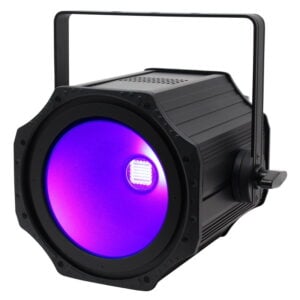
A single high-power chip-on-board (COB) UV LED in a reflector. The highest-wattage UV fixtures we stock are single-COB designs, and they are the easiest way to wash a stage or dancefloor from one position. The LEDJ 150W UV COB Flood has a 150W UV COB LED in a 93° reflector. The ADJ UV COB Cannon uses a 100W COB with a much tighter 33° beam, which throws further but covers less. The manufacturers list them at 4.2kg and 4.98kg respectively.
UV pars
Par-style COB fixtures that fit the same positions as your wash pars. The Chauvet DJ COREpar UV120 ILS has a 120W UV COB and comes with a magnetic Fresnel lens: Chauvet DJ quotes 21° with the lens and 44° without. The ADJ UV PAR 100IP is the outdoor option, rated IP65 with a 100W UV COB and 120° beam; ADJ’s manual describes it as for temporary outdoor use and says IP65-rated cables are needed to keep that rating.
UV battens and bars
A row of LEDs in a long, slim housing. Battens give an even line of UV across a stage front, a back wall, a bar or a cloth, and are easy to hide behind set pieces. The LEDJ UV Spectra Batten (12 x 5W, 1m) is convection cooled, which LEDJ says gives silent operation: useful in theatre where fan noise carries. The QTX UVB-24X (24 x 3W) has its LEDs in four pixel zones, and the ADJ ECO UV Bar DMX (18 x 3W) has a wide 120° beam. The Chauvet DJ LED Shadow 2 ILS is a compact 18 x 3W bar with a 32° coverage angle, a tighter spread than the other bars here. Our battens, pars and uplighters guide compares battens with other wash fixtures in general.
UV is a staple of Halloween, glow parties and themed nights; for planning a venue’s wider seasonal lighting, see our Christmas and seasonal venue lighting guide.
Plug-and-play mini battens and compact floods
The Equinox UV Mini Batten 9 (9 x 3W UV COB LED, 30W) and Equinox UV Mini Batten 12 (12 x 3W, 40W) have no DMX and no menu: their manuals say you plug in and use the inline switch. Equinox describes both as ideal for small stages, entertainers and parties. The Equinox UV Power Flood steps up to 24 x 3W LEDs with 8-channel DMX, sound-active and auto modes in a compact 2.3kg housing.
For uplighting or small rigs there are compact UV pars too. The Equinox MaxiPar UV is a slim par with 12 x 3W UV LEDs, a 25° beam and rubber feet so it can sit on the floor as an uplighter. The Equinox MicroPar UV MKII is a 15W UV COB par weighing under half a kilo, with 4-channel DMX.
UV fixtures we stock, compared
All figures are from the manufacturer’s product page, spec sheet or user manual. Wavelengths are as each manufacturer states them; they are not measured on a common basis, so treat small differences with caution.
| Fixture | UV source | Wavelength (maker) | Beam | Power | Control | Use |
|---|---|---|---|---|---|---|
| LEDJ 150W UV COB Flood | 1 x 150W UV COB | 395-400nm | 93° | 160W | 1 or 2 ch DMX, sound, master/slave | Indoor only |
| ADJ UV COB Cannon | 1 x 100W UV COB | 395-405nm | 33° | 120W | 1, 2 or 3 ch DMX, sound, manual | Not stated |
| Chauvet DJ COREpar UV120 ILS | 1 x 120W UV COB | 390-400nm | 21° (lens) / 44° | 118W (230V) | 1 or 5 ch DMX, ILS, auto, sound | Indoor only |
| ADJ UV PAR 100IP | 1 x 100W UV COB | 390-399nm | 120° | Not published | 1, 2, 3 or 6 ch DMX, RDM, Aria X2 wireless | IP65 (temporary outdoor) |
| Equinox UV Power Flood | 24 x 3W UV LED | 395nm | 60° | 80W | 8 ch DMX, auto, sound, master/slave | Indoor only |
| LEDJ UV Spectra Batten | 12 x 5W UV LED, 1m | 395nm | 65° | 70W | 1 or 2 ch DMX, sound, IR remote supplied | Indoor only |
| QTX UVB-24X | 24 x 3W UV LED, 4 zones | 398nm | 60° | 54W | 4 or 8 ch DMX, RDM, auto, sound | Not stated |
| ADJ ECO UV Bar DMX | 18 x 3W UV LED, 1m | 395-405nm | 120° | 60W | 3 ch DMX, IR remote (UC IR) | Indoor only |
| Chauvet DJ LED Shadow 2 ILS | 18 x 3W UV LED | 405nm | 32° (coverage) | 49W | DMX (4 ch documented), ILS, auto, sound | Indoor only (IP20) |
| Equinox MaxiPar UV | 12 x 3W UV LED | 395nm | 25° | 30W | 1, 2 or 3 ch DMX, auto, sound, master/slave | Indoor only |
| Equinox MicroPar UV MKII | 1 x 15W UV COB | 395-400nm | 60° | 15W | 4 ch DMX, auto, sound, master/slave | Indoor only |
| Equinox UV Mini Batten 12 | 12 x 3W UV LED | 395-405nm | 120° | 40W | Inline on/off switch only | Indoor only |
| Equinox UV Mini Batten 9 | 9 x 3W UV COB LED | 394-410nm | 65° | 30W | Inline on/off switch only | Indoor only |
Chauvet DJ’s spec sheet lists 4 or 8 channel DMX modes for the LED Shadow 2 ILS, but the user manual documents only the 4-channel mode, so we have listed what the manual shows. ADJ has not published a power figure for the UV PAR 100IP.
Choosing for your space
- Big area from one position: a high-power COB flood. The 93° reflector on the LEDJ 150W gives a wide wash; the ADJ UV COB Cannon’s 33° beam suits a longer throw onto a smaller target.
- Even line of UV along a stage edge, wall or bar: battens, butted end to end. Wide-beam bars (120° on the ADJ ECO UV Bar DMX and Equinox Mini Batten 12) spread close up; 60 to 65° bars put more of their output further away.
- Theatre and quiet rooms: check the cooling. The LEDJ UV Spectra Batten and both Equinox mini battens are convection cooled; the LEDJ 150W COB Flood and Equinox UV Power Flood are fan cooled.
- Busking it vs a programmed show: the Equinox mini battens are on or off. Everything else here takes DMX, so it can fade in for a reveal and snap out again from a desk. Chauvet DJ’s ILS fixtures can also run on its wireless D-Fi system using the separately sold D-Fi USB.
- Outdoors: of the fixtures in the table, only the ADJ UV PAR 100IP has an IP rating for outdoor use. The rest are indoor only or have no IP rating published.
- Ambient light: UV effects work best when other lighting is low. Plan the rest of your rig so it can be taken down for UV moments; our guide to colour on stage explains how RGBW and other colour mixing behaves, and the fixture types guide covers the rest of the rig.
Power: look at each fixture’s power consumption and whether it has power through (IEC or powerCON). Check the manual before linking fixtures together; designing, installing and testing the electrical supply itself is a job for a competent person.
UV safety: what the manufacturers and HSE say
Entertainment UV is near-UV (UVA), at the top of the UV band. It still deserves respect, and the manufacturers say so in their manuals:
- LEDJ and Equinox (Prolight): the manuals for the LEDJ 150W UV COB Flood, LEDJ UV Spectra Batten, Equinox UV Power Flood, MaxiPar UV and UV Mini Batten 9 class each as a “Risk Group 2 LED product according to EN 62471”. They tell you to keep a distance of at least 3.3m (11 feet) to avoid direct eye and skin exposure, not to operate the fixture if the protective lens is damaged or missing, and to avoid looking directly at the UV light or using optical instruments that may concentrate the output. They add that people with some eye conditions, sunlight-exposure disorders or on photosensitive medication may experience discomfort under UV. The Mini Batten 12 and MicroPar UV MKII manuals also class them as Risk Group 2.
- ADJ: the manuals for the ECO UV Bar DMX, UV COB Cannon and UV PAR 100IP carry a “Risk Group 3” UV warning. They advise eye and skin protection, avoiding prolonged exposure, avoiding direct eye or skin exposure at distances shorter than 3.3m, not looking directly into the light, and avoiding UV paints on skin.
- Chauvet DJ: the COREpar UV120 ILS manual says the fixture should be positioned so that prolonged staring into it from closer than 2.7m is not expected.
In the UK, the Control of Artificial Optical Radiation at Work Regulations 2010 require employers to protect workers’ eyes and skin from hazardous sources of artificial optical radiation, which HSE says includes ultraviolet. HSE’s guidance for employers lists any Risk Group 2 lamp or LED (under BS EN 62471) among sources that can cause harm if used inappropriately, for example extremely close to the eyes or skin, but are safe in normal use. It lists Risk Group 3 lamps and LEDs among hazardous sources that need control measures. ICNIRP, the international body for non-ionising radiation protection, has noted concern about increased consumer exposure as UV-emitting LEDs become more widely available.
Practical points
Following the manuals: place UV fixtures so nobody stares into them at close range, keep to the manufacturer’s minimum distance, and never run a fixture with its protective lens damaged or missing. It also makes sense to brief performers and staff who work near UV. If your event involves a workplace, include UV fixtures in your risk assessment.
This is a summary of what the manufacturers and HSE publish, not a substitute for the fixture manual or your own risk assessment.
Popular picks from the shop
LEDJ 150W UV COB FloodView product → Equinox UV Mini Batten 9View product → LEDJ UV Spectra Batten, 1mView product → Equinox UV Power Flood, 24 x 3WView product → QTX UVB-24X UV LED Bar, DMXView product → Chauvet DJ COREpar UV120 ILSView product → ADJ UV PAR 100IP Outdoor UV Par, IP65View product → MagTape Xtra Matt Fluorescent Gaffer Tape, YellowView product →
Frequently asked questions
Is UV light the same as blacklight?
Yes. In events and theatre, “UV”, “blacklight” and “black light” all describe fixtures that emit mostly near-ultraviolet (UVA) so that fluorescent materials glow. Older blacklights were fluorescent tubes; current entertainment fixtures use UV LEDs.
What wavelength UV light is best for a party?
Most entertainment UV fixtures sit around 390 to 405nm, which gives the familiar violet glow plus strong fluorescence from UV-reactive paint, tape and white fabrics. Lower-wavelength 365nm sources give less visible light, but none of the fixtures compared in this guide is a 365nm design.
Why is my UV light not making things glow?
Only fluorescent materials glow. Ordinary paint, fabric and tape just reflect dim violet. Use products sold as fluorescent or UV-reactive, and keep other lighting low, because ambient light swamps the effect.
Are LED UV lights safe?
They are designed to be used safely if you follow the manufacturer’s instructions, but they are not harmless. ADJ classes its UV fixtures here as Risk Group 3, which HSE lists among hazardous sources that need control measures. Most manuals for the fixtures we stock warn against looking into the light, many set minimum distances such as 3.3m for direct eye and skin exposure, and note that some people may experience discomfort. Follow the manual and include UV in your risk assessment.
Does fluorescent tape glow in the dark?
No. Fluorescent tape glows only while UV is on it. Glow-in-the-dark marking is photoluminescent tape, such as PRO661 Glow Gaffer, which stores light and keeps glowing for a while after the lights go out.
Can I use UV lights outdoors?
Only with a fixture rated for it. Of the UV fixtures compared above, that is the ADJ UV PAR 100IP, rated IP65, which ADJ specifies for temporary outdoor use with IP65-rated cables. The others in the table are indoor only or have no published IP rating.
Shop this guide
UV floods, battens and pars, plus fluorescent and glow tape for the things you want to light up. Tell us about your venue and we will help you pick the right mix.
UV Lights LED Battens LED Par Cans Gaffer & Electrical Tape DMX Controllers



