

Home » Guides » Lighting & Effects »
Christmas and Seasonal Lighting for Venues: Planning and Kit
How pubs, hotels, wedding venues and town centres plan a festive scheme that installs on time, runs itself all season, and comes down fit to use again next year.
~9 min read · Updated July 2026 · By the Stage Supply team
In this guide: Plan in summer · Season timeline · Area by area · The kit · Colour temperature · Control · Outdoor reality · Power · Domestic vs commercial · Strip down · Mistakes · Picks · FAQ
Festive lighting is the cheapest atmosphere a venue can buy and the one most often bought badly. The pattern repeats: someone decides in mid November that the frontage looks flat, buys whatever is on the shelf, and ends up with three shades of white, a lead across a fire exit and half the runs dead by Boxing Day. Venues that get it right decide the scheme on paper in July. This is for pubs, hotels, wedding venues, town centres, garden centres and the event companies they hire.
Plan in summer, install in autumn
Seasonal lighting has a short selling window and a long supply chain. Most of it lands in the UK on a cycle set months earlier, so once a colour temperature or length sells through there is often no more that season, and the substitute will not match what you own. You cannot buy consistency in a hurry. Three pressures land in the same fortnight: stock, because warm white goes first in the popular lengths; installers, because anyone competent with access equipment or fixed wiring is booked from late October; and weather, because cold surfaces defeat adhesives and wet ladders stop work.
The season also starts earlier than people assume. British Summer Time ends at 2am on the last Sunday in October, 25 October in 2026, so a whole trading evening turns dark overnight, and by midwinter sunset in London is around 15:53. A scheme going live on 1 December has already missed six weeks of dark evenings. The scramble also costs more in ways that never show on one invoice: express carriage, out of hours labour, peak rate access equipment, and mismatched product bought because it was available.
A season timeline that works
| When | What happens |
|---|---|
| June to August | Walk the site after dark and photograph it. Decide the scheme area by area, list run lengths, agree one colour temperature. |
| September | Order everything, spares included, and book the installer. |
| Early to mid October | Bench test every run indoors, then install. Set timers, label, photograph. |
| Late October | Go live with the clock change, then tune levels and times. |
| November to December | Run it. Weekly check, swap failures from the spares box. |
| January | Strip down properly: dry, coil, label, box, photograph. |
Build the scheme area by area
Think in areas, in the order a customer meets them, not in products.
Exterior facade and entrance
Festoon or string runs along eaves, gables and window lines describe the architecture, uplighters at the base of brickwork add depth, and a projector on a gable does the decorative work. Keep the entrance brighter than its surroundings.
Car park and pathways
Decoration is secondary to people walking on uneven ground in the dark. Mark the route rather than flooding it, with something brighter at every step and kerb, and never dazzle a driver or obstruct the lighting that is there for safety.
Courtyard and beer garden
Festoon overhead is the workhorse: a canopy grid or parallel swags put a ceiling of warm light over the space and make it feel like a room. Work the edges with uplighters on walls and trees. Our festoon and outdoor event lighting guide covers rigging and weatherproofing.
Tree wraps
Wrap every tree in a group the same way, at the same pitch, to the same height, or the group looks accidental. Wraps are seasonal: leave slack, avoid tying anything hard around bark, and take them down in January. For hedging, net lights cover ground more evenly.
Interior bar and dining
The objective is warmth and contrast, not brightness. Turn the general lighting down and add small warm sources: string lights along a bar back, LED tape under a counter nose, a warm wash behind the bar.
Function room
A room that changes character weekly wants a small flexible kit, not fixed decoration. Uplighters around the perimeter, a warm wash on the top table and a projector for a client logo re dress it in twenty minutes.
Window displays
Light the display, not the glass: keep sources out of the sightline, aim from above and the sides, and watch reflections, because a source facing outward turns the glass into a mirror.
The kit and where each type belongs
Festoon and string lights
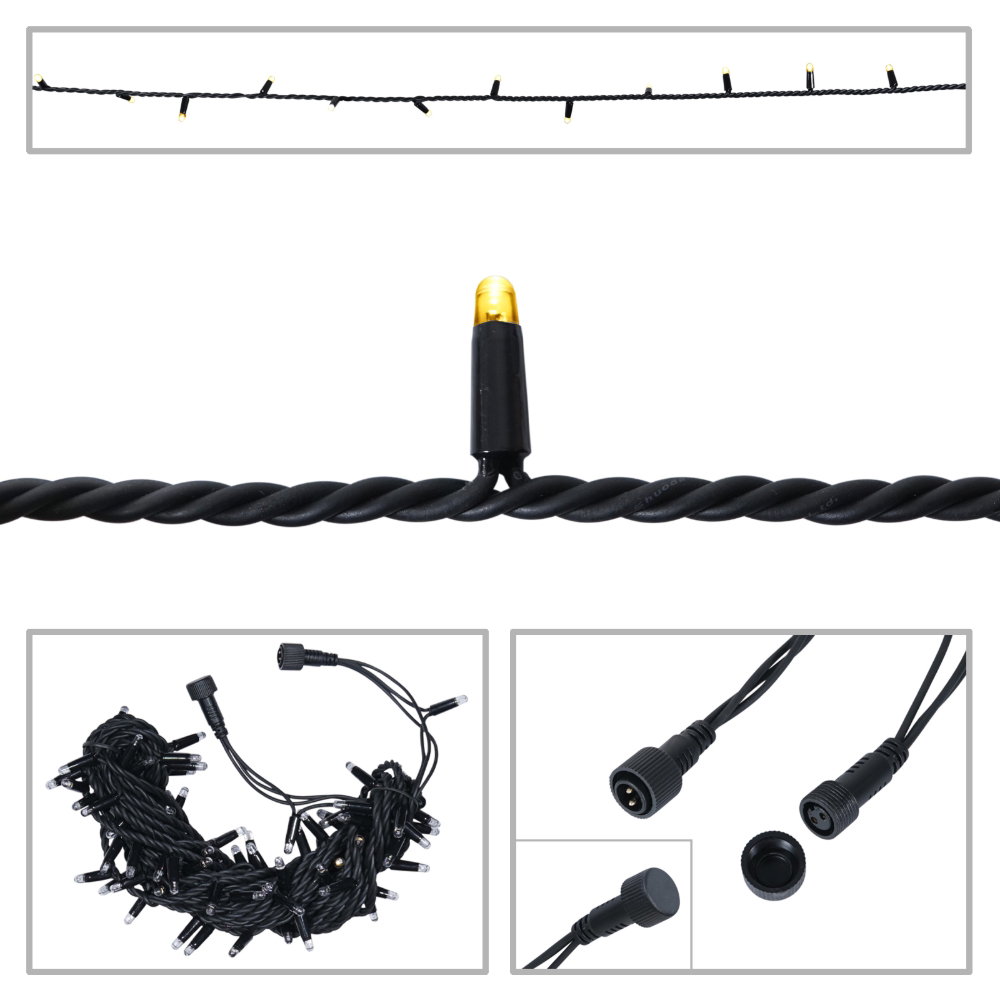
Festoon harness is heavy cable with lampholders moulded in at fixed spacing, taking replaceable lamps, so it stays serviceable. Connectable LED string and net lights carry captive LEDs on thinner rubber cable and link set to set from one supply. Use both: festoon for architectural runs, string and net for trees and hedges.
LED tape and profiles
LED tape in an aluminium profile picks out a bar nose, shelf edge, handrail or step without hanging anything visible. Plan the colour temperature, a rated driver with headroom, and a mounting method that will survive. Anything outdoors needs outdoor rated tape. Related architectural fittings handle the wall washing tape cannot reach.
Uplighters
A handful of uplighters does more for a facade or function room than twice the money spent on string lights, because they add depth point sources cannot. Outdoors the IP rating is the whole decision, and battery units suit places cable cannot cross safely. Our uplighters guide covers counting them.
Warm white PARs
Indoors, warm white PARs are the cheap route to a cosy room: a soft wash onto a wall, beam or dressed fireplace, dimmed well down. A dedicated warm white fixture beats warm white mixed from red, green and blue, which rarely flatters skin or food.
Gobo and logo projectors
A gobo projector throws a pattern or logo onto a wall, floor or gable: snowflakes across a courtyard, a venue name on the entrance floor. Anything permanently outdoors wants a fixture rated for outdoor installation, and custom gobos take lead time, another reason that decision belongs in September. The constraints are throw distance and enough darkness to read the image.
Effects, used sparingly
Moving heads, lasers and hazers belong to a party night, not a scheme meant to look elegant for eleven weeks. See our guides on moving headssmoke and haze and laser safety. One plain warning: haze and smoke set off many smoke detection systems, so speak to whoever holds the fire alarm well before the party.
Warm white and colour temperature
If you fix one thing this year, fix this. Nothing makes an expensive scheme look cheap faster than three whites in one sightline. Colour temperature is in kelvin: lower is warmer.
| Nominal | How it reads | Where it belongs |
|---|---|---|
| 1800K to 2200K | Candle and filament, deeply amber | Filament look lamps, intimate interiors |
| 2700K | Traditional warm white | The hospitality default: bars, dining, festoon |
| 3000K | Warm, slightly cleaner | Facades, contemporary exteriors |
| 4000K | Neutral, clinical beside warm white | Task and back of house. Not a festive colour |
| 5000K and up, ice white | Cold and crisp | A deliberate icy scheme, site wide |
Mixing 2700K and 4000K in one view is the classic failure. Side by side the eye adapts to one and reads the other as sickly grey green or dirty yellow, and it photographs worse than it looks. Pick one nominal temperature, write it on the plan, and hold every purchase to it.
Then the harder problem: two products both labelled warm white that visibly do not match. LED colour consistency is expressed as SDCM, standard deviation of colour matching, where one step equals one MacAdam step. Around three steps is broadly where a difference becomes visible, architectural work is specified at two to three, and five to seven is common in general market product. So buy a whole area in one order, buy its spares with it, never mix brands within a sightline, and power every set together before installing. Batch variation is obvious side by side and invisible one set at a time.
Controlling it all
A scheme nobody has to think about stays on all season. One that needs someone flicking switches gets switched on late or left on all night.
Plug in and fixed timers are cheapest and adequate for one or two circuits, but a fixed clock time does not track sunset, which moves by hours across the season, so a timer set in October is wrong by December. Outdoors it belongs in a rated enclosure.
An astronomical time switch is the right level for most venues. Programmed with the date and location, it calculates sunset itself, so “on at dusk, off after close” holds true from October to February with no intervention. A photocell does a simpler version by measuring ambient light. Fixed switching gear belongs to an electrician.
DMX scenes let you store looks and recall them from a wall panel: house, dinner, party, closing down. Useful in a function room that changes weekly, overkill for a facade that is only ever on or off. Staff pulling pints press one labelled button, so give them one button and schedule the rest. Our DMX guide covers addressing and cabling.
Write the schedule on the wall
Put a laminated card by the panel: what each circuit or button does, the normal on and off times, and who to call. Whoever set it up will be on holiday the week it goes wrong.
Outdoor reality: weather, connections and safety
IP ratings. Two digits: the first for solid objects, the second for water. IP44 covers splashing water from any direction and is the practical minimum for a strung run in its normal orientation. IP65 is dust tight and protected against water jets, which anything mounted low, on the ground or left out permanently needs. IP67 adds temporary immersion, for joins that could sit in water. A lampholder is only rated with its lamp and seal fitted.
Connections are the weak point. An outdoor rated harness plugged into an indoor extension lead on the path is an indoor system with extra steps. Use outdoor rated connectors at every join, keep joins off the ground, and form a drip loop so water runs off instead of tracking into the connector. Any unavoidable 13A connection outdoors goes in a purpose made weatherproof enclosure, never a bag and tape.
RCD protection. Outdoor equipment must be fed from an RCD protected supply. BS 7671:2018+A2:2022 requires additional protection by a 30mA RCD for socket outlets rated up to 32A, a threshold Amendment 2 raised from 20A, with only a narrow documented risk assessment exception. If you cannot confirm what protects the socket, ask an electrician in September.
Cable routes. Plan them on paper in summer, before you own the cable. Runs go at height with the lighting or along walls and boundaries, never across a path, doorway, fire exit route or parking bay, and any crossing goes under rated matting. A route that looks fine in daylight is walked by customers in the dark.
Fixed wiring and work at height need a competent person
Plugging a tested, load checked, outdoor rated system into an existing RCD protected socket is within reach of a venue team. Beyond that it is not. New or altered fixed wiring, outdoor circuits, switching gear, fixing to a building and any work at height need a suitably qualified and competent person, under the Electricity at Work Regulations 1989 and the Work at Height Regulations 2005. This guide gives no electrical, structural or rigging design advice.
Power planning
Count the fixtures and sets in each area, multiply by the stated wattage, total it. LED draws very little, which is why people stop thinking about it and chain eight sets, two projectors and a heater onto one socket.
- Total the whole circuit, not just the lights. Festive lighting rarely trips a breaker alone; it trips one as the last thing added to a circuit already near its limit.
- Leave headroom rather than filling every circuit, because the scheme grows.
- Respect each product’s own limit. Connectable systems state a maximum number of linked sets, set by the first item in the chain, which carries the current for everything after it.
- Do not daisy chain domestic extension leads. Four gang into four gang into a reel hides the load and puts unrated connections where they should never be.
- Do not run a permanent scheme off a trailing lead. If it returns every year, the answer is a dedicated protected circuit installed once.
For town centres, marquees and generators the same discipline applies at higher stakes. Our stage power checklist and power distribution guide cover load totals, distro and the right power cables.
Domestic versus commercial grade
Supermarket seasonal lighting is built for a few hours a night on a sheltered house. A venue runs dusk to after close every night from late October to mid January, in wind and rain, where a dead section is a scruffy building. Domestic product fails that in the most expensive way: mid season, in the dark, unrepairable. What commercial grade buys:
- Serviceable, rated connectors designed to be left connected outdoors, so you can link runs, isolate a section and replace one length, not the lot.
- Replaceable lamps. Festoon with standard lampholders means a failed lamp costs a lamp. Sealed sets with captive bulbs are consumables.
- Published IP ratings per product, not “suitable for outdoor use” on a box.
- Run lengths that suit a building, in tens of metres with a stated maximum linked load, so one feed covers a facade.
- Cable that survives: rubber or cold flexible sheathing that stays workable at low temperatures, where thin PVC flex stiffens and cracks after a season or two of UV.
- Continuity of supply, so next year’s extension matches this install.
Strip down, label and store
The difference between a two day and a five day install next year is almost entirely what happened in January.
- Photograph everything before you touch it, including how each run terminates and where its feed comes from. That is next year’s plan.
- Take down, do not pull down. Remove or guard lamps before lowering festoon, since most damage happens during de rig.
- Dry before boxing, connectors especially, and coil in wide loops.
- Label by location, not product. “Courtyard canopy, run 2 of 4, 25m, 2700K” tells the person unpacking where it goes. “Festoon” tells them nothing.
- Box by area, with its fixings and spares inside, and record every part number and colour temperature.
- Write the snag list now: what failed, what was awkward, what you ran short of. That is next summer’s order.
Common mistakes
- Domestic lights used outdoors, which fail mid season and cannot be repaired.
- No timer, so the lights go on late and stay on all night.
- Mismatched whites, from buying piecemeal or topping up from another brand.
- No spares. Order exactly what fits and by December the matching batch is gone.
- Adhesive mounting in the cold. Tape manufacturers specify a minimum application temperature: 3M gives an ideal range of 21C to 38C for its VHB tapes, with a minimum suggested 15C on some grades, and says applying below that leaves the adhesive too firm to bond. Stick it in October, or fix mechanically.
- Cable across a walkway because the socket was on the wrong wall.
- Daisy chained extension leads, which hide the load and put unrated connections outdoors.
- No strip down plan, so next October means an archaeology exercise.
- Leaving it to November, the root cause of every other item here.
Popular picks from the shop
Chosen on relevance rather than sales rank, since seasonal lines have little sales history. All in stock at the time of writing.
Elumen8 Connectable Dimmable LED String Lights, Warm White, 20mView product → PCE 25m BC Festoon, 1m SpacingView product → Elumen8 Connectable Dimmable LED Net Lights, Warm White, 6 x 4mView product → Elumen8 Impact 400 INSTALL IP65 Gobo ProjectorView product →
Frequently asked questions
When should a venue order Christmas lighting?
Plan in June to August, order in September. Warm white in popular lengths goes first, installers are booked from late October, and ordering early gets matching spares from one batch.
Can I use ordinary Christmas lights outside a pub?
Not sensibly. Retail sets suit a few hours a night on a sheltered house, not dusk to close for eleven weeks on an exposed frontage, and their connectors are not meant to stay connected outdoors.
What IP rating do I need for outdoor festive lighting?
IP44 is the practical minimum for a strung run in its normal orientation. Use IP65 for anything mounted low, on the ground or left out permanently, and IP67 where a join could sit in water.
Is 2700K or 3000K better for a venue?
2700K is the hospitality default indoors, 3000K reads cleaner on contemporary exteriors. Applying one consistently matters far more than the choice.
Why do my warm white lights not match each other?
Either they are different nominal temperatures, or the same temperature from different batches or brands. Buy each area in one order, buy spares with it, and do not mix brands within a sightline.
Do I need an electrician to install festive lighting?
Plugging a tested, load checked, outdoor rated system into an existing RCD protected socket is within a venue team’s reach. Fixed wiring, outdoor circuits, switching gear and work at height need a suitably qualified and competent person.
Shop this guide
UK stock of festoon, string lighting, LED tape, uplighters and projection.
String & Festoon Lighting Festoon Cables LED Tape Uplighters Gobo Projectors Power Cables



