

Home » Guides » Lighting & Effects »
Gobo and Logo Projection for Events and Venues
How a pattern in the light path becomes a monogram on a dance floor or a logo on a building: the three fixture routes, steel versus glass gobos, the artwork a gobo maker needs, and how to get size and brightness right.
~9 min read · Updated July 2026 · By the Stage Supply team
In this guide: What a gobo is · Three routes · What it is used for · Materials · Gobo sizes · Custom gobos · Throw and size · Brightness · Outdoor and IP · Rotation · DMX or standalone · Checklist · Mistakes · FAQ
What a gobo actually is
A gobo is a pattern placed in the light path so the fixture projects the pattern instead of a plain beam. In a profile or ellipsoidal it sits at the gate, the point inside the fixture where the beam is narrowest and the optics are focused. Whatever sits at the gate is imaged onto the surface to scale.
A gobo is a stencil or a slide, not a light source: it can only remove light. The image is the beam minus what the pattern blocks, so contrast between lit and blocked is the whole effect, and the surface and ambient light matter as much as the fixture. A breakup is the trade term for an abstract pattern used as texture.
Three ways to project a gobo
1. A dedicated gobo or logo projector
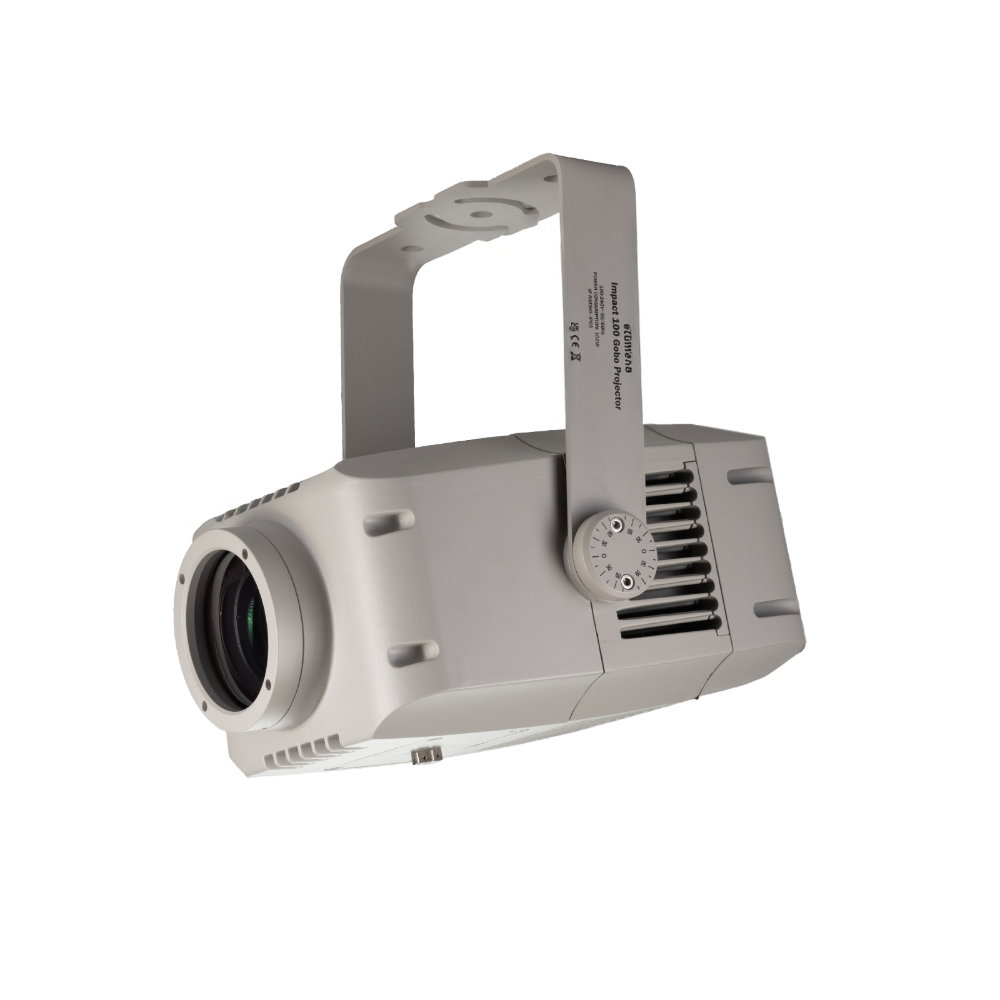
Fixtures whose only job is throwing a pattern, and the default for logo work. A modern unit pairs a white LED with motorised zoom and focus, a rotating indexable gobo wheel of replaceable gobos, a colour wheel and effects such as a prism and a ripple wheel. Many are IP65 rated for facade work, and the wheel holds several looks in one fixture. The Elumen8 Impact 100 Install is typical: a 100 W white LED, a 15 to 30 degree motorised zoom, seven indexable gobos plus open and seven colours, on 13 DMX channels. Ranges split into install builds for fixed positions and pro or rental builds for repeated rig and de-rig.
2. A profile or spot fixture with a gobo slot
Any profile, ellipsoidal or theatre spot with a gobo slot will project a pattern, so if a venue owns profiles this is the cheapest route to a monogram on a wall. The Elumen8 Virtuoso 600, for example, has four framing shutters and an M size gobo slot. Framing shutters are the real advantage: they crop the projected circle to a hard edge, keeping a pattern off a ceiling. Against that, the image is static without a rotator, beam angle is fixed by the lens tube, and the fixture is almost always indoor rated.
Gobo holders are fixture-specific and often material-specific, because steel and glass sit at different thicknesses in the gate. Buy one holder per gobo and keep them pre-loaded, so a look change is a swap rather than a circlip fight in a dark room.
3. A moving head spot with gobo wheels
Spot-type moving heads are built around gobo projection: gobo wheels, a colour wheel, prisms, motorised focus and usually zoom, aimed anywhere on a cue. An Equinox Fusion 150 Spot is typical of the compact end, with dual wheels carrying six rotating replaceable gobos and seven static ones. They win in a show, with patterns sweeping a floor and gobos morphing as wheels overlap. They lose on logo work: apertures are small and manufacturer-specific, so a custom logo must be cut to that size, and most heads are IP20. Our moving head buying guide compares the fixture types.
What gobo projection is used for
- Monograms on a dance floor or wall. Floor projection needs a fixture high enough to clear guests, so it is steeply angled and brings keystone into play. Wall projection stays undistorted and visible once the floor fills. See the wedding and function venue guide.
- Company logos on a facade or in a foyer. Sponsor branding on a building, a mark in a foyer, a permanent projection at an entrance. Needs an outdoor rated fixture and a surface with enough reflectance.
- Snowflakes and seasonal patterns. Stars and falling-snow animation across a ceiling or exterior wall, where one projector often beats a lot of decoration. See the Christmas venue lighting guide.
- Texture and breakup patterns. A flat wall under an even wash looks flat; through a leaf breakup it gains depth. Add haze and the beam shows as well as the pattern, covered in the smoke and haze guide.
- Signage and wayfinding. Projected arrows and room names put nothing on a wall. A projected sign vanishes if the fixture fails, so never make it the only means of communicating anything safety related.
Gobo types and materials
Steel
A thin metal disc with the pattern cut out of it. Light passes through the cuts and is blocked elsewhere, so it projects a single colour image: whatever the fixture is producing. Steel is cheap, robust and the default for breakups, textures and bold logos.
The limitation is a stencil limitation. Because the disc must hold together, enclosed shapes need tabs or bridges: slivers of metal keeping an island attached to the disc. The counter of a letter O and the inside of a ring both need one, and the bridge shows in the projected image as a thin line across the shape. A good maker hides tabs where they are least obtrusive, but they cannot be eliminated.
Glass
Glass carries the image on a substrate instead of cutting it out of metal, which removes the stencil constraint. Three kinds are made: black and white glass, which behaves like a monochrome slide and holds detail steel cannot; multi-colour glass built from dichroic coatings; and high definition photographic gobos. Use glass for more than one colour, fine detail, gradients, or shapes you do not want bridged.
Rosco, which makes its own dichroic glass, publishes continuous exposure limits of 400 degrees C for the substrate and 200 degrees C for the coating, and notes that some high output moving lights run gates too hot for steel gobos. Glass costs more, is more fragile and sits thicker than steel, so fixtures often specify a separate holder for it.
Gobo sizes: get this right before ordering
Gobos for conventional profiles come in standard lettered sizes. Each has an outer diameter, the disc that must fit the holder, and an image diameter, the area the fixture projects. Artwork is drawn to the image diameter.
| Size | Outer diameter | Image diameter | Typical fixtures |
|---|---|---|---|
| A | 100 mm | 75 mm | Most conventional ellipsoidals |
| S | 92 mm | 79 mm | Source Four style fixtures (steel only) |
| B | 86 mm | 64.5 mm | Industry standard ellipsoidals and most gobo rotators |
| M | 66 mm | 48 mm | Junior ellipsoidals and compact LED profiles |
| E | 37.5 mm | 28 mm | Mini ellipsoidals (specify the fixture model) |
Moving heads, gobo projectors and architectural projectors do not use these sizes. Their gobos are manufacturer-specific and can differ between wheels in one fixture, so give the maker the exact make, model and wheel.
Check the fixture before you commission artwork
Confirm the gobo size, the material the fixture accepts and whether you need a separate holder before paying for artwork or tooling. A B size gobo will not go into an M size profile, and a profile gobo will not fit a moving head.
Custom gobos: what the maker needs from you
The quality of the projection is almost entirely determined by the artwork you send.
- Vector artwork. Illustrator, EPS, SVG or a PDF with vector data intact: line art rather than pixels, so it scales without softening. ProGobo notes vector art moves straight to tooling, while poor artwork needs redrawing.
- If it must be a bitmap, send it big. Typical minimums are 300 DPI or 900 by 900 pixels. Rosco asks 600 DPI for black and white glass and 800 DPI for multi-colour and photographic glass.
- High contrast. For steel the art must resolve into “light passes here” and “metal here”, so line art works and a soft photograph does not.
- Text converted to paths. Live text depends on the font being available and traced correctly, and ornate faces are where it fails.
- Correct size and orientation. Supply the design sized to the image area and say which way up it projects. Optics invert the image and makers handle the flip, but state it.
- Fine detail and thin lines fail. On steel, hairlines and small serifs close up. Glass holds more detail, but thin lines lose contrast once the image is metres across. Simplify the mark.
- Ask about keystone correction. Some makers pre-distort artwork so a steeply angled projection lands square: GoboSource offers correction beyond about 45 degrees.
Throw, image size and focus
Image size is set by two things only: distance from the surface, and the beam angle. Double the distance and you double the image diameter, at a quarter of the light per square metre. So the first measurement on any projection job is the throw distance, taken before the fixture is chosen.
The geometry is simple enough for site work: image diameter is roughly twice the throw multiplied by the tangent of half the beam angle. A fixture at 15 degrees over 10 m gives about 2.6 m of image; at 30 degrees, about 5.4 m; a 26 degree profile lens at 6 m gives about 2.8 m.
Keystone: project straight on where you can
Project at an angle and the image stops being a circle: the far edge lands bigger, and a rectangle becomes a trapezoid. That is keystone distortion, geometry rather than a fault, and it costs focus too, because near and far parts of the image sit at different distances. Perpendicular and centred gives a square image and even focus. Otherwise keep the angle shallow and consider ordering the gobo keystone-corrected.
Brightness against ambient light
The single biggest cause of disappointing logo projection is projecting into a lit room. The image is visible only because of the contrast between the lit pattern and the unlit surface around it. Point a projector at a wall already washed with uplighting and the contrast collapses.
Projection looks its best on a surface no other fixture is hitting. If the room must stay bright you need more output or a smaller image. Daylight on a facade is the extreme case: exterior projection is an after-dark effect.
Dark surfaces eat the image too. Black drape, dark brick and deep painted walls absorb most of the light. Pale matte surfaces read cleanest: light plaster, a pale marquee lining, light stone. Gloss throws a hotspot at the audience instead of holding the image, and textured stone breaks up fine detail. When the surface fights you, make the image smaller and simplify the gobo.
Indoor, outdoor and IP rated fixtures
Most profiles and most moving heads are IP20: indoor only, no protection against water. Putting one outside under a sheet of plastic is not weatherproofing. For anything projecting onto a building, use a fixture with a published IP rating. Dedicated gobo projectors are commonly IP65: dust tight and protected against water jets.
An IP rating alone does not tell you whether the model is meant to stay out: install versions are specified for fixed positions and permanent supply, pro and rental versions for repeated deployment. Exterior work also needs weatherproof power connection, and cable runs clear of standing water. A wet surface also reflects differently from a dry one.
Mounting at height
Fixing a projector to a building, a structure or any position at height is work for a competent person with the right training, access equipment and assessment of the fixture and the fixing. This guide gives no rigging, mounting or structural advice. If a projector needs to go up a wall, on a pole or onto a truss, get someone qualified to do it and to specify the fixings and any secondary retention.
Rotation, animation and effects wheels
A static pattern is right for a monogram and dull for a texture. Movement is what makes a breakup read as water, foliage in wind or falling snow.
- Gobo rotators. A motorised accessory that fits a profile’s gobo slot and spins the gobo, with variable speed, direction and DMX control. Rosco lists B size as fitting most rotators.
- Rotating gobo wheels. Built into projectors and moving heads. The good ones are indexable: the gobo stops at a specified angle. Without indexing you cannot guarantee a logo sits level.
- Ripple and animation wheels. A wheel of moving texture passing in front of the gobo, adding flow to a static pattern. This is how water and flame effects are made.
- Prisms. A rotating multi-facet prism splits the image into copies: good for beam looks, poor for a legible logo.
- Colour wheels. Dichroic filters recolour a steel gobo image instantly, and two gobo wheels can overlay and animate one pattern on another.
One rule for logos: if the image must be legible, lock it. Index the gobo, leave the prism out, and put movement elsewhere in the rig.
DMX control or standalone
Standalone covers the set-and-forget cases. In manual or auto mode a fixture holds a chosen gobo, colour and rotation speed on power-up with no control cable, which is what a permanent foyer logo needs. Sound active mode reacts to music, and master/slave links fixtures to one leader.
DMX is what you want once the projection is part of a show. A typical projector presents around a dozen channels covering dimmer, strobe, gobo selection, rotation and indexing, colour, prism, zoom and focus, so a desk can cue a monogram for arrival and a sponsor logo for the speeches. Addressing, universes and cable are covered in the DMX explained guide, and the DMX controllers range runs from a playback wing to a full desk. On fixed installs, RDM lets you change a fixture’s address from the desk end.
A practical spec checklist
- Throw distance in metres, fixture position to surface. This decides the beam angle.
- Surface: material, colour, texture, and whether it is flat.
- Ambient light at the moment the projection has to work. This is what most often kills the result.
- Image size in metres, checked against throw and beam angle.
- Indoor or outdoor: outdoors means a published IP rating and weatherproof power.
- Static or rotating: a monogram wants an indexable wheel; moving texture wants a rotator or ripple wheel.
- Custom or stock: breakups, foliage, stars and snowflakes are stock items. A logo means a custom gobo, so confirm size, material and holder first.
Common mistakes
- Ordering a custom gobo without checking the fixture’s gobo size and format. The most expensive mistake here: wrong outer diameter is scrap.
- Projecting onto a lit or dark surface. A wall that already has uplighters on it has no contrast left, and black drape or dark brick absorbs the light you are trying to bounce back.
- Fine-line artwork that closes up. Hairline rules and detailed crests do not survive steel cutting scaled to three metres.
- Forgetting keystone. A projector jammed into the only available position at a steep angle gives a trapezoid with soft focus.
- No spare for a headline moment. If a projected logo backs a speech or a first dance, one fixture is a single point of failure. Carry a spare fixture, gobo and lamp.
- Not indexing the gobo. A logo on a wheel that cannot index sits at whatever angle it stopped at.
Popular picks from the shop
Elumen8 Impact 100 Install IP65 Gobo ProjectorView product → Elumen8 Impact 100 PRO IP65 Gobo ProjectorView product → Elumen8 Virtuoso 600 WW LED Profile SpotView product → Equinox Fusion 150 Spot Moving HeadView product →
Frequently asked questions
What is a gobo projector?
A fixture built specifically to project a pattern. It holds gobos on a wheel at the gate and images them onto a surface through a zoom or fixed lens, with motorised focus, a colour wheel and effects. Most are IP65 rated for outdoor use.
How do I project a logo onto a wall?
Measure the throw from where the fixture can sit to the wall, decide how big the image must be, and pick a beam angle that gives that size at that distance. Have a custom gobo cut for that fixture, mount square to the wall, and keep other light off it.
Can I use a wedding monogram gobo in any fixture?
No. Profile sizes (A, S, B, M, E) differ from each other and from the proprietary sizes in moving heads and projectors. Tell the maker the exact fixture.
Steel or glass gobo for a company logo?
Steel if the logo is one colour with bold shapes and you accept bridging lines across enclosed shapes. Glass if it has more than one colour, fine detail or photographic content, or if the fixture specifies glass.
Why does my projected logo look faint?
Almost always ambient light or surface: something else is lighting the surface, the room is too bright, or the surface is dark. Secondary causes are an image far larger than the output supports, and focus set for the wrong part of an angled image.
Can I project a gobo outdoors onto a building?
Yes, with an IP rated fixture and weatherproof power, after checking whether the model is meant for temporary or permanent exterior use. It reads only after dark, and mounting at height must be done by a competent person.
What artwork do I need for a custom gobo?
Vector artwork (Illustrator, EPS, SVG or vector PDF) with text converted to paths, drawn at the fixture’s image diameter, high contrast, and simplified so no line is too thin to cut. Otherwise send a bitmap of at least 300 DPI.
Shop this guide
Gobo projectors, profile spots, moving heads, gobo holders and the control to run them. Talk to us if you need help matching a custom gobo to a fixture.
Gobo Projectors Spots Spot Accessories Theatrical Moving Heads DMX Controllers



