

Home » Guides » Mixers & PA Systems »
Power Amplifiers for Install and Touring: Channels, 100V, DSP and Networked Control
How the power amplifiers we stock from Lab Gruppen, Biamp Apart, Cloud, Crown, Dynacord, Linea Research, Martin Audio and NEXO differ on channel count, power into 2, 4 and 8 ohms and 100V lines, built-in DSP, Dante and network control, rack space, cooling and standby. Manufacturer figures throughout, with the test conditions that matter.
~13 min read · Updated October 2026 · By the Stage Supply team
In this guide: The short answer · 100V or low impedance · Reading power ratings · Install amplifiers · DSP and touring amplifiers · DSP and network control · Rack space, cooling and standby · Matching to speakers · Checklist · Popular picks · FAQ
The short answer
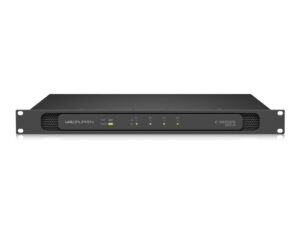
- Background music and paging on 100V lines: an install amplifier that drives 70/100V directly. The Biamp Apart Revamp 4240T gives 4 x 240W at 100V, the Lab Gruppen CA2402 2 x 240W in a fanless half-rack box, and the Lab Gruppen E 20:4 4 x 500W in 1U, switchable per channel between 100V and low impedance.
- Lots of low-impedance zones in a small rack: the Revamp 8250 (8 x 250W into 4 ohms) or the 16-channel Revamp 1680. Neither has DSP, so pair them with a zone mixer or a speaker processor.
- Install with DSP, Dante and remote monitoring: the Dynacord IX60:8 (8 channels, 1U, Dante), the Crown DCi 8|300N (8 x 300W, BLU-link), the Cloud CXA215K (web-app DSP over Ethernet) or a Linea Research 88C10.
- Touring and big venue PA: buy the amplifier the speaker maker names. That means NEXO NXAMP4x1mk2 for NEXO boxes, Martin Audio iKON iK42 or VIA for Martin boxes, or a Linea Research 44M20 running a downloaded preset.
- Simple and cheap for a passive PA: a two-channel DSP amp such as the Lab Gruppen IPX 2400 (2 x 1200W into 4 ohms, 1U).
The rest of this guide explains how to read the numbers, then compares the models in two tables. Wiring, cable sizing and mains supply for an amplifier rack are for a competent person to design, install and test; this guide is about choosing the hardware.
100V line or low impedance: which amplifier type?
A low-impedance amplifier drives 2, 4, 8 or 16 ohm speakers directly. It suits PA, music venues and installs where a few good speakers sit fairly close to the rack. A 100V line amplifier drives many transformer-tapped speakers on one long cable, which is how shops, offices, schools and pubs are wired. The full explanation, and why an 8 ohm speaker must never go on a 100V output, is in our commercial and background audio guide.
Many current amplifiers do both, set per channel. Three ways makers handle it:
- Switchable: the amplifier runs either low impedance or 70V/100V. The Lab Gruppen E and CA Series, Cloud CXA, Crown DCi, Dynacord IX and Linea Research C and M Series all do this; on the E Series, IX and Linea models it is set per channel. Lab Gruppen and Dynacord call their 70V/100V output direct drive.
- Dedicated 100V models: Biamp lists output taps of 100, 70, 50 and 35V plus 4 ohms on the Revamp 4240T, while its Revamp 8250 is marked as not suitable for 100V.
- Low impedance only: touring amplifiers such as the Martin Audio VIA2004 and NEXO NXAMP are specified into ohms, not 100V lines.
One detail that catches people out: the Lab Gruppen E 10:4 tops out at 70V. Lab Gruppen says 100V speakers can be driven from it but get half the power of the tap they are set to. For a true 100V system pick a model whose 100V rating is published.
How to read amplifier power ratings
Two amplifiers both “rated at 1000W” can behave very differently. Check four things.
- All channels driven or one channel. Lab Gruppen’s E Series sheet lists both. The E 20:4 gives 500W per channel into 4 ohms with all four driven, but up to 1000W from a single channel when the others are quieter. Linea Research quotes all channels driven “even when driven with the same dense program material” and says these are not transient, burst or peak figures.
- The test signal. Dynacord quotes the IX60:8 with a burst test signal (IHFA-202: 20 ms on, 480 ms off). That is a legitimate method, but it is not the same as a continuous rating. Compare like with like.
- Which load. Many amplifiers make less power into 2 ohms than into 4. The NEXO nanoNXAMP4 shows why it pays to check: NEXO’s datasheet gives 4 x 250W into 2 ohms but its product page gives 2 x 250W, so confirm with NEXO before planning 2 ohm loads. The Lab Gruppen IPX 2400 drops from 1200W per channel into 4 ohms to 800W into 2 ohms.
- Power sharing. Some amplifiers share one power budget between channels. Dynacord calls this powerTANK; Cloud says its CXA amplifiers share power between pairs of outputs in low-impedance mode; Lab Gruppen’s E Series can deliver extra power to one channel while others use less. Useful when zones are uneven, but add up the whole load against the total.
Rule of thumb
For a 100V system, add up every speaker tap on a channel and leave headroom, as set out in our install speakers guide. For a low-impedance PA, follow the speaker maker’s recommended amplifier and load per channel.
Install amplifiers compared
Per-channel power from each maker’s own data sheet or product page: all channels driven where the maker states it (Lab Gruppen, Crown, Dynacord, Linea), and Biamp’s RMS figures for the Revamp models. A dash means the maker does not publish that figure, or the model is not meant for that load.
| Model | Channels | 2 Ω | 4 Ω | 8 Ω | 70V / 100V | DSP and control | Size and cooling |
|---|---|---|---|---|---|---|---|
| Lab Gruppen CA2402 | 2 | – | 2 x 240W rated; output set to 4 Ω, 8 Ω, 70V or 100V by DIP switch | Bass/treble, 80Hz high-pass; RJ45 for wall controllers | Half-rack 1U, fanless | ||
| Lab Gruppen E 10:4 | 4 | – | 250W | 250W | 250W at 70V | None; GPI/GPO power control | 1U, fans |
| Lab Gruppen E 20:4 | 4 | 500W | 500W | 500W | 500W / 500W | None; GPI/GPO | 1U, fans |
| Lab Gruppen E 40:4 | 4 | 900W | 1000W | 1000W | 1000W / 1000W | None; GPI/GPO | 1U, fans |
| Biamp Apart Revamp 4240T | 4 | – | 240W | 120W | 240W at 100V (bridgeable to 2 x 480W) | None; 250Hz high-pass for horns | 2U, fan |
| Biamp Apart Revamp 8250 | 8 | – | 250W | 125W | Not for 100V | None | 2U, fan |
| Biamp Apart Revamp 1680 | 16 | – | 80W | 40W | Not listed | None; audio-sense and trigger power-on | 3U, convection |
| Cloud CXA215K | 4, or 2 bridged | – | 750W (2 x 1500W bridged) | 750W | 2 x 1500W | Matrix DSP via built-in web app; Ethernet | 2U |
| Crown DCi 8|300N | 8 | 150W | 300W | 300W | 300W / 300W | DSP, matrix, line monitoring; BLU-link; Audio Architect | 2U, fan |
| Dynacord IX60:8 | 8 | 750W | 600W | 750W | 750W / 750W | 96kHz DSP, 16 x 16 matrix, FIR; 8 x 8 Dante, OCA/AES70 | 1U, fans |
| Linea Research 88C10 | 8 | 1250W | 1250W | 1250W | 1250W | 96kHz DSP, FIR; Ethernet; Dante/AES67 option | 2U, fans |
| Linea Research 44C20 | 4 | 5000W | 3000W | 1500W | 3500W / 5000W | 96kHz DSP, FIR; Ethernet; Dante/AES67 option | 2U, fans |
For the CA2402, Lab Gruppen quotes one rated figure rather than one per load. Dynacord’s IX figures use the burst test described above.
Plain install power: Lab Gruppen E Series, CA Series and Apart Revamp
These have no DSP. You set level, high-pass and mode on the unit and do the processing in a zone mixer or DSP upstream. The E Series switches each channel between low-impedance and 70V or 100V modes with a limit switch, adds a switchable 50Hz high-pass, and has GPI/GPO terminals so a control system can switch it on and off. The CA2402 is the small one: an 80Hz high-pass, bass and treble trim, and an RJ45 socket for Lab Gruppen’s CRC-V wall controllers. Lab Gruppen supplies it with rubber feet and rack hardware, and two fit side by side in one rack space.
The Revamp range is the straightforward choice for plain zone amplification. The 4240T is the 100V workhorse; the 8250 and 1680 are for low-impedance speakers, such as the low-impedance Apart MASK models in bars and restaurants (see our install speakers compared guide). For choosing the zone mixer that feeds them, see zone mixers compared.
Install with DSP and network: Cloud CXA, Crown DCi N, Dynacord IX, Linea C Series
These put processing, monitoring and remote control inside the amplifier, so a separate DSP box may not be needed. Cloud configures the CXA215K’s full-matrix DSP through a web app built into the amplifier, over Ethernet. Crown’s DCi 8|300N adds BLU-link digital audio, HiQnet control over standard TCP/IP, Audio Architect and Powered by Crown app control, and speaker line monitoring. The Dynacord IX60:8 is the most self-contained: eight Dante inputs and outputs, eight mic/line inputs that can break into the Dante feed, a 16 x 16 matrix, and a TaskEngine for scheduling and third-party control, all in 1U.
Linea Research’s 44C and 88C Series are its installation amplifiers; the 44C20 carries the same per-channel power figures as the touring 44M20. Linea describes a tamper-proof front panel and control from third-party systems over TCP/IP, RS232 and RS485. Dante/AES67 is a factory-fitted option, which is why there are separate Dante versions such as the 88C10 Dante.
DSP and touring amplifiers compared
For live sound and loudspeaker-specific processing. Per-channel power with all channels driven unless noted.
| Model | Channels | 2 Ω | 4 Ω | 8 Ω | Processing | Network and inputs | Size and cooling |
|---|---|---|---|---|---|---|---|
| Lab Gruppen IPX 1200 | 2 | 500W | 600W | 300W | 40 PEQs, FIR, crossovers, delay, 50 presets | Analogue, AES3; Ethernet (IPX Controller) | 1U, fan |
| Lab Gruppen IPX 2400 | 2 | 800W | 1200W | 600W | As IPX 1200 | Analogue, AES3; Ethernet | 1U, fan |
| Martin Audio VIA2004 | 4 | – | 500W | 250W | None: pair with a Martin DX processor | Analogue XLR | 2U, fan |
| Martin Audio iKON iK42 | 4 | 5000W | 3000W | 1500W | 96/48kHz DSP, up to 1000 FIR taps | Analogue, AES3, Dante (AES67 compatible); VU-NET | 2U, fans |
| Martin Audio iKON iK81 | 8 | 1250W | 1250W | 1250W | As iK42 | Analogue, AES3, Dante (AES67 compatible); VU-NET | 2U, fans |
| NEXO nanoNXAMP4 | 4 | See note above | 250W | 200W | NEXO presets for ID and ePS ranges | Analogue, S/PDIF; Ethernet; Dante/AES67 on the -D | Half-rack 1U |
| NEXO NXAMP4x1mk2 | 4 | 1300W | 900W | 600W | NEXO presets, touchscreen | Ethernet (NeMo); optional AES, Dante, Dante + AES, AES67 cards | 2U |
| Linea Research 44M20 | 4 | 5000W | 3000W | 1500W | 96kHz DSP, LIR crossovers, FIR | Analogue, AES3; Ethernet; Dante/AES67 option | 2U, fans |
Linea also lists 70V and 100V figures for the 44M20 (3500W and 5000W), so the same touring amplifier can run a distributed line. The 44M20 Dante has the Dante/AES67 option fitted. Martin Audio’s iKON pages also list line figures (iK42: 3500W at 70V and 5000W at 100V; iK81: 1250W at both), while the VIA2004 is specified into ohms only.
Why the speaker maker’s amplifier matters
NEXO publishes its speaker performance “with NEXO processing” and names NXAMPmk2 controllers as the way to drive its cabinets. Martin Audio pairs passive boxes with VIA amplifiers and a DX processor, or with iKON amplifiers that have the processing built in. Our Martin Audio vs NEXO guide lists which boxes go with which electronics, and the Blackline XP vs BlacklineX guide covers which VIA or iKON suits passive BlacklineX. If you own speakers from another maker, a Linea Research or Lab Gruppen IPX with a published preset is the flexible route.
NEXO’s NXAMP4x1mk2 has a rear slot for network cards, such as the NEXO AEDT Dante and AES card for NXAMPmk2. Its smaller sibling, the nanoNXAMP4, is aimed at installs: NEXO limits its presets to an edited range drawn from the ID and ePS Series, and the nanoNXAMP4-D adds four Dante or AES67 inputs.
DSP and network control: what you actually get
- No DSP: Lab Gruppen E and CA, Apart Revamp, Martin VIA. Cheaper and simpler; you need EQ, crossover and limiting upstream.
- DSP with Ethernet control: Lab Gruppen IPX (IPX Controller, PC and Mac), Cloud CXA (web app), NEXO NXAMPmk2 (NeMo) and nanoNXAMP4, Linea (System Engineer, Podware), Crown DCi N (Audio Architect). You can set and monitor amps remotely but audio still arrives as analogue or AES3.
- Dante audio networking: Dynacord IX (8 x 8 Dante as standard), Martin iKON -DANTE models, NEXO nanoNXAMP4-D, NXAMPmk2 with a card, and Linea C and M Series Dante versions. Martin, NEXO and Linea list AES67 compatibility too. See our Dante vs analogue guide for whether a network is worth it.
- Redundancy: the IPX can fail over from AES3 to analogue automatically; the Dynacord IX has primary and secondary network ports with glitch-free redundancy and keeps its DSP and Dante running from PoE (ghostPOWER) if the mains drops.
Rack space, cooling and standby
Rack units and cooling decide where an amplifier can live. A fanless amplifier can sit in a cupboard or behind a bar; a fan-cooled rack needs airflow front to back.
| Model | Size | Cooling | Standby and energy features (maker’s figures) |
|---|---|---|---|
| Lab Gruppen CA2402 | Half-rack 1U | Convection, fanless | Sleeps after 20 minutes without signal, wakes on signal; Energy Star certified |
| Lab Gruppen E Series | 1U | Temperature-controlled fans | Auto standby after 20 minutes, under 2.5W standby (under 1W on the E 10:4) |
| Biamp Apart Revamp 1680 | 3U | Convection | Under 0.5W standby; audio-sense or trigger power on |
| Biamp Apart Revamp 4240T | 2U | Variable-speed fan, which Biamp says is only activated in case of emergency | – |
| Dynacord IX60:8 | 1U | Temperature-controlled fans | 40W idle/eco, under 15W standby |
| NEXO nanoNXAMP4 | Half-rack 1U | – | Under 2W standby, 20W maximum idle |
| NEXO NXAMP4x1mk2 | 2U, 502mm deep | – | 10W standby |
| Linea Research 44M / 88C | 2U, 357mm deep | Dual variable-speed fans, washable filters | User-set standby; deeper ECO sleep woken by command |
| Crown DCi 8|300N | 2U | Variable-speed forced air, 47 dBA at 1m maximum | – |
Big touring amplifiers have demanding mains connections. Linea’s 44M Series uses a 32A powerCON input, for example. Check the maker’s current draw before planning a rack, and have a competent person design the supply.
Matching amplifiers to speakers
The basics of impedance, power and headroom are in matching amplifiers and speakers. Points specific to these amplifiers:
- Do not load a channel below its minimum. Biamp lists 4 ohms as the minimum for Revamp channels and 8 ohms bridged; NEXO publishes two different 2 ohm figures for the nanoNXAMP4, so confirm before using 2 ohm loads.
- Use the high-pass on 100V lines. Lab Gruppen says the CA Series high-pass should be on for all constant-voltage systems to protect speaker transformers.
- Bridged mode trades channels for power. A Revamp 4240T becomes 2 x 480W at 100V; NXAMP4x1mk2 bridged gives 2 x 2600W into 4 ohms.
- For processed systems, load the maker’s preset before connecting speakers.
Checklist before you order
- Speaker type per zone: 100V or low impedance, and the total taps or load per channel.
- Channel count, with spare channels for growth.
- Does the speaker maker require its own amplifier or a preset?
- Is DSP needed in the amp, or is there a processor or zone mixer upstream?
- Audio transport: analogue, AES3 or Dante.
- Rack space, ventilation and whether fans are acceptable in the room.
- Standby behaviour and how the amp will be switched on (signal sense, GPI, network).
- Mains supply for the rack, designed by a competent person.
Popular picks from the shop
Lab Gruppen E 20:4 4-Channel 1U Install AmplifierView product → Martin Audio VIA2004 4-Channel AmplifierView product → Biamp Apart Revamp 4240T 4 x 240W 100V AmplifierView product → Lab Gruppen CA2402 2 x 240W Commercial AmplifierView product → Dynacord IX60:8 8-Channel Dante DSP AmplifierView product → NEXO NXAMP4x1mk2 Powered ControllerView product → Linea Research 44M20 4-Channel DSP AmplifierView product → Lab Gruppen IPX 2400 2-Channel DSP AmplifierView product →
Frequently asked questions
Can I use a normal PA amplifier on 100V speakers?
Only if the maker rates it for 70V or 100V. Direct-drive models such as the Lab Gruppen E 20:4, Cloud CXA215K, Crown DCi 8|300N, Dynacord IX60:8 and Linea Research C and M Series publish 100V figures. Amplifiers specified only into ohms, such as the Martin Audio VIA2004, are not for 100V lines.
What is the difference between an install amplifier and a touring amplifier?
Touring amplifiers favour power density, front-panel control and rugged connectors such as Speakon. Install amplifiers favour Euroblock connectors, 100V operation, tamper-proof fronts, auto standby and control-system integration. Linea Research lists the 44M Series as touring amplifiers and the 44C Series as installation amplifiers, with the same power figures for the 44M20 and 44C20.
Do I need an amplifier with DSP?
Not if a processor or zone mixer upstream already handles EQ, crossover and limiting (see our speaker processors and DSP guide). Choose a DSP amplifier when you want speaker presets and protection in the amp, or fewer boxes in the rack.
Do NEXO speakers need a NEXO amplifier?
NEXO specifies its cabinets with NEXO processing and recommends NXAMPmk2 powered controllers. The nanoNXAMP4 covers selected ID and ePS models.
What does “all channels driven” mean?
Every channel delivering the stated power at once. It is the honest figure for a multi-channel amp. Single-channel maximums, like the E 20:4’s 1000W into 4 ohms, are higher but only apply when the other channels are working less.
Which amplifiers are fanless?
Of the models here, the Lab Gruppen CA Series (convection-cooled, fanless) and the Biamp Apart Revamp 1680 (convection). The Revamp 4240T has a variable-speed fan that Biamp says is only activated in case of emergency.
Shop this guide
Power amplifiers, install amplifiers and processors. Tell us your speakers and zones and we will help check the amplifier choice.
Power Amplifiers Install Amplifiers Speaker Processors & DSP Install DSP & Control Passive PA Speakers



