

Home » Guides » Install & Commercial »
Allen & Heath AHM-16 vs AHM-32 vs AHM-64: Choosing an Install Audio Matrix
The three AHM matrix processors run the same software and the same processing per channel. They differ in channel count, local I/O, automatic mic mixers, echo cancelling and how expanders connect. This guide sets out those differences, the cards, expanders and controllers that go with each, and which model suits which job.
~11 min read · Updated October 2026 · By the Stage Supply team
In this guide: The short answer · Side-by-side · What all three share · I/O Port cards · Expanders · Echo cancelling and feedback · Controllers and apps · System Manager · Which one for which job · Popular picks · FAQ
The short answer
- AHM-16: a 16×16 matrix with 8 mic/line inputs and 8 line outputs in 1U. Allen & Heath pitches it at single rooms and smaller multi-room sites such as bars, restaurants, shops and school halls. One automatic mic mixer, and no echo cancelling option.
- AHM-32: a 32×32 matrix with 12 in and 12 out in 1U, four automatic mic mixers and a slot for the processing expansion module that adds echo cancelling or feedback suppression. The middle ground for multi-room hospitality, corporate and education jobs.
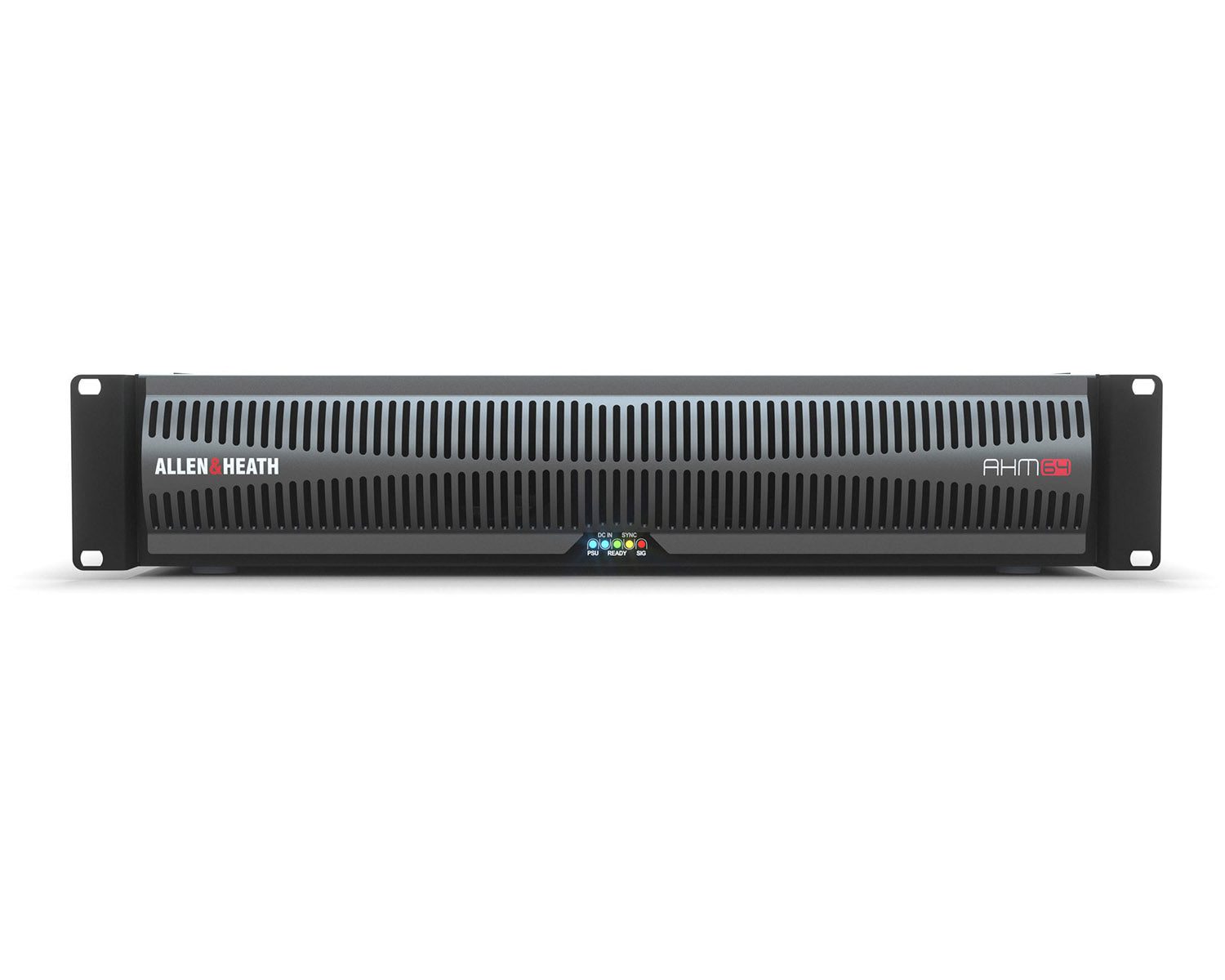
- AHM-64: a 64×64 matrix with 12 in and 12 out in 2U, eight automatic mic mixers, a built-in SLink port for expanders as well as the I/O Port, and a 12V DC input for backup power. The one for large sites with many zones and controllers.
If you are unsure, count your zones first (a stereo zone uses two outputs), then decide whether you need echo cancelling for video calls. Those two answers usually settle it. Allen & Heath’s fixed architecture gives every input and output its full processing, so you do not run out of DSP as the design grows; you run out of channels.
Side-by-side
From Allen & Heath’s own model comparison and the technical datasheets.
| AHM-16 | AHM-32 | AHM-64 | |
|---|---|---|---|
| Processing matrix | 16×16 | 32×32 | 64×64 |
| Zones / processed outputs | Up to 16 mono or 8 stereo | Up to 32 mono or 16 stereo | Up to 64 mono or 32 stereo |
| Local analogue I/O (Phoenix) | 8 in, 8 out | 12 in, 12 out | 12 in, 12 out |
| I/O Port (option card, up to 128×128) | Yes | Yes | Yes |
| SLink for expanders | Via SLink card in I/O Port | Via SLink card in I/O Port | Built in, plus I/O Port |
| Automatic mic mixers | 1 (1×16) | 4 (1×32, 2×16 or 4×8) | 8 (1×64, 2×32, 4×16 or 8×8) |
| Echo cancelling (AEC) / feedback suppression (FBS) | Not available | Optional module | Optional module |
| Front panel | Screen and 4 SoftKeys | Screen and 8 SoftKeys | No screen or SoftKeys |
| IP controller limits (IP1 / IP4 / IP8 / IP6) | 8 / 8 / 2 / 2 | 32 / 32 / 8 / 8 | 64 / 64 / 16 / 16 |
| User profiles | 4 | 16 | 32 |
| Local GPIO | 2 in, 2 out | 2 in, 2 out | 2 in, 2 out |
| DC backup input | No | No | Yes, 12V |
| Rack size and weight | 1U, 3.8 kg | 1U, 4 kg | 2U, 7 kg |
What all three share
The processing engine is the same family across the range, so a project designed on one model behaves the same way on another. Per Allen & Heath, all three have:
- A 96kHz FPGA core with analogue in-to-out latency under 1ms.
- Gate, compressor, 8-band PEQ and delay on every input channel, with automatic mic mixing available on inputs.
- Source selector, 8-band PEQ, graphic EQ, compressor, ambient noise compensation (ANC), limiter and delay on every zone.
- Outputs that can be set as zones or as speaker processing with 2, 3 or 4-way crossovers, PEQ, delay and limiter.
- Priority ducking for paging and announcements.
- Mic/line preamps with up to 60dB of gain, a 20dB pad and 48V phantom power on pluggable Phoenix connectors, and relay-protected balanced line outputs.
- 500 nameable presets, an event scheduler with 50 events for timed preset recall, and built-in stereo playback of WAV, MP3 and FLAC files.
- A Gigabit control network port for System Manager, IP controllers, the Custom Control app and third-party TCP control, with Crestron, AMX and Extron drivers available.
I/O Port cards: Dante, MADI, Waves and SLink
Every AHM has one I/O Port that takes a card from the SQ family, giving up to 128×128 channels. The card decides how the processor talks to the rest of the building. Allen & Heath lists these for AHM:
- SQ Dante 32×32 and SQ Dante 64×64: 96kHz or 48kHz Dante, AES67 and Dante Domain Manager ready. Allen & Heath describes the 32×32 card as the partner for AHM-16 and AHM-32, and its AHM-64 guide names the 64×64 card. AHM needs the V2 or later card, not the original M-SQ-DANTE module.
- SQ MADI: 64×64 MADI at 48kHz or 96kHz over BNC coax, for broadcast feeds and third-party consoles.
- SQ Waves: 64×64 onto a Waves SoundGrid network for plug-in processing and multitrack recording.
- SQ SLink: gives AHM-16 and AHM-32 access to Allen & Heath’s Everything I/O expanders. On AHM-64 it runs independently of the built-in SLink port, so you can use two different Allen & Heath protocols at once.
The practical consequence: an AHM-16 or AHM-32 has one card slot, so it is either on Dante or on SLink expanders, not both. If a job needs a Dante network and DX expanders, either use Dante expanders (below) or choose the AHM-64, whose SLink port is already built in. Our Allen & Heath option cards guide covers which card family fits which console, and Dante vs analogue multicore explains when networked audio is worth it.
Expanders: adding I/O around the building
Local I/O runs out quickly on a multi-room job, and running long analogue lines back to the rack is the expensive part. Remote expanders put the inputs and outputs where the sources and amplifiers are, on a single Cat5e (or better) cable.
Over SLink
With the built-in port (AHM-64) or an SLink card (AHM-16, AHM-32), Allen & Heath lists these as compatible. The AHM detects the expander type, switches protocol automatically, and matches the expander firmware to its own.
| Expander | Type | Inputs / outputs | Sample rate |
|---|---|---|---|
| DX88-P | DX, Phoenix connectors, fixed install | 8 / 8 | 96kHz |
| DX164-W | DX, wall or floor mount | 16 / 4 | 96kHz |
| DX168 | DX, portable or rack | 16 / 8 | 96kHz |
| DX012 | DX, outputs only | 0 / 12 | 96kHz |
| DX32 | DX, modular (filled with I/O cards) | Depends on cards fitted | 96kHz |
| GX4816 | gigaACE | 48 / 16 | 96kHz |
| DX Hub | Hub for up to 8 DX expanders | Up to 128 / 128 | 96kHz |
| AR2412 | dSnake | 24 / 12 | 48kHz |
| AB168 | dSnake | 16 / 8 | 48kHz |
| AR84 | dSnake | 8 / 4 | 48kHz |
- Up to two DX168, DX164-W, DX88 or DX012 units can be daisy-chained from the SLink port. AHM does not support redundant connection to DX expanders.
- A DX Hub takes up to eight DX expanders, and also lets several expanders on another floor or building come back to the AHM on one cable.
- Two dSnake expanders can be chained if the first is an AR2412 or AB168 and the second is an AB168 or AR84. Two AR2412s cannot be chained.
- Expanders need a point-to-point link. Layer 2 switches and media converters (for example to fibre) are allowed at the right link speed, but nothing else should share a switch carrying the expander audio. For the DX88-P, Allen & Heath markets it specifically as the easy way to add local or remote I/O to AHM.
Over Dante
With a Dante card fitted, the DT168 stagebox (16 in, 8 out) and DT164-W wall box (16 in, 4 out) appear in System Manager with gain, 48V and pad control once patched in Dante Controller. Allen & Heath says up to 32 DT168s can be added to a Dante-equipped AHM. The small DT22, DT20 and DT02 interfaces are useful for a single lectern mic or a pair of outputs at a remote rack.
Echo cancelling and feedback suppression
This is the clearest dividing line. AHM-32 and AHM-64 have a slot for the Processing Expansion Module; AHM-16 does not, and Allen & Heath lists AEC as unavailable on it.
- Two part numbers. The module is model specific: M-AHM-32-A for AHM-32 (our listing: M-AHM-32-AX) and M-AHM-64-A for AHM-64.
- AEC mode. Up to 12 channels of acoustic echo cancellation with a 150ms adaptive filter, far-end AGC, residual echo suppression, background noise reduction and comfort noise. One far-end reference per setup and up to 12 microphones in a multi-mic setup. Allen & Heath recommends one AEC per microphone rather than one on a mic mix.
- FBS mode. Since firmware V1.60 the same module can instead run feedback suppression: up to 8 engines, one per zone, each with up to 25 fixed or live bands. Allen & Heath positions it for voice lift and sound reinforcement systems where feedback is a problem.
- Fitting. The module fits inside the unit: behind the expansion slot cover on AHM-64, and under the top panel on AHM-32. Allen & Heath says fitting must only be done by technically skilled personnel.
If a meeting room joins Teams or Zoom calls through room speakers and ceiling or table mics, you need AEC somewhere in the chain, so the AHM-16 is out unless the codec or another device handles it. Our conference room AV guide covers the rest of that system.
Controllers and apps
All three models work with the same controllers; the model only changes how many you can connect (see the table above). Allen & Heath lists these for AHM:
| Controller | What it is | Power |
|---|---|---|
| IP1 | Wallplate with one push-and-turn rotary and colour LCD. EU/UK version fits MK Elements faceplates. | PoE (802.3af) |
| IP4 | Wallplate with four illuminated, configurable buttons for source select, mutes, levels or preset recall | PoE (802.3af) |
| IP6 | Desktop or mounted controller with six push-and-turn rotaries and SoftKeys | 12V PSU supplied, or PoE |
| IP8 | Eight motorised faders, for a duty manager or AV desk | 12V PSU supplied, or PoE (802.3at) |
| GPIO | 8 in, 8 out networkable interface for switches, relays and third-party kit | PoE (802.3af) |
| CC-7 / CC-10 | 7in (1024×600) and 10in (1280×800) touch panels running the Custom Control app in kiosk mode | PoE or 12V DC |
The CC panels have VESA 75×75 mounting, with an optional CC-STN desk stand and CC-BRK wall/glass bracket. The same Custom Control app runs on phones, tablets and laptops for bring-your-own-device control, and the integrator can build different interfaces for different users: a simple volume and source page for bar staff, fuller control for the AV team. Allen & Heath states it does not charge for its apps.
Like the expanders, IP controllers and the GPIO interface are firmware-matched automatically by the AHM when they connect.
System Manager
Programming is done in AHM System Manager for Mac and Windows. Allen & Heath positions it as quick to learn, with no certified training required, and offers free online AHM training. Points worth knowing before a job:
- System Manager and the AHM firmware must be the same version to connect, so update both together.
- Updating firmware deletes presets and current settings unless you use the option to restore the config during the update. Save the config first.
- Firmware V1.60 (October 2025) added unit stacking, so several AHMs can be managed from one System Manager project, plus expanded third-party control over TCP, PJLink and HTTP/REST.
- AHM supports up to 100 TCP connections in total, counting every IP controller, GPIO interface, System Manager and Custom Control instance.
Which one for which job
These are our own starting points, built from the specs above, not Allen & Heath recommendations. Our commercial and background audio guide covers zoning and 100V line, and install speakers: how many you need covers the speaker side. If a bar or shop only needs a few music zones with no Dante or echo cancelling, also look at the simpler dedicated zone mixers in our zone mixers and controllers compared guide.
| Job | Our suggested starting point | Why |
|---|---|---|
| Bar, restaurant or shop with a few zones | AHM-16 | Up to 8 stereo zones, local inputs for a mic and music sources, IP1 or IP4 plates for staff |
| Meeting room with video calls | AHM-32 with AEC module | AEC needs the module slot; four mic mixers cover several rooms |
| Hotel, school or office floor with several rooms | AHM-32 | 16 stereo zones, more controllers and user profiles, AEC or FBS when needed |
| Campus, conference centre or venue with many zones | AHM-64 | 32 stereo zones, built-in SLink plus a Dante card, DC backup input, more controllers |
| Hall with lectern and voice lift | AHM-32 or AHM-64 with module in FBS mode | Feedback suppression per zone, plus automatic mic mixing |
Three questions settle most specs:
- How many zones, and are they stereo? Add speaker-processing outputs for subs or crossovers; they count against the same total.
- Do you need echo cancelling? If yes, AHM-32 or AHM-64.
- Do you need Dante and SLink expanders together? If yes, AHM-64, or use DT Dante expanders on a smaller model.
Mains wiring, rack power and the installation of fixed audio systems should be designed, installed and tested by a competent person.
Popular picks from the shop
Allen & Heath AHM-64 64×64 Audio Matrix ProcessorView product → Allen & Heath AHM-16 16×16 Audio Matrix ProcessorView product → Allen & Heath AHM-32 32×32 Audio Matrix ProcessorView product → Allen & Heath M-AHM-32 AEC Processing Expansion ModuleView product → Allen & Heath SQ Dante 64×64 CardView product → Allen & Heath IP4 Wallplate Controller, WhiteView product → Allen & Heath DX88-P Install ExpanderView product → Allen & Heath CC-7 Custom Control Touch PanelView product →
Frequently asked questions
Does the AHM-16 have echo cancelling?
No. The Processing Expansion Module that adds AEC (and feedback suppression) fits the AHM-32 and AHM-64 only. For video-call rooms, choose an AHM-32 or AHM-64 with the module, or handle AEC elsewhere in the chain.
Which Dante card do I need for an AHM?
An SQ Dante card, V2 or later: the 32×32 or 64×64 for AHM-16 and AHM-32, and the 64×64 that Allen & Heath names for AHM-64. Allen & Heath says to use the V2 card, not the original M-SQ-DANTE. The dLive and Avantis Dante cards are a separate family and are not listed as AHM options.
Can an AHM-16 or AHM-32 use DX expanders?
Yes, with an SQ SLink card in the I/O Port. That uses the only card slot, so Dante is then not available on the same unit. The AHM-64 has SLink built in and keeps its I/O Port free.
How many wall controllers can I connect?
It depends on the model. Allen & Heath lists 8 IP1 and 8 IP4 for AHM-16, 32 of each for AHM-32 and 64 of each for AHM-64, with lower limits for IP6 and IP8.
Can I control an AHM from a phone or tablet?
Yes. The Custom Control app runs on phones, tablets and computers, and the CC-7 and CC-10 are dedicated touch panels running the same app. The integrator designs the screens in the Custom Control editor.
Is there a licence fee for System Manager or Custom Control?
Allen & Heath says it does not charge for its apps or add service fees. System Manager (Mac and Windows) and the Custom Control app and editor are available from Allen & Heath.
Shop this guide
AHM processors, option cards, expanders and controllers. Send us your zone list and we will help check which model and cards fit.
Zone & Install Mixers Digital Matrix Mixers Mixer Option Cards Stage Boxes & Dante I/O IP Controllers Conference Microphones



