

Home » Guides » Microphones »
Best Live Vocal Microphones: SM58, Beta 58A, Nexadyne 8, V7, e935 and e945 Compared
There is no single best vocal mic, only the one that suits the singer, the stage and the monitors. This guide groups the handheld vocal microphones we stock by the job they do, puts the manufacturers’ published specs side by side, and points to the wireless capsule that gives you the same head on a radio mic.
~10 min read · Updated October 2026 · By the Stage Supply team
In this guide: The short answer · Three choices that matter · Specs side by side · Cardioid workhorses · Loud stages and wedges · Cardioid upgrades · Condenser handhelds · Switched versions · Wireless equivalents · Popular picks · FAQ
The short answer
Pick the pattern first, then the model:
- One mic for everyone, wedges anywhere: a cardioid dynamic. The Shure SM58 is the reference point; the Sennheiser e835 and Audio-Technica ATM510 do the same job.
- Loud stage, wedges, feedback trouble: a supercardioid or hypercardioid dynamic, such as the Shure Beta 58A, Nexadyne 8/S, sE Electronics V7, Sennheiser e945 or Audio-Technica AE6100. Move the wedges to suit the pattern.
- Want more detail but keep the forgiving cardioid pattern: the Nexadyne 8/C, Sennheiser e935 or Audio-Technica AE4100.
- Controlled singer, in-ears or a well-run stage, wants a condenser sound: the Shure Beta 87A, Beta 87C or Sennheiser e965. All need phantom power.
If you are choosing between the three Shure dynamics specifically, our SM58 vs Beta 58A vs Nexadyne 8 comparison goes deeper than this page. For everything the V7 range includes, see the sE V7 family guide.
Three choices that matter more than the brand
1. Polar pattern
This is the decision that changes how the stage behaves. Shure’s polar pattern guidance puts a cardioid’s point of maximum rejection at 180 degrees, directly behind the mic. A supercardioid is least sensitive at about 125 degrees and a hypercardioid at about 110 degrees, and both have a small pickup lobe at the back.
In practice: a cardioid wants its wedge straight in front of the singer, at the back of the mic. A supercardioid or hypercardioid rejects more from the sides, but Shure’s advice is to place the wedges either side at the mic’s least sensitive angle rather than directly behind it. Put a Beta 58A or V7 in front of a wedge set up for an SM58 and it can feed back sooner, not later. The full method is in our guide to stopping feedback.
A tighter pattern also rewards good technique. A singer who sings off to the side, or waves the mic about, drops out of a supercardioid faster than a cardioid. For guest vocalists, speeches and anyone you have not heard before, cardioid is the safer choice.
2. Dynamic or condenser
Dynamics need no power and shrug off rough handling. Handheld condensers need phantom power, pick up more detail and air, and hear more of the stage around them. The trade-offs are explained in choosing microphones for live sound, and phantom power in phantom power and DI boxes.
3. Output and top end
Sensitivity tells you how much signal the mic gives for the same voice: higher numbers mean less preamp gain is needed. Frequency response tells you roughly how far up the top end goes. Neither is a quality score, and the shape of the response matters more than the end points, but they explain why a quiet singer may suit a hotter mic. Gain itself is covered in gain staging for live sound.
The specs side by side
All figures are from each manufacturer’s own product page or specification sheet. Sennheiser and sE quote sensitivity in mV/Pa; Shure and Audio-Technica quote it in dBV/Pa (dB re 1 V at 1 Pa), so both are shown where the manufacturer gives both.
| Microphone | Element | Pattern | Frequency response | Sensitivity (1 kHz) | Weight |
|---|---|---|---|---|---|
| Shure SM58 | Dynamic | Cardioid | 50 Hz to 15 kHz | -54.5 dBV/Pa (1.85 mV) | 330 g |
| Shure Beta 58A | Dynamic | Supercardioid | 50 Hz to 16 kHz | -51 dBV/Pa (2.8 mV) | 278 g |
| Shure Nexadyne 8/C | Dynamic (Revonic dual transducer) | Cardioid | 50 Hz to 20 kHz | -54 dBV/Pa (2.00 mV) | 258 g |
| Shure Nexadyne 8/S | Dynamic (Revonic dual transducer) | Supercardioid | 50 Hz to 20 kHz | -51 dBV/Pa (2.81 mV) | 294 g |
| sE Electronics V7 | Dynamic | Supercardioid | 40 Hz to 19 kHz | 2.0 mV/Pa (-54 dB) | 305 g |
| Sennheiser e835 | Dynamic | Cardioid | 40 Hz to 16 kHz | 2.7 mV/Pa | 330 g |
| Sennheiser e845 | Dynamic | Supercardioid | 40 Hz to 16 kHz | 1.8 mV/Pa | 360 g |
| Sennheiser e935 | Dynamic | Cardioid | 40 Hz to 18 kHz | 2.8 mV/Pa | 355 g |
| Sennheiser e945 | Dynamic | Supercardioid | 40 Hz to 18 kHz | 2.0 mV/Pa | 366 g |
| Audio-Technica ATM510 | Dynamic | Cardioid | 90 Hz to 16 kHz | -55 dB (1.7 mV) | 258 g |
| Audio-Technica ATM610a | Dynamic | Hypercardioid | 40 Hz to 16 kHz | -55 dB (1.7 mV) | 270 g |
| Audio-Technica AE4100 | Dynamic | Cardioid | 90 Hz to 18 kHz | -55 dB (1.7 mV) | 310 g |
| Audio-Technica AE6100 | Dynamic | Hypercardioid | 60 Hz to 15 kHz | -55 dB (1.7 mV) | 310 g |
| Shure Beta 87A | Electret condenser | Supercardioid | 50 Hz to 20 kHz | -52.5 dBV/Pa | 207 g |
| Shure Beta 87C | Electret condenser | Cardioid | 50 Hz to 16 kHz | -51 dBV/Pa (2 mV) | 207 g |
| Sennheiser e965 | Externally polarised condenser, 1 in dual diaphragm | Cardioid or supercardioid (switch) | 40 Hz to 20 kHz | 7 mV/Pa (2.3 mV/Pa with -10 dB pad) | 396 g |
Different manufacturers measure in slightly different ways, so treat small differences between brands as approximate. Within one brand’s range the comparison is fairer: Shure’s Beta 58A, for example, is rated about 3.5 dB hotter than its SM58.
Cardioid workhorses: one mic for everyone
For a venue, a rehearsal room, a hire stock or a band with several singers, a cardioid dynamic is the low-risk choice. It tolerates sloppy technique, works with wedges in the usual spot, and survives being dropped.
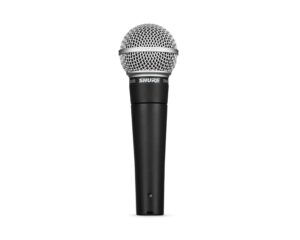
- Shure SM58: Shure describes a response shaped for vocals, with brightened midrange and bass roll-off. It is the mic most engineers and singers already know, which counts for a lot with guest performers.
- Sennheiser e835: cardioid dynamic with a 40 Hz to 16 kHz published response and 2.7 mV/Pa output.
- Audio-Technica ATM510: cardioid dynamic, 90 Hz to 16 kHz, and at 258 g one of the lighter mics here. Audio-Technica quotes a uniform 120 degree angle of acceptance.
How the SM58 compares with Shure’s own upgrades is covered in the three-way Shure comparison. Technique matters as much as the model with any of these; see microphone technique for a live stage.
Louder stages and feedback trouble: supercardioid and hypercardioid
When the band is loud and the singer relies on wedges, a tighter pattern rejects more of the drums, guitars and side-fills. That only helps if the wedges are moved to the mic’s null, as explained above and in the feedback guide.
- Shure Beta 58A: supercardioid, 50 Hz to 16 kHz. Shure lists a neodymium magnet for greater sensitivity and higher output, and a response shaped for vocals with brightened midrange.
- Shure Nexadyne 8/S: supercardioid, 50 Hz to 20 kHz, -51 dBV/Pa. Shure describes its Revonic design as two precisely calibrated transducers working together.
- sE Electronics V7: supercardioid with sE’s DMC7 capsule and an aluminium voice coil, 40 Hz to 19 kHz. It comes in several finishes; the V7 family guide lists them. Not to be confused with the V7 X, which is an instrument mic, not a vocal mic: sE describes the V7 X as a dynamic instrument microphone, while the V7 is the vocal-optimised model.
- sE Electronics V8: sE’s newer vocal model, which it describes as building on the V7 with a newly developed DMCV8 capsule and a highly focused supercardioid pattern.
- Sennheiser e845 and e945: Sennheiser’s supercardioid dynamics, at 40 Hz to 16 kHz and 40 Hz to 18 kHz respectively.
- Audio-Technica ATM610a and AE6100: hypercardioid dynamics. Audio-Technica quotes a 100 degree angle of acceptance for the AE6100. Hypercardioids have the narrowest front pickup here and the largest rear lobe, so wedge placement matters most.
Cardioid upgrades: more detail, same forgiving pattern
Some singers want more top end and output than an SM58-style mic gives, without the stricter technique a supercardioid demands. Softer or quieter voices can also benefit from a hotter mic, because less gain is needed before the mix fills up with stage noise.
- Shure Nexadyne 8/C: cardioid, with a 50 Hz to 20 kHz published response against the SM58’s 50 Hz to 15 kHz.
- Sennheiser e935: cardioid, 40 Hz to 18 kHz, and the highest published output of the Sennheiser dynamics here at 2.8 mV/Pa.
- Audio-Technica AE4100: cardioid, 90 Hz to 18 kHz, with the same 120 degree acceptance angle Audio-Technica quotes for the ATM510.
The Beta 58A is also often bought as an SM58 upgrade, but remember it is a supercardioid, so it belongs in the previous group as far as wedges are concerned.
Condenser handhelds
A handheld condenser gives a more open, detailed sound and suits singers with controlled technique, especially on in-ear monitors where wedge spill is not a problem. A wired condenser needs phantom power from the desk, and it hears more of the room, so it is a poor choice for a singer who holds the mic at waist height between lines.
- Shure Beta 87A: supercardioid electret condenser, phantom powered from 11 to 52 V DC. Shure’s spec sheet gives 50 Hz to 20 kHz and a maximum SPL of 140.5 dB.
- Shure Beta 87C: the cardioid version, 50 Hz to 16 kHz on its spec sheet. Shure says its sound and rear rejection create an ideal environment for personal monitoring.
- Sennheiser e965: a 1 inch dual-diaphragm true condenser with a switch for cardioid or supercardioid, a low-cut switch and a -10 dB pad. It needs 48 V phantom.
Switched versions for presenters and talkback
Several of these mics come with an on/off switch, useful for speeches, compères, churches and talkback, where the user controls their own mute. We stock the Shure SM58S, Sennheiser e835S, e845S and the sE V7 Switch, which sE fits with a recessed, lockable on/off switch. For live music, an unswitched mic avoids a singer switching off mid-song.
Wireless equivalents
Most of these sounds are also available as a capsule for a wireless handheld, so you can keep the same mic across wired and radio channels. Capsules fit only their own maker’s family of transmitters, with the sE capsules as designed exceptions. The details are in our wireless capsule compatibility guide, and choosing the radio system itself is covered in the wireless microphone buying guide.
| Wired mic | Wireless capsule | Fits |
|---|---|---|
| SM58 | Shure RPW112 | Shure handhelds with interchangeable capsules |
| Beta 58A | Shure RPW118 | Shure handhelds with interchangeable capsules |
| Beta 87A | Shure RPW120 | Shure handhelds with interchangeable capsules |
| Nexadyne 8/C and 8/S | Shure RPW200 (8/C) and RPW204 (8/S), black | Shure says all Shure handheld transmitters with interchangeable capsules |
| sE V7 | sE V7 MC1 for Shure, V7 MC2 for Sennheiser | MC1: Shure handhelds except BLX and GLX-D (sE also lists Audio-Technica 3000 series). MC2: Sennheiser handhelds |
| sE V8 | sE V8 MC1 for Shure, V8 MC2 for Sennheiser | Compatible Shure or Sennheiser handhelds; check sE’s list for your transmitter |
| Sennheiser e835, e845, e935, e945 | MMD 835, MMD 845, MMD 935, MMD 945 | Sennheiser handhelds that take MMD capsules (Sennheiser lists ew G3, ew G4, D1, AVX, SpeechLine Digital Wireless and 2000 series) |
Check your transmitter body before ordering a capsule, and see the compatibility guide for which Sennheiser and Shure bodies take interchangeable heads.
Popular picks from the shop
Shure SM58 Cardioid Dynamic Vocal MicrophoneView product → sE Electronics V7 Supercardioid Dynamic Vocal Microphone, BlackView product → Shure Beta 58A Supercardioid Dynamic Vocal MicrophoneView product → Shure Nexadyne 8/S Supercardioid Dynamic Vocal MicrophoneView product → Sennheiser e945 Supercardioid Dynamic Vocal MicrophoneView product → Audio-Technica AE6100 Hypercardioid Dynamic Vocal MicrophoneView product → Sennheiser e935 Cardioid Dynamic Vocal MicrophoneView product → Shure Beta 87A Supercardioid Condenser Vocal MicrophoneView product →
Frequently asked questions
What is the best microphone for live vocals?
It depends on the stage. For a mic that suits almost anyone and forgives wedge placement, a cardioid dynamic such as the Shure SM58 or Sennheiser e835. For loud stages with wedges, a supercardioid such as the Beta 58A, Nexadyne 8/S, sE V7 or Sennheiser e945, with the wedges moved to suit. For controlled singers on in-ears, a handheld condenser such as the Beta 87A.
Is the Beta 58A better than the SM58?
Different rather than better. Shure rates the Beta 58A about 3.5 dB hotter, with a slightly wider published response, and it is supercardioid rather than cardioid. That helps on loud stages if the wedges are placed for it, and hinders if they are not. Our SM58 vs Beta 58A vs Nexadyne guide covers it in detail.
Is the sE V7 a good alternative to the SM58?
It does a different job. The V7 is a supercardioid with a published response of 40 Hz to 19 kHz against the SM58’s cardioid pattern and 50 Hz to 15 kHz. Choose it for a singer who works the mic close on a loud stage; choose a cardioid for mixed or unknown users. The V7 family guide has more.
Should I use a condenser or dynamic mic for live vocals?
Dynamic for most stages, especially loud ones with wedges and for singers whose technique varies. A handheld condenser suits controlled singers, quieter stages and in-ear monitoring. Condensers need phantom power.
What is the difference between the Sennheiser e835 and e935?
Both are cardioid dynamics. Sennheiser publishes 40 Hz to 16 kHz and 2.7 mV/Pa for the e835, and 40 Hz to 18 kHz and 2.8 mV/Pa for the e935. The e845 and e945 are the supercardioid equivalents.
Can I get the same mic on a wireless system?
Usually, as a capsule for a wireless handheld: the SM58, Beta 58A, Beta 87A and Nexadyne 8 have Shure capsules, Sennheiser makes MMD capsules for its handhelds, and the sE V7 and V8 come as MC1 capsules for Shure and MC2 capsules for Sennheiser (sE excludes Shure BLX and GLX-D for the V7 MC1). Capsules fit only their own family of transmitters.
Shop this guide
Vocal microphones, condensers and matching wireless capsules from Shure, sE Electronics, Sennheiser and Audio-Technica. Tell us about the singer and the stage and we will help you choose.
Dynamic Microphones Condenser Microphones Wireless Mic Capsules Handheld Transmitters Microphone Stands Microphone Accessories



