

Home » Guides » Wireless Mics & In-Ear Monitoring »
Sennheiser Antennas and Splitters: What Works With G3, G4, EW-D and EW-DX
Which Sennheiser antenna splitter, paddle, booster and cable goes with which receiver, which frequency variant to order for UK Channel 38 kit, and what powers what. Everything here is taken from Sennheiser’s own manuals, specification sheets and support articles.
~9 min read · Updated October 2026 · By the Stage Supply team
In this guide: The short answer · Compatibility table · Splitters · Antennas · Boosters and bands · Powering · Cables and racking · Shure equivalents · Popular picks · FAQ
Sennheiser antenna accessories are shared across generations more than the transmitters and receivers are, but not completely. Splitters and boosters are band-specific and some of them send DC up the antenna cable, so the wrong pairing either fails to work or works badly.
This guide is about which part goes with which. Why you need distribution at all, how far apart to put antennas and how cable loss works are covered in our antennas and RF distribution guide, so they are not repeated here.
The short answer
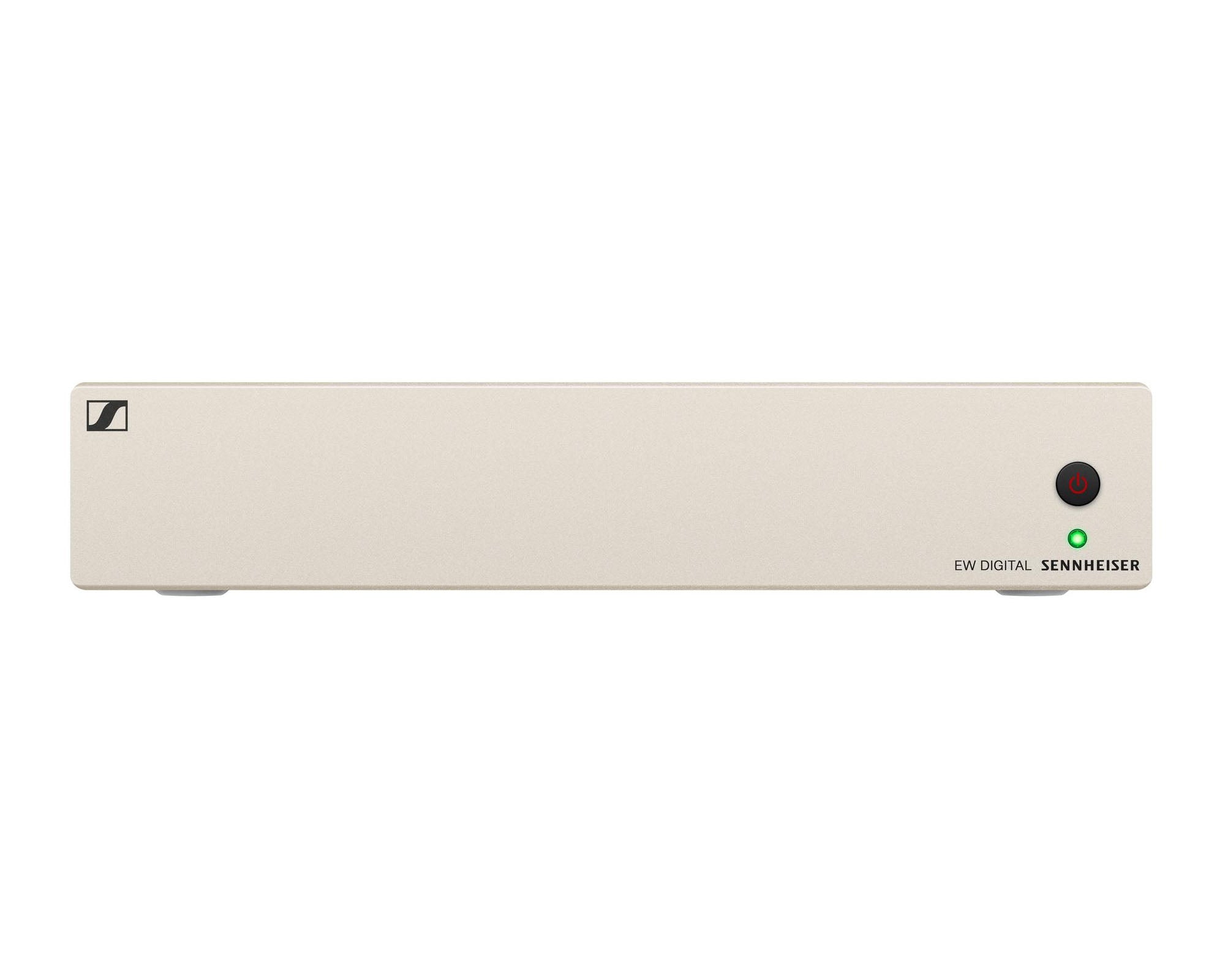
- EW-D and EW-DX: the EW-D ASA is the splitter. Sennheiser says it runs up to four EW-D EM or EW-DX EM 2 receivers from one pair of antennas. For UK Channel 38 kit you want the Q-R-S version (470–694 MHz).
- G3 and G4: the matching splitter was the ASA 214, which Sennheiser lists as working with EM 100 G4, EM 300-500 G4 and EM 100, 300 and 500 G3. Sennheiser now marks the ASA 214 as no longer available, and a Sennheiser support article says it has been replaced by the “fully compatible” EW-D ASA. The EW-D ASA’s own manual and product page only name EW-D and EW-DX receivers, so read the note below before planning a G4 rack around it.
- Boosters are band-specific. For EW-D and EW-DX on Channel 38 the booster is the EW-D AB (S), 606–694 MHz. For G4 GB-range kit it is the AB 4-GBw, 606–678 MHz. Sennheiser’s ew compatibility article warns against mixing boosters and splitters across series, because frequency ranges and DC requirements differ.
- Passive antennas are the easy part. A passive paddle or omni carries no DC, so what matters is that its frequency range covers your band. The ADP UHF covers 470–1075 MHz and the A 1031-U 450–960 MHz.
- One catch on power: the EW-D ASA powers EW-D EM receivers through the antenna cables, but not EW-DX EM 2 receivers. Those need their own supply, PoE or the EW-D power distribution cable.
For the wider move from G4 to the digital ranges, see our G4 to EW-D and EW-DX upgrade guide and EW-D vs EW-DX.
Compatibility table
Frequency ranges are Sennheiser’s published figures. “Works with” means what Sennheiser’s own documentation names, not what might also work.
| Product | Type | Frequency range | Works with (per Sennheiser) |
|---|---|---|---|
| EW-D ASA (Q-R-S) | Active splitter, 2 x 1:4 or 1 x 1:8 | 470–694 MHz | Up to 4 EW-D EM or EW-DX EM 2; a Sennheiser support article calls it the fully compatible replacement for the ASA 214 (see below) |
| EW-D ASA (X-Y) | Active splitter, 2 x 1:4 or 1 x 1:8 | 1350–1805 MHz | EW-D and EW-DX in the 1.8 GHz ranges |
| ASA 214-UHF | Active splitter, 2 x 1:4 or 1 x 1:8 | 470–870 MHz | EM 100 G4, EM 300-500 G4, EM 100/300/500 G3, EM 2000/2050. No longer available |
| ASP 212 | Passive splitter, 2 x 1:2 | Not stated | Sennheiser lists it simply as a passive 2 x 2-way splitter |
| EW-D AB (S) | In-line booster | 606–694 MHz | EW-D / EW-DX systems; specified in the EW-D ASA manual |
| AB 4-GBw | In-line booster | 606–678 MHz | ew G4 accessory; specified in the ASA 214 manual |
| Half Wave Dipole (S) | Rod antenna pair | 606–694 MHz | Evolution Wireless Digital receivers |
| A 1031-U | Passive omni | 450–960 MHz | Listed in Sennheiser’s ew G4 accessory range |
| ADP UHF | Passive directional (paddle) | 470–1075 MHz | Recommended in the EW-D EM, EW-DX EM 2 and EW-DX EM 4 Dante manuals |
| AWM UHF I | Active directional, wall or stand | 470–694 MHz | Recommended for EW-DX EM 4 Dante; powered by EM 4 Dante or EW-D ASA over BNC |
| AD 1800 | Passive directional | 1400–2400 MHz | Recommended for EW-D / EW-DX 1.8 GHz; in the ew G4 accessory list too |
| A 5000 CP | Passive, circularly polarised | 450–960 MHz | Wideband; Sennheiser groups it with its directional antennas |
Antenna splitters: which one for which receiver
EW-D ASA (EW-D and EW-DX)
The EW-D ASA is an active splitter that feeds two antennas to four receivers, or eight with a second unit. Sennheiser’s manual describes three set-ups: two antennas to a four-channel system, two four-channel systems linked together, and two antennas feeding eight channels. Gain from input to each output is 0 ±1 dB: it makes up for the split rather than amplifying.
Variants, per Sennheiser’s specification sheet:
- Q-R-S, 470–694 MHz. Covers the UK S ranges: EW-D EM (S1-7) tunes 606.2–662 MHz and EW-DX EM 2 (S1-10) tunes 606.2–693.8 MHz.
- T-U-V-W, 694–1075 MHz, for higher-band systems.
- X-Y, 1350–1805 MHz. The 1.8 GHz version for Y-range EW-D and EW-DX.
It ships with the NT 12-35 CS power supply and eight BNC cables. The ASA sends DC to boosters on its two antenna inputs (12 V, 320 mA) and to receivers on outputs A1 to A4 (12 V, typically 350 mA, maximum 500 mA). Sennheiser rates total draw at up to 3 A with four EW-D EM receivers and boosters connected.
ASA 214 (G3 and G4)
The ASA 214 was the G4-era splitter. Sennheiser’s G4 manual lists the EM 100 G4, EM 300-500 G4, EM 100 G3, EM 300 G3 and EM 500 G3 as compatible and powers them through the A outputs. EM 2000 and EM 2050 receivers also work but need their own supply. The UHF version covers 470–870 MHz and the 1G8 version 1785–1805 MHz. It runs from the NT 1-1 supply; a UK NT 1-1 replacement supply is available if yours has gone missing.
Sennheiser now lists the ASA 214 as no longer available. Sennheiser’s support article on G4 antenna distribution says it “has been replaced by the fully compatible EW-D ASA”. The EW-D ASA’s own manual and product page are narrower: they name only EW-D EM and EW-DX EM 2 receivers, and the manual says the splitter powers EW-D EM receivers only. The one G4-era part the manual does mention is the ASA 214, which its RF OUT A socket can feed to build an eight-channel system. Sennheiser’s EW-D documentation does not cover powering G3 or G4 receivers from the EW-D ASA’s outputs. If you plan to run G4 receivers from an EW-D ASA, talk to us first and we will check the details for your setup.
EW-DX EM 4 Dante: a splitter built in
The EW-DX EM 4 Dante has a built-in antenna splitter. Sennheiser says up to four EM 4 Dante receivers can be cascaded from one pair of antennas or boosters, by linking each RF out to the next receiver’s RF in. For a rack of EM 4 units you may not need an ASA at all. All cascaded receivers share the same booster frequency range.
Passive splitters
The ASP 212 is a passive 2 x 1:2 splitter. Sennheiser’s support team says a passive split costs roughly 3 dB per 1:2 split, and that boosters can make up for it. Most Sennheiser splitters are active with the booster built in. Its compatibility article also notes the old ASP 1 and ASP 2 splitters were meant for G1 and G2 only.
Antennas: paddles, omnis and active antennas
Whether your existing Sennheiser paddles will work with EW-D or EW-DX mostly comes down to frequency. A passive antenna has no electronics and, on the ADP and the dipoles, no DC path. If its frequency range covers your receiver’s range, it is the right band. Sennheiser does not publish a cross-generation antenna chart, so the frequency is the check to make.
- ADP UHF. Passive directional paddle, 470–1075 MHz, typically 5 dBi gain, roughly 100° opening angle, BNC with no DC path. It is the UHF antenna Sennheiser recommends in the EW-D EM, EW-DX EM 2 and EM 4 Dante manuals. The G4 accessory list names the A 2003 UHF as the directional antenna instead.
- A 1031-U. Passive omnidirectional antenna, 450–960 MHz, BNC. It appears in Sennheiser’s ew G4 accessory list. That range spans both the G4 GB range (606–648 MHz) and the EW-D / EW-DX S ranges.
- Half Wave Dipole (S). A pair of rod antennas for EW-D receivers, 606–694 MHz, typically +2 dBi, no DC path. Other bands have their own dipole variants, from Q (470–550 MHz) to Y (1785–1805 MHz).
- AWM UHF I. Active directional antenna for wall, ceiling, VESA or stand mounting, 470–694 MHz, with a switchable +12, +6, 0 or −6 dB booster. It needs DC even at 0 dB. Sennheiser says the EW-DX EM 4 Dante and EW-D ASA power it over the BNC cable. With EW-D EM, EW-DX EM 2 and EM 2 Dante receivers it needs its own supply through its DC socket.
- AD 1800. Passive directional antenna for 1400–2400 MHz, so for 1.8 GHz systems only. It is no use on UHF Channel 38 kit.
- A 5000 CP. Passive, circularly polarised wideband antenna, 450–960 MHz. Sennheiser says circular polarisation minimises variations in signal strength.
Directional versus omni, and how to space and angle them, is covered in the antennas and RF distribution guide.
Boosters and frequency bands
Boosters are filtered to one band, so you must order the variant that matches your receivers. Sennheiser’s published ranges:
| Booster variant | Range | Booster variant | Range |
|---|---|---|---|
| EW-D AB (Q) | 470–550 MHz | AB 4-Aw+ | 470–558 MHz |
| EW-D AB (R) | 520–608 MHz | AB 4-Gw | 558–626 MHz |
| EW-D AB (S) | 606–694 MHz | AB 4-GBw | 606–678 MHz |
| EW-D AB (T) | 694–824 MHz | AB 4-Bw | 626–698 MHz |
| EW-D AB (U) | 823–865 MHz | AB 4-Cw | 718–790 MHz |
| EW-D AB (V) | 902–960 MHz | AB 4-Dw | 790–865 MHz |
| EW-D AB (Y) | 1785–1805 MHz | AB 3-1G8 | 1G8 range (ASA 214 manual: 1785–1800 MHz) |
For UK Channel 38 kit, that means the EW-D AB (S) on EW-D and EW-DX, and the AB 4-GBw on G4 GB-range systems. Licensing for Channel 38 is explained in our Channel 38 licensing guide.
The EW-D AB takes its power up the antenna cable (Sennheiser: DC 12 V, 9–18 V, max. 160 mA, fed from OUT to ANT), and the EW-D ASA supplies 12 V to boosters on its antenna inputs. Sennheiser’s compatibility article for the analogue ew series (G1 to G4) warns that, because of changing frequency ranges and different DC requirements, it is not good practice to mix splitters and boosters across series. Each splitter’s manual names its own booster: the EW-D AB in the EW-D ASA manual, the AB 3 and AB 4 in the ASA 214 manual. So: EW-D AB with EW-D ASA, AB 4 with ASA 214.
When Sennheiser says you need one
Sennheiser’s support guidance is that boosters may be needed above about 10 m of cable, or after a passive splitter. They will not fix a poor antenna or bad placement, because a booster lifts the noise along with the signal. The EW-D ASA manual gives these maximum cable lengths:
| Frequency (around) | EW-D AB in line | Max. RG 58 | Max. GZK 5000 |
|---|---|---|---|
| 500 MHz | None | 8 m | 16 m |
| 500 MHz | One | 36 m | 72 m |
| 700 MHz | None | 7 m | 14 m |
| 700 MHz | One | 30 m | 60 m |
Sennheiser’s table also covers 900 MHz and 1800 MHz and two boosters in line. Treat these as the manufacturer’s ceiling, not a target. If you have long runs or a complex system, Sennheiser recommends contacting its support for design help, and so do we.
Powering: what feeds what
- EW-D ASA: runs only from its supplied NT 12-35 CS, and Sennheiser says to use only that unit. Through the antenna cables it powers up to four EW-D EM receivers plus boosters on its antenna inputs.
- EW-DX EM 2 and EM 2 Dante: cannot be powered from the ASA’s BNC outputs; Sennheiser says the ASA powers EW-D EM receivers only. They run from their own power supply or PoE. The EW-D power distribution cable runs up to four EW-DX EM 2 or EM 2 Dante receivers from one supply, and Sennheiser says it must only be used with the NT 12-35 CS.
- ASA 214: runs from the NT 1-1 supply and powers EM 100/300/500 G3 and G4 receivers through outputs A1 to A4.
- Active antennas: the AWM is powered over BNC by the EW-D ASA or EW-DX EM 4 Dante, or through its DC socket otherwise.
These are product-selection notes. Design, installation and testing of the mains side of any rack or fixed installation is a job for a competent person.
Cables and rack hardware
Use 50 ohm coax with BNC connectors. Sennheiser’s guidance compares the two types it sells:
- RG 58 (6.15 mm): for short runs. Higher loss, so less suited to long runs or higher frequencies. Sennheiser GZL RG 58 lengths include 0.5 m, 5 m and 10 m.
- RG 8X (6.8 mm): lower loss than RG 58, for medium runs and higher frequencies. Sennheiser GZL RG 8X lengths include 5 m, 10 m and 20 m. Sennheiser notes lower-loss cable can remove the need for a booster.
For racking, Sennheiser lists the GA 3 rack kit for mounting the EW-D EM, EW-DX EM 2 or EW-D ASA in a 19-inch rack. The AM 2 front mount kit brings the antenna connections to the front of the rack when those units are used with the GA 3. The EW-DX EM 4 Dante uses a separate antenna front-mount kit.
Why 75 ohm video coax is the wrong cable is explained in the RF distribution guide.
Shure equivalents
For Shure systems, Shure makes its own parts. Neither maker documents using one brand’s distribution with the other’s receivers, so treat these as Shure-to-Shure.
- Shure UA844+SWB: active splitter for up to five receivers, covering 470–960 MHz according to its user guide. It ships with DC cords for QLXD4, SLX4, BLX4R and ULXD4 receivers.
- Shure UA874WB: active directional antenna, 470–900 MHz. Shure says it will not work without 10–15 V DC bias from a compatible Shure receiver or distribution system, even at its passive gain settings.
More on Shure’s range is in our Shure wireless range guide.
Popular picks from the shop
Sennheiser EW-D ASA Antenna Splitter (Q-R-S)View product → Sennheiser ADP UHF Directional AntennaView product → Sennheiser EW-D AB Antenna Booster (S)View product → Sennheiser AB 4-GBw Antenna BoosterView product → Sennheiser NT 12-35 CS Power SupplyView product → Sennheiser GZL RG 8X Antenna Cable, 10 mView product → Sennheiser A 1031-U Omni AntennaView product → Sennheiser Half Wave Dipole Pair (S)View product →
Frequently asked questions
Does the EW-D ASA work with G4 receivers?
A Sennheiser support article on G4 antenna distribution says the ASA 214 has been replaced by the “fully compatible” EW-D ASA. The EW-D ASA’s manual and product page, though, only name EW-D and EW-DX receivers and say nothing about powering G3 or G4 receivers, so check with us before planning a G4 rack around it.
Will my Sennheiser paddles work with EW-D or EW-DX?
Passive paddles and omnis have no electronics, so the check is frequency. The ADP UHF covers 470–1075 MHz and the A 1031-U 450–960 MHz, both of which include the UK S ranges used by EW-D (606.2–662 MHz) and EW-DX (606.2–693.8 MHz). Active antennas and boosters are different: they must match the band and get DC from the right source.
Can I use my AB 4 booster on EW-D?
Sennheiser’s EW-D documentation specifies the EW-D AB, and its ew compatibility article warns against mixing boosters and splitters across series because frequency ranges and DC requirements differ. The range matters too: the AB 4-GBw stops at 678 MHz, while EW-DX EM 2 (S1-10) receivers tune up to 693.8 MHz. For Channel 38 the EW-D booster is the S variant, 606–694 MHz.
Does the EW-D ASA power EW-DX receivers?
No. It powers EW-D EM receivers through outputs A1 to A4, but Sennheiser says EW-DX EM 2 receivers cannot be powered that way. Use their own supplies, PoE, or the EW-D power distribution cable with an NT 12-35 CS.
Do I need an antenna booster?
Sennheiser suggests one for cable runs over about 10 m or after a passive splitter, and says a booster cannot rescue a badly placed antenna. Lower-loss RG 8X cable can remove the need for one.
Which Sennheiser antenna splitter do I need for Channel 38?
For EW-D or EW-DX, the EW-D ASA Q-R-S version (470–694 MHz). For a G3 or G4 rack the original part was the ASA 214-UHF (470–870 MHz), which Sennheiser now lists as no longer available.
Shop this guide
Sennheiser splitters, paddles, boosters, cables and receivers. Tell us which receivers and frequency range you have and we will check which parts match.
Antennas & Splitters RF Antenna Cables Wireless Mic Receivers Wireless Mic Accessories Wireless Microphone Systems



