

Home » Guides » Install & Commercial »
Hearing Loops in UK Venues: The Equality Act, IEC 60118-4 and Choosing a Loop Driver
What an induction loop does, what UK law and building guidance actually say, the three numbers in the performance standard, which type of loop suits a counter, a meeting room or a hall, how Ampetronic sizes its drivers, and when infrared or Auracast is the better answer.
~11 min read · Updated October 2026 · By the Stage Supply team
In this guide: The short answer · How a loop works · The law and building guidance · The performance standard · Loop types · Choosing a driver · Infrared and Auracast · Signage and testing · Popular picks · FAQ
The short answer
A hearing loop sends the sound from a microphone or PA straight to hearing aids switched to their telecoil (T) setting, cutting out the room’s noise and echo. UK law does not name hearing loops, but the Equality Act 2010 requires service providers to take reasonable steps to provide auxiliary aids, and RNID’s guide to the Act names a hearing loop as an example of an auxiliary aid or service covered by the duty to make reasonable adjustments. For new buildings and building work in England, Approved Document M expects a hearing enhancement system at reception points and in rooms used for meetings, lectures, performances and films.
For the kit: a counter or reception desk needs a small counter-loop kit; a meeting room or small hall needs a perimeter loop and a driver sized for its area; a large room, a building with a lot of steel, or rooms side by side need a designed array. Whatever you fit, it should meet IEC 60118-4 and be commissioned with a field strength meter.
How an induction loop works
A loop driver (an amplifier built for the job) takes audio from a microphone or the venue’s sound system and drives it as a current through a loop of cable. That current creates a magnetic field in the area where people listen. Inside most hearing aids is a small coil, the telecoil, which picks up the field and turns it back into sound in the user’s ear, as Ampetronic’s design guide explains.
The benefit comes from bypassing the room. Ampetronic is blunt about the input: the loop must carry the wanted signal, not the background noise, so it needs a feed from the existing sound system or from microphones that pick up the talker. An omnidirectional microphone on a meeting-room ceiling, in its words, will amplify everything and yield little or no benefit.
The law and building guidance
The Equality Act 2010 (Great Britain)
Section 20 of the Act sets out the duty to make reasonable adjustments. Its third requirement is the one that covers listening aids: where a disabled person would, but for the provision of an auxiliary aid, be put at a substantial disadvantage compared with people who are not disabled, the provider must “take such steps as it is reasonable to have to take to provide the auxiliary aid”. Auxiliary aids include auxiliary services.
Two details in Schedule 2 matter for venues and shops. The duty is owed to disabled persons generally, not only to an individual who has asked, so providers need to think ahead rather than wait for a request. And a service provider is not required to take a step that would fundamentally change the nature of its service or trade.
What the Act does not do is list equipment, so whether a particular loop is a reasonable step depends on the premises and the service. RNID’s guide to the Act says the duty to make reasonable adjustments can cover “providing an auxiliary aid or service, such as a hearing loop or an interpreter”. RNID also notes that in Northern Ireland the protection comes from the Disability Discrimination Act. This guide is not legal advice; for a specific premises, take it from a qualified adviser.
Approved Document M (England)
Approved Document M Volume 2 is the guidance for meeting the access requirements of the Building Regulations in buildings other than dwellings in England, so it bites on new buildings and building work rather than on existing premises left untouched. Elsewhere in the UK, check the building regulations guidance that applies there. In it:
- Any reception point should have a hearing enhancement system, for example an induction loop (paragraph 3.6).
- Provision for a hearing enhancement system should be installed in rooms and spaces designed for meetings, lectures, classes, performances, spectator sport or films, and at service or reception counters in noisy areas or behind glazed screens (paragraph 4.36).
- The presence of an induction loop or infrared system should be indicated by the standard symbol (4.36).
- It names induction loop, infrared and radio as the three systems commonly used, accepts a portable induction loop in small meeting rooms, and warns that loops in adjacent spaces can overlap (4.35).
For detail on choosing and using hearing enhancement systems, Approved Document M points to BS 8300.
The performance standard: IEC 60118-4 in three numbers
IEC 60118-4 (published in the UK as BS EN 60118-4) is the international performance standard for audio-frequency induction loop systems. Ampetronic summarises its three key requirements, all measured across the volume where hearing aids will actually be:
| Requirement | Target | Why it matters |
|---|---|---|
| Field strength | 400 mA/m ±3 dB (1 kHz sine) | Loud enough for a clean signal, not so strong it overloads the hearing aid, and even as people move |
| Frequency response | 100 Hz to 5 kHz within ±3 dB of the 1 kHz level | Ampetronic notes that 2 to 5 kHz is vital for intelligibility, and that metal in the building is a main cause of losing it |
| Background magnetic noise | -32 dB (A-weighted) or better, relative to 400 mA/m | Hum and buzz from lighting and electrical plant reaches the user along with the speech |
Background noise belongs to the building, not the loop, so Ampetronic advises measuring it before the system is designed, with the lighting and AV running. Its FSM handbook treats a reading below -42 dB as excellent and flags anything above -32 dB as a potential problem for hearing aid users.
The “volume” is defined by where hearing aids sit. Ampetronic’s design guide gives typical heights of 1.2 to 1.4m for seated adults and wheelchair users, and 1.4 to 1.7m for standing adults, lower for children. Ampetronic’s commissioning guidance says that where an audience may be both seated and standing, measurements are needed at both heights.
Loop types and where each one fits
Ampetronic’s design guide divides loops into a handful of layouts. The four that cover most venues:
| Layout | What it is | Suits |
|---|---|---|
| Counter / one-to-one | A small loop coil close to the listener, with a directional microphone to pick up the member of staff | Reception desks, ticket windows, tills, kiosks, help points |
| Perimeter loop | A single cable around the room or area | Rooms up to about 20 to 25m wide with no metal, or 2 to 5m wide with metal present |
| Low loss phased array | Two overlaid loop patterns, 90° apart in phase, on a two-channel driver | Areas wider than about 20 to 25m, or rooms where metal kills a perimeter loop |
| Low spill phased array | A tighter, more complex array pattern | Adjacent looped rooms, confidential meetings, courtrooms, stages with electric instruments |
Counter loops
Ampetronic’s CLD1 is sold as counter kits pairing the compact driver with a preformed multi-turn loop pad, a choice of microphone and a loop sign. The datasheet says that in this use it projects a field to the requirements of IEC 60118-4 about 1m from the pad, which is the reach you want at a desk. We stock it as the CLD1-CB with boundary microphone, the CLD1-CD with desktop microphone and the CLD1-CX with loop coil. Ampetronic warns that a counter with both a metal top and a metal front may stop a counter loop working at all, so test before committing.
Perimeter loops
The simplest room system and the right one for most meeting rooms, small halls and chapels in buildings without much steel. Two limits to know. Metal in the structure, such as reinforced concrete floors, steel decks and metal suspended ceilings, reduces the signal and robs the high frequencies; more power does not fix the unevenness. And a perimeter loop spills: Ampetronic says a simple perimeter loop can be picked up by a hearing aid up to four times the loop width to the side, above and below.
Low spill and phased arrays
Where spill matters, the answer is an array: two overlaid patterns of cable driven 90° out of phase by a two-channel MultiLoop driver. Ampetronic says a good low spill design can contain the signal to about 1.5m from the loop edge and 3.5m above and below. It is the standard solution for steel-framed buildings and large areas, and for rooms where a loop next door, a confidential conversation or a stage with electric guitars rules out a perimeter loop. Arrays need a proper design, which Ampetronic offers or which an installer produces with its Loopworks Design software.
Choosing a loop driver
Driver choice follows from the loop type and the area. Ampetronic’s coverage figures below are maximums that assume the loop is 1 to 2m above or below listening height and there is no metal in the plane of the loop. For drivers in the CLS and ILD ranges, a long thin room gets more area than a square one.
| Driver | Output | Stated maximum area | Typical use |
|---|---|---|---|
| CLD1 | 2.4 A rms | Counter use about 1m from the pad; small perimeter loops 20 / 30 / 35m² (1:1 / 2:1 / 3:1 room) | Counters, desks, small rooms, vehicles |
| CLS1 | 3.5 A rms | 120 / 150 / 200m² | Wall-mounted, tamper-resistant; meeting rooms, small halls |
| ILD122 | 3.5 A rms | 120 / 150 / 200m² | Half-rack unit for the same size of room |
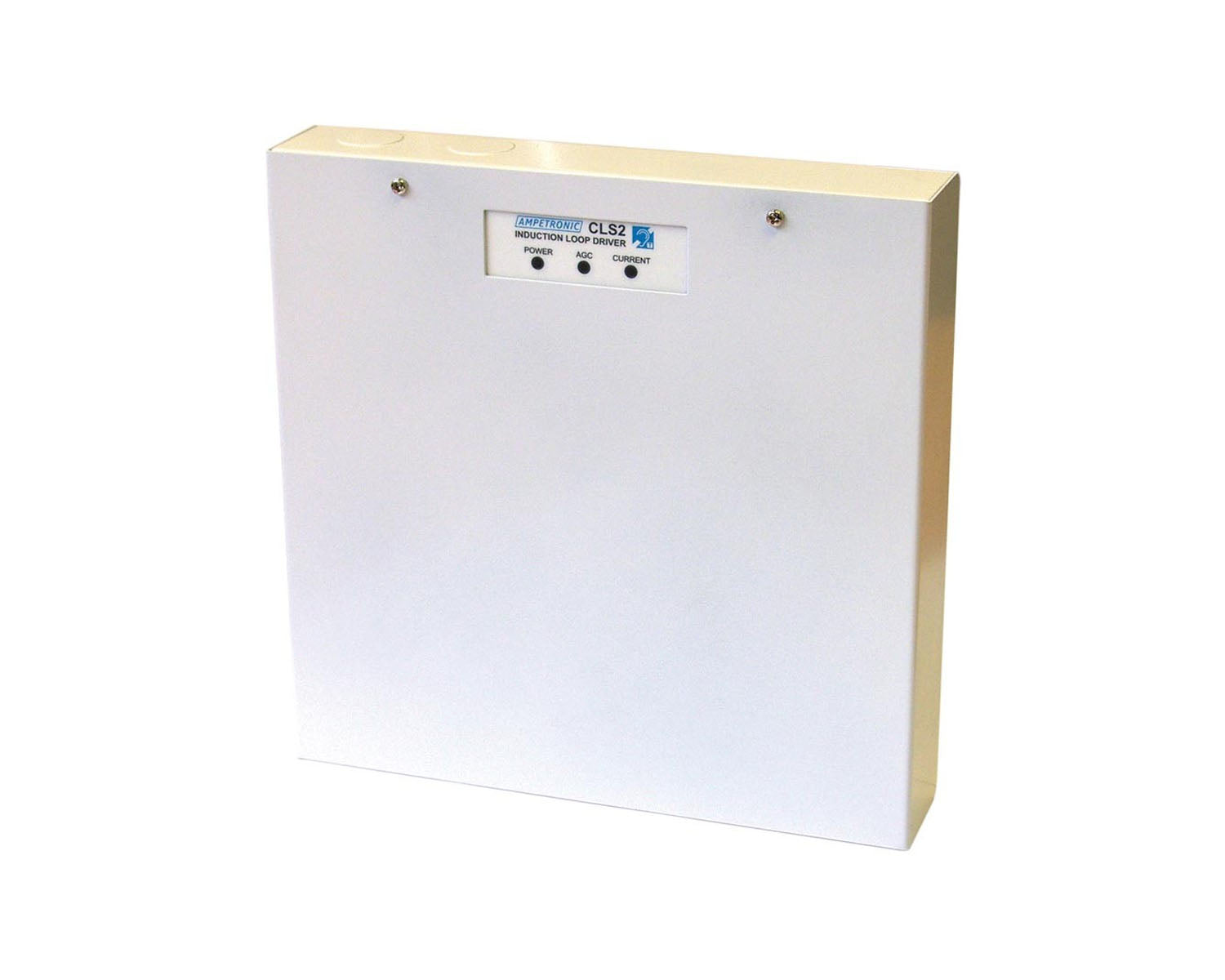
| CLS2 | 4.9 A rms | 250 / 310 / 400m² | Larger rooms, four inputs |
| C5-1 / C7-1 / C10-1 | 5 / 7 / 10 A rms | No printed figures: Ampetronic gives an indicative chart only, with coverage rising from C5-1 to C7-1 to C10-1 | 1U rack drivers; Ampetronic lists lecture theatres, conference facilities, theatres, cinemas and sports halls |
Wall-mount: CLS1 and CLS2
The CLS1 has three inputs: balanced microphone or line, a second line input, and an isolated input that takes a 100V line or low impedance speaker feed, handy for tapping an existing PA. The CLS2 steps up to 4.9 A and four independent inputs. Both have tamper-resistant covers and metal loss correction, which suits a church, community hall or school where the kit lives on a wall rather than in a rack.
Rack: ILD122 and the C Series
The ILD122 covers the same room sizes as the CLS1 in a half-rack-width 1U case, with balanced XLR microphone and jack line inputs. For more drive current in a full-width rack unit, the C Series single-output perimeter drivers are the C5-1, C7-1 and the networked C10-1N, all full-width 1U with built-in test tones, automatic gain control, metal loss correction and a 100V line input. An N suffix means network: a browser control panel for remote set-up and monitoring, with fault alerts by email, SNMP or Telnet. There is also a networked C5-1N.
Treat area figures as a shortlist, not a design
Ampetronic’s C Series datasheet says its coverage figures “are a guideline only and should not be used to specify a system”, and its phased array guide says “metal losses are hard to predict”. Its examples are concrete with moderate reinforcement (moderate metal loss) and a metal system floor (high metal loss), and its design guide notes that a loop needs substantially more power where metal is present. Use the table to pick a likely driver, then have the loop designed for the actual room.
Design, installation and commissioning
Loop drivers are mains-powered equipment and the loop is a cable run through the building. Design, installation and testing of electrical systems is work for a competent person, and a loop should be designed and commissioned by an installer who knows loops. Ampetronic says commissioning is often done by the installing engineer, and that a Certificate of Conformity should be completed and given to the venue once the system meets IEC 60118-4. Ask for one; it is your evidence the loop works and your baseline for later checks.
Loop cable is part of the installer’s choice too. For runs under carpet and other floor coverings Ampetronic offers its FB1.8 flat copper tape, and Ampetronic also supplies loop installation warning tape; how and where they are laid is for the installer.
Infrared and Auracast: when a loop is not the answer
A loop works with the user’s own hearing aid, with nothing to borrow or hand back. Ampetronic calls loops the most effective and least discriminatory form of assistive listening. But loops spill, they struggle with steel, and they do nothing for people without a telecoil. The two alternatives we stock both use receivers, and both can feed a telecoil user through a neck loop such as the Listen LA-438.
Infrared (ListenIR)
Infrared carries the audio on invisible light. Listen points out that it cannot pass through walls, ceilings or glass, so the sound stays in the room, which is why it is used in courtrooms, medical and government settings. The flip side is that receivers need line of sight to a radiator. Listen’s LT-84 transmitter/radiator sends two channels at once. Listen quotes 2,787m² line-of-sight coverage on one channel or 1,394m² on two with its LR-4200-IR receivers, and up to four LA-141 expansion radiators can be added. There is a Dante version, the LT-84-D, and receivers include the LR-4200-IR.
Auracast (Listen Auri)
Auracast is Bluetooth LE broadcast audio: one transmitter, any number of listeners. The Auri TX2N has two radios broadcasting separate streams, each with its own name and optional encryption, two mic/line inputs and PoE power; the TX2N-D adds Dante. Listen specifies the system with dedicated receivers for people without Auracast-enabled devices, such as the Auri RX1, which has two 3.5mm outputs for headphones or a neck loop and over 20 hours of battery life, charged by USB-C or in an Auri docking station such as the D16.
| System | User needs | Stays in the room? | Good for |
|---|---|---|---|
| Induction loop | Hearing aid with telecoil, nothing else | Perimeter loops spill; low spill arrays contain it | Counters, meeting rooms, halls, places of worship |
| Infrared | A borrowed receiver (plus neck loop for telecoil users) | Yes, does not pass through walls, ceilings or glass | Courtrooms and confidential meetings, two-channel use |
| Auracast | An Auracast device or a borrowed receiver | Radio; open or password-encrypted streams | Large or multi-room venues, guests with compatible devices |
Signage, testing and maintenance
A loop nobody knows about is no help. Approved Document M asks for the presence of a loop or infrared system to be shown by the standard symbol. Ampetronic’s A6 and A4 adhesive signs cover desks and doors. Put the sign where users will see it, and make sure the loop is switched on whenever the sign is up.
Loops fail silently: a microphone unplugged, a driver switched off, a cable cut during building work. Two tools, kept on site:
- A loop listener for routine checks. The ILR3 lets staff hear the loop through headphones, with a low-cut setting to mimic a hearing aid; the ILR3+ adds LEDs that show field strength.
- A field strength meter for commissioning and checks against the standard. The Ampetronic FSM measures background noise, field strength and frequency response to IEC 60118-4, works on any make of loop, and doubles as a listener.
RNID recommends maintaining a hearing loop every 12 months. Compare each check with the commissioning certificate, and re-test after any building work, new lighting or changes to the sound system.
For the rest of the room, see our conference room AV guide, the conference and gooseneck microphone guide for clean loop inputs, and the church AV and school AV guides.
Popular picks from the shop
Ampetronic FSM Hearing Loop Field Strength MeterView product → Ampetronic CLD1 Counter Loop Kit with Boundary MicrophoneView product → Ampetronic CLS1 Wall-Mount Hearing Loop DriverView product → Ampetronic CLS2 Wall-Mount Hearing Loop DriverView product → Ampetronic C7-1 Perimeter Hearing Loop DriverView product → Listen ListenIR LT-84 2-Channel Infrared TransmitterView product → Listen Auri TX2N Auracast TransmitterView product → Listen Auri RX1 Auracast ReceiverView product →
Frequently asked questions
Is a hearing loop a legal requirement in the UK?
Not by name. The Equality Act 2010 requires service providers to take reasonable steps to provide auxiliary aids, and the duty is owed to disabled people generally, so you should plan ahead rather than wait to be asked. RNID’s guide to the Act names a hearing loop as an example of an auxiliary aid or service covered by the duty. For new buildings and building work in England, Approved Document M expects hearing enhancement at reception points and in meeting, lecture, performance and film spaces.
What standard should a hearing loop meet?
IEC 60118-4, published in the UK as BS EN 60118-4. In short: 400 mA/m ±3 dB across the listening area, 100 Hz to 5 kHz within ±3 dB of 1 kHz, and background magnetic noise of -32 dB(A) or better. It is verified with a field strength meter and recorded on a certificate.
What size hearing loop amplifier do I need?
For a counter, a CLD1 kit. For a room, Ampetronic’s stated maximums are 120 to 200m² for the CLS1 and ILD122 and 250 to 400m² for the CLS2, depending on room shape, with the C Series stepping up to 5, 7 and 10 A rms for larger spaces (Ampetronic publishes only an indicative chart for these, marked “a guideline only”). These assume no metal in the structure, so treat them as a shortlist and have the loop designed for the room.
Will a loop in one room be heard in the next room?
With a simple perimeter loop, often yes: Ampetronic says spill can reach up to four times the loop width sideways, above and below. Where rooms sit next to each other or conversations are confidential, use a low spill array, which can contain the signal to about 1.5m from the loop edge, or use infrared.
Is infrared or Auracast better than a hearing loop?
Different, not better. A loop needs nothing but a telecoil hearing aid. Infrared stays in the room, which suits confidential settings, but means handing out receivers. Auracast reaches guests with compatible devices plus borrowed receivers. Many venues combine them, and both receiver-based systems can serve telecoil users through a neck loop.
How often should a hearing loop be tested?
RNID recommends maintaining a hearing loop every 12 months. Between visits, a quick listen with a loop receiver before events or opening catches most faults, and the system should be re-checked after building or electrical work.
Shop this guide
Ampetronic loop drivers, Listen Technologies infrared and Auracast systems, test equipment and signage. Send us your room plan and use and we will help shortlist the kit and point you to a loop designer.
Hearing Loops & Assistive Listening Conference & Paging Microphones Install Amplifiers Commercial & Install Audio



